
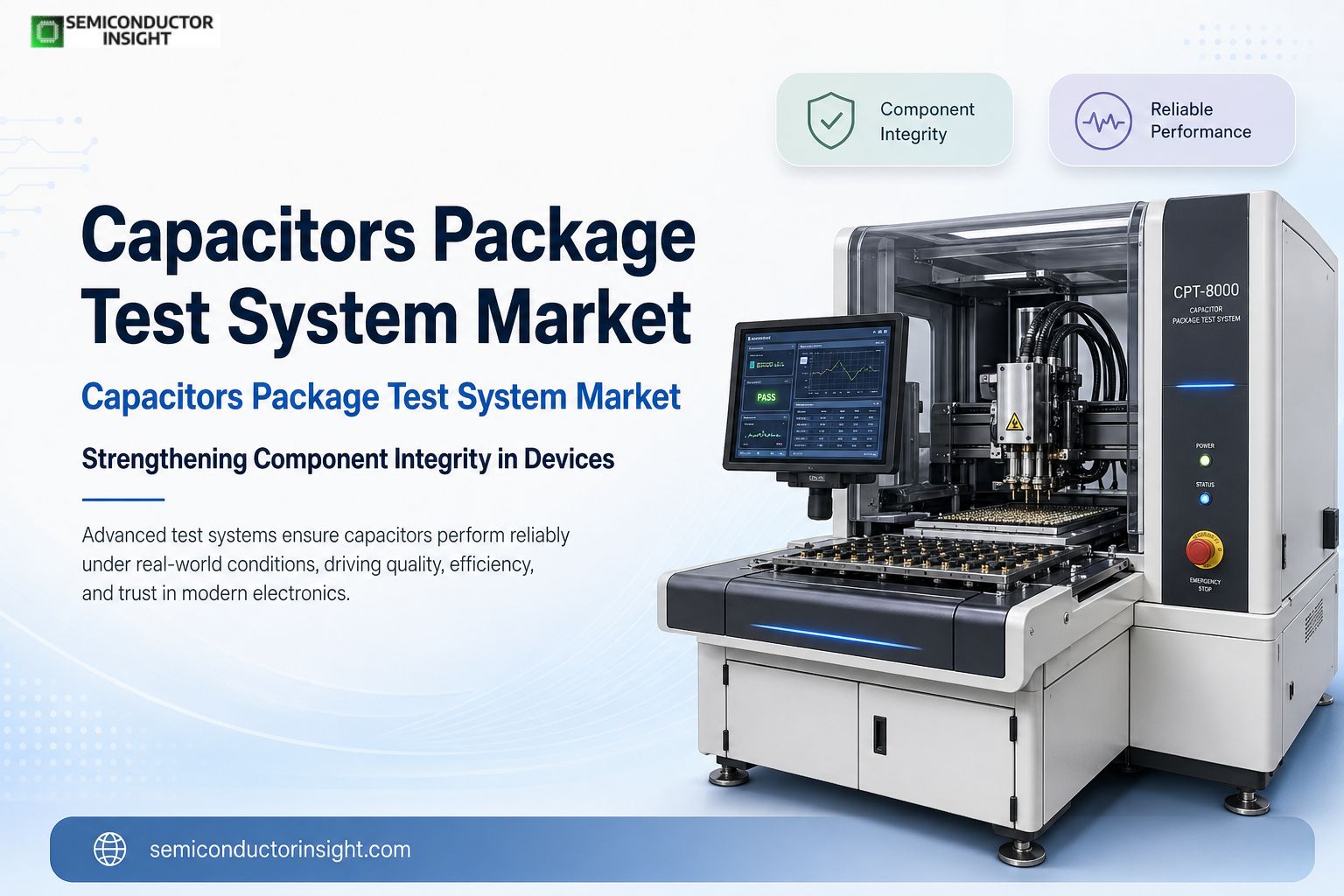
Capacitors Package Test System Market Strengthening Component Integrity in Devices
In semiconductor manufacturing, fabrication may create the component, but testing determines its real-world viability. Capacitors, though often categorized as passive elements, play a critical role in stabilizing voltage, filtering signals, and maintaining circuit integrity. The testing of these components at the packaging stage has become increasingly advanced, giving rise to dedicated capacitor package test systems designed to validate performance under realistic operating conditions.
As electronics become more compact and functionally dense, even minor inconsistencies in capacitor behavior can disrupt entire systems. This has made testing not just a quality step, but a defining phase in semiconductor production.
Review the complete report for fresh industry intelligence: https://semiconductorinsight.com/report/capacitors-package-test-system-market/
The Hidden Complexity of Packaged Capacitors
- At a glance, capacitors appear simple, but once integrated into semiconductor packages, their behavior changes due to thermal stress, electrical interference, and packaging materials.
- Capacitor package test systems are engineered to evaluate these variables with high precision.
- These systems measure parameters such as capacitance stability, equivalent series resistance, leakage current, and breakdown voltage.
- Each parameter provides insight into how a capacitor will perform over time, especially in high-frequency and high-temperature environments.
- In advanced electronics like 5G infrastructure and automotive control units, these tests are critical.
- A failure at this stage can translate into significant downstream risks, including device malfunction or reduced lifespan.
Semiconductor Packaging Driving Testing Innovation
Modern semiconductor packaging has evolved beyond traditional methods into advanced formats such as system-in-package (SiP) and multi-chip modules. These configurations increase component density, placing capacitors in closer proximity to active elements.
This proximity introduces new testing challenges. Capacitor package test systems must now simulate real-world electrical environments where interference and signal coupling are common. As a result, testing equipment is becoming more integrated with simulation capabilities, enabling engineers to predict performance under dynamic conditions rather than static measurements alone.
This shift reflects a broader trend in semiconductor engineering moving from isolated component validation to system-level reliability assurance.
Automation Redefining Testing Efficiency
- The scale of semiconductor production today demands speed without compromising accuracy. Automated capacitor package test systems are addressing this need by enabling high-throughput testing with minimal manual intervention.
- Modern systems are equipped with robotic handlers, real-time data analytics, and adaptive testing algorithms. These features allow manufacturers to test thousands of components per hour while maintaining consistent quality standards.
- In practice: A semiconductor facility producing components for consumer electronics may process millions of capacitors daily. Automated test systems ensure that each unit meets strict performance criteria without slowing down production lines.
Reliability as a Competitive Benchmark
In industries such as automotive electronics and industrial automation, reliability is not optional it is mandatory. Capacitor failures can lead to system instability, making rigorous testing essential.
Capacitor package test systems contribute to reliability by identifying defects that are not visible during earlier manufacturing stages. These include microcracks, material inconsistencies, and electrical deviations that only appear under stress conditions.
This level of testing is particularly important for applications like electric vehicles, where electronic systems must operate flawlessly under varying environmental conditions.
Miniaturization and Its Testing Implications
As electronic devices continue to shrink, capacitors are becoming smaller while maintaining or even increasing performance. This miniaturization presents unique challenges for testing systems.
Testing equipment must achieve higher sensitivity and precision to accurately measure electrical characteristics at micro scales. Even slight measurement errors can lead to incorrect assessments, making advanced calibration and instrumentation essential.
This trend underscores the importance of continuous innovation in testing technologies to keep pace with component evolution.
The Strategic Role of Testing in Semiconductor Ecosystems
- Capacitor package test systems are not standalone tools; they are integral to the broader semiconductor ecosystem. Their role extends beyond quality assurance to influencing design decisions, manufacturing strategies, and product reliability.
- For semiconductor companies, investing in advanced testing systems is a strategic move that enhances product credibility and reduces long-term risks. It also supports compliance with industry standards, which are becoming increasingly stringent as electronic systems grow more complex.
- While they operate behind the scenes, capacitor package test systems are essential to the functioning of modern electronics. From smartphones to industrial machinery, their impact is felt in the reliability and performance of countless devices.
As the semiconductor industry continues to evolve, the importance of precise, efficient, and intelligent testing will only grow. Capacitor package test systems, though often overlooked, are shaping the foundation of trust in electronic technologies worldwide.

Comments (0)