
Bus Transceiver Market 2026: From 1 Mbps CAN to 20 Mbps CAN XL Communication
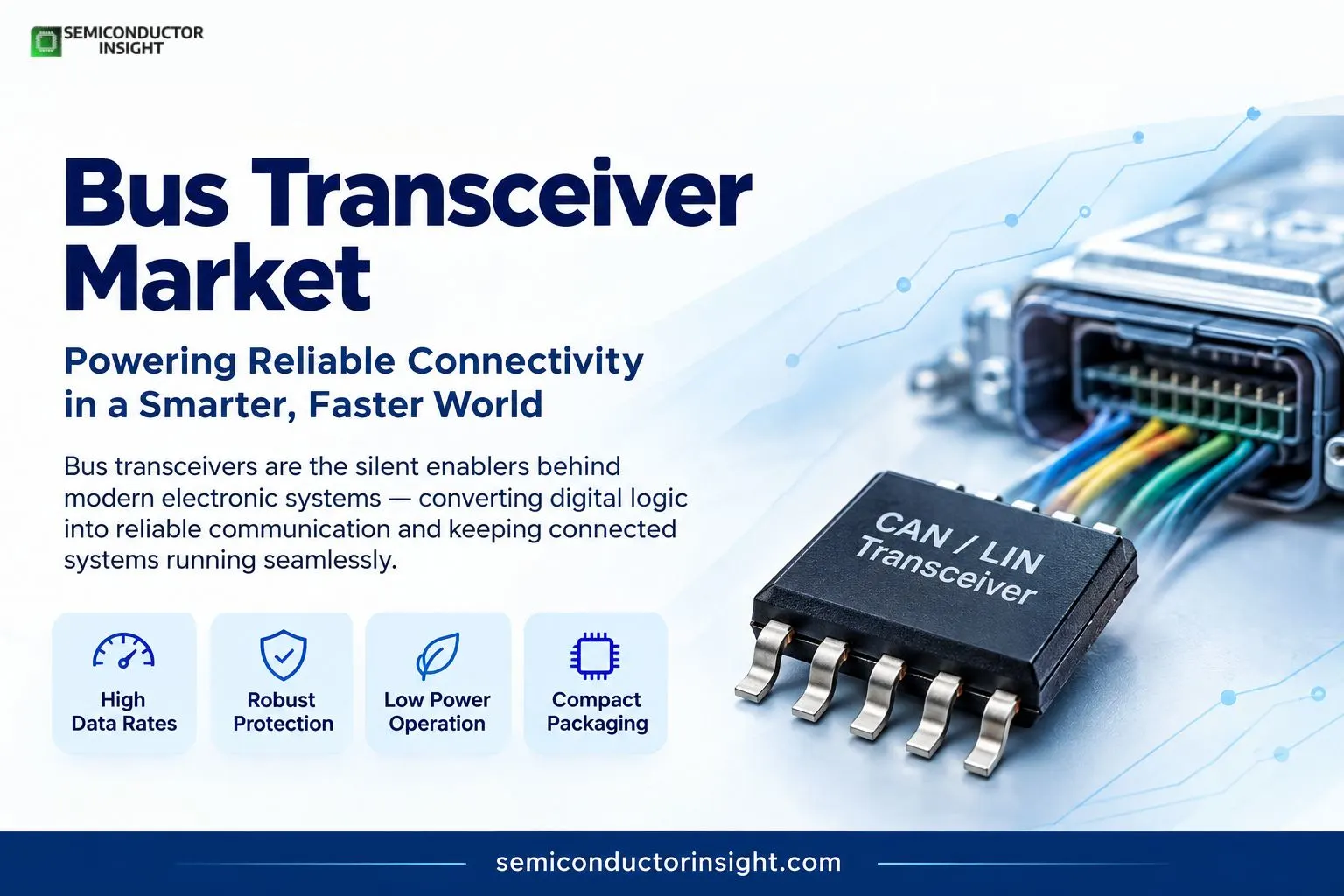
Bus transceivers rarely receive the same attention as processors, memory or power semiconductors, yet they sit directly between digital controllers and physical communication networks. Their job is straightforward but critical: convert logic-level signals into electrical signals that can travel across a shared bus and then translate incoming bus signals back into digital information.
That role is becoming more demanding as vehicles, factory equipment, robotics and embedded systems add more electronic control units and sensors. A modern transceiver therefore has to combine communication speed with electromagnetic compatibility, fault protection, low standby consumption and increasingly compact packaging.
The Speed Ladder Is Moving Up
- The evolution of Controller Area Network provides a clear picture of where the technology is heading.
- CAN Classic supports data fields of up to 8 bytes and speeds up to 1 Mbit/s. CAN FD expands the data field to 64 bytes and can reach 8 Mbit/s, while CAN XL supports data fields up to 2,048 bytes and can reach 20 Mbit/s with appropriate physical-layer technology.
- This progression matters for semiconductor suppliers because higher signaling rates place greater demands on transceiver timing, signal quality, electromagnetic emissions and network topology.
For More Detailed Insights, You Can Surf Our Latest Report Here: https://semiconductorinsight.com/report/bus-transceiver-market/
CAN XL Opens a New Semiconductor Design Window
CAN XL is emerging as an important technology development for next-generation vehicle networks. CAN in Automation notes that CAN XL is designed for backbone and sub-backbone applications and can integrate more easily with TCP/IP-based network architectures. CAN XL SIC XL transceivers can support bit rates of up to 20 Mbit/s.
For transceiver manufacturers, this creates a new design space between traditional low-speed control networks and much faster Ethernet-based architectures. The objective is not simply to increase the number of megabits. It is to maintain deterministic communication while handling increasingly complex electronic systems.
Automotive Is Becoming the Technology Test Bed
Vehicle electronics remain one of the most important application areas for bus transceivers. Infineon describes CAN as a key communication medium for powertrain, chassis and ADAS electronic control units, while its current portfolio covers conventional CAN, CAN FD and CAN FD Signal Improvement Capability technologies. Its CAN FD SIC devices reach up to 8 Mbps.
The shift toward electric vehicles adds another layer of demand. Battery-management systems, onboard chargers, traction inverters, thermal-management modules and electronic control units all need dependable communication under electrically noisy conditions.
A 2 × 3 mm Package Can Carry a Lot of Responsibility
- Miniaturization is becoming another visible development.
- Microchip’s MCP2542FD CAN FD transceiver is available in a 2 × 3 mm DFN-8L package and supports communication speeds up to 8 Mbps.
- It also supports automotive temperature ranges extending to 150°C in its high-temperature version.
- Such packaging trends matter because automotive and industrial control boards are becoming more densely populated.
- Smaller transceivers provide designers with greater flexibility while reducing the board area allocated to communication interfaces.
Protection Features Are Moving From Optional to Essential
A bus transceiver is directly exposed to the physical communication line, making protection a fundamental part of semiconductor design. Texas Instruments’ TCAN1044-Q1, for example, supports CAN and CAN FD up to 8 Mbps and includes protection against bus faults up to ±58 V. It also supports 1.8 V, 2.5 V, 3.3 V and 5 V logic interfaces.
These capabilities reflect what system designers increasingly expect from interface ICs. The transceiver must continue communicating reliably even when the surrounding electrical environment is far from ideal.
Low-Power Wake-Up Is Reshaping Standby Operation
- Connected machines do not necessarily need every communication circuit running continuously. Selective wake-up and low-power standby modes allow electronic systems to remain partially asleep and activate when a valid communication request arrives.
- Infineon’s current CAN portfolio includes devices with standby and bus wake-up capabilities, while some products specify standby currents below 20 µA. This is particularly relevant for vehicles, battery-powered equipment and industrial systems where every unnecessary milliamp contributes to overall energy consumption.
The Semiconductor Industry Is Already Preparing for the Next Layer
The transition is not stopping at CAN FD. CAN in Automation identifies CAN XL SIC transceivers as a physical-layer option capable of supporting up to 20 Mbit/s, while CAN FD and CAN SIC technologies continue serving lower-speed network requirements.
That creates a layered opportunity for bus transceiver suppliers. Legacy CAN will remain important, CAN FD will continue expanding in higher-data-rate control applications, and CAN XL is positioning itself for more demanding backbone communication.
What the 2026 Design Conversation Looks Like?
Bus transceiver market is increasingly being shaped by engineering requirements rather than simple interface availability. Designers are evaluating data rate, propagation delay, EMI, ESD robustness, standby current, thermal performance, package size and compatibility with different MCU voltage levels at the same time.
The result is a new generation of semiconductor interface devices that are smaller, more protected and considerably faster than earlier bus transceivers. With automotive architectures becoming more distributed and industrial systems becoming more connected, the humble transceiver is moving closer to the center of the semiconductor connectivity story.

Comments (0)