

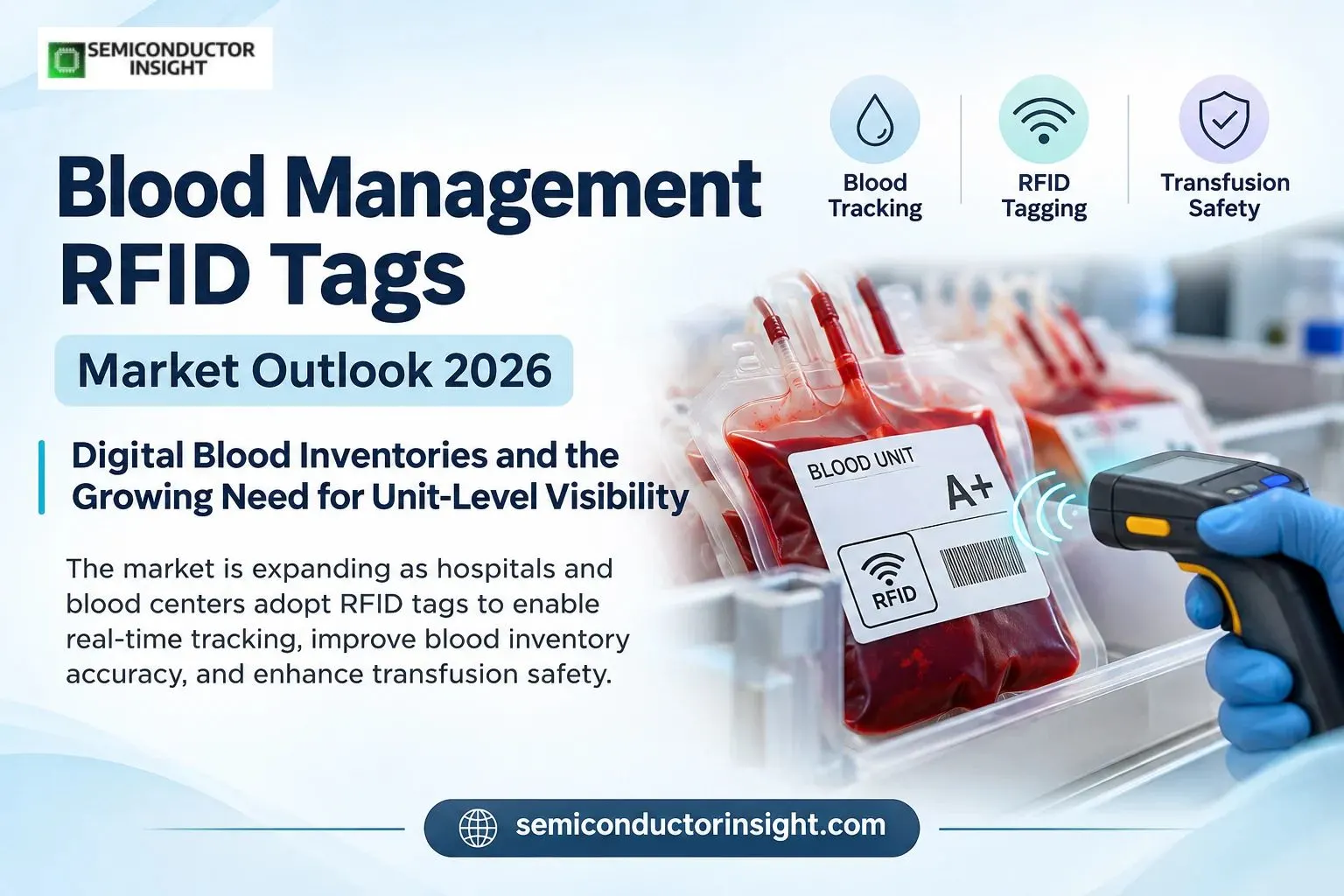
Blood Management RFID Tags Market Outlook 2026: Digital Blood Inventories and the Growing Need for Unit-Level Visibility
Blood management is moving beyond conventional barcode scanning as hospitals seek faster, more reliable ways to identify, locate and monitor blood components. RFID tags are becoming an important part of this transition, connecting blood bags with storage refrigerators, transport containers, inventory platforms and transfusion workflows.
The technology is particularly relevant to healthcare systems where component traceability and timely availability can directly influence patient care.
From a Blood Bag Label to a Connected Digital Identity
- A blood unit passes through several stages before transfusion, including collection, testing, component separation, storage, transportation and hospital issue.
- Traditional identification methods can require repeated manual scanning and data entry at different checkpoints. RFID introduces a more automated approach by assigning a unique digital identity to each tagged unit.
- Depending on the system, readers can identify multiple tagged units without requiring individual line-of-sight scanning. This can help blood-bank personnel verify inventory movements, locate specific components and record their movement between storage locations.
- The technology is especially relevant for red blood cells, plasma and platelet concentrates, where handling requirements and expiry periods differ.
Singapore’s National Blood Network Demonstrates the Next Step
A significant 2026 development is Singapore’s Next-Generation Blood Supply Management System. Operational across the Health Sciences Authority’s Blood Services Group and public and private hospital blood-bank laboratories, the system enables online blood ordering and automated tracking of blood components.
- SATO and CADI Scientific contributed to the implementation, with SATO supplying PJM RFID labels and readers. The system is designed to improve national stock visibility, simplify hospital ordering and strengthen tracking and quarantine procedures.
This development demonstrates how RFID can move beyond individual hospital installations towards coordinated national blood-supply infrastructure. It also creates a practical reference point for healthcare networks considering similar upgrades.
Emergency Departments Put RFID Performance to the Test
Emergency transfusions provide one of the clearest use cases for connected blood identification. Delays in locating, retrieving and issuing compatible components can complicate time-sensitive treatment, particularly when several departments are involved.
A 2026 study published in Frontiers in Medicine examined an integrated RFID-based blood-management programme at Qingdao Hospital in China. The study compared 261 patients receiving 714 blood units under conventional workflows with 308 patients receiving 509 units through the RFID-enabled programme. The system combined RFID tags, an IoT-enabled blood refrigerator, RFID transport boxes and a digital management platform.
The reported average blood-waiting time declined from 57.10 minutes to 46.56 minutes, while the proportion of transfusions issued within 60 minutes increased from 60.2% to 84.7%. Although this was a single-centre study rather than a global performance benchmark, it offers concrete evidence of how integrated identification and workflow redesign can improve operational efficiency.
Don’t Forget to Surf Our Updated Report for More Detailed Analysis: https://semiconductorinsight.com/report/global-blood-management-rfid-tags-market/
Cold-Chain Visibility Becomes Part of the RFID Opportunity
- Tracking a blood bag’s location is only one part of safe blood management. Temperature history is equally important, particularly when components move between central blood banks, hospital storage facilities and smaller transfusion centres.
- A 2025 study examining a temperature-monitored blood transfusion network in India combined RFID identification with temperature sensors and connected storage systems. Conducted across facilities in Thiruvananthapuram district, the research reported a 68% reduction in blood wastage over a six-month intervention period.
- The study illustrates an important direction for the market: RFID tags increasingly form part of a wider monitoring system rather than functioning as standalone labels. Connecting unit identity with temperature records can help staff assess handling conditions, identify potential excursions and make more informed inventory decisions.
India’s Digital Blood Infrastructure Creates a New Adoption Context
India’s e-RaktKosh platform already provides a centralised digital framework for blood-bank inventory, donor management, testing information and blood availability. More than 2,800 blood banks across 36 States and Union Territories have used the platform for routine activities or stock updates, according to the Centre for Development of Advanced Computing.
In August 2026, India’s Drugs Technical Advisory Board also recommended provisions for mandatory blood-centre registration on e-RaktKosh and donor authentication through ABHA or Aadhaar-linked OTP verification. These recommendations concern digital blood-centre and donor traceability, not a nationwide RFID mandate. However, they strengthen the broader direction towards connected blood-management records.
Beyond Tag Reading Toward Connected Blood Management
Hospitals selecting RFID solutions must look beyond reading performance to assess blood-bag materials, fluid interference, reader placement, storage conditions, data security and compatibility with existing blood-bank software.
Choosing high-frequency, ultra-high-frequency or specialised RFID technology requires validation for the intended reading environment, tagging configuration, blood components and workflows. Blood Management RFID Tags Market will increasingly centre on integrated systems that link identification, inventory visibility, cold-chain records and transfusion verification, with value determined by reliable connectivity from blood collection to the patient’s bedside.

Comments (0)