
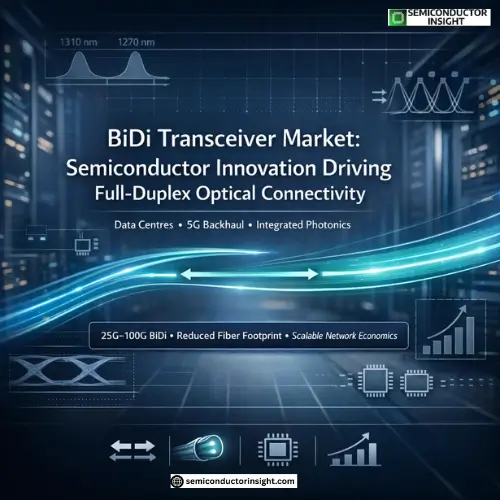
BiDi Transceiver Market Outlook Strengthens as Data Traffic Surges Worldwide
Bidirectional (BiDi) transceivers represent a distinctive class of optical communication modules that enable simultaneous two-way data transmission over a single fibre strand. They are fundamental to applications where fibre infrastructure must be optimized for both capacity and cost, such as data centre interconnects, metro networks, and enterprise LAN backbones.
At its essence, a BiDi transceiver integrates semiconductor lasers, photodiodes, driver/receiver chips, and signal-processing logic into a compact package that responds to ever-increasing data throughput requirements. The market is now expanding beyond traditional niche use into mainstream networking systems driven by data volume growth, 5G backhaul demand, and scalable cloud services.
You can freely browse our most recent updated report to learn more about it before scrolling further:
https://semiconductorinsight.com/report/bidi-transceiver-market/
Data Centre Expansion as a Recent Market Catalyst
Data Centres continue to be a major market segment for BiDi transceivers. With colocation facilities and hyperscale platforms expanding capacity at unprecedented rates recent estimates indicate global data Centre traffic grew more than 30% year-over-year the infrastructure that supports this traffic must scale efficiently. BiDi transceivers support this by enabling higher density I/O ports and reducing the fiber footprint in dense rack environments.
Semiconductor suppliers and module manufacturers are responding with pluggable BiDi transceivers supporting 25G, 50G, and 100G per wavelength speeds, often compatible with QSFP and SFP form factors. These are directly tied to the evolution of PAM4 signalling and high-speed DSPs inside the modules.
5G Backhaul and Edge Networks Driving Next Phase Adoption
The rollout of 5G networks has placed new demands on optical transport infrastructure. Backhaul networks connecting cell sites to centralized compute nodes require scalable and cost-effective optical links. BiDi transceivers, with their reduced fiber count and simpler deployment, are increasingly specified in small cell, tower aggregation, and metro access contexts.
In many cases, service providers are deploying BiDi solutions where fiber is scarce or expensive to install. The semiconductors enabling these modules must deliver precise wavelength control and robustness in diverse environmental conditions from controlled data Centres to outdoor telecom shelters.
Recent Innovations in BiDi Transceiver Technology
The last 24 months have seen noteworthy progress:
- Wavelength Locked Lasers: New semiconductor laser designs that maintain wavelength precision over temperature swings, enhancing link stability without active cooling.
- Integrated Photonics: Silicon photonic platforms are enabling tighter integration of optical components with electronic control, improving performance and reducing assembly costs.
- Low-Power DSPs: Digital signal processing chips designed for optical front ends that reduce module power draw critical in dense deployments where thermal limits constrain system density.
These advances reflect the broader trend of semiconductor and photonic convergence, where chips not only process signals but also manage optical pathways.
Manufacturing and Supply Chain Resilience
Global supply chain conditions have shaped how the BiDi transceiver market evolves. Semiconductor shortages in previous years forced OEMs to diversify sources for high-purity materials, laser chips, and driver ICs. More recently, capacity expansions in Asia-Pacific, particularly in Taiwan and South Korea, have helped normalize supply, while Western vendors focus on design leadership and IP creation.
Strategic alliances between semiconductor fabs, photonics foundries, and module assemblers have emerged to coordinate wafer supply, integration technologies, and test capabilities. This collaborative model supports both cost control and technological differentiation.
Market Segmentation by Speed and Application
BiDi transceivers are now segmented across multiple performance tiers:
- 25G/50G BiDi: Common in enterprise switches and lower-tier service provider networks
- 100G BiDi: Increasing adoption in data Centre spine/leaf architectures and cloud fabrics
- 200G+ and Next-Gen Goals: Under development with advanced modulation and integrated photonics
Each tier requires semiconductor components with specific performance profiles from high-sensitivity photodiodes to high-speed modulator drivers tying module capability directly to underlying chip technology.
Looking ahead, the BiDi transceiver market is expected to grow as semiconductor technologies evolve to support:
- Higher baud rates and multi-level modulation
- Increased integration of photonics and electronics on shared platforms
- Dynamic wavelength tuning and adaptive equalization
- Advanced thermal management at module and system levels
As networks continue to densify and data traffic patterns become more complex, the ability to deliver scalable, high-speed, low-power optical links will make semiconductors at the heart of BiDi transceivers essential for future networking.
BiDi transceiver market is a compelling example of how semiconductor innovation, optical engineering, and networking demand converge to create scalable, cost-effective connectivity solutions. From hyperscale data Centres and 5G backhaul to enterprise LANs and edge computing nodes, BiDi transceivers are enabling full-duplex optical communication with efficiency and resiliency. Continued advancements in laser technology, photonic integration, and semiconductor design will drive market growth and expand application horizons in the years ahead.

Comments (0)