

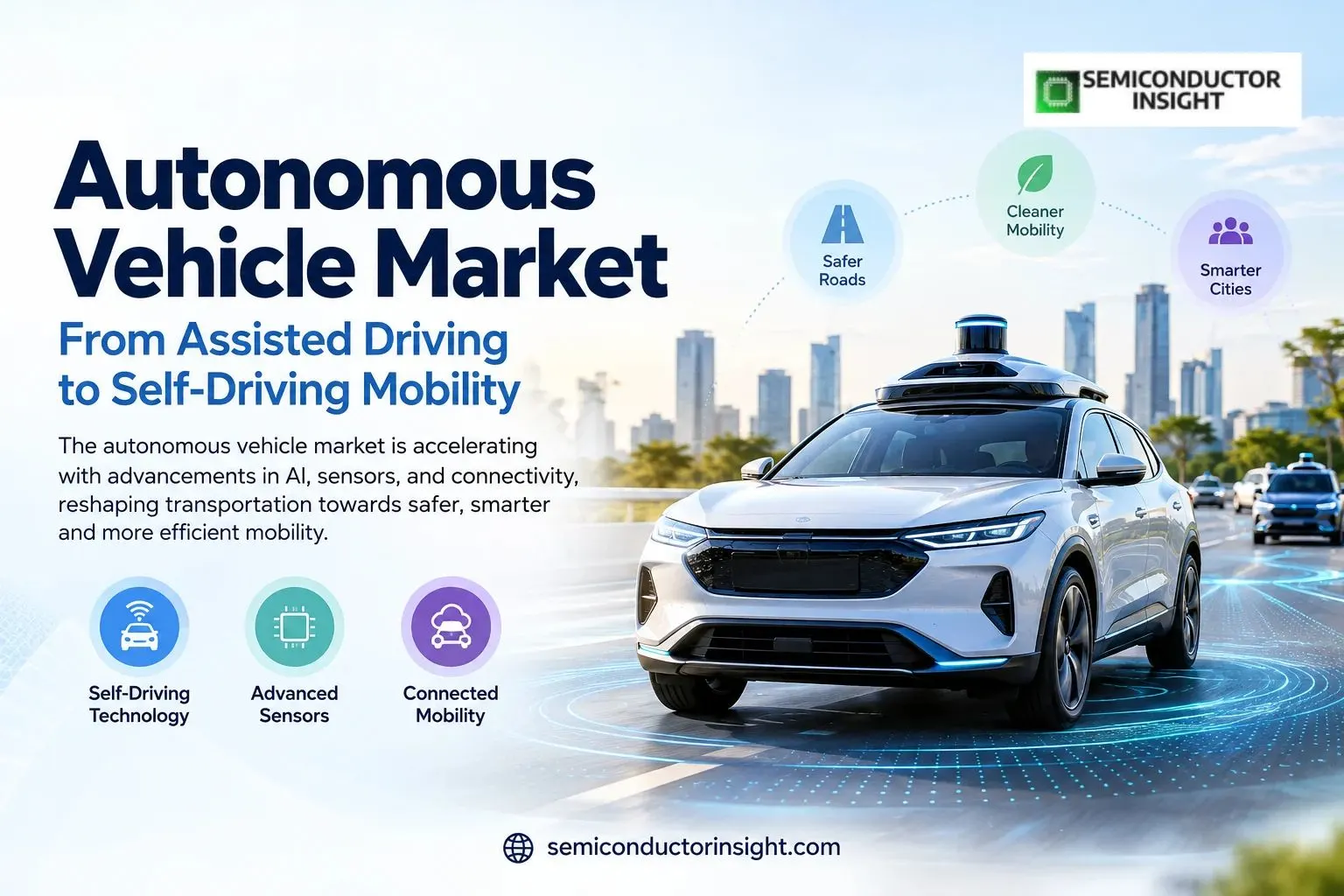
Autonomous Vehicle Market Outlook through 2034 with Advances in AI Chips, Sensors and Vehicle Software
The autonomous vehicle market is moving from controlled testing toward commercial deployment in selected cities, freight corridors and industrial environments. It includes vehicles equipped with automated driving systems, the computing platforms that process sensor data, perception software, mapping systems and services that operate driverless fleets.
The distinction between driver assistance and full driving automation matters. SAE Level 2 systems still require continuous driver supervision, while Level 4 systems can perform driving tasks without human intervention within defined operating conditions. This distinction affects technology investment, regulatory approval and the commercial readiness of individual applications.
Robotaxi Fleets Are Turning Autonomous Driving Into a Commercial Service
- Waymo reported more than 14 million paid trips during 2025, over three times its public rides in 2024.
- By August 2025, the company had also reported more than 100 million miles of public-road experience and hundreds of thousands of fully autonomous trips each week.
- These figures illustrate how driverless mobility is developing into a recurring transportation service rather than remaining exclusively a vehicle-development project.
- For investors and fleet operators, the key questions are vehicle utilization, maintenance costs, service availability and the economics of operating without an onboard driver.
- Expansion into additional cities also requires local permits, suitable road conditions, mapping and operational support.
You can freely browse our most recent updated related report to learn more about it before scrolling further: https://semiconductorinsight.com/report/autonomous-vehicle-processor-market/
AI Computing and Sensor Fusion Are Becoming Core Vehicle Technologies
Autonomous vehicles must interpret camera images, radar returns and, where installed, lidar measurements while predicting the movement of surrounding road users. These tasks demand substantial computing capability, reliable software and careful management of heat and electrical power.
At CES in January 2025, NVIDIA announced safety and cybersecurity milestones for its DRIVE Hyperion platform, featuring DRIVE Thor based on the Blackwell architecture. The platform combines automotive computing, operating-system software and sensor integration, with Mercedes-Benz, Jaguar Land Rover and Volvo Cars among the manufacturers adopting the platform.
This creates opportunities for semiconductor suppliers, automotive software developers and sensor manufacturers. Buyers must evaluate processing performance alongside functional safety, cybersecurity, software support and the ability to update systems over a vehicle’s service life.
Driverless Freight Is Opening a Different Commercial Path
Autonomous trucking offers a distinct deployment model from urban robotaxis. Freight operators can focus on defined highway corridors, logistics hubs and repeatable routes, where operating conditions may be easier to characterize than dense city streets.
California adopted new autonomous vehicle regulations on April 28, 2026, allowing manufacturers to apply for permits to test and deploy heavy-duty autonomous vehicles on public roads. The rules also address transit applications and strengthen oversight requirements. This is an important regulatory development for companies developing driverless freight services.
For logistics buyers, the commercial case depends on safe operation, predictable delivery schedules, transfer arrangements at terminals and the ability to maintain service during adverse weather or road disruptions.
Safety Reporting Is Becoming a Commercial Gatekeeper
- Autonomous driving companies must demonstrate that their systems can operate safely within their approved conditions.
- In the United States, the National Highway Traffic Safety Administration requires designated manufacturers and operators to report specified crashes involving automated driving systems and certain Level 2 driver-assistance systems.
- An amended reporting order took effect on June 16, 2025, refining reporting requirements and deadlines.
- The agency cautions that incident reports are not necessarily statistically representative, because companies differ in their access to vehicle telemetry and crash information.
- For manufacturers, robust event recording, cybersecurity and transparent safety documentation are therefore important operational capabilities, not merely regulatory paperwork.
Deployment Permits and Fleet Economics Will Determine Expansion
California’s autonomous vehicle programme illustrates the difference between testing and commercial availability. Its permit framework separates testing with a safety driver, driverless testing and deployment, with distinct operational conditions for each category.
The California DMV reported that permit holders logged 4,498,066 public-road testing miles between December 2023 and November 2024. Of these, 552,895 miles were recorded in fully autonomous mode. The agency also noted that disengagement reports are not designed to provide straightforward comparisons between companies.
These figures show why raw mileage alone cannot establish commercial readiness. Fleet operators must also assess service reliability, intervention frequency, maintenance, insurance, geographic coverage and the costs of remote assistance.
Where the Next Investment Opportunities Are Emerging
The autonomous vehicle market extends beyond vehicle manufacturers. Semiconductor suppliers, simulation software companies, mapping providers, sensor developers and fleet-management platforms all contribute to deployment. The most credible opportunities will depend on whether a technology can satisfy safety requirements and deliver measurable operating benefits in a defined application.
As driverless services expand, commercial progress will depend less on demonstrations alone and more on repeatable performance across real-world journeys, regulatory environments and operating costs.

Comments (0)