
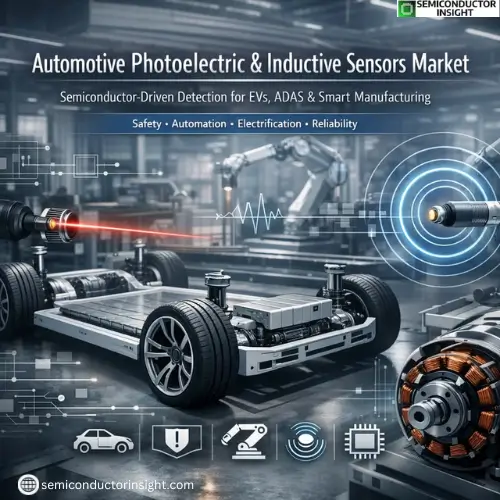
Automotive Photoelectric and Inductive Sensors Market Dynamics Expand with Smart Vehicle Electrification
Modern vehicles are no longer defined only by engines or mechanical strength. Today’s automotive platforms are increasingly shaped by electronics, embedded intelligence, and semiconductor-based sensing systems. Within this shift, photoelectric sensors and inductive sensors have become critical components enabling safer driving, smarter manufacturing, and more responsive vehicle systems.
Automotive Photoelectric Sensors and Inductive Sensors Market is growing steadily because sensing is now at the heart of mobility. From proximity detection and object recognition to position feedback and automated assembly, these sensors support both in-vehicle functions and the industrial processes used to build next-generation cars.
As automakers transition toward electric, connected, and software-defined vehicles, the demand for high-performance sensing hardware continues to rise.
Market Definition through a Semiconductor Lens
Photoelectric sensors operate using light-based detection, typically involving an emitter and receiver that identify objects based on reflection or interruption of a beam. These sensors are widely used for presence detection, safety systems, and automated vehicle manufacturing.
Inductive sensors, on the other hand, rely on electromagnetic fields to detect metallic objects without physical contact. They are essential for applications requiring durability, high precision, and resistance to harsh automotive environments.
Both sensor types are deeply connected to semiconductor innovation because they depend on:
- Signal conditioning ICs
- Integrated microcontrollers
- Packaging and thermal stability
- Advanced wafer-level manufacturing
In many ways, sensors represent one of the fastest-growing semiconductor content areas per vehicle.
Why Automotive Platforms Are Increasing Sensor Density?
Vehicles today require far more sensing points than they did a decade ago. The rise of ADAS features, electrified powertrains, and automated manufacturing has pushed sensor integration into nearly every system.
Photoelectric and inductive sensors are increasingly used across:
- Electronic braking and stability systems
- Battery module assembly lines
- Parking and proximity functions
- Motor position and speed monitoring
- Robotic inspection in automotive plants
This growing sensor density reflects a broader industry reality: the automotive market is becoming one of the most important demand engines for semiconductor suppliers.
Take a Quick Glance at Our In-Depth Analysis Report:
ADAS, Safety Compliance, and the Push for Reliable Detection
Automotive safety expectations have changed dramatically. Regulatory frameworks and consumer demand are pushing manufacturers toward higher precision and faster detection systems.
Photoelectric sensors contribute to safety by supporting detection-based automation in manufacturing and vehicle subsystems. Inductive sensors provide highly reliable feedback in critical environments where mechanical wear or contamination could impact performance.
As vehicles incorporate more automated decision-making, sensor reliability becomes non-negotiable. This is creating stronger demand for semiconductor-grade sensing solutions with proven durability and functional safety support.
Electrification and EV Production Reshaping Sensor Demand
The EV transition is introducing new sensing requirements, especially around battery manufacturing, thermal management, and power electronics integration.
Inductive sensors are widely used in EV motor control systems for position and speed feedback. Photoelectric sensors are playing a larger role in battery assembly automation, where non-contact detection improves safety and reduces production defects.
EV production lines are also more sensor-intensive because battery systems require:
- Higher precision assembly
- Continuous monitoring
- Advanced automation and inspection
This has positioned automotive sensing as a strategic growth area for semiconductor component suppliers.
Semiconductor Manufacturing Trends Influencing Sensor Innovation
Sensor development is increasingly tied to semiconductor process advancements. Suppliers are focusing on smaller, more integrated sensor modules that combine detection with onboard processing.
Key innovation directions include:
- Higher integration of sensing + control electronics
- Improved resistance to vibration, oil, and temperature cycling
- Smarter sensor modules with embedded diagnostics
- Compact packaging for space-limited vehicle architectures
The market is moving beyond basic detection toward intelligent sensing nodes that align with software-defined vehicle roadmaps.
Competitive Landscape and Strategic Moves by Key Players
Major semiconductor and automotive sensor suppliers are investing heavily in product reliability, automotive qualification, and long-term OEM partnerships.
Key players active in this market include:
- Infineon Technologies
- STMicroelectronics
- Texas Instruments
- Omron Corporation
- SICK AG
- Panasonic Industry
- TE Connectivity
- Honeywell International
Common strategies shaping competition include:
- Expanding automotive-grade sensor portfolios
- Partnering directly with EV manufacturers and Tier-1 suppliers
- Developing sensors optimized for harsh environments
- Offering integrated solutions combining sensors with control ICs
In this market, trust, qualification cycles, and supply consistency matter as much as technology.
Industrial Automation Inside Automotive Manufacturing
An important growth dimension is that sensor demand is rising not only inside vehicles, but also inside the factories building them.
Automotive plants rely heavily on photoelectric sensors for:
- Robotic safety zones
- Conveyor tracking
- Automated inspection systems
- High-speed component sorting
Inductive sensors are equally critical in heavy-duty assembly where metal detection and durability are required.
This dual-market exposure vehicle integration plus factory automation adds resilience to overall sensor demand.
Trade, Supply Chain Localization, and Production Shifts
Recent supply chain disruptions have encouraged automakers to rethink sourcing strategies for critical sensor components. Many OEMs are pushing for:
- Regional semiconductor supply alignment
- Multi-sourcing to reduce risk
- Localized manufacturing of key sensor modules
Asia-Pacific remains a major production hub, while Europe and North America continue to lead in automotive-grade sensor innovation and qualification.
Trade policies, export controls, and semiconductor investment programs are likely to influence market structure over the next few years.
Unique Market Pointers Shaping the Next Phase
Instead of closing with a standard wrap-up, it is worth highlighting several forward-looking market realities:
- Vehicles are evolving into sensor-driven electronic platforms, increasing long-term demand stability
- EV manufacturing is accelerating the adoption of automation-grade photoelectric sensing
- Inductive sensors remain essential for harsh-condition feedback where optical systems are less effective
- Semiconductor suppliers that align early with OEM platforms will secure multi-year revenue cycles
- Sensor fusion trends will increase demand for smarter, integrated sensing modules rather than standalone parts
The Automotive Photoelectric Sensors and Inductive Sensors Market is no longer just a component category it is becoming a strategic pillar in automotive semiconductor growth.

Comments (0)