

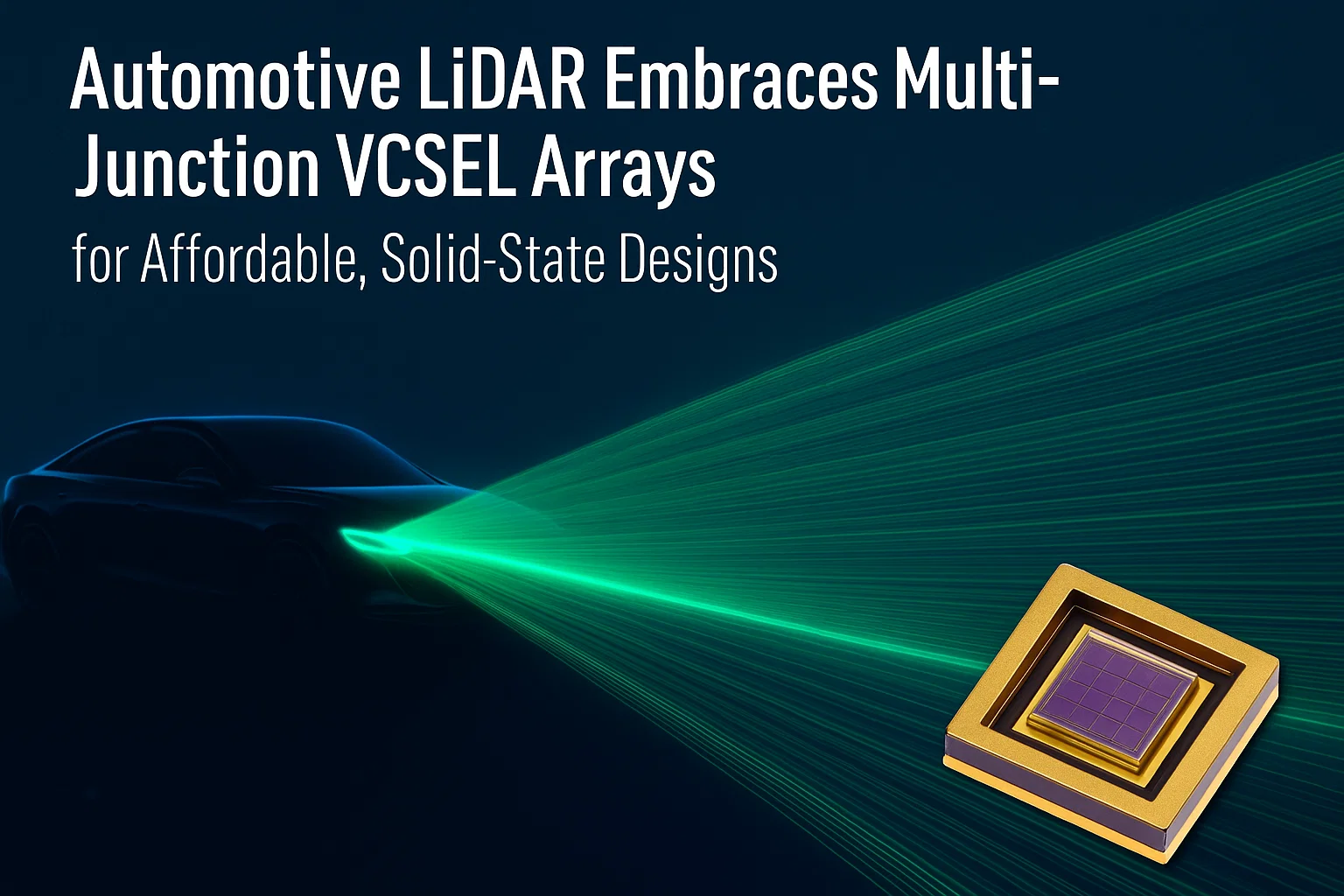
Automotive LiDAR Embraces Multi-Junction VCSEL Arrays for Affordable, Solid-State Designs
The photonics industry is undergoing a quiet but transformative revolution, and at the heart of this change lies a tiny device with outsized influence—the Multi-Junction Vertical Cavity Surface Emitting Laser (VCSEL). Once a niche technology for short-range optical links, multi-junction VCSELs are now at the center of innovation in consumer electronics, automotive LiDAR, high-speed data centers, and augmented/virtual reality.
As the world races toward a future defined by immersive digital experiences, autonomous mobility, and AI-driven data centers, the demand for compact, energy-efficient, and high-power light sources has never been higher. Multi-junction VCSELs are emerging as a key enabler.
According to recent industry analysis, the Multi-Junction VCSEL market was valued at USD 3.84 billion in 2024 and is projected to reach USD 9.17 billion by 2032, registering a CAGR of 13.2% from 2025–2032. This remarkable growth trajectory highlights the accelerating adoption of the technology across industries.
Access Your Free Sample Report- Multi-Junction Vertical Cavity Surface Emitting Laser Market
What Are Multi-Junction VCSELs? A Quick Primer
A VCSEL (Vertical Cavity Surface Emitting Laser) is a semiconductor laser diode that emits light perpendicular to the wafer surface. Unlike edge-emitting lasers, VCSELs are easier to fabricate in arrays, highly reliable, and offer superior beam quality.
A multi-junction VCSEL stacks several active regions (junctions) in series within the same laser cavity. This architecture enables:
- Higher Optical Power Output – multiple active layers contribute to emission.
- Improved Power Conversion Efficiency – less heat dissipation compared to single-junction devices.
- Compact Form Factor – ideal for applications requiring high density.
- Scalability in Arrays – enabling sensing and imaging applications.
This innovation has pushed VCSELs beyond datacom into 3D sensing, LiDAR, and AR/VR.
Market Landscape: Multi-Junction VCSEL Growth Trajectory
The global market’s expansion is driven by convergence of consumer, automotive, and industrial demand.
- 2024 Market Size: USD 3.84 billion
- 2032 Projection: USD 9.17 billion
- CAGR (2025–2032): 13.2%
Key Growth Drivers
- Consumer Electronics – Apple, Meta, and others using multi-junction VCSELs for Face ID, LiDAR, AR glasses, VR headsets.
- Data Centers – demand for 100–200 Gb/s optical interconnects fueled by AI workloads.
- Automotive – solid-state LiDAR systems requiring compact, high-power lasers.
- Industrial & Medical – applications in machine vision, biometric authentication, and sensing.
Geographic Hotspots
- North America: Innovation hub (Apple, Meta, Coherent, Lumentum).
- Europe: Strong in automotive sensing (ams-Osram, automotive OEMs).
- Asia-Pacific: Largest manufacturing base, rising demand from consumer electronics.
Recent Industry Developments (2024–2025)
Now let’s dive into the most significant advancements, based on recent reports from credible sources such as IEEE Spectrum, Photonics.com, Semiconductor Today, and company announcements.
Apple, Lumentum, and ams-Osram: Next-Gen 3D Sensing
Apple remains the most influential driver of VCSEL adoption. Its Face ID technology, powered by multi-junction VCSELs, has already reached hundreds of millions of devices.
- Lumentum and ams-Osram supply VCSEL arrays for Apple’s iPhones and iPads.
- The shift to multi-junction architectures delivers higher optical power at lower thermal loads, essential for compact mobile devices.
- In 2024, suppliers reported new design wins for Apple’s AR/VR ecosystem, suggesting multi-junction VCSELs will play a crucial role in the company’s mixed reality headsets.
Insight: Apple’s roadmap hints at expanding VCSEL use beyond Face ID into environmental sensing for AR, creating an entirely new class of user interfaces.
Download Sample Report PDF- Multi-Junction Vertical Cavity Surface Emitting Laser Market
Meta Reality Labs: AR Glasses & VR Headsets
Meta is heavily investing in optical sensing technologies to enable natural interactions in AR/VR. Multi-junction VCSELs are central to:
- Eye Tracking – ensuring accurate rendering and foveated displays.
- Hand Tracking – enabling intuitive gesture control.
- Compact Depth Sensing – reducing the need for bulky external sensors.
Reports from EE Times and Optics.org note that Meta’s AR glasses prototypes rely on VCSEL arrays for low-power, always-on sensing.
Insight: In AR/VR, efficiency is king—every milliwatt saved extends wearable device battery life. Multi-junction VCSELs deliver exactly that.
Coherent Corp. (formerly II-VI): Data Center Connectivity
As AI and machine learning workloads reshape the data center landscape, the bottleneck is shifting from compute to optical interconnects.
- In late 2024, Coherent Corp. demonstrated multi-junction VCSELs enabling 100–200 Gb/s per channel links.
- This represents a leap forward for short-reach data center interconnects, where VCSELs compete with silicon photonics.
- The advantage? Cost-effective, scalable, and power-efficient transceivers for intra-data center connectivity.
Insight: With hyperscale operators like Microsoft, Google, and AWS scaling AI clusters, multi-junction VCSELs may soon become standard in data center interconnects.
Automotive LiDAR: Compact and Robust Sensing
The automotive sector is another hotbed of VCSEL innovation.
- Ouster (via Sense Photonics) and other LiDAR players are exploring multi-junction VCSEL arrays for compact, solid-state LiDAR.
- Compared to edge-emitting lasers, VCSELs offer:
- Lower manufacturing costs
- Simpler packaging
- Higher reliability
- com (2024) reported that VCSEL-based LiDAR prototypes are being trialed with automotive OEMs.
Insight: While fiber lasers dominate high-end LiDAR, VCSELs promise low-cost scalability for mass-market vehicles.
Research Breakthroughs: Efficiency and Reliability
Academic and industrial research is pushing VCSEL performance further.
- Optica Publishing Group (2024) published work on VCSELs achieving >70% power conversion efficiency.
- Advances in thermal management and cavity design extend device reliability, critical for automotive and industrial deployment.
- IEEE Photonics Letters reports multi-wavelength multi-junction VCSELs, expanding applications in spectroscopy and sensing.
Insight: Beyond commercial adoption, research is unlocking entirely new frontiers—particularly in industrial and scientific applications.
Strategic Implications Across Industries
The latest developments point to a future where multi-junction VCSELs are foundational across multiple sectors:
- Consumer Electronics: Seamless biometric authentication, AR/VR immersion.
- Automotive: Affordable solid-state LiDAR for ADAS and autonomy.
- Data Centers: High-throughput, low-latency interconnects for AI workloads.
- Healthcare & Industry: Machine vision, spectroscopy, and diagnostics.
Challenges Ahead
Despite rapid progress, several challenges remain:
- Thermal Management – high-power operation requires advanced packaging.
- Manufacturing Scalability – wafer-level production must meet soaring demand.
- Competition from Silicon Photonics – especially in data centers.
- Standardization – industry alignment on testing and reliability metrics.
Click Here To Download Full Sample Report- Multi-Junction Vertical Cavity Surface Emitting Laser Market
Future Outlook: 2025 and Beyond
Looking ahead, several trends are expected to define the next chapter:
- Integration with CMOS for compact modules.
- Expansion into 1550 nm VCSELs, unlocking longer-range LiDAR and eye-safe operation.
- VCSEL-on-chip architectures for AR glasses and wearable devices.
- Synergy with AI – machine learning-driven design optimization for higher efficiency.
The market projection of USD 9.17 billion by 2032 underscores not just growth but also the central role multi-junction VCSELs will play in enabling next-gen technologies.

Comments (0)