
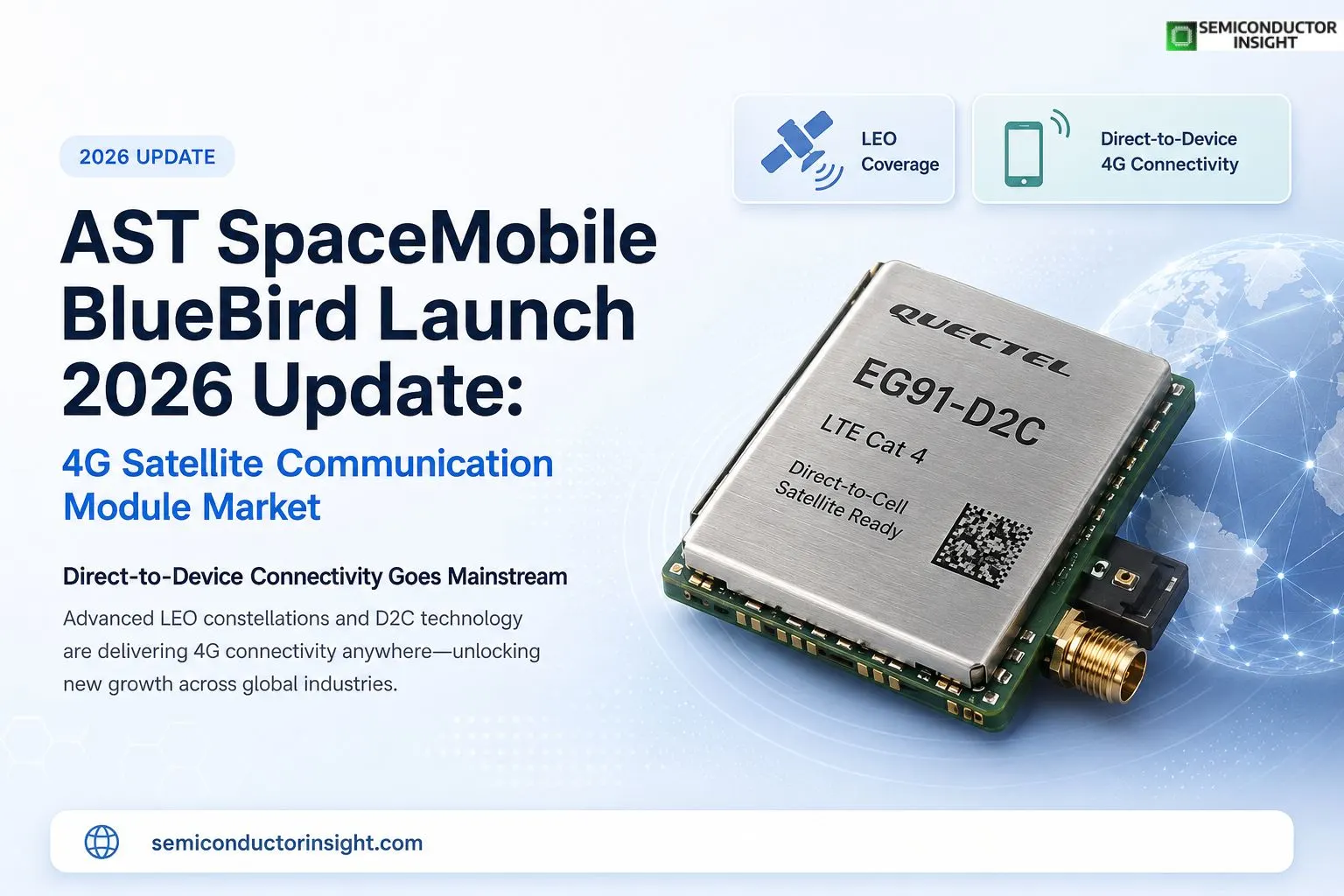
AST SpaceMobile BlueBird Launch 2026 Update: Impact on 4G Satellite Communication Module
The semiconductor landscape witnessed a watershed moment in September 2024 when AST SpaceMobile launched its first five commercial BlueBird satellites via SpaceX Falcon 9. These spacecraft feature approximately 693 square foot arrays and now deliver 4G broadband directly to unmodified smartphones, marking the critical transition from laboratory testing to operational service for 4G Satellite Communication Module Market.
The satellites have completed successful test calls with major carriers, including AT&T, Verizon, Vodafone, Rakuten, and Bell, proving the technology works across different network standards and geographic regions. This production deployment represents the first batch of commercial satellites designed specifically to connect billions of mobile subscribers globally without requiring any special hardware on the user’s device, fundamentally changing how we think about cellular coverage gaps and dead zones.
LEO Constellation Architecture Reshapes Semiconductor Requirements
- Low Earth Orbit satellites operate under fundamentally different constraints than traditional geostationary systems, creating unique semiconductor design challenges.
- LEO platforms are typically smaller, require significantly lower power budgets, and are manufactured in much greater quantities to build dense constellations.
- The semiconductor solutions powering these systems must withstand Total Ionising Dose radiation and Single Event Effects while maintaining stable operation throughout mission lifecycles that can extend several years.
- Infineon’s radiation-tolerant device portfolio specifically addresses these space-specific challenges, enabling high-frequency power conversion with minimal losses to reduce thermal footprints in weight-critical designs where every gram matters.
- This architectural shift means semiconductor manufacturers must now develop chips that balance performance, radiation hardness, power efficiency, and cost simultaneously.
Maritime Sector Achieves Ultra Broadband Era through Space Fibre
Maritime communications entered what industry experts now call the ‘ultra-broadband era’ with dense LEO constellation deployment transforming ocean connectivity. Modern LTE 4G routers now support dedicated LEO satellite interfaces, effectively equipping commercial vessels and private boats with ‘space fibre’ connectivity that matches terrestrial broadband speeds.
Pilot projects conducted across multiple shipping routes demonstrate tenfold increases in data transmission rates at comparable or lower costs compared to traditional satellite systems, enabling real-time 4K video streaming from open ocean operations for both safety monitoring and crew welfare. This transformation shifts ocean operations from ‘fate-dependent’ to ‘precision-controlled’ through the vessel’s all-weather nerve centre, allowing ship operators to monitor engine performance, cargo conditions, and crew communications in real-time regardless of location.
Want to learn more about the report? Check out our latest updated version for free: https://semiconductorinsight.com/report/4g-satellite-communication-module-market/
Direct to Cell Module Portfolio Expands Across Industry Verticals
Quectel Wireless Solutions announced in September 2025 that several LTE modules now feature Direct-to-Cell functionality, bridging terrestrial and satellite networks seamlessly for the first time in mass production. The enhanced portfolio spans EG91, EG21, EG25, and EG916 series modules, addressing diverse global markets with different frequency allocations and regulatory requirements.
These D2C-enabled LTE modules serve residential and commercial fixed subscribers requiring reliable broadband in remote locations, maritime communication subscribers needing stable vessel connections for cargo tracking and crew safety, RV mobile subscribers seeking always-on internet for remote work and entertainment, and aviation communication subscribers depending on in-flight connectivity for both passenger service and operational data transmission. The versatility of these modules makes them suitable for applications ranging from personal trackers to industrial IoT sensors.
Government Defence Contracts Accelerate Commercial LEO Capability Procurement
The U.S. Space Force’s PLEO contract vehicle, initiated in 2023, fundamentally changed how the government procures commercial LEO satellite capabilities for defence applications.
In April 2025, Intelsat received a 12-month task order providing the Department of Defence with maritime connectivity, including satellite bandwidth, specialised equipment, and managed services for global coverage across all oceans.
This order supports global maritime operations for multiple government end users, including Coast Guard vessels, Navy ships, and commercial vessels supporting defence logistics.
Space Force officials noted that most PLEO task orders previously went exclusively to SpaceX for Starshield, the military version of Starlink, making this Intelsat award significant for diversifying the government’s satellite communication supply chain and creating competition that drives innovation down the cost curve.
Turkey Direct to Device Testing Demonstrates Global MNO Partnership Model
Lynk Global successfully demonstrated patented direct-to-device technology in rural Türkiye with mobile network operator Turkcell in March 2025, proving the partnership model works across different regulatory environments. The companies signed a February 2024 agreement collaborating on direct-to-cellular connectivity to expand mobile coverage and provide additional network resilience during disasters or network congestion events.
Lynk has tested technology successfully on all seven continents with 50 mobile network operator partners’ worldwide and commercial contracts delivering services to roughly 60 countries, demonstrating unprecedented global scale for satellite-to-phone technology. The FCC granted Lynk operating approval in September 2022 for 10 LEO satellites providing connectivity to existing GSM and LTE devices outside the U.S., establishing the regulatory precedent that other companies are now following.
500000 Square Mile Beta Coverage Enables Rural Wireless Access
- AT&T and Verizon launched beta tests of direct-to-cell satellite service using Starlink satellites covering 500000 square miles across the United States in remote or rural areas lacking traditional cellular coverage.
- The beta service currently remains free for participating customers, with monthly charges scheduled to start in July 2025 at approximately $10-15 per month, depending on the carrier.
- AST SpaceMobile has launched five operational satellites delivering 4G and 5G services worldwide and is planning network expansion to as many as 243 satellites to achieve true global coverage, including oceans and Polar Regions.
- Lynk Global similarly deployed satellites providing coverage in remote areas, emphasising partnerships with telecom operators and obtaining necessary regulatory approvals before commercial launch, creating a sustainable business model that shares revenue between satellite operators and mobile carriers.
Next Generation Bluebird Satellites Feature Largest Commercial Phased Arrays
AST SpaceMobile’s next-generation BlueBird satellites scheduled for launch throughout 2025 and 2026 feature nearly 2400 square foot arrays, more than three times larger than the first production generation. These will become the largest commercial phased arrays ever deployed in low Earth orbit, surpassing the previous record held by earlier satellites and approaching the size of some military reconnaissance satellites.
The newest satellites support 10 GHz of processing bandwidth with peak speeds of 120 Mbps per coverage cell, enough capacity for millions of daily connections including voice calls, video calls, text messages, and high-definition streaming. The first next-generation satellite launched December 23, 2025, from Satish Dhawan Space Center in India, joining BlueWalker 3 and BlueBird 1-5 already in orbit, forming the initial operational constellation that will provide global coverage.
European Space Agency Collaborates on Open Architecture LEO Constellation
The European Space Agency established a collaboration with Viasat, extending and promoting European participation in standards-based open architecture LEO constellation development. This open architecture approach augments existing GEO and LEO direct-to-device satellite capabilities, creating a hybrid network that leverages the strengths of different orbit altitudes.
The European Space Agency partnership demonstrates international commitment to interoperable satellite communication infrastructure supporting 4G Satellite Communication Module Market globally, ensuring European manufacturers and operators can participate in the growing market. Open standards prevent vendor lock-in and enable competition, which historically drives innovation and reduces costs for end users across all market segments, from consumer devices to industrial applications.
Satellite IoT Extends Connectivity beyond Terrestrial Network Limitations
- Satellite IoT development created significant leaps forward, extending IoT connectivity beyond terrestrial networks’ physical and economic limitations to reach previously unreachable locations.
- In critical infrastructure management such as power grids, transportation networks, and water systems, satellite IoT enhances real-time monitoring, control, and predictive maintenance, improving efficiency, safety, and cost savings while reducing unplanned outages.
- Maritime sector satellite IoT aids vessel and cargo monitoring and management, improving navigation safety through real-time weather data and collision avoidance, plus logistics management in open seas where cellular coverage doesn’t exist.
- This capability particularly benefits remote areas where terrestrial infrastructure remains economically unviable due to low population density or difficult terrain, enabling agricultural monitoring, environmental sensing, and emergency response capabilities in regions that previously had no connectivity options.

Comments (0)