
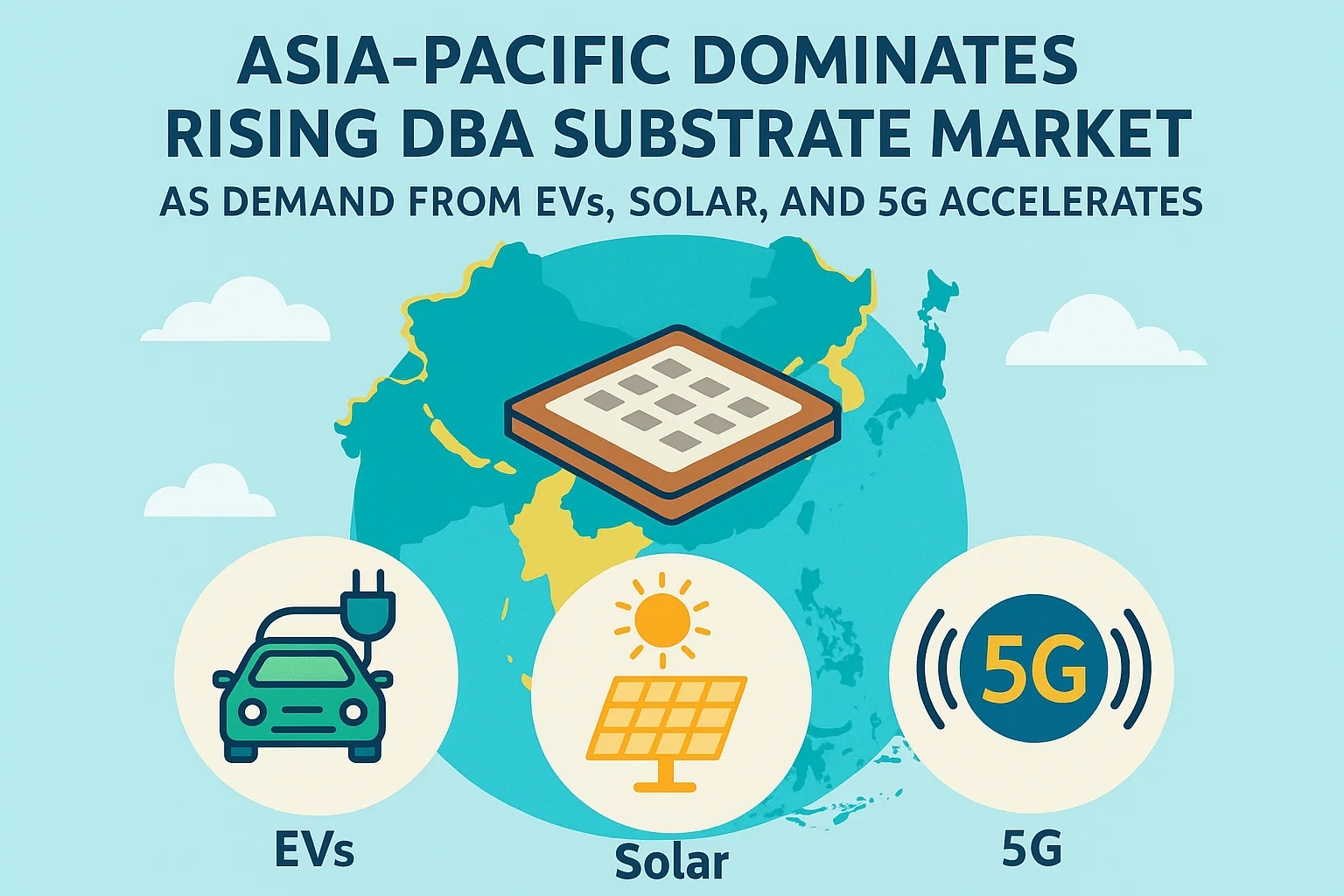
Asia-Pacific Dominates Rising DBA Substrate Market as Demand from EVs, Solar, and 5G Accelerates
The world of power electronics and high-performance semiconductor packaging is undergoing a significant transformation, and at the heart of this evolution lies an often overlooked, yet mission-critical material: Direct Bonded Aluminum (DBA) substrates. These high-performance substrates have become indispensable in sectors where thermal conductivity, electrical insulation, and mechanical reliability are essential — particularly in electric vehicles (EVs), renewable energy systems, industrial automation, and 5G base stations.
According to industry sources, the DBA Substrate Market, valued at US$ 234.9 million in 2024, is projected to reach approximately US$ 456.2 million by 2032, growing at a CAGR of 9.9% during the 2025–2032 forecast period. This strong upward trajectory is being driven by a convergence of technology advancements, increasing energy demands, and global sustainability initiatives.
Access Your Free Sample Report- DBA (Direct Bonded Aluminum) Substrate Market
What is a DBA (Direct Bonded Aluminum) Substrate?
A DBA substrate consists of an aluminum base plate that is bonded to a ceramic insulator, typically aluminum nitride (AlN) or alumina (Al₂O₃). This configuration provides a unique combination of high thermal conductivity, strong dielectric strength, and mechanical durability—key for transferring heat from power semiconductors while maintaining electrical isolation.
Unlike traditional metal substrates, DBA substrates can withstand high operating temperatures and thermal cycling, making them ideal for power-intensive applications such as EV inverters, power modules, industrial drives, and solar inverters.
Recent Technological Developments Reshaping the DBA Market
- Laser-Assisted Bonding Techniques
The introduction of laser-assisted direct bonding has emerged as a critical advancement in improving the reliability and speed of substrate production. Laser systems provide localized, non-contact heating, which minimizes stress on materials while ensuring a high-quality bond between ceramic and aluminum layers. This is especially beneficial for high-throughput manufacturing environments.
- Advanced Ceramic Integration
Recent innovations in ceramic engineering—especially aluminum nitride (AlN) substrates—have improved the thermal conductivity of DBA boards to over 170 W/mK, significantly outperforming older alumina-based materials. This directly translates to better heat dissipation and longer component lifetimes, a necessity in EV power modules and IGBT packages.
- Sintering and Metallization Enhancements
New metallization techniques such as active metal brazing and silver sintering are improving thermal interfaces and providing lower thermal resistance and stronger mechanical bonds, critical for next-generation high-power applications.
- Eco-Friendly Manufacturing
Global sustainability goals are pushing manufacturers toward low-carbon production methods, such as the use of recycled aluminum substrates, lead-free bonding pastes, and energy-efficient sintering furnaces.
EV Boom and Power Electronics: A Major Market Catalyst
The surging demand for electric vehicles (EVs) is perhaps the largest driver behind the rapid expansion of the DBA substrate market. Here’s why:
- Power Inverters and On-Board Chargers: These components operate at high voltages and generate significant heat, making DBA substrates essential for heat dissipation.
- SiC and GaN Semiconductor Adoption: Wide bandgap semiconductors like silicon carbide (SiC) and gallium nitride (GaN) require advanced substrates that can withstand extreme conditions—DBA fits the bill.
- Battery Management Systems (BMS): Efficient thermal management is crucial for battery life and safety, and DBA offers the necessary thermal stability.
According to industry insiders, each EV can contain up to 5–8 DBA substrates depending on its design and power electronics architecture—indicating the potential for explosive volume demand.
Renewable Energy and High-Power Systems Fuel Market Growth
Beyond EVs, DBA substrates are also penetrating deep into renewable energy infrastructures, particularly in wind turbines, solar inverters, and battery storage inverters.
- Solar Power Electronics: Power inverters used in photovoltaic (PV) systems require high-reliability DBA substrates to handle temperature fluctuations and prevent breakdowns in high-humidity outdoor conditions.
- Wind Power Systems: Wind turbines incorporate power modules that use DBA substrates for their ruggedness and insulation capabilities.
These applications benefit from DBA’s mechanical toughness and electrical reliability, ensuring long service lifetimes in remote or hostile environments.
Industrial Automation & 5G Infrastructure: An Emerging Opportunity
With the global push toward Industry 4.0, automation systems using servo drives, robotic arms, and motor controllers demand compact, reliable, and thermally efficient substrates. DBA technology ensures high uptime and consistent operation even under intense loads.
Meanwhile, the rapid deployment of 5G base stations and data centers requires efficient thermal solutions for the high-frequency, high-power RF modules—again, DBA substrates are increasingly favored for these roles.
Download Sample Report PDF- DBA (Direct Bonded Aluminum) Substrate Market
Regional Insights: Asia-Pacific Leads the Charge
Asia-Pacific: The Powerhouse
Countries like China, Japan, and South Korea dominate global DBA production due to their stronghold in semiconductor, automotive, and power electronics manufacturing. Japanese firms such as DENKA, Mitsubishi Materials, and DOWA Metaltech are industry pioneers, continuously innovating material properties and production scalability.
Europe: Innovation Meets Regulation
European firms are heavily invested in EVs and renewable energy, bolstered by the EU’s commitment to carbon neutrality by 2050. Companies like IXYS (Littelfuse) are integrating DBA substrates into advanced power module designs for EVs and industrial drives.
North America: Growing EV Ecosystem
With Tesla, Lucid Motors, and other EV innovators scaling up production, demand for domestic DBA manufacturing is growing. Strategic partnerships and reshoring initiatives could see more North American firms entering the substrate market.
Competitive Landscape: Key Players to Watch
| Company | Region | Focus Area |
| Mitsubishi Materials Corp. | Japan | High-performance ceramics and DBA substrates for EVs and power modules |
| DENKA Co. Ltd. | Japan | Advanced aluminum nitride (AlN) substrates |
| DOWA Metaltech | Japan | Custom metallization and thermal management |
| Littelfuse (IXYS) | USA/Germany | Power semiconductor packaging |
| Ferrotec Corporation | Japan/Global | Ceramics and electronic packaging |
Strategic partnerships, joint R&D programs, and vertical integration into semiconductor packaging are key strategies among leading players to maintain their competitive edge.
Market Forecast: What Lies Ahead
The expected CAGR of 9.9% reflects the industry’s strong momentum, driven by:
- Increasing vehicle electrification
- Expanding renewable energy investments
- Growing industrial automation
- Higher 5G infrastructure rollout
Challenges Ahead
Despite a promising outlook, the DBA substrate market must address several hurdles:
- High Production Costs
Advanced ceramic bonding and laser-assisted manufacturing processes are expensive and require capital-intensive infrastructure.
- Material Availability
Fluctuating prices and availability of aluminum nitride and high-purity ceramics may impact profit margins.
- Competition from DBC and AMB Substrates
Other substrates like Direct Bonded Copper (DBC) and Active Metal Brazed (AMB) ceramics are viable alternatives, especially in applications that don’t require aluminum’s lightness or specific mechanical traits.
- Thermal Fatigue and Cracking
Improper bonding or thermal cycling can lead to microcracks in ceramic layers—potentially compromising performance over time.
Click Here To Download Full Sample Report- DBA (Direct Bonded Aluminum) Substrate Market
The Future of DBA Substrates: Innovation, Integration, and Intelligence
Looking forward, the DBA substrate industry is expected to evolve across three major dimensions:
- Integration: Embedding sensors and diagnostics into DBA substrates to create “smart” substrates for predictive maintenance.
- Miniaturization: Innovations in micro-patterning and laser trimming will enable more compact, high-density circuit layouts.
- Customization: OEMs will demand application-specific DBA solutions, leading to modular designs and tailored ceramic-aluminum blends.
The Direct Bonded Aluminum (DBA) substrate market stands at the cusp of explosive growth, powered by megatrends such as EV adoption, 5G infrastructure, and clean energy deployment. With its superior thermal and electrical properties, DBA substrates are no longer just an option—they’re becoming a necessity in modern power electronics.
As global players race to innovate, expand, and dominate this niche yet impactful sector, one thing is certain: DBA substrates will play a foundational role in the energy-efficient, electrified, and connected world of tomorrow.

Comments (0)