
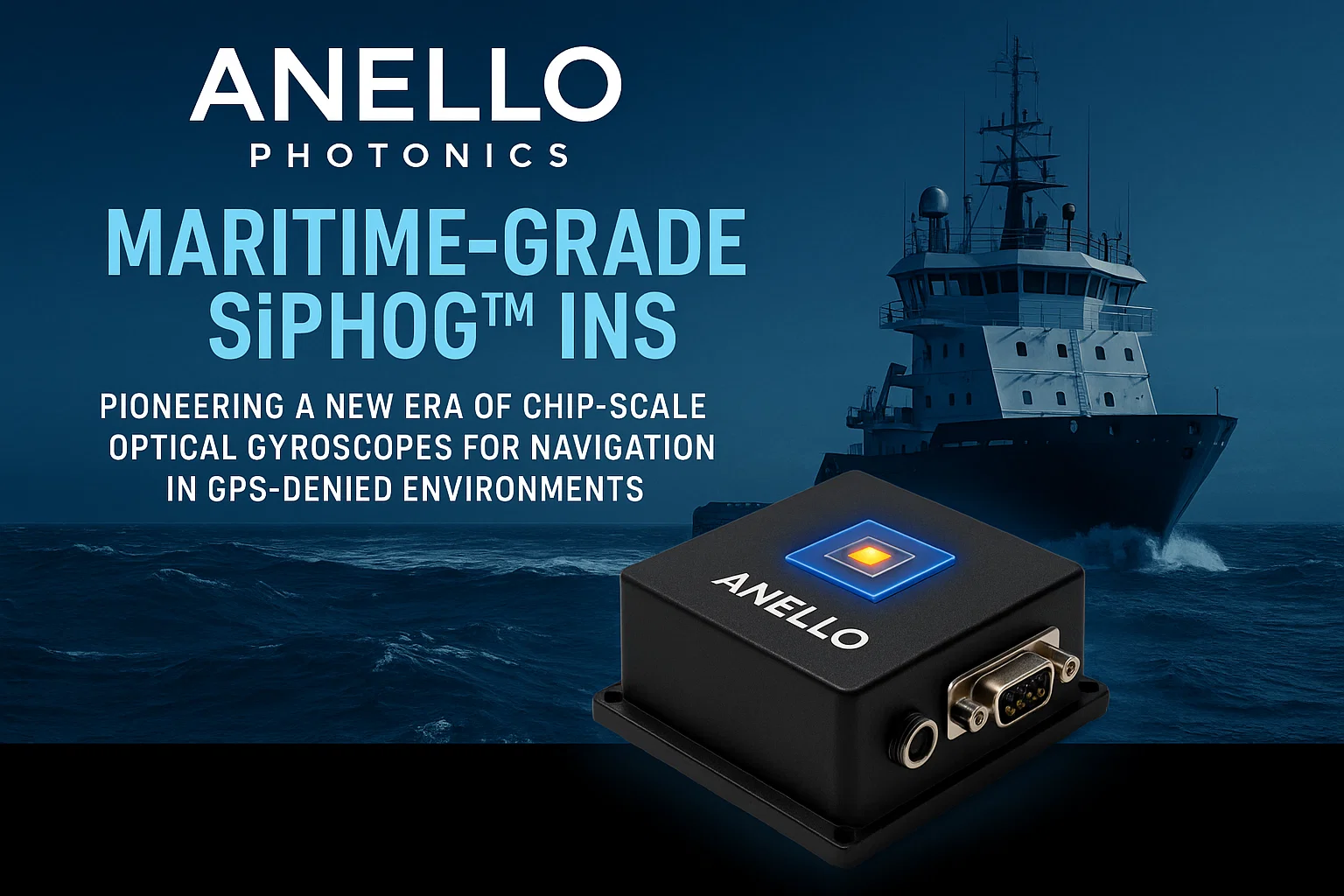
ANELLO Photonics Launches Maritime-Grade SiPhOG™ INS, Pioneering a New Era of Chip-Scale Optical Gyroscopes for Navigation in GPS-Denied Environments
In an increasingly autonomous world—where drones zip through airspaces, ships navigate uncharted waters, and spacecraft traverse the void—precision in navigation has become a cornerstone of technological progress. At the heart of these navigation systems lies the gyroscope. But not just any gyroscope: the latest innovation driving accuracy, compactness, and power efficiency comes in the form of the Integrated Optic Chip for Gyroscope (IOCG).
As of 2024, the Integrated Optic Chip for Gyroscope market was valued at US$ 98 million, and it is expected to grow at a CAGR of 8.7%, reaching US$ 178 million by 2032. This surge is being propelled by rapid innovation in photonics, miniaturization, and demand across autonomous vehicles, defense, aerospace, maritime, and space exploration.
Access Your Free Sample Report- Integrated Optic Chip for Gyroscope Market
Understanding Integrated Optic Chips in Gyroscopes
Before delving into market dynamics and newsworthy innovations, it’s essential to understand what sets integrated optic gyroscopes apart from traditional gyroscopic technologies.
At its core, an integrated optic gyroscope utilizes the Sagnac effect to measure angular velocity. Instead of bulky fiber-optic coils or mechanical parts, it uses photonic integrated circuits (PICs), which confine light within tiny waveguides etched into semiconductor materials such as silicon photonics (SiPh) or lithium niobate (LNOI).
The result? Systems that are:
- Ultra-compact and lightweight
- More robust under shock and vibration
- Energy-efficient with faster signal processing
- Scalable for mass production and AI fusion
Major Recent Developments in the IOCG Market
Let’s now explore the game-changing developments that are defining the next chapter of integrated optic gyroscope technology.
ANELLO Photonics: Silicon Photonic Gyroscopes Set New Benchmark
ANELLO Photonics, a Silicon Valley-based leader in photonic inertial systems, is at the forefront of integrated optic chip gyroscope innovation. Their proprietary SiPhOG™ (Silicon Photonic Optical Gyroscope) technology replaces bulky fiber loops with on-chip photonic waveguides, delivering top-tier performance in miniature form.
Maritime INS – Launched January 2025
- Introduced an Inertial Navigation System (INS) specifically for maritime use, based on SiPhOG.
- Features include:
- <0.5°/hr heading drift
- IP68 rating, capable of functioning in harsh oceanic conditions
- <6W power consumption
- GNSS spoofing detection, vital for naval defense and commercial shipping
X3 IMU – Introduced January 2024
- Targets aerial and autonomous vehicle markets
- Specifications:
- Bias instability of <0.5°/hr
- Angular Random Walk (ARW) of <0.05°/√hr
- Volume under 8 in³
- Mass < 5 lbs
Use Cases: Autonomous underwater vehicles (AUVs), unmanned surface vessels (USVs), UAVs, drones, and robotics.
EMCORE Corporation: Fiber-Optic Meets Photonics with PIC Inside™
EMCORE, a seasoned player in fiber-optic gyro systems, has migrated its portfolio to Photonic Integrated Chip (PIC) platforms. Their PIC Inside™ technology enhances system durability and manufacturing yield by integrating essential FOG components into a miniaturized, chip-scale format.
- This platform powers their TAC-450 and other gyro-based IMUs.
- Integration leads to:
- Higher resistance to vibration/shock
- Better long-term calibration stability
- Compactness, ideal for defense-grade inertial systems
Significance: Enables high-precision navigation in military UAVs, armored vehicles, and commercial aerospace.
INPHOMIR Project (EU Funded – July 2024)
The INPHOMIR initiative is a pan-European project supported by Horizon Europe. It focuses on developing dual-function navigation sensors using indium phosphide-based PICs, including:
- An on-chip optical gyroscope
- A Mid-IR FMCW LiDAR
These sensors will be fused with AI for:
- Satellite navigation
- Autonomous drones and aircraft
- European defense sovereignty
Technology: Combines LiDAR and inertial sensing onto a single chip, reducing SWaP-C (Size, Weight, Power, and Cost) dramatically.
Download Sample Report PDF- Integrated Optic Chip for Gyroscope Market
OSCPS Motion Sensing: Next-Gen Spiral and Resonator PIC Gyros
At SPIE Photonics West 2025, OSCPS Motion Sensing presented pioneering work on spiral and ring resonator-based photonic gyroscopes, offering:
- Sagnac-effect-based measurement without discrete optics
- Chip-scale packaging with integrated waveguides and interferometry
- Performance levels approaching that of high-end FOGs
These chips are ideal for micro-UxVs (unmanned vehicles), including aerial drones, robotic arms, and wearable sensors.
PSI “PIGEON” – Space-Grade PIC Gyroscopes (July 2024)
Backed by the U.S. Space Force, Physical Sciences Inc. (PSI) is developing the PIGEON gyroscope—Photonic Integrated Gyroscope for Enhanced On-chip Navigation.
- Based on ring-laser gyroscope architecture and designed for operation at exceptional points to improve sensitivity
- Focused on ultra-low SWaP, making it ideal for CubeSats, small satellites, and space vehicles
Outcome: Enhances the precision of attitude control systems in LEO (Low Earth Orbit) deployments.
Lithium Niobate (LNOI) Hybrid Gyroscopes: A Material Revolution
In January 2025, researchers unveiled a new hybrid integrated optic chip made from lithium niobate on insulator (LNOI).
- Combines:
- Beam splitters
- Phase modulators
- Polarization controllers
- All on a single photonic platform
- Benefits:
- Higher electro-optic efficiency
- Improved signal fidelity
- Lower thermal drift
This innovation is especially useful in industrial-grade gyroscopes used for mining, oil exploration, and robotics.
Application Areas: Where IOCG Technology is Making a Difference
Aerospace & Defense
- Navigation in GPS-denied environments
- Missile guidance and UAV control
- Satellite attitude and orbit control
Maritime & Subsea
- Autonomous underwater navigation
- Deep-sea oil exploration
- Unmanned maritime surveillance
Autonomous Vehicles
- AI-guided cars, delivery drones
- High-precision motion sensing
- Redundancy to GNSS systems
Industrial & Robotics
- Warehouse automation
- Precision agricultural robotics
- Smart manufacturing
Technology Comparison: Why IOCG Wins
| Feature | Traditional Gyroscope | Fiber Optic Gyroscope (FOG) | Integrated Optic Chip Gyroscope (IOCG) |
| Size/Weight | Bulky, mechanical | Medium (fiber coils) | Ultra-compact (<10 cm³) |
| Power Efficiency | Low | Moderate | High (sub-6W) |
| Drift/Accuracy | Low | High | High (comparable to FOG) |
| Scalability | Difficult | Limited | Easy (chip fabrication) |
| Environmental Robustness | Low | Medium | High (shock, temp, EMI resistant) |
| Cost Efficiency (mass prod.) | Low | Moderate | High |
Challenges Ahead
While integrated optic gyroscope chips are brimming with potential, a few challenges still need to be tackled:
- Thermal sensitivity: Managing temperature-induced drift in chips
- Packaging complexity: Hybrid photonics and electronics need better integration techniques
- Production costs: Currently higher due to custom wafers and low yield
- Standardization: Absence of global benchmarks for performance verification
Click Here To Download Full Sample Report- Integrated Optic Chip for Gyroscope Market
Future Outlook: Where Are We Headed?
The next decade promises a quantum leap in precision navigation, as integrated optic chips continue to shrink and improve in capability. The most exciting trajectories include:
- Quantum-enhanced photonic gyroscopes
- Mass deployment in Level-5 autonomous vehicles
- All-in-one AI-driven navigation modules for drones
- Photonic gyroscopes in wearables and AR devices
Expect increased collaboration between semiconductor foundries, defense R&D agencies, and automotive manufacturers to co-develop industry-specific solutions.
The Integrated Optic Chip for Gyroscope market is no longer niche—it is rapidly becoming the cornerstone of modern navigation systems. With giants like ANELLO, EMCORE, PSI, and ambitious R&D initiatives across Europe and North America, the race toward miniaturized, drift-free, scalable, and rugged gyroscopic solutions is in full motion.
As the market grows from US$ 98 million in 2024 to US$ 178 million by 2032, innovators are not just replacing legacy systems—they’re reinventing navigation itself.

Comments (0)