
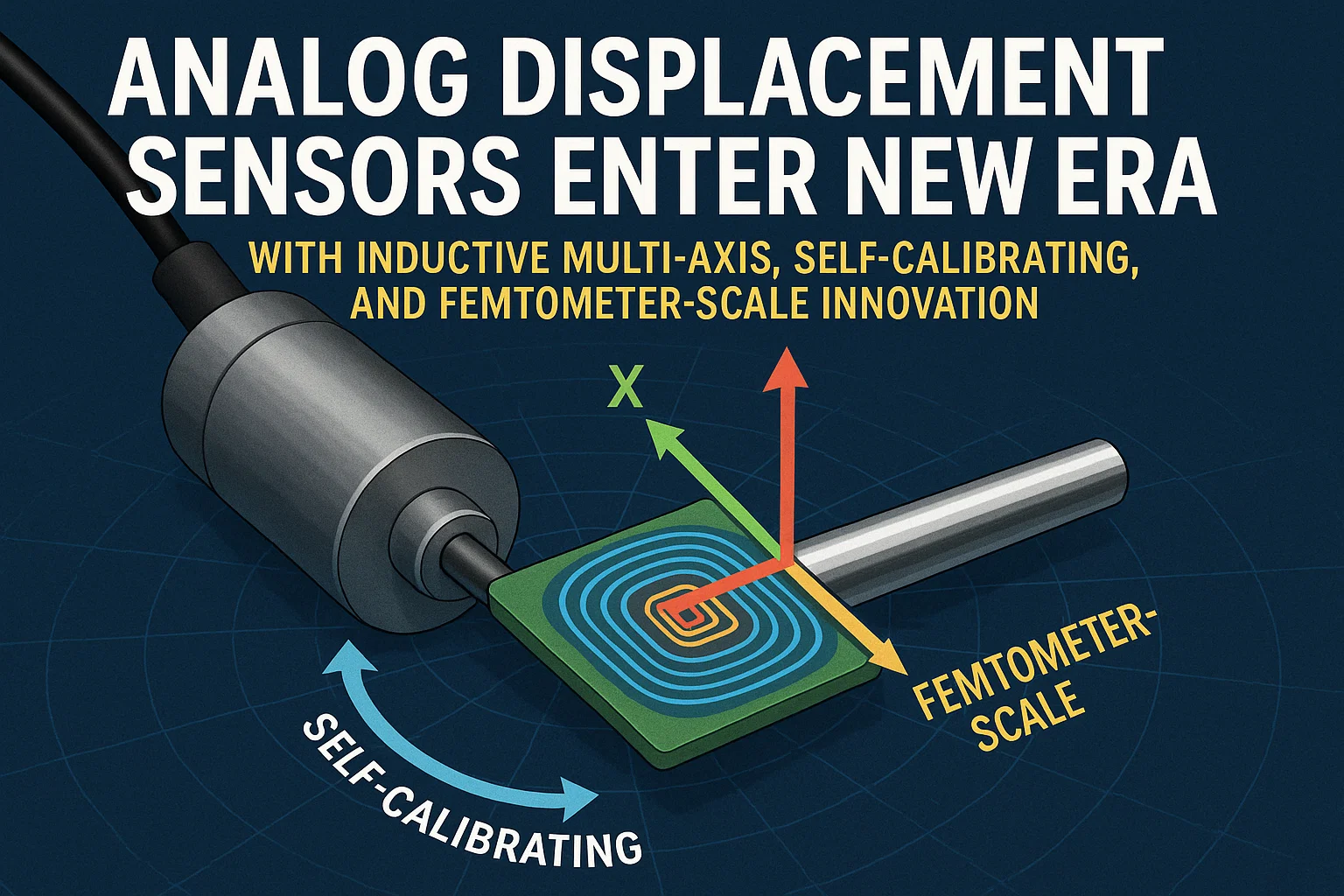
Analog Displacement Sensors Enter New Era with Inductive Multi-Axis, Self-Calibrating, and Femtometer-Scale Innovations
In the modern industrial landscape, precision has become the backbone of innovation. Whether it’s robotic automation in factories, high-speed trains, advanced manufacturing systems, or cutting-edge scientific research, the ability to measure movement with accuracy and reliability is non-negotiable. This is where analog displacement sensors play a critical role. These sensors, designed to detect and measure linear or angular displacement, are increasingly being enhanced with new technologies such as inductive sensing, cavity-based interferometry, and advanced calibration methods.
The global Analog Displacement Sensor Market reflects this growing demand. Valued at US$ 567 million in 2024, the industry is expected to grow to US$ 892 million by 2032, expanding at a CAGR of 6.8% during 2025–2032. The growth is driven not only by industrial adoption but also by rapid technological progress that is reshaping what displacement sensors can achieve.
Access Your Free Sample Report- Analog Displacement Sensor Market
Understanding Analog Displacement Sensors
Analog displacement sensors are devices that measure movement or position and provide a continuous analog output proportional to the displacement. Unlike digital sensors, which give discrete values, analog sensors excel in applications where smooth, real-time monitoring of position is critical.
Core Applications:
- Industrial automation – controlling robotic arms, conveyors, CNC machines.
- Automotive engineering – measuring brake and suspension movement.
- Aerospace and defense – precision monitoring of actuator and control surfaces.
- Scientific research – ultra-fine displacement measurements in laboratories.
- Healthcare equipment – surgical robotics and imaging systems.
The continuous output of analog sensors makes them particularly valuable in applications requiring high responsiveness, accuracy, and reliability.
Market Outlook: Growth Drivers and Forecast
The analog displacement sensor market’s projected growth from US$ 567 million in 2024 to US$ 892 million in 2032 is supported by several factors:
- Automation in Manufacturing
Industries worldwide are adopting automation and robotics at unprecedented rates. Analog displacement sensors are indispensable in ensuring precise control and measurement within these systems.
- Advancements in Robotics
Collaborative robots (cobots) and industrial robots demand sensors that can deliver continuous feedback for safety and precision. High-resolution analog displacement sensors are filling this gap.
- Rising Demand for Precision Engineering
From semiconductor fabrication to aerospace, industries need displacement measurement accuracy at the micro and even nanometer scale.
- Scientific & Research Applications
Research institutions are exploring advanced analog displacement sensors for applications like interferometry, quantum physics experiments, and nano-positioning systems.
- Cost Efficiency & Reliability
Analog sensors, with fewer complex electronics compared to some digital counterparts, remain cost-effective and robust, making them attractive for industries where ruggedness is vital.
Recent Developments in Analog Displacement Sensors
- Novel Inductive 6-Axis Force/Torque Sensor
A cutting-edge development introduced a non-contact inductive sensor capable of measuring six degrees of freedom in force and torque applications. Unlike conventional sensors that rely on strain gauges, this new design leverages changes in inductance due to displacement of a conductive target.
Key features:
- Integrated signal processing via CAN-FD on the PCB.
- Data acquisition rates of up to 4 kHz.
- High resolution of 0.03 N and quantization levels above 55,000.
- Low crosstalk, high sensitivity, and superior repeatability.
Implications:
This development significantly boosts the utility of analog displacement sensors in robotics, especially for precision tasks such as surgical robots, aerospace engineering, and industrial automation where multi-axis measurements are critical.
Download Sample Report PDF- Analog Displacement Sensor Market
- Self-Calibrating Analog Hall Sensors
One of the limitations of traditional displacement sensors has been calibration requirements. Recent innovations in self-calibrating analog Hall effect sensors are addressing this challenge.
Researchers introduced a data-driven calibration method that eliminates the need for external encoders. By collecting closed-loop data and applying nonlinear system identification, the method drastically reduces errors caused by manufacturing variances.
Outcomes:
- Achieved a 2.6x reduction in root-mean-square error.
- Enabled Hall sensors to approach sensor-noise-level accuracy in rotor-angle measurement.
Industry relevance:
This breakthrough has major implications for automotive systems (e.g., EV motors), robotics, and industrial machinery, reducing reliance on costly external calibration tools.
- Heterodyne Cavity-Tracking for Ultra-Precision Measurement
In scientific metrology, displacement sensors are being pushed to unimaginable levels of precision. Researchers developed a cavity-based interferometry system capable of measuring displacements at the femtometer (10⁻¹⁵ m) scale.
Performance benchmarks:
- Sensitivity of 260 fm/√Hz at 1 Hz.
- Around 46 fm/√Hz at 130 Hz.
- Dynamic range spanning six orders of magnitude, up to 0.15 μm motion.
Impact:
While still largely confined to research environments, this technology demonstrates the potential of analog displacement sensors in quantum computing, optics research, and nanoscale engineering.
Industry Insights: Trends Driving Adoption
The recent innovations highlight broader trends shaping the analog displacement sensor industry:
- Integration with Smart Electronics
New designs integrate signal processing, calibration algorithms, and connectivity protocols (like CAN-FD, EtherCAT, or IoT interfaces) directly on the sensor PCB.
- Miniaturization & Compact Form Factors
With growing demand for lightweight, compact devices in aerospace, automotive, and medical robotics, analog displacement sensors are becoming smaller yet more powerful.
- Shift Toward Non-Contact Sensing
Inductive and interferometric methods reduce wear, increase reliability, and allow deployment in harsh industrial conditions where mechanical contact would cause rapid degradation.
- Cross-Industry Applications
While originally tied to manufacturing, analog displacement sensors now serve in healthcare (surgical robotics), defense (targeting systems), transportation (railway monitoring), and research (nano-displacement).
Challenges in the Analog Displacement Sensor Market
Despite promising growth, the industry faces certain challenges:
- Competition from Digital Sensors – Digital displacement sensors offer data compatibility advantages with modern systems, forcing analog solutions to innovate continuously.
- Calibration Complexity – Even with self-calibrating approaches, ensuring accuracy across different environments remains a challenge.
- Environmental Sensitivity – Factors like temperature, humidity, and electromagnetic interference can affect sensor accuracy.
- Cost Pressure – As industries demand both precision and affordability, manufacturers must balance advanced R&D with cost-effective production.
Opportunities Ahead
The forecasted CAGR of 6.8% reflects the strong opportunity pipeline for analog displacement sensors. Key opportunities include:
- Robotics and Automation: Growth in cobots, automated factories, and autonomous vehicles.
- Healthcare and Surgical Robotics: Precision measurement in minimally invasive surgery.
- Aerospace and Defense: Deployment in satellites, navigation, and guidance systems.
- Research and Quantum Applications: Ultra-fine displacement measurement for advanced metrology.
- Green Energy Systems: Monitoring displacement in wind turbines, hydro systems, and EV components.
Future Outlook: Toward Smarter, More Precise Analog Sensors
Looking ahead, the analog displacement sensor industry will likely evolve in three main directions:
- Hybrid Analog-Digital Systems – Combining the smooth real-time output of analog sensors with the processing power and connectivity of digital systems.
- AI-Driven Calibration & Compensation – Using machine learning to continuously optimize sensor accuracy in real-time environments.
- Extreme Precision Expansion – Leveraging technologies like heterodyne interferometry to push displacement measurement to sub-atomic scales for high-end scientific use.
Click Here To Download Full Sample Report- Analog Displacement Sensor Market
The analog displacement sensor market is at a pivotal moment. With its size expected to grow from US$ 567 million in 2024 to US$ 892 million by 2032, the sector is driven by automation, robotics, aerospace, healthcare, and advanced research applications.
Recent innovations—such as inductive multi-axis sensing, self-calibrating Hall effect sensors, and femtometer-level cavity interferometry—are not only enhancing precision but also expanding the industry’s relevance across multiple fields.
As industries continue to demand higher accuracy, reliability, and compact form factors, analog displacement sensors are poised to remain a vital component in the global technology ecosystem, bridging the gap between physical motion and intelligent control systems.

Comments (0)