
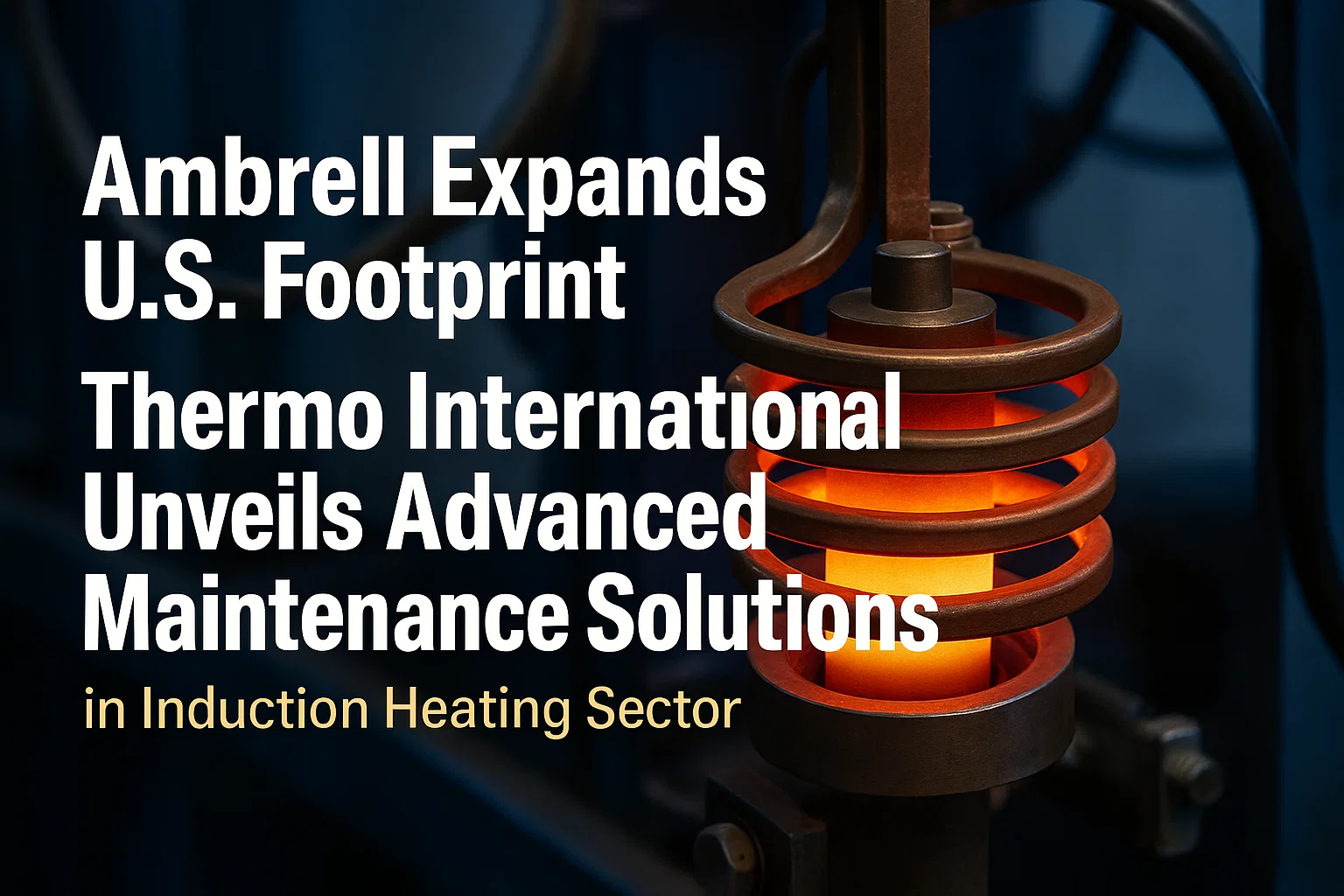
Ambrell Expands U.S. Footprint and Thermo International Unveils Advanced Maintenance Solutions in Induction Heating Sector
The electromagnetic induction heating industry is undergoing a significant transformation driven by cutting-edge innovations, sustainability imperatives, and the integration of digital technologies. As industries seek energy-efficient, precise, and environmentally friendly heating solutions, induction heaters are emerging as a game-changer in sectors ranging from automotive and aerospace to manufacturing, pharmaceuticals, and renewable energy.
According to recent estimates, the global electromagnetic induction heater market was valued at US$ 4.23 billion in 2024 and is projected to reach US$ 7.89 billion by 2032, registering a compound annual growth rate (CAGR) of 9.3% during the forecast period of 2025–2032. This surge underscores the increasing adoption of induction technology for industrial heating applications as businesses aim to optimize performance, cut operational costs, and reduce their carbon footprint.
Access Your Free Sample Report- Electromagnetic Induction Heater Market
1. Understanding Electromagnetic Induction Heating: Why It Matters
Electromagnetic induction heating works by generating heat through electromagnetic induction—an alternating current flows through a coil, creating a magnetic field that induces eddy currents in the conductive material, heating it internally. Unlike traditional methods like gas or resistance heating, induction delivers:
- Rapid, uniform heating without direct contact
- High energy efficiency, reducing energy waste by up to 30–50%
- Enhanced safety by eliminating open flames
- Precision control for critical industrial applications
As industries push for Industry 4.0 compliance and sustainable manufacturing, these advantages make induction heating a preferred choice over conventional technologies.
2. Recent Developments in the Electromagnetic Induction Heater Industry
The past two years have seen numerous strategic moves by industry leaders, product launches, and advancements aimed at enhancing performance, efficiency, and accessibility. Below are the key developments:
2.1 Ambrell’s West Coast Expansion for Better Customer Access
Ambrell Corporation, a prominent name in induction heating solutions and part of inTEST Corporation, announced the launch of a new applications laboratory in Fremont, California. This facility complements its existing labs in Rochester, New York, and Hengelo, Netherlands, offering:
- Hands-on demonstrations
- Customer part testing and validation
- Direct technical consultations
This expansion is particularly significant for clients in Western U.S. manufacturing hubs, providing localized support for industries including aerospace, electronics, and medical devices.
2.2 Steel Dynamics Adds a 3-MW Induction Furnace
Another notable development is from Steel Dynamics, which installed a 3-megawatt induction furnace at its Columbia City, Indiana rolling mill. The move is part of a broader modernization project to:
- Enhance heating efficiency
- Reduce reliance on fossil fuels
- Support large-scale, high-precision metal processing
This reflects a growing trend where major steel manufacturers integrate induction technology for sustainability and performance improvements.
2.3 Thermo International Introduces Advanced Maintenance Tools
Thermo International, in July 2024, rolled out advanced induction heating systems designed for non-contact maintenance applications, especially in power plants. Key applications include:
- Turbine bolt removal
- Boiler tube repairs
These systems allow maintenance teams to achieve precise, controlled heating without damaging surrounding components—critical in energy and utility sectors where downtime is costly.
2.4 Ambrell Launches EKOHEAT® 2 Series
In December 2023, Ambrell introduced its EKOHEAT® 2 induction heating system series, which incorporates:
- Next-gen semiconductor technology
- Enhanced internal monitoring
- High-performance power electronics
These improvements translate into higher efficiency, better process repeatability, and expanded application flexibility for sectors such as automotive, aerospace, and electronics manufacturing.
Download Sample Report PDF- Electromagnetic Induction Heater Market
3. Technological Innovations Shaping the Industry
The electromagnetic induction heater market is not just expanding; it is evolving with smart technology integration, portability, and hybrid systems. Below are the major innovations:
3.1 Silicon Carbide (SiC) Power Modules for Efficiency
Manufacturers are increasingly adopting SiC-based inverter modules, which:
- Improve efficiency by approximately 8%
- Reduce weight by nearly 20%
- Operate at higher switching frequencies, making systems more compact and responsive
This technology is essential for high-precision sectors like aerospace and electronics.
3.2 AI-Driven Digital Control Systems
The integration of AI and IoT in induction heating systems enables:
- Real-time thermal profiling
- Predictive maintenance
- Improved repeatability and energy optimization
Digital controls are particularly useful in automated production lines, aligning with Industry 4.0 standards.
3.3 Portable and Battery-Powered Induction Units
Portable systems, including battery-operated induction heaters, are gaining traction for:
- On-site repairs in construction, aerospace, and oil & gas
- Reduced downtime with quick-change coil assemblies
- Enhanced field mobility and ergonomic designs
3.4 Hybrid Heating Systems
Combining induction heating with infrared or convection systems allows:
- Faster heating cycles
- Improved surface finish
- Greater process versatility for complex industrial tasks
3.5 Air-Cooled Systems for Cost Efficiency
Companies like Hitfar Group are focusing on air-cooled induction heating systems, eliminating water cooling requirements, thereby:
- Lowering installation costs
- Simplifying maintenance
- Reducing water consumption, aligning with sustainability goals
4. Market Size, Growth, and Regional Insights
The electromagnetic induction heater market, valued at US$ 4.23 billion in 2024, is expected to grow to US$ 7.89 billion by 2032, at a CAGR of 9.3%.
4.1 Regional Breakdown
- Asia-Pacific (APAC) dominates the market with a 42% share, driven by rapid industrialization, robust automotive production, and the presence of large manufacturing bases.
- North America accounts for around 25%, supported by technology adoption and investments in smart manufacturing.
- Europe holds 22%, focusing on green technology integration and energy-efficient industrial solutions.
4.2 Sector-Wise Growth
- Automotive Industry: Demand for induction brazing, hardening, and shrink-fitting components.
- Aerospace: High adoption for precision heating and material stress testing.
- Pharmaceutical Industry: Fastest-growing sector, requiring sterile and controlled heating environments.
- Renewable Energy: Used in wind turbine assembly and solar panel manufacturing.
5. Key Market Drivers
- Energy Efficiency Mandates: Industries seek solutions that cut energy consumption and emissions.
- Industry 4.0: Push toward smart, automated, and data-driven manufacturing.
- Rising Labor Costs: Automation-friendly induction systems reduce dependence on manual heating processes.
- Sustainability Goals: Induction systems reduce carbon footprint by up to 50% compared to fossil-fuel-based heating.
6. Challenges Hindering Market Growth
Despite strong momentum, the industry faces challenges:
- High Initial Cost: Capital investment for advanced induction systems remains significant.
- Integration Complexity: Retrofitting induction heaters into existing production lines requires skilled technicians.
- Awareness Gap: Many small and mid-sized enterprises are still unaware of the long-term benefits.
7. Future Outlook: What to Expect by 2032
The future of the electromagnetic induction heater industry is promising, characterized by:
- Smarter, Connected Systems: Full integration with predictive analytics and cloud-based monitoring.
- Increased Portability: Ultra-light, battery-powered models for diverse industrial and field applications.
- Hybrid Heating Solutions: Combining induction with laser, infrared, or microwave
- Green Manufacturing Compliance: Induction heating as a core enabler of low-carbon production.
- Regional Diversification: Emerging economies in South America and Africa will join mainstream adoption.
Click Here To Download Full Sample Report- Electromagnetic Induction Heater Market
8. Key Players Driving Innovation
- Ambrell Corporation
- Radyne Corporation
- Thermo International
- Chengdu Duolin Electric Co.
- Magneforce Inc.
- Hitfar Group
- JKZ Induction Heating
Each of these companies is pushing the envelope with custom solutions, smart control systems, and sustainable designs.
The electromagnetic induction heater industry is on a strong growth trajectory, fueled by technological innovations, energy efficiency mandates, and green manufacturing trends. As global industrial ecosystems evolve, induction heating will play a pivotal role in reshaping manufacturing processes, reducing operational costs, and meeting sustainability goals.
With the market projected to nearly double in size by 2032, stakeholders who invest early in smart induction solutions stand to gain a competitive advantage in an increasingly digital and eco-conscious industrial landscape.

Comments (0)