

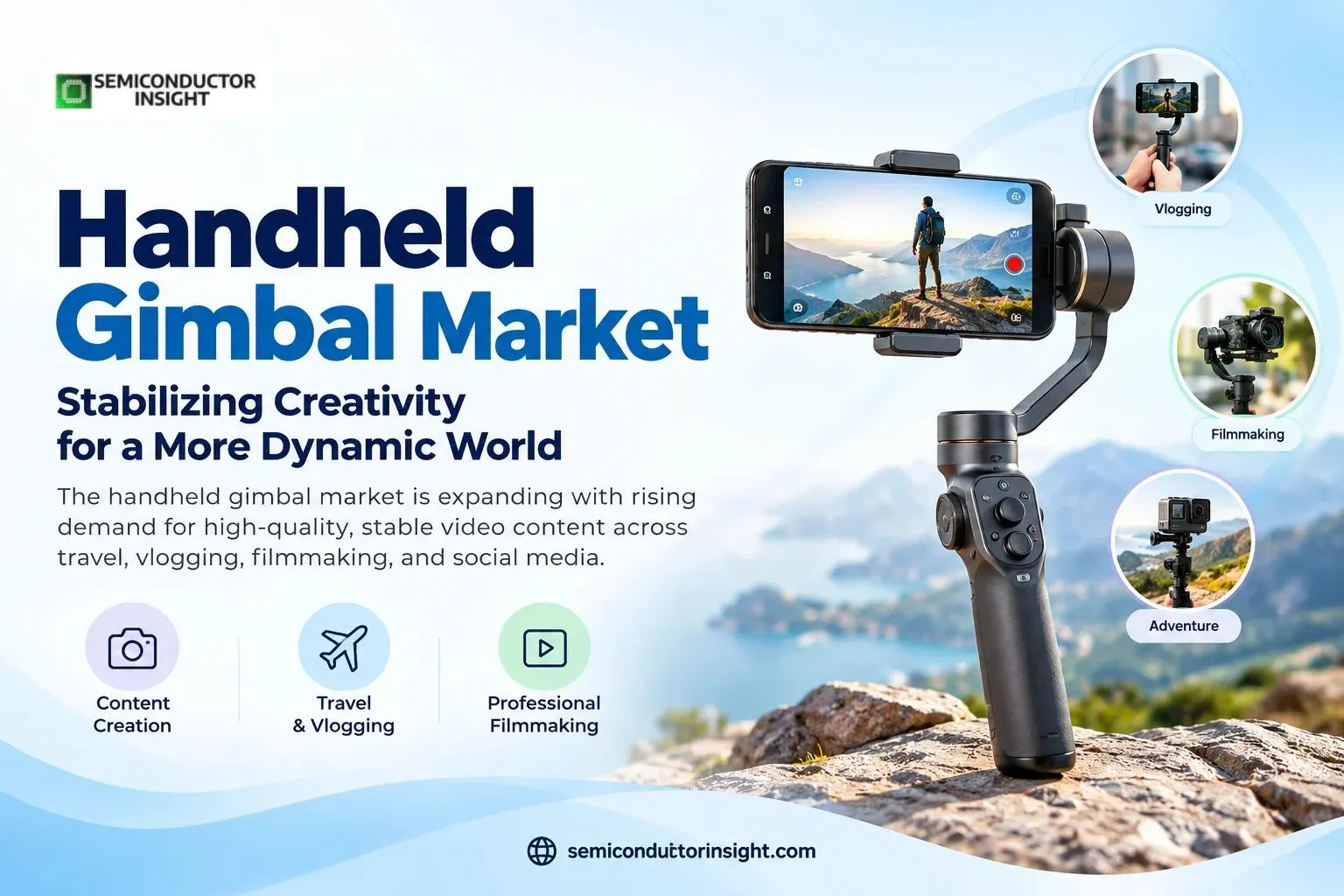
AI Tracking Meets Mobile Filmmaking as Handheld Gimbal Market Enters a New Phase
A handheld gimbal used to have one obvious job: keep a camera steady while the person holding it walks, pans or follows a subject. That definition is becoming outdated. The newest generation of smartphone gimbals is moving into tracking, composition, remote monitoring, lighting and even semi-automated filming.
That change matters because the smartphone has effectively become a production camera for millions of creators. The accessory attached to it is now being designed less like a mechanical stabilizer and more like an intelligent filming assistant.
- TikTok’s 2026 trend forecast, for example, points toward audiences seeking more authentic stories, behind-the-scenes moments and real-world creator experiences rather than heavily polished content.
- That type of content often requires creators to film themselves while moving, working or interacting with their surroundings.
2026 Brings a New Generation of AI Gimbals
The most visible change is the integration of AI directly into the filming hardware.
Hohem’s iSteady M7 combines a detachable 1.4-inch touchscreen remote, on-device AI tracking, a built-in extension pole and a 500-gram smartphone payload. Its tracking system can recognize people as well as objects such as pets, buildings and vehicles.
The product can also track a subject while the operator performs dynamic movements, reducing the need for another person behind the camera. Hohem specifies 360-degree infinite pan rotation and a 325-degree tilt range, showing how the category is expanding beyond basic three-axis stabilization.
DJI Is Turning the Smartphone Gimbal into a Connected Camera System
DJI’s Osmo Mobile 8 illustrates another direction: deeper integration between the gimbal, smartphone and software.
- The device supports 360-degree unlimited pan rotation, an integrated extension rod and native-camera tracking through compatible functionality. DJI says its DockKit integration enables intelligent tracking across more than 200 iOS applications.
- The hardware itself weighs approximately 370 grams with the built-in tripod, magnetic clamp and multifunctional module, while DJI specifies approximately 10 hours of operating time under its stated test conditions.
The important development is not simply the specification sheet. It is the move toward making tracking available inside the applications creators already use.
You can freely browse our most recent updated report to learn more about it before scrolling further: https://semiconductorinsight.com/report/handheld-gimbal-market/
Insta360 Is Pushing Tracking beyond a Single Person
Insta360’s Flow 2 Pro takes another route through software-heavy intelligence. The company highlights Apple DockKit integration, Deep Track 4.0, active zoom tracking, multi-person tracking and 360-degree pan tracking.
That matters for creators who are no longer producing only talking-head videos. A single person can now move between locations, demonstrate a product, record a fitness routine or create travel footage while allowing the gimbal to maintain framing.
The category is consequently moving toward a simple proposition:
Person moves → AI identifies subject → gimbal maintains composition → creator concentrates on performance
Battery Life Is Becoming a Production Specification
Battery endurance is another area where current products reveal the changing use case.
Hohem rates the iSteady M7 for approximately 12 hours under balanced, stationary conditions. With AI tracking, the company’s stated runtime is around 8 hours, falling to roughly 3–4 hours when AI tracking and maximum fill-light brightness are used together.
That distinction is important. Gimbals are increasingly expected to support longer creator sessions rather than a few short clips. Reverse charging, integrated lighting and extension rods are therefore becoming part of the overall filming workflow.
The New Gimbal Is Becoming a One-Person Production Kit
The most interesting evolution can be seen by comparing what creators previously carried with what manufacturers are integrating into one device.
Earlier workflow
Smartphone → tripod → separate light → manual framing → second person for tracking
Emerging workflow
Smartphone → gimbal → AI tracking → integrated light → extension pole → remote preview
Hohem’s M7, for instance, combines AI tracking, RGB and CCT lighting, remote preview, an extension pole and reverse charging in one system. hohem.com
This convergence could be particularly relevant to travel creators, livestreamers, fitness instructors, educators, product demonstrators and small businesses producing their own marketing material.
From “Steady” to “Follow Me”
The defining question for Handheld Gimbal Market is gradually changing.
Earlier buyers asked: “How smooth can this gimbal make my footage?”
Today’s buyers increasingly ask: “Can this gimbal keep me in the frame without another person operating the camera?”
That is a much broader proposition.
AI tracking, native-camera compatibility, multi-person recognition, remote monitoring and automated composition are turning handheld gimbals into active participants in the filming process. DJI, Insta360 and Hohem are already demonstrating different approaches to that transition.
Why the Next Battle Will Be About Intelligence?
Mechanical stabilization is becoming increasingly mature. The more interesting differentiation is now happening in software, tracking accuracy, app compatibility, subject recognition, camera control and how naturally the device fits into a creator’s workflow.
Handheld Gimbal Market is therefore entering a different chapter. The product is no longer competing only with another stabilizer. It is increasingly competing with the need for a camera operator, tripod, tracking system and basic lighting setup.
That makes the next generation of gimbals less about simply eliminating camera shake and more about giving one person the ability to produce footage that previously required a small production crew.

Comments (0)