

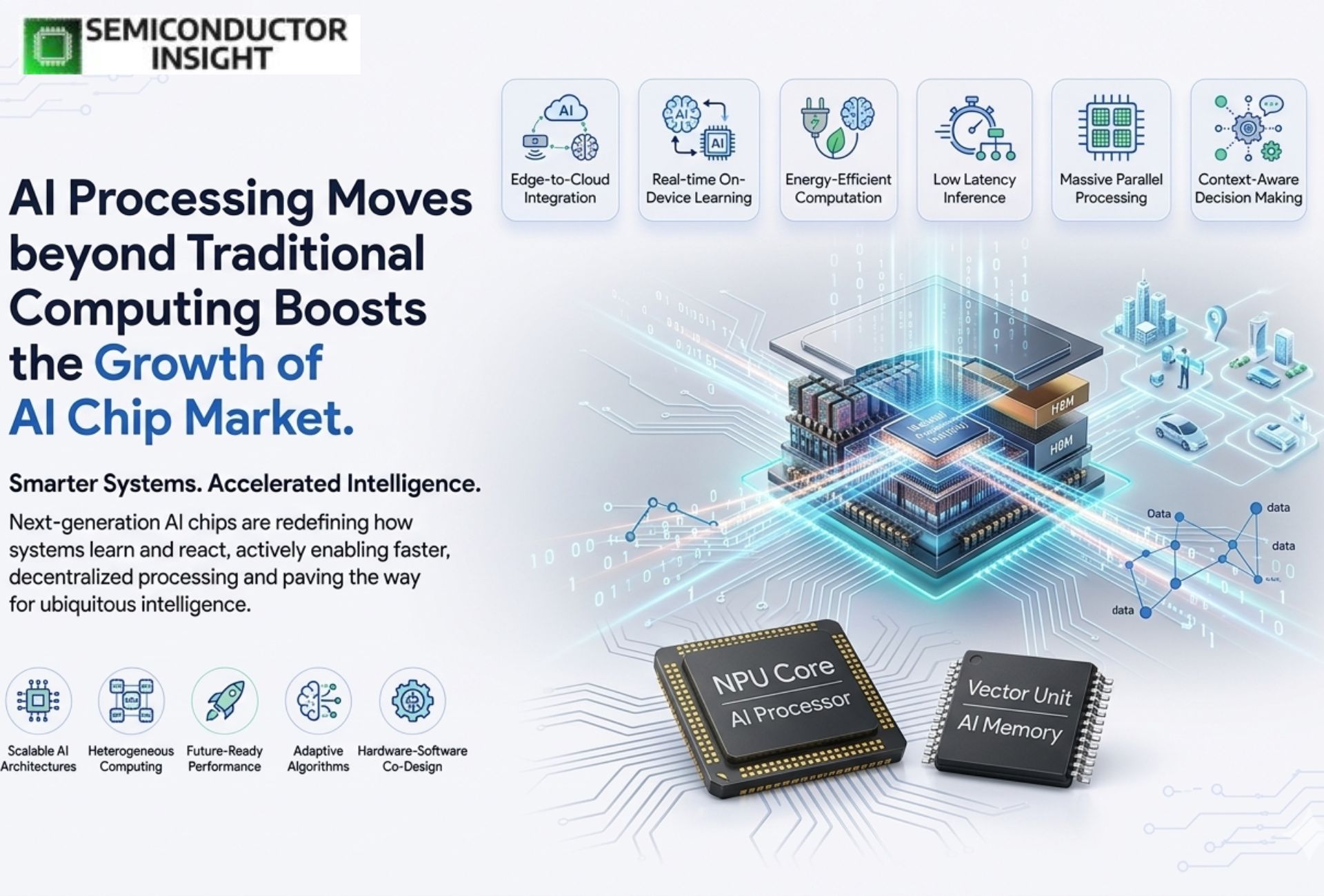
AI Processing Moves beyond Traditional Computing Boosts the Growth of AI Chip Market
Artificial intelligence is no longer dependent on standard processors built for general computing. Modern AI workloads demand specialized semiconductor architectures capable of handling billions of parallel calculations in real time. This shift has pushed AI chips into the spotlight across industries ranging from cloud computing and healthcare to defence and automotive systems.
The growing popularity of generative AI platforms, multimodal models, and intelligent automation tools has dramatically increased the need for advanced processors. Companies are now racing to develop chips optimized for machine learning inference, AI training, neural processing, and edge intelligence.
- According to data published by the International Energy Agency and semiconductor industry reports, large AI data centres can consume electricity equivalent to small cities, highlighting the enormous processing scale required for modern AI systems.
- Training advanced language models now involves thousands of interconnected GPUs operating continuously for weeks.
Latest Innovations & Development:
- In January 2026; NVIDIA today kick-started the next generation of AI with the launch of the NVIDIA Rubin platform, comprising six new chips designed to deliver one incredible AI supercomputer. NVIDIA Rubin sets a new standard for building, deploying and securing the world’s largest and most advanced AI systems at the lowest cost to accelerate mainstream AI adoption.
- In February 2026; Cadence announced a transformative step forward in redefining how semiconductors are designed with the launch of the ChipStack AI Super-Agent an agentic AI solution for front-end silicon design and verification. The Cadence ChipStack AI Super-Agent is the world’s first agentic workflow for automating chip design and verification. It provides up to 10X productivity improvements for coding designs and testbenches, creating test plans, orchestrating regression testing, debugging and automatically fixing issues.
- In April 2026; Google is dedicating a chip to running artificial intelligence models, and a separate processor to training models. Amazon is pursuing a similar strategy, as both companies take on Nvidia by offering custom-built silicon as an alternative to graphics processing units. Google’s new chip comes with ample static random access memory, like a forthcoming chip from Nvidia.
Explore the full relevant report details in our recently refreshed edition anytime: https://semiconductorinsight.com/report/cloud-ai-chip-market/
Hyperscaler ASIC Race Intensifies as Major Buyers Turn Chip Designers
Major cloud and AI buyers are rapidly taking on the job of chip designers as a result of the hyperscaler ASIC race, which is changing the AI hardware landscape. Anthropic has already committed one million units, Midjourney has lowered its compute expenditure from $2.1 million to $700,000 per month using TPU v6e, and Google is developing its TPU v7 Ironwood, which offers 10x inference performance over the previous generation.
With more than 500,000 Trainium 2 deployments, 2.52 PetaFLOPS FP8 performance, and a purported 30-40% higher price-performance ratio than GPUs, Amazon Web Services is moving forward with Trainium 3, which is based on 3nm technology. Trainium 4 is also under development.
Microsoft Azure has also entered the custom chip race with Maia 200, launched in January 2026, featuring over 140 billion transistors, TSMC’s 3nm process, a 750W TDP, and 3x FP4 performance of Trainium 3, powering GPT-5.2 and Copilot in the US Central region.
OpenAI, in partnership with Broadcom, is developing a custom ASIC expected in Q3 2026 as part of a $10 billion collaboration. The program, led by around 40 engineers including former Alphabet talent, is focused on inference workloads and is planned for TSMC fabrication, though the timeline has slipped from Q2 2026.
Data Centres Become the New Battleground
- AI infrastructure investments are transforming hyper scale data centres into highly specialized computing environments. In 2025, several global technology companies announced multi-billion-dollar expansions focused entirely on AI-ready facilities.
- Companies like NVIDIA, Advanced Micro Devices, and Intel are aggressively expanding AI accelerator production as cloud providers compete to build faster AI clusters.
- Recent estimates from authorized semiconductor associations show that high-bandwidth memory demand surged significantly due to AI server deployments. Modern AI accelerators now integrate advanced packaging technologies, stacked memory architectures, and chiplet-based designs to overcome performance bottlenecks.
- One notable example is the growing deployment of AI supercomputers containing more than 100,000 GPUs interconnected through ultra-fast networking systems. These systems are being designed specifically for generative AI model training and scientific simulations.
Custom Silicon Gains Momentum across Industries
AI chip market is no longer limited to GPU manufacturers. Technology firms are increasingly designing custom AI processors tailored to their internal ecosystems.
Google continues expanding its Tensor Processing Unit ecosystem for AI workloads, while Amazon develops Trainium and Inferentia chips to reduce cloud AI operational costs. Meanwhile, Apple integrates neural engines into consumer devices to support on-device AI processing.
This transition toward custom silicon is changing the semiconductor supply chain. Foundries capable of producing advanced-node chips below 5 nanometers are experiencing unprecedented demand. Taiwan, South Korea, and the United States remain central hubs for advanced fabrication technologies supporting AI processor manufacturing.
Industry publications also report that advanced chip packaging capacity has become one of the most critical constraints in the semiconductor sector due to rising AI accelerator shipments.
Edge AI Opens a New Semiconductor Frontier
- While cloud AI receives most of the attention, edge AI is becoming one of the fastest-growing segments within the AI chip ecosystem. Smart cameras, industrial robots, autonomous drones, wearable devices, and automotive systems increasingly require localized AI processing without relying entirely on cloud connectivity.
- Automotive manufacturers are integrating AI chips into advanced driver assistance systems capable of processing real-time sensor data within milliseconds. Modern electric vehicles can now contain thousands of semiconductor components, with AI processors playing a major role in safety and autonomous navigation systems.
- Healthcare is another rapidly expanding area. AI chips are now being used in portable diagnostic devices, medical imaging systems, and smart monitoring platforms capable of analyzing patient data directly at the edge.
AI Chips Move toward Energy Efficient Intelligence
As AI models become larger, energy efficiency is emerging as one of the most important innovation areas in semiconductor development. Researchers are exploring neuromorphic computing, optical interconnects, and low-power AI accelerators capable of reducing energy consumption while maintaining high computational performance.
Several start-ups are now developing processors inspired by the human brain to improve efficiency in pattern recognition and real-time inference applications. This next phase of semiconductor innovation could redefine how AI systems operate across industries.
AI chip market is no longer just another semiconductor segment. It has evolved into the technological backbone of modern artificial intelligence infrastructure, shaping everything from cloud computing and robotics to healthcare and national digital strategies.

Comments (0)