

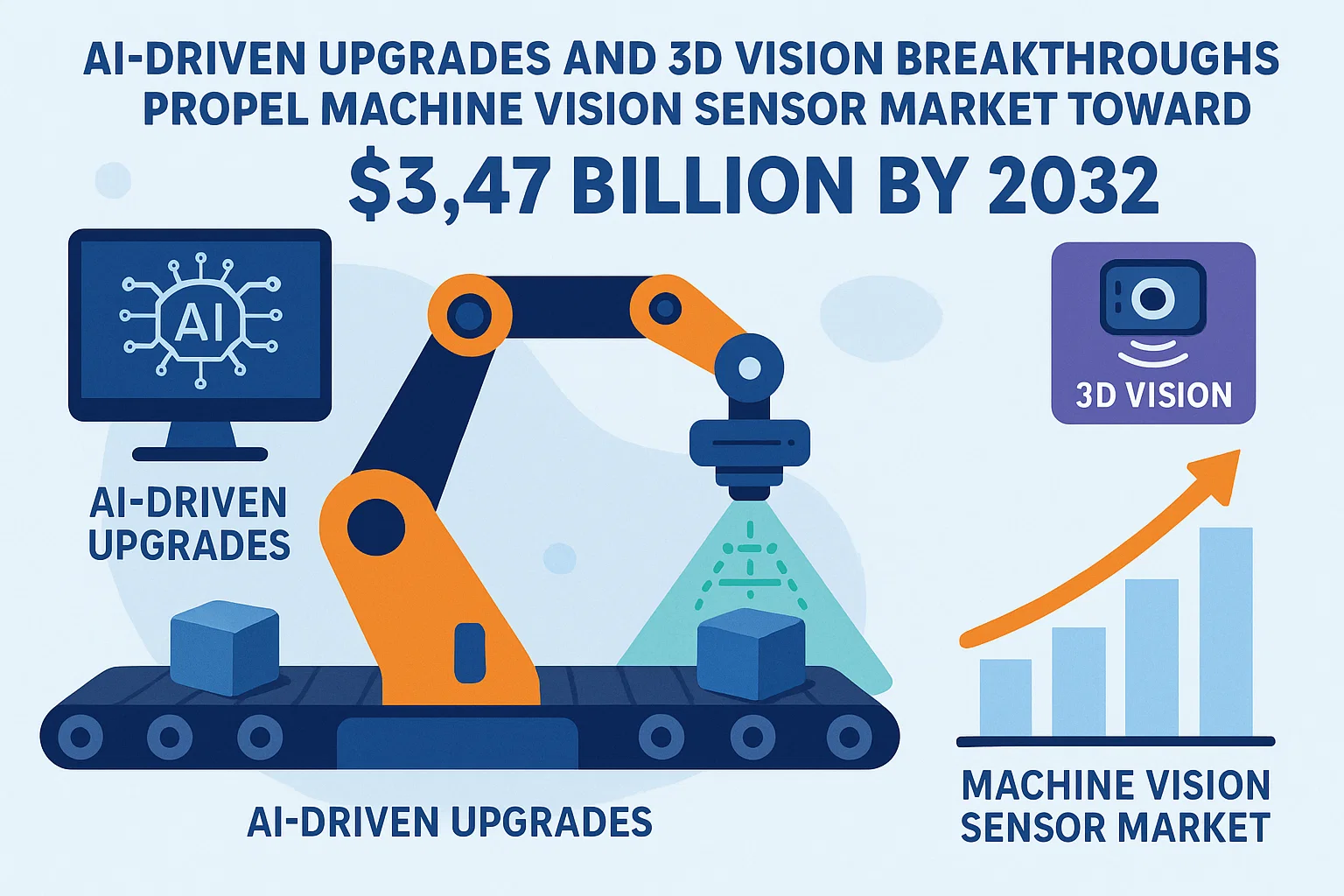
AI-Driven Upgrades and 3D Vision Breakthroughs Propel Machine Vision Sensor Market Toward $3.47 Billion by 2032
The global manufacturing and industrial sectors are undergoing a transformative shift, led in part by a powerful convergence of technologies such as artificial intelligence (AI), automation, and advanced imaging systems. At the heart of this shift lies the increasing adoption of machine vision sensors—devices that allow machines to see, interpret, and respond to visual data. As industries pivot towards greater efficiency and precision, machine vision sensors are becoming essential in quality control, robotics, autonomous systems, and smart manufacturing.
According to recent industry data, the Machine Vision Sensors Market was valued at US$ 1,940 million in 2024 and is projected to reach an impressive US$ 3,470 million by 2032, growing at a CAGR of 8.6% during the forecast period of 2025-2032. This exponential growth is fueled by technological advancements and increasing demand across sectors like automotive, pharmaceuticals, electronics, and logistics.
Access Your Free Sample Report- Machine Vision Sensors Market
The Rise of AI and Deep Learning in Vision Systems
In 2025, AI and deep learning are no longer futuristic concepts; they are integral to machine vision systems. Companies like Cognex and Zebra Technologies are leading the charge.
- Cognex’s OneVision Platform: Cognex has introduced OneVision, a cloud-based platform that empowers users to build, train, and deploy AI-based vision applications with minimal coding. This democratization of AI enables small and medium-sized enterprises (SMEs) to tap into high-end vision capabilities.
- Zebra Technologies’ Aurora Software Upgrade: Zebra’s enhanced Aurora vision software suite integrates new deep learning capabilities. This update allows users to detect defects and anomalies that traditional rule-based systems often miss.
These developments mark a paradigm shift from rule-based algorithms to systems that learn and adapt over time, offering higher accuracy and flexibility.
Cutting-Edge Sensor Hardware Innovations
Machine vision sensors are reaching new levels of resolution, sensitivity, and versatility:
- SVS-Vistek’s TEC-cooled SHR Cameras: These 151-megapixel cameras provide ultra-high-resolution imaging even in thermally unstable environments, crucial for semiconductor inspection and aerial imaging.
- XIMEA’s Sony IMX811 Integration: XIMEA’s latest medium-format cameras use the backside-illuminated Sony IMX811 sensor, offering exceptional low-light performance and image fidelity.
- MVTec HALCON 25.05: Scheduled for release in mid-2025, this hybrid machine vision software blends classic image processing with modern AI methods to enhance robotic bin-picking applications and complex visual inspections.
These innovations enable the capture of more detailed and accurate visual data, a cornerstone for precise automation.
The Emergence of 3D Vision and Time-of-Flight (ToF) Cameras
Depth sensing and 3D imaging are rapidly advancing, particularly in autonomous systems and warehouse automation.
- LUCID Vision Labs’ Helios 2 Narrow Camera: This compact 3D ToF camera offers a narrow field-of-view for focused depth sensing. It is ideal for applications requiring high spatial accuracy, such as robotic arm positioning and pick-and-place tasks.
- New Imaging Technologies’ SWIR Line-Scan Sensors: These sensors extend vision beyond the visible spectrum, enabling detailed inspection of transparent or reflective materials—a breakthrough for solar panel and pharmaceutical industries.
3D vision is no longer a niche; it’s becoming mainstream due to its effectiveness in handling irregular and complex shapes.
Download Sample Report PDF- Machine Vision Sensors Market
Cloud and Edge Integration: The Future is Distributed
The convergence of cloud computing and edge processing is creating intelligent, decentralized systems:
- MVTec and Siemens Partnership: Siemens has joined MVTec’s Technology Partner Program, aiming to streamline integration between industrial automation tools and machine vision software. This alliance is expected to accelerate adoption in smart factories.
- Mikrotron’s MotionBLITZ Quad1.1S: Designed for high-speed industrial environments, this GigE-based camera system provides real-time image capture and processing at the edge, reducing latency and improving decision-making speed.
These collaborations and technologies are making real-time processing a reality, thereby minimizing downtime and optimizing throughput.
Precision Optics and Illumination Technologies
Proper lighting and optics are crucial for high-quality image capture. Recent product releases are setting new benchmarks:
- Schneider-Kreuznach’s TOURMALINE Lens Series: These C-mount lenses cater to both long and short working distances, making them suitable for varying inspection setups without compromising image quality.
- Chromasens’ Combined Tube Light: Integrating three distinct lighting technologies into one system, this innovation simplifies complex inspection setups and enhances detection of surface defects.
- SmartRay’s JOSY Upgrade: This system revamp includes better terminals and controllers to support larger-scale weld inspection projects, especially in automotive manufacturing.
These developments ensure that even the finest defects and inconsistencies are caught before they affect product quality.
Industry-Specific Applications Driving Demand
Different sectors are pushing the limits of what machine vision can accomplish:
- Battery Inspection: SinceVision has introduced sensors that can precisely measure lithium battery electrode properties. Given the rise of electric vehicles (EVs), this development is vital for battery reliability and safety.
- Pharmaceuticals: Machine vision sensors are being used to inspect labels, packaging seals, and fill levels to meet stringent regulatory standards.
- Logistics and Warehousing: With the e-commerce boom, vision sensors are used in sorting, tracking, and automated guided vehicles (AGVs) to streamline operations.
- Electronics Manufacturing: High-resolution sensors and AI-enabled vision software now allow for micro-level PCB inspection, reducing defective units and returns.
These industry-tailored applications underscore the flexibility and adaptability of modern vision systems.
Market Drivers and Growth Enablers
Several factors are fueling the growth of the machine vision sensors market:
- Rising Demand for Quality Control: As product quality becomes a key differentiator, industries are investing more in vision sensors for consistent, real-time inspection.
- Labor Shortages: Automation through machine vision fills workforce gaps in critical roles, especially in high-precision environments.
- Government Regulations: Stricter compliance norms, especially in food and pharma sectors, are encouraging the use of vision systems.
- Industry 4.0 Adoption: The shift toward digital factories, driven by IoT and AI, makes machine vision an essential technology.
Challenges and Limitations
Despite rapid advancements, the industry faces certain bottlenecks:
- High Initial Investment: Advanced vision systems can be expensive, especially for SMEs.
- Integration Complexity: Aligning sensors with existing PLCs, robotics, and software platforms remains a technical challenge.
- Data Management: Handling and processing vast volumes of image data in real-time requires significant infrastructure.
However, these are gradually being addressed through modular hardware, open-source software, and scalable cloud platforms.
What’s on the Horizon?
Looking ahead, several trends are expected to further revolutionize the space:
- Hyper-Spectral Imaging: Capable of detecting material composition and chemical properties, hyperspectral sensors could open up new applications in agriculture and mining.
- Quantum Dots and Organic Sensors: Promising better sensitivity and lower power consumption, these sensors could redefine mobile and wearable machine vision.
- AI-on-Chip: Edge devices with embedded AI processors will enable autonomous decision-making without reliance on central servers.
- Collaborative Robots (Cobots): As machine vision becomes more intuitive, its integration with cobots will facilitate safer, smarter human-machine collaboration.
These innovations will usher in a new era of industrial intelligence.
Click Here To Download Full Sample Report- Machine Vision Sensors Market
The machine vision sensors industry is experiencing a dynamic transformation, propelled by advances in hardware, AI, optics, and integration technologies. From AI-driven defect detection to ultra-high-resolution cameras and intelligent lighting systems, every innovation is pushing the boundary of what machines can perceive and act upon.
With a market projected to grow from US$ 1,940 million in 2024 to US$ 3,470 million by 2032, at a CAGR of 8.6%, the future looks incredibly promising. Stakeholders in manufacturing, logistics, electronics, and beyond must stay agile and invest wisely to harness the full potential of machine vision sensors in the decade ahead.
In a world where speed, precision, and intelligence define success, machine vision sensors are not just tools—they are enablers of the future.

Comments (0)