
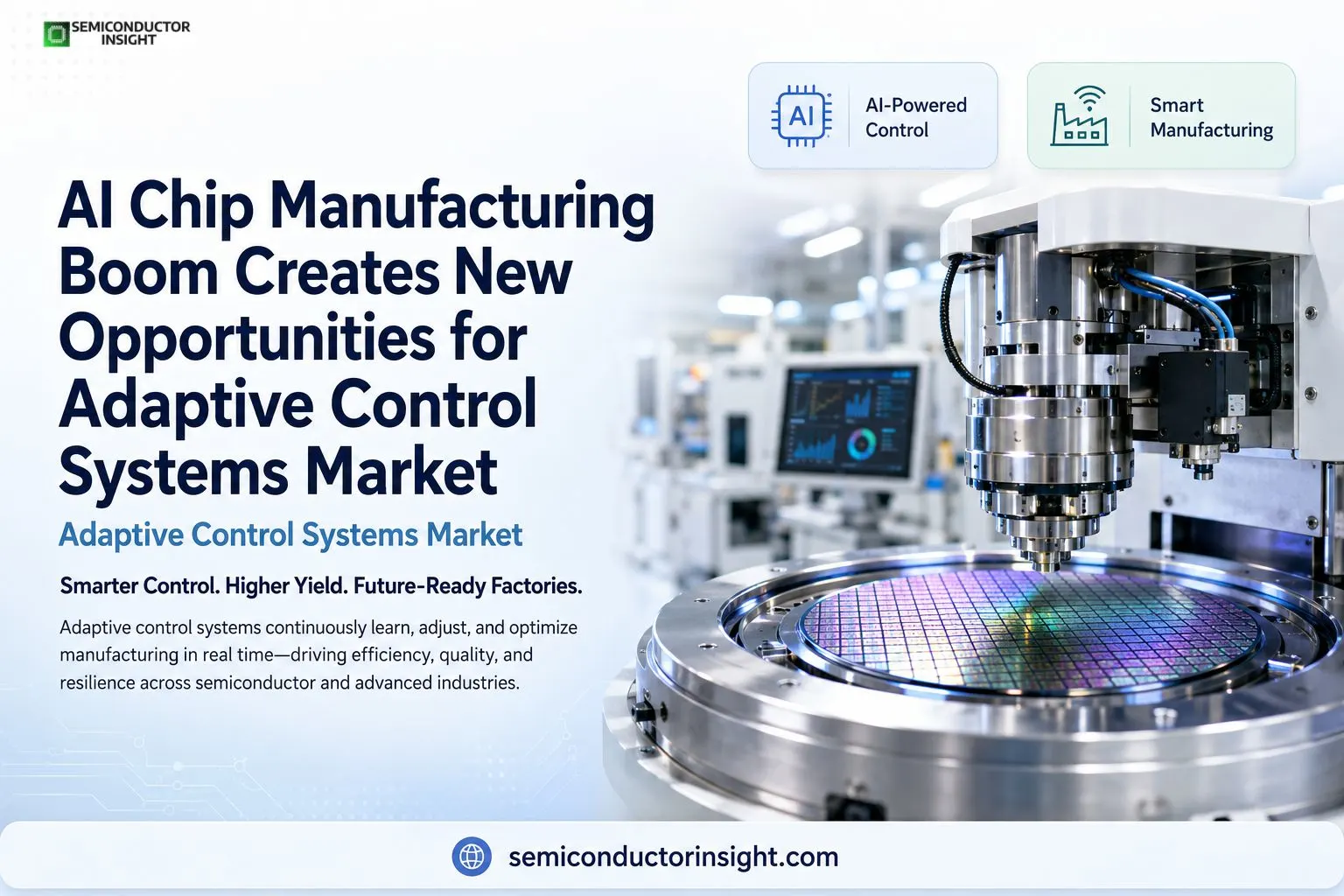
AI Chip Manufacturing Boom Creates New Opportunities for Adaptive Control Systems Market
Modern semiconductor factories process thousands of production variables every second. Adaptive control systems have emerged as a critical technology that continuously adjusts manufacturing conditions without requiring manual intervention. Unlike conventional automation, these systems learn from process data and optimize operations in real time.
According to industrial automation studies and manufacturing reports, adaptive control technologies are increasingly integrated into semiconductor wafer fabrication, robotics, aerospace manufacturing, renewable energy systems, and pharmaceutical production. The expansion of smart factories and Industry 4.0 initiatives has accelerated global adoption.
Adaptive Control Systems Market Snapshot
- In 2026, the market is estimated to be worth around USD 1.95 billion, reflecting strong momentum across key industrial sectors such as semiconductors, automotive, aerospace, and energy.
- This growth is being supported by large-scale smart factory investments, which now exceed USD 200 billion globally under active programs.
- Industrial robot installations also continue to rise, with more than 540,000 units deployed annually, while average process efficiency gains are estimated at 15 to 30%.
- This data is broadly aligned with industrial automation trends and government-backed digitalization initiatives.
Why Semiconductor Plants Need Adaptive Control?
Chip manufacturing involves hundreds of highly sensitive process steps, including lithography, plasma etching, and chemical deposition, wafer inspection, packaging, and testing. Even the smallest change in temperature, pressure, or vibration can influence chip yield and overall output quality. To maintain consistency, adaptive control systems continuously track these conditions and automatically correct any deviations in real time.
Smart Manufacturing Loop
Raw Sensor Data
↓
AI Analytics Engine
↓
Adaptive Decision Model
↓
Machine Parameter Adjustment
↓
Quality Verification
↓
Continuous Learning Cycle
This feedback process reduces material waste while improving throughput.
Five Companies Leading Adaptive Control Innovation
Strong skills in automation, control systems, and smart manufacturing are helping a number of large corporations shape this market. Honeywell concentrates on process optimisation platforms, while Siemens contributes knowledge in digital twins and industrial automation.
Schneider Electric focuses on smart factory energy management, Emerson provides cutting-edge process control systems, and ABB is well-known for robotics and intelligent manufacturing. These businesses are working together to create AI-integrated control solutions that are utilised in the industrial, semiconductor, and energy sectors.
The Semiconductor Connection Nobody Talks About
Adaptive control systems are becoming increasingly important because semiconductor manufacturing equipment itself is becoming more intelligent.
Recent developments include:
- Predictive maintenance for wafer fabrication equipment.
- AI driven defect detection.
- Self-calibrating robotic arms.
- Digital twin simulations for production optimization.
- Real time energy consumption balancing.
Large semiconductor fabrication facilities can process tens of thousands of wafers each month, making operational stability a major economic factor.
Real World Examples Shaping the Market
- Smart Factories
- Manufacturers are deploying adaptive robotic systems capable of adjusting production schedules based on supply chain conditions and machine availability.
- Electric Vehicle Production
- Battery manufacturing lines use adaptive process control to maintain coating thickness and improve product consistency.
- Semiconductor Fabrication
- Advanced fabs use machine learning algorithms to predict equipment drift before yield losses occur.
- Renewable Energy
- Wind turbine control systems automatically adapt blade angles according to changing wind conditions to maximize power generation.
New Technologies Expanding Market Opportunities
Several innovations are generating new demand for adaptive control systems across modern factories. Machine learning enables predictive optimization, while edge computing supports faster local decision-making.
Digital twins make virtual production testing possible, industrial IoT allows massive sensor integration, and collaborative robots add flexibility to manufacturing operations. Together, these technologies are helping factories become more autonomous, efficient, and responsive.
Investment Momentum across Global Industries
Several government initiatives are indirectly supporting adaptive control adoption.
- Semiconductor manufacturing expansion projects.
- Smart manufacturing incentives.
- Industrial digitalization programs.
- Clean energy infrastructure investments.
- National AI development strategies.
Manufacturing facilities are focusing not only on increasing production but also on improving sustainability by reducing waste and energy consumption.
What Makes Adaptive Control Different From Traditional Automation?
Traditional systems operate based on predefined rules, while adaptive systems continuously assess operating conditions and adjust their responses without requiring extensive manual programming. This makes them especially valuable in semiconductor manufacturing, where consistency and precision are critical.
Their key benefits include faster responses to unexpected events, lower downtime, better resource utilization, higher manufacturing precision, and reduced maintenance costs. As production demands become more complex, these capabilities are becoming increasingly important for maintaining product quality and operational efficiency.
Innovation Watch
Several developments could shape the Adaptive Control Systems Market over the next few years:
- AI powered semiconductor fabs.
- Autonomous industrial robotics.
- Self optimizing chemical processing plants.
- Quantum computing enabled process optimization.
- Edge AI controllers for real time manufacturing.
As global manufacturers pursue smarter and more resilient production systems, adaptive control technologies are moving from optional upgrades to essential infrastructure. Their growing role in semiconductor manufacturing, advanced robotics, and intelligent factories positions the Adaptive Control Systems Market as one of the most influential segments within the broader industrial automation ecosystem.

Comments (0)