
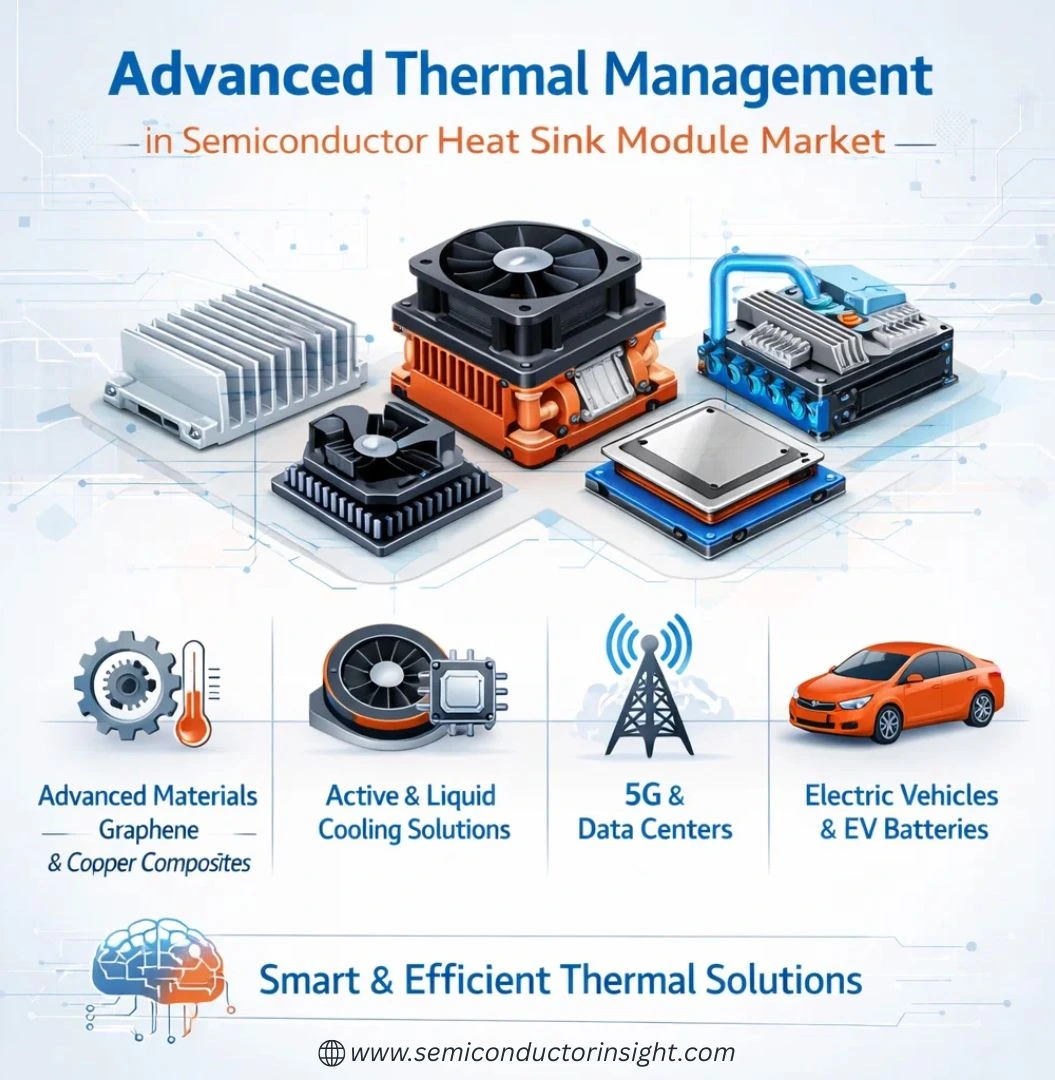
Advanced Thermal Management Solutions in Semiconductor Heat Sink Module Market
Silicon chips may be the brain of modern electronics, but thermal control is what keeps that intelligence alive. As semiconductor devices become smaller, faster, and more power-intensive, the demand for efficient heat dissipation is growing rapidly. This is where the heat sink module market emerges as a critical pillar of the semiconductor ecosystem, ensuring performance stability, device longevity, and operational efficiency across advanced electronic systems.
A heat sink module is an integrated thermal management solution designed to remove excess heat from semiconductor components and maintain safe operating temperatures. These modules typically combine heat sinks, heat pipes, vapor chambers, and cooling interfaces to deliver high-efficiency heat transfer in compact electronic environments. The growing complexity of high-performance chips, AI processors, and power electronics is accelerating innovation in thermal technologies, positioning heat sink modules as a strategic component in next-generation semiconductor development.
Material Innovations Transforming Heat Sink Module Design
Material science plays a defining role in the evolution of heat sink modules. Traditional designs primarily used aluminum and copper, which continue to dominate due to their high thermal conductivity and mechanical stability. Aluminum accounts for more than half of installations due to its lightweight and cost-efficient properties, while copper is preferred in high-performance applications for superior heat transfer capability.
Recent innovations are introducing graphene-enhanced materials, phase-change materials, and copper-graphite composites, offering improved thermal conductivity and reduced weight. These advanced materials enhance cooling efficiency while supporting the miniaturization of semiconductor devices.
Hybrid heat sink modules combining multiple materials are also gaining traction, providing a balance between performance, durability, and cost efficiency in complex electronic environments.
Primary Heat Sink Module Variants and Innovations
- Passive heat sink modules rely on natural heat dissipation through conduction and convection. These modules are widely used in consumer electronics and industrial devices where energy efficiency and silent operation are critical.
- Active cooling modules integrate fans or airflow mechanisms to enhance heat transfer, making them suitable for high-performance computing and data center applications. Active cooling solutions now account for a significant share of server thermal management systems due to their dynamic temperature control capabilities.
- Liquid-cooled modules represent an emerging technology designed for ultra-high heat environments. These systems utilize fluid-based cooling channels to manage extreme temperatures in advanced processors and power electronics.
- Vapor chamber heat sinks offer uniform heat distribution and are widely used in compact devices such as laptops and high-density electronics, supporting efficient heat spreading across limited surface areas.
Expanding Applications across Emerging Technologies
The growth of advanced digital infrastructure is significantly expanding the application scope of heat sink modules. The rapid deployment of 5G networks is generating higher heat levels in telecom equipment, creating strong demand for advanced cooling systems.
Similarly, the expansion of data centers and cloud computing infrastructure is driving large-scale adoption of heat sink modules to maintain system performance in high-density server environments. Data center construction alone accounts for a substantial share of cooling technology demand worldwide.
The automotive industry is also emerging as a major application area, particularly in electric vehicles, where heat sink modules manage temperature in battery systems and power electronics. Each electric vehicle integrates multiple heat sink components to support thermal stability and energy efficiency.
Industrial automation, robotics, and renewable energy systems further contribute to market expansion by requiring reliable thermal solutions for power control units and electronic modules.
Smart Cooling and AI Driven Thermal Solutions
The integration of digital intelligence into thermal management systems is reshaping the heat sink module landscape. Modern modules increasingly incorporate AI-based monitoring, adaptive cooling mechanisms, and predictive thermal analytics to optimize performance in real time.
Smart cooling technologies enable automatic temperature regulation based on workload conditions, improving energy efficiency and extending device lifespan. These systems also provide continuous monitoring capabilities that support preventive maintenance and operational reliability.
The shift toward intelligent thermal management reflects the broader digital transformation within semiconductor manufacturing and electronic system design.
At Last before Ending, Don’t Forget to Browse Our Recent Exclusive Report for Detailed Insights: https://semiconductorinsight.com/report/heat-sink-module-market/
And further, semiconductor heat sink module market stands at the intersection of thermal engineering, material innovation, and advanced electronics development. As semiconductor devices continue to evolve toward higher power density and compact design, efficient heat management becomes increasingly critical.
From advanced materials and intelligent cooling systems to specialized thermal modules for next-generation technologies, heat sink modules are shaping the future of semiconductor performance. Their expanding role across digital infrastructure, electric mobility, and industrial automation positions the market as a fundamental component of modern technological progress.

Comments (0)