
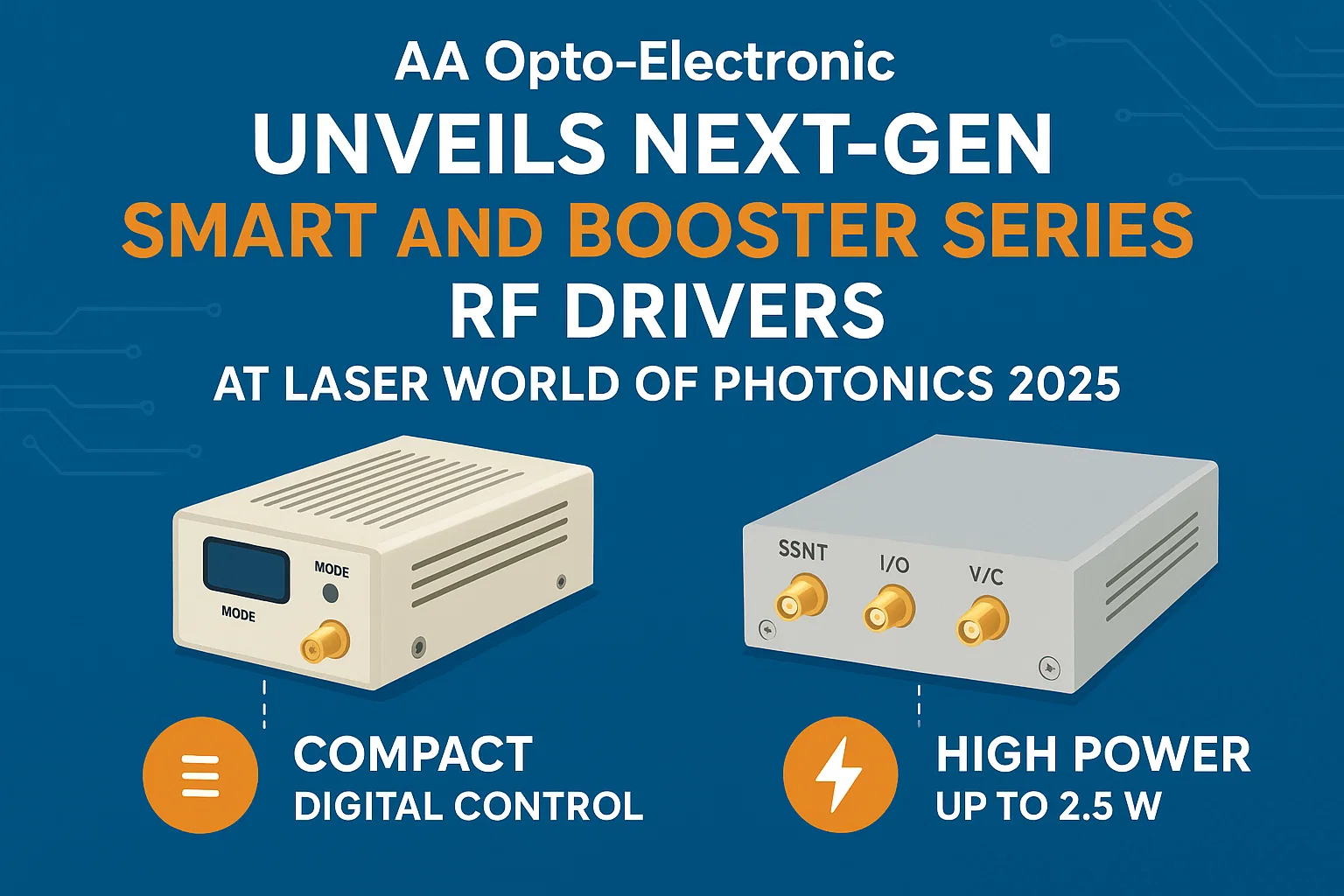
AA Opto-Electronic Unveils Next-Gen SMART and Booster Series RF Drivers at Laser World of Photonics 2025
In the high-stakes world of photonics and precision optics, acousto-optic (AO) devices stand at the heart of next-generation laser modulation, beam steering, and signal processing applications. Driving this revolution from behind the scenes are RF (radio frequency) drivers, the indispensable electronics responsible for energizing and precisely controlling AO devices.
As we move further into an era shaped by quantum computing, ultra-fast communication, and LiDAR-powered automation, the importance of RF drivers for acousto-optic systems is surging. Recent developments, both at the research and industrial levels, suggest that this segment is on the brink of a transformative evolution.
According to new market insights, the global RF Drivers for Acousto-Optic Device Market was valued at USD 45 million in 2024, and is projected to reach USD 58 million by 2032, growing at a CAGR of 3.6% over the forecast period (2025–2032). But behind this seemingly modest growth lies a wave of technological innovation, market diversification, and application-specific optimization.
Access Your Free Sample Report- RF Drivers for Acousto-Optic Device Market
This blog takes a deep dive into:
- The latest industry and research developments,
- Emerging product innovations,
- Market trends across key verticals,
- And strategic opportunities for stakeholders.
1. Understanding RF Drivers in Acousto-Optic Systems
Before diving into the recent developments, it’s vital to clarify the role of RF drivers. In an acousto-optic device, RF drivers generate high-frequency electrical signals that stimulate a crystal or medium to produce acoustic waves. These waves interact with light through the acousto-optic effect, allowing manipulation of laser beams in terms of intensity, frequency, phase, or direction.
Common Applications Include:
- Laser beam modulation (e.g., AOMs, AODs)
- Pulse picking in ultrafast lasers
- LiDAR scanning
- Quantum optics
- Spectroscopy
- Optical communication systems
With such a wide array of use cases, RF drivers must deliver high power, fast switching, low phase noise, and precise amplitude control—all in compact and reliable formats.
2. Recent Product Developments and Innovations
AA Opto-Electronic Unveils the “SMART Series” and “Booster Series” RF Drivers
At Laser World of Photonics 2025, AA Opto-Electronic made headlines by introducing two groundbreaking RF driver series aimed at modernizing how AO devices are powered and controlled.
SMART Series RF Drivers:
- Frequency range: 10 MHz to 500 MHz
- Output power: 1 W to 10 W
- Features: USB connectivity, front-panel manual control, analog modulation, and programmable amplitude/frequency/phase.
- Compact design: Ideal for research labs, modular systems, and integration into tight photonic setups.
The SMART Series addresses a long-standing demand for intelligent, software-controlled RF drivers that support both plug-and-play and automated use cases. These drivers also cater to single-mode and polarization-maintaining fiber systems—crucial for applications in quantum computing and telecom.
Booster Series RF Drivers:
- Multi-channel rack-mounted format
- Up to 8 outputs, each delivering up to 4 W
- Frequencies up to 900 MHz
These high-channel-count drivers are tailored for complex setups such as multi-beam LiDAR, quantum array systems, or automated materials processing requiring synchronized laser control. The Booster Series highlights the industry’s move toward scalable, centralized RF signal management.
3. Research Frontiers: Pushing Frequency and Integration Limits
The innovation in RF drivers isn’t limited to industrial players—academic institutions and startups are also redefining what’s possible.
3.1. On-Chip RF Drivers for Visible-Wavelength AO Modulators
In late 2024, researchers unveiled on-chip acousto-optic phase modulators operating at 7 GHz, built on lithium niobate-on-sapphire platforms. These devices support visible wavelengths—a domain historically difficult for AO modulation due to material and frequency limitations.
- Footprint: 200 μm scale
- Use Case: High-speed quantum systems, miniature spectroscopic tools
- Highlight: Enables real-time modulation of light at GHz speeds with low power consumption
Such breakthroughs are paving the way for fully integrated photonic systems on a chip (SoC)—a milestone that will increase demand for miniaturized, efficient RF drivers capable of being embedded directly within semiconductor platforms.
3.2. Cavity-Enhanced, Polymer-Loaded Lithium Niobate AO Devices
Another innovative development featured photonic crystal nanobeam cavities (PCNBCs) integrated into polymer-loaded lithium niobate AO modulators. These devices demonstrate:
- Extinction ratios of ~38 dB
- Operational threshold powers in the sub-milliwatt range
- RF driving thresholds around –50 dBm
These new architectures drastically reduce power consumption and increase efficiency, suggesting that future AO systems may require ultra-low-noise RF drivers with high spectral purity and micro-scale form factors.
Download Sample Report PDF- RF Drivers for Acousto-Optic Device Market
4. Market Dynamics: Drivers, Trends, and Restraints
Despite being a niche market, the RF Drivers for Acousto-Optic Devices segment plays a critical role in multiple high-growth industries. Let’s examine the market landscape.
Market Overview:
- 2024 market size: USD 45 million
- 2032 forecast: USD 58 million
- CAGR (2025–2032):6%
This growth is fueled by a growing reliance on optical beam steering, high-speed communication, quantum technologies, and laser-based industrial automation.
Key Growth Drivers:
- Expansion of 5G and optical communications: More fiber and wavelength-division multiplexing (WDM) systems require RF-controlled AO modulators.
- Proliferation of LiDAR in autonomous systems: Real-time scanning demands fast, accurate AO beam steering.
- Quantum optics and research funding: New university and government-backed initiatives are investing in modular, low-noise photonics.
- Miniaturization of RF systems: Demand for embedded and portable RF-AO systems is pushing innovation toward low-power, compact RF drivers.
Market Challenges:
- Cost sensitivity in R&D-centric industries
- Thermal management and stability of RF amplifiers at high frequencies
- Limited awareness outside of niche photonics and research communities
5. Application Landscape: Where RF Drivers Shine
Let’s explore how RF drivers impact end-user sectors:
a. Telecommunications
Used in AO modulators for controlling wavelength, frequency, and pulse characteristics. RF drivers enable precision control in WDM and fiber amplifiers, optimizing data throughput and signal clarity.
b. Medical Imaging & Diagnostics
AO tunable filters and scanners rely on low-noise RF drivers to modulate light in OCT systems, fluorescence imaging, and more.
c. Quantum Computing
Quantum labs require stable, frequency-locked RF drivers to manipulate optical qubits via AO modulators with sub-nanosecond timing.
d. Industrial Lasers
In systems used for material marking, cutting, or lithography, RF drivers dynamically modulate beam intensity and position at microsecond intervals.
e. Defense and Aerospace
RF-driven AODs are used in optical radar, countermeasure systems, and spectroscopy tools for atmospheric sensing.
6. Competitive Landscape: Leading Players & Startups
Several companies dominate the global RF driver ecosystem for AO devices, including:
| Company | Notable Products | Focus Area |
| AA Opto-Electronic | SMART & Booster Series | Modular, multi-output RF systems |
| Gooch & Housego | AOD modules and RF control boards | Quantum & LiDAR |
| Isomet | Integrated driver-modulator assemblies | Industrial & defense |
| Brimrose | Custom AOM/AOD systems | High-precision telecom and imaging |
| AMS Technologies | RF & optical components | Distribution and system integration |
Startups and research spin-offs are also entering the space, particularly in on-chip photonics and GHz-scale RF driver innovations.
7. Future Outlook: What to Expect from 2025–2032
Predictions:
- RF drivers will become more software-defined, with USB/serial, digital control, and AI-based adaptive tuning.
- Higher bandwidths (>1 GHz) will be standard in LiDAR and spectroscopy systems.
- Low-power embedded drivers will enter commercial optical chips, driven by silicon photonics and hybrid integration.
- New materials (e.g., thin-film lithium niobate, GaN) will improve power handling and frequency stability.
Strategic Recommendations:
- Invest in R&D partnerships with academic labs for on-chip RF-AO integration.
- Focus on modular, customizable platforms to serve telecom and defense clients.
- Explore vertical applications like biomedical imaging or 3D sensing for revenue diversification.
Click Here To Download Full Sample Report- RF Drivers for Acousto-Optic Device Market
A Niche That Moves Light Itself
Though the RF drivers for acousto-optic devices market may not grab daily headlines, its impact resonates throughout telecommunications, quantum tech, aerospace, and industrial automation. The convergence of miniaturization, intelligent control, and application diversification is making RF drivers a silent but essential catalyst for optical innovation.
With new players, breakthrough technologies, and emerging demands, this market is set to redefine how we control light in the coming decade.

Comments (0)