
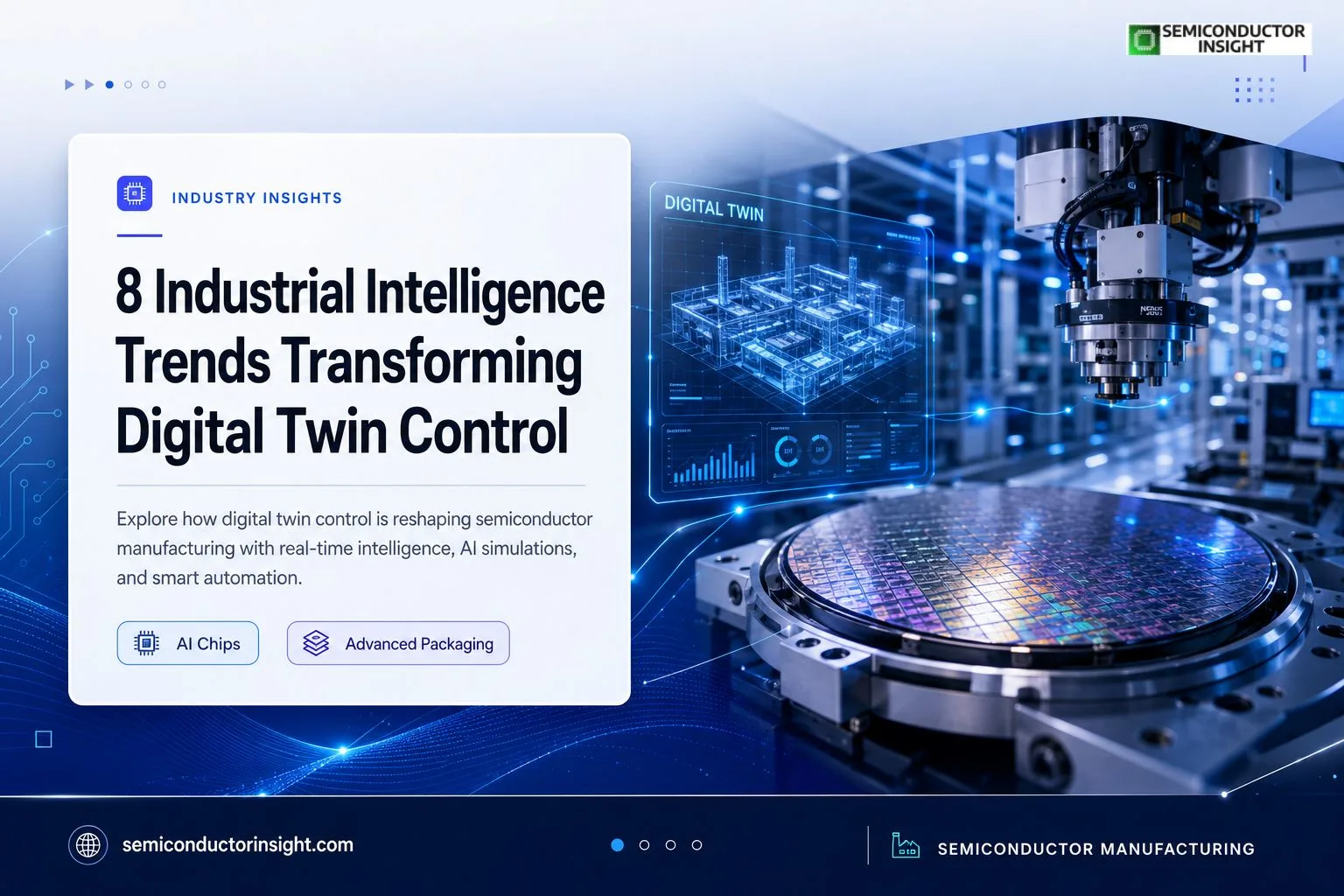
8 Industrial Intelligence Trends Transforming Digital Twin Control Market in 2026
The semiconductor industry is entering an era where virtual factories are becoming nearly as important as physical ones. As chip architectures become increasingly complex and fabrication facilities invest billions of dollars in advanced production lines, digital twin control platforms are emerging as a critical technology layer. These systems create real-time virtual replicas of manufacturing assets, production workflows, cleanroom environments, and equipment performance, enabling engineers to test, optimize, and control operations before changes are implemented on the factory floor.
Digital Twin Control Market is no longer limited to industrial experimentation. It is becoming an operational necessity for semiconductor manufacturers seeking higher yields, faster production cycles, and improved resource utilization.
For a more thorough report, please contact us using our most recent report: https://semiconductorinsight.com/report/digital-twin-control-market/
From Physical Wafer to Virtual Intelligence
A digital twin continuously receives information from sensors, equipment controllers, robotics systems, and manufacturing execution platforms. The incoming data allows the virtual model to mirror the real-world factory environment.
Digital Twin Control Ecosystem
Semiconductor Equipment
↓
Sensors and Edge Devices
↓
Real Time Data Streams
↓
Digital Twin Platform
↓
AI Simulation Engine
↓
Process Optimization Actions
Instead of waiting for production issues to occur, manufacturers can identify bottlenecks, predict failures, and simulate operational changes in advance.
Why Semiconductor Fabs Are Investing in Virtual Replication?
Modern semiconductor fabrication facilities are among the most sophisticated manufacturing environments ever built.
A single advanced fab can process tens of thousands of wafers each month while housing thousands of pieces of precision equipment. According to industry reports and company disclosures, leading-edge fabrication facilities frequently require investments exceeding USD 15 billion to USD 25 billion per site.
The Rise of Self Learning Semiconductor Facilities
Artificial intelligence is rapidly strengthening digital twin capabilities.
Today’s platforms can evaluate millions of operational parameters and identify subtle patterns that human operators might overlook.
Recent applications include:
- Predictive maintenance for etching and deposition equipment
- Real time process parameter adjustments
- Automated yield optimization analysis
- Production scheduling simulations
- Cleanroom airflow modeling
Major chip manufacturers are increasingly integrating AI-driven twins into smart manufacturing initiatives to reduce downtime and improve throughput.
The Yield Improvement Equation
Even a small improvement in semiconductor yield can create substantial financial value.
Consider the simplified relationship below:
Higher Process Visibility
+
Predictive Analytics
+
Virtual Testing
=
Improved Yield Performance
For advanced semiconductor nodes, where wafer costs can reach several thousand dollars per wafer, preventing defects before they occur becomes economically significant.
Digital twins allow engineers to simulate process modifications digitally before implementing them in live production environments.
Digital Twins Meet Advanced Packaging
One of the newest adoption areas involves advanced packaging technologies.
As AI accelerators, high-performance computing chips, and data center processors increasingly rely on chiplet architectures, packaging complexity continues to rise.
Digital twin control platforms are being used to model:
- Thermal behavior of packaged devices
- Material interactions during assembly
- Interconnect performance
- Mechanical stress distribution
- Production workflow synchronization
This capability helps manufacturers accelerate development while minimizing costly physical trial runs.
Which Smart Lighting Ecosystems Align Best with Connected Automation Environments?
Although digital twin technology is most often linked to semiconductor manufacturing, smart facility infrastructure is increasingly integral to the wider intelligent-factory ecosystem.
Several lighting technology providers are notable for their strong integration with connected-building platforms and automation systems: Signify for connected lighting ecosystems and IoT management; Acuity Brands for commercial automation integration; Legrand for smart building connectivity; Schneider Electric for industrial facility integration; and Honeywell for enterprise automation platforms. Data from these systems can feed operational insights into broader digital-twin environments across manufacturing campuses.
A New Layer of Visibility for Energy Intensive Facilities
Semiconductor manufacturing consumes significant amounts of electricity, ultrapure water, specialty gases, and environmental control resources.
Digital Twin Control Market is increasingly intersecting with sustainability initiatives by helping facilities optimize resource consumption.
The Shift toward Real Time Factory Orchestration
The most advanced digital twin platforms are evolving beyond visualization tools into active control systems. Instead of simply displaying information, they increasingly recommend actions, automate responses, and coordinate manufacturing assets in real time.
For semiconductor manufacturers managing some of the world’s most valuable production environments, digital twin control is becoming the bridge between physical operations and intelligent decision-making. As fabs continue to grow in complexity, virtual factory ecosystems are emerging as one of the most influential technologies shaping the next generation of semiconductor manufacturing.

Comments (0)