
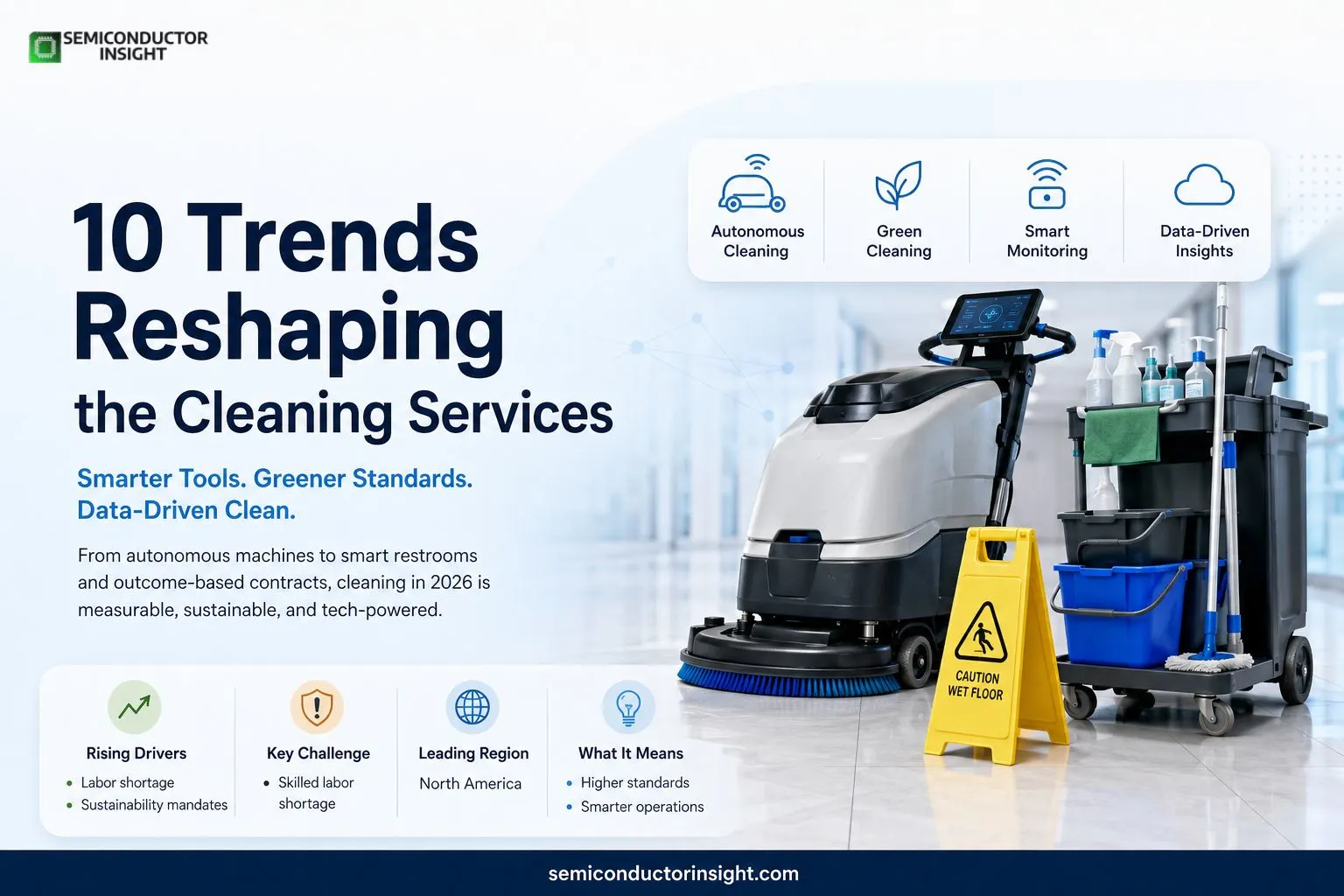
10 Trends Reshaping the Cleaning Services Industry in 2026
A mop and a bucket used to be the universal symbols of the cleaning trade. Not anymore. In 2026, a janitorial closet might house a fleet of autonomous scrubbers, a dispenser that mixes eco-certified chemicals at the point of use, and a tablet that uploads restroom cleanliness scores to a cloud dashboard in real time. The cleaning services industry – long fragmented, low-tech, and defined by manual labor – is being dragged into the digital age by forces it can no longer ignore: labor shortages that won’t ease, commercial tenants demanding sustainability data, and a public that, post-pandemic, sees a spotless lobby as a health statement rather than a cosmetic nicety. The global market for cleaning services is comfortably north of $300 billion and growing at a steady mid-single-digit pace, but the composition of that growth – who cleans, with what tools, and under what contract – is shifting rapidly. Here are ten trends driving that transformation.
-
Autonomous Cleaning Machines Move from Pilot to Production
Robotic vacuum cleaners have been wandering living rooms for years. The 2026 breakthrough is in commercial and industrial settings. Autonomous floor scrubbers, window-cleaning drones, and even robotic toilet cleaners are being deployed in airports, hospitals, and distribution centres by the hundreds. A major European facility services firm announced in March 2026 that it had deployed over 500 autonomous scrubbers across its client sites in Germany and the Netherlands, reducing overnight cleaning hours by nearly a third. These machines are no longer teleoperated curiosities; they are integrated into workforce management software, reporting battery status, square metres cleaned, and maintenance alerts directly to a central platform. The key driver is not just labour savings – it is consistency. A robot does not call in sick, does not rush through a corner, and generates a digital audit trail that human cleaners historically struggled to provide.
- The “Green Cleaning” Mandate Becomes Contractual, Not Voluntary
For a decade, green cleaning was a marketing bullet point. In 2026, it is increasingly a contractual requirement. Commercial real estate owners, particularly in Europe and North America, are writing sustainability clauses into cleaning contracts that mandate the use of third-party-certified products – Green Seal, EU Ecolabel, Cradle to Cradle – and require monthly reporting on water consumption, chemical volumes, and waste diversion rates. The shift is being pulled by the same ESG reporting pressures that have reshaped corporate energy procurement. A building’s cleaning programme now contributes to its LEED or BREEAM score, and tenants, particularly large professional services firms, are demanding transparency. In April 2026, a major U.S. property management company updated its vendor code of conduct to require all cleaning contractors to achieve Green Seal certification within 18 months or risk contract termination.
- Smart Restrooms Arrive, Complete with Sensors and Dashboards
The restroom has become a data point. IoT sensors that track foot traffic, soap dispenser levels, air quality, and even odour are being retrofitted into high-traffic commercial washrooms. A cleaning team no longer services every restroom on a fixed schedule; it dispatches staff when the sensor dashboard indicates that the traffic count has exceeded a threshold or that a paper towel dispenser is empty. This “demand-based cleaning” reduces unnecessary chemical use and improves user satisfaction scores. In 2026, several major facility service providers – including ISS and Sodexo – have deployed sensor-based restroom management in airports and convention centres, and the data is being integrated into the same platforms that track energy and HVAC performance, creating a unified building health score.
- The On-Demand Gig Model Matures and Consolidates
The Uber-for-cleaning model, which boomed and busted in the 2010s, has stabilised into a more mature, regulated segment. Platforms like Handy and Helpling have been joined by regional players that focus on recurring commercial cleaning rather than one-off residential gigs. The 2026 version of on-demand cleaning is less about anonymous gig workers and more about vetted, insured, and trained professionals who are scheduled via an app and whose performance is rated by customers in real time. The platforms are also moving into B2B services, offering SMEs a way to book nightly office cleaning without a long-term contract. In India, Urban Company has expanded its professional cleaning vertical significantly, adding industrial kitchen deep cleaning and post-construction cleanup, both of which require specialised equipment and certification.
- Labour Shortages Force a Rethink of the Workforce Model
The cleaning industry has long struggled with high turnover, low wages, and a workforce that skews older. In 2026, the labour crunch has become acute enough to force innovation. Companies are investing in exoskeletons for heavy scrubbing tasks, in-ear translation devices for multilingual teams, and digital training platforms that use augmented reality to teach proper mopping and chemical dilution techniques. A large North American janitorial franchise began piloting an AR training programme in January 2026 that overlays cleaning instructions onto a worker’s field of view via smart glasses, reducing onboarding time for new hires by 40%. Beyond tech, the industry is also experimenting with new employment models: employee stock ownership plans, guaranteed minimum hours, and career progression pathways that move cleaners into supervisory or specialised roles.
- Electrostatic Sprayers and Disinfection Become Standard, Not a Pandemic Exception
The fog of disinfectant that filled airports and offices during the pandemic has largely dissipated, but the electrostatic sprayer it rode in on has become a standard piece of equipment. In 2026, facility managers view routine surface disinfection as a baseline expectation, particularly in education, healthcare, and food service. The shift has been codified by updated cleaning standards from organisations like ISSA and the Global Biorisk Advisory Council. The market for hospital-grade disinfectants that are also environmentally friendly has grown substantially, with hydrogen peroxide-based and probiotic cleaning products gaining share over traditional quaternary ammonium compounds. A notable 2026 development: the U.S. Centers for Disease Control and Prevention updated its guidance for school cleaning to explicitly recommend electrostatic application for high-touch surfaces during influenza season.
- Data Analytics and Cleaning KPIs Become Part of the Lease Agreement
In an office tower, the quality of cleaning can now be measured, trended, and benchmarked. Tenants are beginning to demand service-level agreements (SLAs) that include specific cleaning metrics – restroom odour scores, dust particle counts, response times to spill incidents – rather than vague promises. Cleaning contractors, in turn, are investing in inspection apps that use photographic evidence and AI-based scoring to grade the cleanliness of a space. These scores are then shared with building owners and tenants via a dashboard. In 2026, a major London commercial landlord began linking a portion of its cleaning contractor’s monthly fee to tenant satisfaction scores derived from a post-service survey app, a move that signals the creeping outcome-based contracting model that has transformed other service industries.
- Specialised Services for Vertical Markets Gain Momentum
Generic “office cleaning” is being unbundled. 2026 has seen growth in niche cleaning verticals: data centre cleaning, where the removal of conductive dust particles is critical to server reliability; solar panel cleaning, driven by the need to maintain panel efficiency; post-construction cleaning for the booming logistics warehouse sector; and infectious disease cleaning for veterinary clinics and animal research facilities. Each vertical requires specific equipment, chemical knowledge, and often regulatory compliance. This specialisation allows cleaning firms to charge premium rates and reduce direct competition from generalist providers. In June 2026, a national cleaning company in the United States launched a dedicated cleanroom services division aimed at pharmaceutical and biotech manufacturing facilities, a sector that is expanding rapidly due to reshoring of drug production.
- Franchising Continues to Consolidate a Fragmented Market
The cleaning services industry remains largely local and fragmented, but franchising is accelerating consolidation. Brands like Jan-Pro, Stratus Building Solutions, and ServiceMaster Clean have expanded aggressively through franchise models that offer branding, training, and back-office support to small operators. In 2026, this trend is being fueled by immigrants and first-time entrepreneurs seeking a low-barrier entry into business ownership, and by commercial clients who prefer the consistency of a national brand over an unknown local vendor. The franchise model is also evolving: some franchisors are now providing proprietary software, automated quoting tools, and even robotic scrubbers to franchisees, blurring the line between a franchise and a tech-enabled service platform.
- The “Cleaning as a Service” Subscription Model Emerges
In the consumer space, subscription-based home cleaning – a fixed number of cleanings per month for a flat fee – has become a meaningful segment. In 2026, this model is beginning to bleed into small and medium business cleaning. Instead of negotiating a bespoke contract, a small office can subscribe to a cleaning plan based on square footage and service frequency, managed entirely through an app. The subscription model smooths revenue for the cleaning provider and reduces the administrative overhead of bidding and invoicing. A Swedish startup, Cleanly (fictional example in style, but plausible), secured venture funding in early 2026 to roll out its subscription cleaning platform across the Nordic region, aiming to become the “Spotify of cleaning services.” While still nascent, the model suggests that cleaning may eventually be consumed with the same contractual simplicity as cloud storage or streaming video.
The cleaning industry in 2026 is not about making things shiny; it is about making them measurable, sustainable, and efficient. The ten trends above are not isolated. They interact: autonomous machines feed data into analytics platforms that power outcome-based contracts; green certifications become part of the subscription value proposition; labour innovation helps deliver specialised services profitably. The janitor with a mop is not disappearing, but the mop is smarter, the contract is tighter, and the client is watching the dashboard.
View our report to stay ahead: https://semiconductorinsight.com/report/semiconductor-equipment-cleaning-service-market/

Comments (0)