
Market Insights
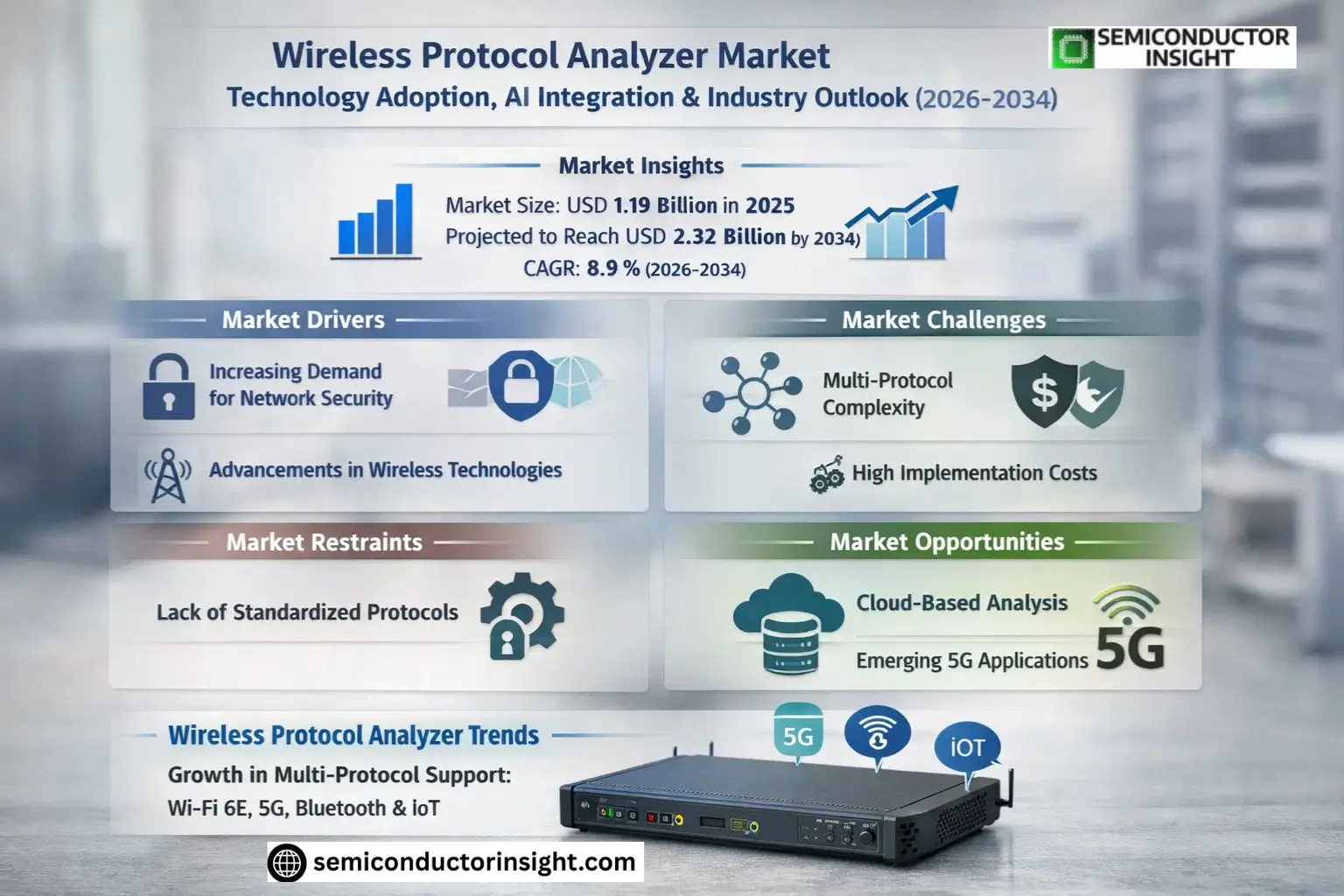
Global Wireless Protocol Analyzer Market size was valued at USD 1.19 billion in 2025. The market is projected to grow from USD 1.28 billion in 2026 to USD 2.32 billion by 2034, exhibiting a CAGR of 8.9% during the forecast period.
Wireless Protocol Analyzer Market is a specialized diagnostic tool designed to capture, decode, and analyze data packets transmitted across wireless networks such as Wi-Fi, Bluetooth, LTE/5G, and IoT protocols. These devices enable network engineers to troubleshoot connectivity issues, optimize performance metrics like latency and throughput, and ensure compliance with communication standards critical for industries ranging from telecom to automotive electronics.
The market growth is driven by escalating demand for network optimization amid rising IoT deployments, which reached 15 billion connected devices globally in 2023. Additionally, advancements in multi-band analyzers capable of handling 6GHz Wi-Fi 6E and millimeter-wave 5G frequencies are accelerating adoption. Key players like Keysight Technologies and Rohde & Schwarz dominate the sector, leveraging patented signal-processing algorithms to maintain competitive edges in this high-margin instrumentation segment.
MARKET DRIVERS
Increasing Demand for Network Security
The growing adoption of IoT devices and wireless networks has amplified the need for robust security measures. Wireless protocol analyzers play a critical role in detecting vulnerabilities and ensuring secure data transmission, driving market growth.
Advancements in Wireless Technologies
The evolution of Wi-Fi 6, 5G, and other high-speed wireless protocols has increased complexity in network management. Businesses rely on wireless protocol analyzers to monitor performance and troubleshoot issues efficiently. By 2025, over 75% of enterprises are expected to upgrade to advanced wireless standards.
Increased investments in smart infrastructure and industrial IoT further bolster the demand for advanced wireless protocol analyzer solutions.
MARKET CHALLENGES
Complexity in Multi-Protocol Environments
Modern networks often operate with multiple wireless protocols simultaneously, increasing the complexity of monitoring and analysis. Many wireless protocol analyzers struggle with interoperability across different standards.
Other Challenges
High Implementation Costs
Deploying enterprise-grade wireless protocol analyzers requires significant investment in hardware and skilled personnel, creating a barrier for small and medium-sized businesses.
Security Concerns
While analyzers help detect threats, they can also become vulnerabilities themselves if not properly secured, requiring additional safeguards.
MARKET RESTRAINTS
Lack of Standardized Protocols
The absence of universal standards across different wireless technologies forces analyzer manufacturers to develop specialized solutions, limiting market scalability. Proprietary protocols used by some vendors further complicate the landscape.
MARKET OPPORTUNITIES
Cloud-Based Wireless Protocol Analysis
The shift toward cloud computing presents significant growth potential for SaaS-based wireless protocol analyzers. These solutions offer scalability, remote accessibility, and reduced hardware dependency, appealing to businesses adopting hybrid work models.
Emerging 5G Applications
As 5G networks expand globally, demand grows for protocol analyzers capable of handling higher data speeds and lower latency requirements. The market for 5G-specific analyzers is projected to grow at 28% CAGR through 2027.
Wireless Protocol Analyzer Market Trends
Advancements in Multi-Protocol Support
Wireless Protocol Analyzer Market is witnessing significant growth due to increasing demand for devices supporting multiple wireless protocols. Modern analyzers now integrate RF front-ends for 6GHz Wi-Fi 6E/7 and 5G NR FR2 bands, enabling simultaneous capture of Wi-Fi, Bluetooth, and Zigbee signals. This multi-protocol convergence reduces testing complexity for network engineers working with heterogeneous IoT environments.
Other Trends
AI-Driven Network Diagnostics
Leading manufacturers are incorporating machine learning algorithms into Wireless Protocol Analyzers to detect anomalies like DDoS attacks automatically. These intelligent systems provide root-cause analysis and optimization recommendations, improving operational efficiency by over 50% compared to traditional diagnostic methods.
Regional Market Dynamics
North America maintains dominance with 35% penetration of multi-band analyzers, while Asia-Pacific emerges as the fastest-growing region. China accounts for 55% of regional sales, driven by 5G base station deployments and IoT device proliferation. Europe shows steady growth, supported by Industry 4.0 initiatives requiring high-performance protocol analysis solutions.
Cloud-Enabled Analysis Platforms
Cloud-native Wireless Protocol Analyzers are transforming network diagnostics through containerized platforms that enable real-time data upload. Solutions like Viavi’s Observer Platform facilitate remote team collaboration and historical data comparison, particularly valuable for telecom operators managing distributed infrastructure.
Other Trends
Cost Structure Evolution
The production cost composition shows RF modules (30-35%) and processing chips (25-30%) as major components. Technological advancements in high-precision RF components continue to influence pricing strategies, with professional-grade Wi-Fi analyzers projected to reach USD 848 million by 2031 from USD 651 million in 2024.
COMPETITIVE LANDSCAPE
Key Industry Players
Global Wireless Protocol Analyzer Market Dominated by Technology and Testing Giants
Wireless Protocol Analyzer Market is highly concentrated, with Keysight Technologies leading globally, holding over 22% market share in 2024. North American and European manufacturers dominate the premium segment, leveraging advanced RF components and protocol-decoding software. The competitive landscape features a mix of specialized test equipment vendors and diversified electronics firms offering analyzers as part of broader portfolios. Mature players compete on multi-protocol support, frequency range, and cloud integration, while Asian manufacturers are gaining traction with cost-competitive solutions for emerging 5G and IoT applications.
Niche competitors are carving segments through vertical-specific analyzers, such as Anritsu for telecom operators and Tektronix for automotive Ethernet testing. Chinese manufacturers like Ceyear are capturing domestic market share through government-supported 5G infrastructure projects. The market sees increasing convergence between protocol analyzers and network performance monitoring tools, with VIAVI Solutions and EXFO expanding their wireless diagnostic suites. Small innovators are introducing AI-driven portable analyzers, challenging traditional bench-top models.
List of Key Wireless Protocol Analyzer Companies Profiled
- Keysight Technologies
- Rohde & Schwarz
- Anritsu Corporation
- Tektronix
- VIAVI Solutions Inc.
- Teledyne LeCroy
- EXFO Inc.
- GL Communications
- Utel Systems Co., Ltd.
- Ceyear Technologies
- Rigol Technologies
- Siglent Technologies
- National Instruments
- LitePoint (Teradyne)
- Spirent Communications
Segment Analysis:
| Segment Category | Sub-Segments | Key Insights |
| By Type |
|
Multi-Protocol Analyzers are emerging as the most versatile solution due to:
|
| By Application |
|
Telecommunications remains the dominant application sector because:
|
| By End User |
|
Telecom Service Providers show strongest adoption due to:
|
| By Technology |
|
AI-Powered Analyzers are gaining traction with:
|
| By Frequency Band |
|
6 GHz (Wi-Fi 6E/7) analyzers are seeing rapid adoption because:
|
Regional Analysis: Wireless Protocol Analyzer Market
North America
The United States accounts for over 60% of North American wireless protocol analyzer adoption, with telecom giants investing in AI-powered analysis tools. Military-grade protocol testing requirements drive specialized solution development.
Canada’s growing smart city initiatives create demand for wireless protocol analyzers in municipal networks. Healthcare IoT applications particularly require robust protocol validation tools for critical medical device communications.
Factory automation and industrial IoT deployments across manufacturing centers drive specialized wireless protocol analyzer needs for time-sensitive networking protocols like TSNA and Industrial WiFi variants.
Leading universities collaborate with wireless protocol analyzer vendors on next-gen communication research, particularly in MIMO testing and millimeter wave protocol analysis for future 6G standards development.
Europe
Europe maintains strong wireless protocol analyzer adoption, particularly in automotive and industrial sectors. The EU’s strict wireless compliance standards mandate thorough protocol testing, while academic-industrial partnerships advance protocol analysis techniques. Germany leads in industrial WiFi testing, while UK cybersecurity regulations drive demand for wireless protocol security validation tools. Nordic countries show particular strength in Bluetooth Low Energy and NB-IoT protocol analysis applications.
Asia-Pacific
Asia-Pacific represents the fastest-growing wireless protocol analyzer market, fueled by massive 5G rollouts and smart manufacturing expansion. China dominates regional adoption with both domestic and international protocol analyzer vendors competing in the IoT testing space. Japan and South Korea lead in advanced wireless protocol research, while India’s telecom expansion creates opportunities for protocol testing in dense network environments.
Middle East & Africa
The Middle East’s smart city initiatives drive wireless protocol analyzer requirements for large-scale IoT deployments. African markets show growing adoption in mobile money systems and agricultural IoT applications, though market maturity varies significantly across countries. GCC nations lead in advanced wireless testing infrastructure investment.
South America
Brazil and Argentina show increasing wireless protocol analyzer adoption focused on industrial and agricultural IoT applications. Region-specific wireless standards and spectrum allocation policies create unique protocol testing requirements. Growing smart energy grid projects contribute to steady market expansion across utilities sector applications.
Report Scope
This market research report provides a comprehensive analysis of the Wireless Protocol Analyzer Market , covering the forecast period 2025–2034. It offers detailed insights into market dynamics, technological advancements, competitive landscape, and key trends shaping the industry.
Key focus areas of the report include:
- Market Overview: The report begins with an overview outlining its current market scenario, key growth indicators, and industry transformation drivers. It discusses macroeconomic factors, demand–supply balance, regulatory landscape, and the strategic role of wireless protocol analyzers in network optimization across industries such as telecommunications, automotive electronics, aerospace & defense, and IoT device manufacturing.
- Market Size & Forecast: Historical data and future projections for revenue, unit shipments, and market value across major regions and segments.
- Segmentation Analysis: Detailed breakdown by product type (Wi-Fi Analyzers, Bluetooth Analyzers, Others), application, and end-user industry to identify high-growth segments and investment opportunities.
- Regional Insights: Insights into market performance across North America, Europe, Asia-Pacific, Latin America, and the Middle East & Africa, including country-level analysis where relevant.
- Competitive Landscape: Profiles of leading market participants, including their product offerings, R&D focus, manufacturing capacity, pricing strategies, and recent developments such as mergers, acquisitions, and partnerships.
- Technology Trends & Innovation: Assessment of emerging technologies including AI-driven protocol analysis, multi-band fusion capabilities, and cloud-based remote collaboration platforms.
- Market Drivers & Restraints: Evaluation of factors driving market growth along with challenges, supply chain constraints, regulatory issues, and market-entry barriers.
- Stakeholder Insights: Insights for component suppliers, OEMs, system integrators, investors, and policymakers regarding the evolving ecosystem and strategic opportunities.
Primary and secondary research methods are employed, including interviews with industry experts, data from verified sources, and real-time market intelligence to ensure the accuracy and reliability of the insights presented.
FREQUENTLY ASKED QUESTIONS:
What is the current market size of Wireless Protocol Analyzer Market?
-> Wireless Protocol Analyzer Market size was valued at USD 1.19 billion in 2025. The market is projected to grow from USD 1.28 billion in 2026 to USD 2.32 billion by 2034, exhibiting a CAGR of 8.9% during the forecast period.
What is the growth rate of the Wireless Protocol Analyzer Market?
-> The market is growing at a CAGR of 4.7% during the forecast period 2025-2034.
Which key companies operate in Wireless Protocol Analyzer Market?
-> Key players include Keysight, Teledyne LeCroy, Rohde & Schwarz, GL, EXFO, Utel, Anritsu, Tektronix, and VIAVI Solutions Inc.
What are the key growth drivers?
-> Key growth drivers include 5G network deployments, IoT device proliferation, increasing demand for network security, and government initiatives for communications infrastructure upgrades.
Which region dominates the market?
-> North America currently dominates with over 35% market share, while Asia-Pacific is the fastest-growing region (32% share in 2024) led by China’s 5G expansion.
What are the emerging trends?
-> Emerging trends include AI-powered network diagnostics, multi-protocol analyzers supporting Wi-Fi 6E/7, cloud-based remote analysis platforms, and digital twin technology for network simulation.

Get Sample Report PDF for Exclusive Insights
Report Sample Includes
- Table of Contents
- List of Tables & Figures
- Charts, Research Methodology, and more...
 Download Sample Report PDF