MARKET INSIGHTS
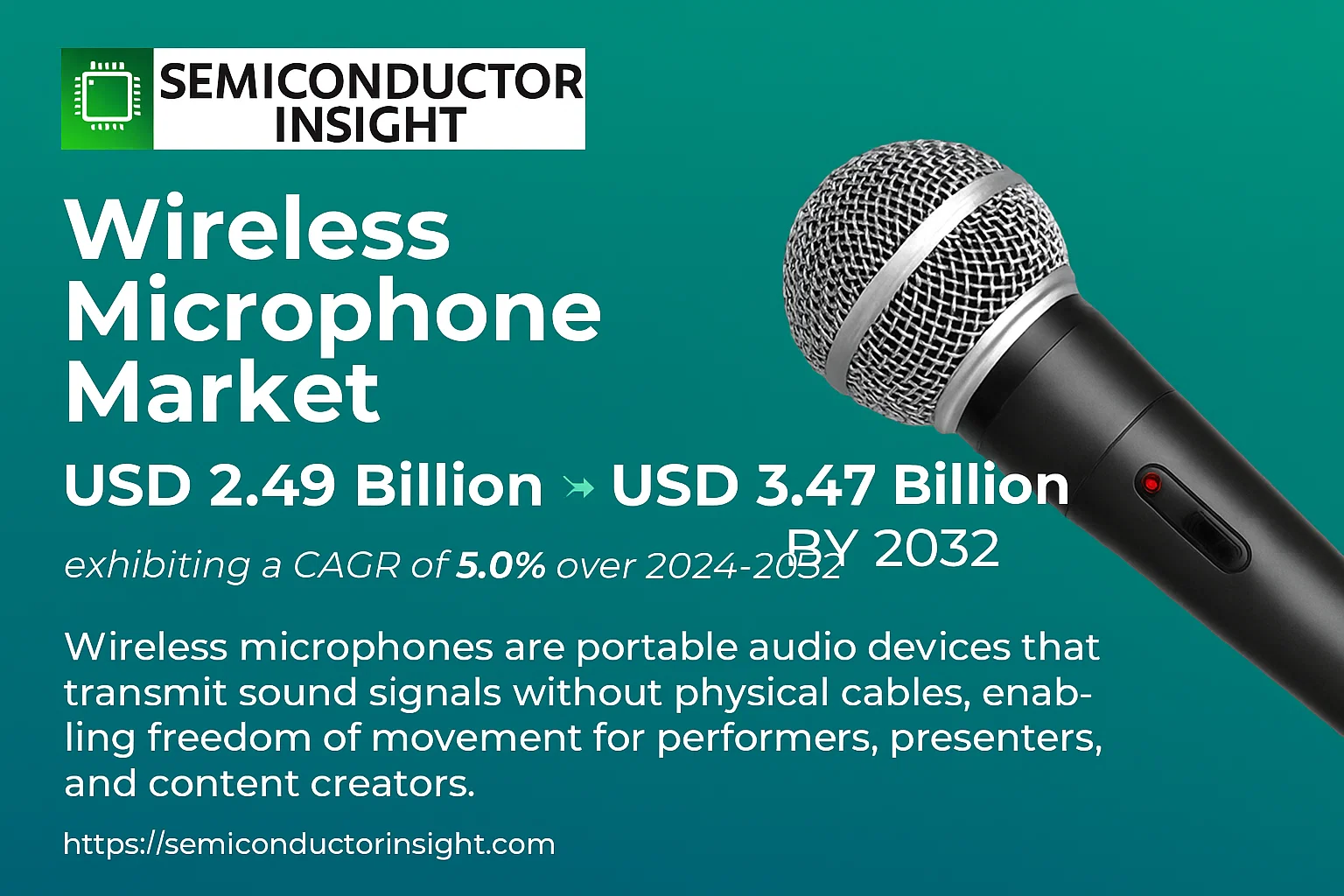
Global Wireless Microphone Market size was valued at USD 2.49 billion in 2024 to USD 3.47 billion by 2032, exhibiting a CAGR of 5.0% during the forecast period.
Wireless microphones are portable audio devices that transmit sound signals without physical cables, enabling freedom of movement for performers, presenters, and content creators. These systems operate using radio frequency (RF) technology with components including transmitters, receivers, and antennas that facilitate wireless audio transmission across various frequency bands.
The market is experiencing steady growth driven by increasing demand from entertainment venues, corporate events, educational institutions, and broadcasting applications. The transition from analog to digital wireless systems has improved audio quality while reducing interference issues. However, spectrum reallocation challenges due to the growing demand for mobile broadband services have created regulatory pressures on traditional frequency bands used by wireless microphones. Key players like Sennheiser and Shure Incorporated continue to innovate with advanced features such as enhanced battery life, improved signal processing, and compatibility with emerging digital standards.
MARKET DRIVERS
Proliferation of Live Events and Entertainment
The robust return of in-person events post-pandemic, including concerts, corporate conferences, and theater productions, is a principal driver. The demand for high-quality, reliable audio solutions is paramount, pushing the adoption of professional-grade wireless microphone systems. Global live events industry is projected to grow significantly, requiring flexible and robust audio equipment.
Technological Advancements and Digital Transition
Continuous innovation, particularly the shift from analog to digital UHF systems and the adoption of spectrum-efficient technologies like DECT, enhances audio quality, battery life, and signal reliability. Features such as encryption and automatic frequency coordination are becoming standard, meeting the needs of premium applications in broadcasting and large-scale productions.
Furthermore, the demand from the education and corporate sectors for wireless presentation solutions, coupled with the growing creator economy utilizing microphones for streaming and podcasting, provides sustained market growth.
MARKET CHALLENGES
Spectrum Scarcity and Regulatory Pressures
A critical challenge is the ongoing spectrum reallocation, notably the repurposing of the 600 MHz band for mobile broadband in many regions. This forces users to replace existing equipment and intensifies competition for available UHF frequencies, leading to potential interference issues and increased operational costs for frequency licensing and management.
Other Challenges
High Initial Investment and Cost Sensitivity
Professional wireless systems represent a significant capital expenditure. This can be a barrier for small production companies, educational institutions, and individual content creators, who may opt for more affordable wired alternatives or lower-tier wireless solutions, impacting market penetration.
Security and Interference Vulnerabilities
Despite advancements, wireless systems remain susceptible to dropouts, interference from other electronic devices, and potential security breaches. Ensuring secure, uninterrupted audio transmission in crowded RF environments is an ongoing technical challenge for manufacturers.
MARKET RESTRAINTS
Stringent Regulatory Compliance and Certification
Manufacturers face significant restraints from the need to comply with diverse and evolving radio frequency regulations across different countries. Obtaining certifications from bodies like the FCC (USA) and CE (Europe) is time-consuming and costly, potentially delaying product launches and increasing the final cost to consumers, thereby restraining market expansion.
Competition from Integrated Solutions and Substitutes
The market faces competition from alternative audio solutions, including high-quality wired microphones, which offer reliability without spectrum concerns, and the increasing audio capabilities of smartphones and conference systems with built-in microphones. These substitutes can satisfy basic needs, limiting the addressable market for dedicated wireless microphone systems in certain segments.
MARKET OPPORTUNITIES
Expansion in Prosumer and Content Creation Markets
The explosive growth of podcasting, live streaming, and online content creation presents a substantial opportunity. Prosumers seek broadcast-quality audio with the convenience of wireless operation, driving demand for mid-range, feature-rich systems that bridge the gap between consumer and professional gear. This segment is expected to be a key growth driver.
Adoption of AI and Advanced Software Integration
The integration of Artificial Intelligence for features like automatic mixing, noise reduction, and real-time audio optimization represents a significant frontier. Developing systems with sophisticated software control and analytics can create new value propositions for high-end professional users in broadcasting and installed sound, opening premium market segments.
Growth in Emerging Economies
Rapid infrastructure development, growing media & entertainment industries, and increasing investments in corporate and educational facilities in Asia-Pacific and Latin America offer fertile ground for market expansion. Tailoring cost-effective and robust solutions for these price-sensitive yet high-growth markets is a major strategic opportunity.
Wireless Microphone Market Trends
Transition to Digital and UHF Technologies
The Wireless Microphone Market is undergoing a significant technological shift from traditional analog VHF systems toward digital UHF (Ultra-High Frequency) systems. This trend is driven by the superior audio quality, enhanced signal stability, and reduced susceptibility to interference offered by digital UHF technology. The ongoing global spectrum reallocation, particularly the repurposing of the 600 MHz band for mobile broadband in regions like North America, is accelerating this transition. Manufacturers are innovating to develop systems that operate in more congested frequency bands while maintaining performance, making digital UHF the new standard for professional applications in live performance, broadcasting, and large-scale events.
Other Trends
Market Consolidation and Competitive Dynamics
The market landscape is characterized by the dominance of a few key players, with the top five manufacturersSennheiser, Shure Incorporated, Audio-Technica, AKG, and MIPROcollectively holding approximately 30% of the global market share. This consolidation trend is leading to intense competition focused on product innovation, reliability, and brand reputation. Companies are investing heavily in research and development to differentiate their offerings, particularly in areas like battery life, microphone capsule design, and networkability for system control and monitoring. This competition is benefiting end-users with more advanced and reliable products.
Expansion in Diverse Application Sectors
While the performance and entertainment sectors remain the core drivers of the Wireless Microphone Market, growth is increasingly fueled by expansion into new and diverse application segments. The corporate world represents a major growth area, with rising demand for high-quality audio in conference rooms, board meetings, and large corporate events to facilitate clear communication. Similarly, the education and training sector is adopting wireless microphone systems for lectures, presentations, and hybrid learning environments. This diversification beyond traditional entertainment uses is a key factor supporting the projected market growth from USD 2.48 billion in 2024 to USD 3.46 billion by 2032, representing a compound annual growth rate of 5.0%.
Strong Regional Demand Patterns
Geographically, the market demonstrates strong regional trends. North America is the largest market, accounting for about 35% of global share, driven by a mature entertainment industry and high adoption rates in the corporate and education sectors. Europe follows closely with a 30% market share, supported by a robust live events scene and broadcasting industry. The Asia-Pacific region is expected to exhibit significant growth potential during the forecast period, fueled by increasing investments in entertainment infrastructure, rising corporate expenditures, and the expanding education sector in countries like China, Japan, and India.
COMPETITIVE LANDSCAPE
Key Industry Players
A Concentrated Market with Top 5 Players Holding Significant Share
Global Wireless Microphone Market is characterized by the dominance of a few established players, with the top five manufacturersSennheiser, Shure Incorporated, Audio-Technica, AKG, and MIPROcollectively accounting for approximately 30% of the market share. This concentration reflects the high barriers to entry associated with advanced RF technology, stringent global regulatory compliance, and strong brand loyalty within professional audio communities. Market leadership is built on technological innovation, particularly in digital transmission systems that offer superior audio clarity and robust interference avoidance. These leading companies have extensive global distribution networks and deep relationships with key end-user segments such as large-scale performance venues, broadcasters, and corporate enterprises, allowing them to maintain a strong competitive position.
Beyond the market leaders, a range of other significant players compete effectively by focusing on niche applications or offering compelling value propositions. Companies like Yamaha and Sony leverage their broad brand recognition and extensive product ecosystems to capture market share across professional and prosumer segments. Other established competitors, including Samson, Rode Microphones, and LEWITT, have carved out positions by targeting specific user bases such as content creators, houses of worship, and educational institutions with reliable and cost-effective solutions. Furthermore, manufacturers like BBS, Takstar, and SUPERLUX are prominent in regional markets and the budget-conscious segment, providing competitive alternatives. InMusic Brands, through its portfolio, and specialists like Audix, which is renowned for its microphone transducer technology, add further depth to the competitive field, ensuring a dynamic and diverse market landscape.
List of Key Wireless Microphone Companies Profiled
- Sennheiser
- Shure Incorporated
- Audio-Technica
- AKG
- MIPRO
- BBS
- Yamaha
- Samson
- Sony
- Takstar
- SUPERLUX
- Rode Microphones
- Lane
- InMusic Brands
- Audix
- LEWITT
Segment Analysis:
| Segment Category | Sub-Segments | Key Insights |
| By Type |
|
Handheld microphones represent the dominant product type, favored for their versatility and reliability across numerous professional and casual applications. Their market leadership is sustained by robust demand from the performance and entertainment sectors, where user familiarity and ease of use are paramount. The design allows for direct vocal control and is highly visible to audiences, making it a standard for vocalists, public speakers, and presenters. Continuous innovation in battery life and rugged construction further solidifies the position of handheld microphones as the preferred choice for applications requiring durability and a strong stage presence. |
| By Application |
|
Performance is the leading application segment, driven by the critical need for high-fidelity, uninterrupted audio in live settings such as concerts, theater productions, and large-scale corporate events. The segment’s growth is underpinned by the unwavering demand for professional audio equipment that guarantees clarity and reliability, which are non-negotiable for performers and production crews. The evolution of digital wireless systems with enhanced signal stability and security has been a significant catalyst, directly addressing the core requirements of this high-stakes environment and making it the most influential application driving technological advancements in the market. |
| By End User |
|
Professional Audio/Entertainment Industry stands as the clear leader among end-user segments, constituting the primary consumer base for high-end wireless microphone systems. This segment’s dominance is rooted in its reliance on professional-grade audio quality, operational reliability, and advanced features for live events, broadcasting, and studio recording. The continuous cycle of product upgrades, driven by the industry’s pursuit of superior sound and seamless integration with other audio-visual equipment, ensures a consistently strong demand. This user group’s influence is so significant that it often dictates the direction of research and development for major manufacturers. |
| By Technology |
|
UHF (Ultra High Frequency) technology is the prevailing standard in the professional market, prized for its superior signal penetration, resistance to interference, and ability to support multiple simultaneous systems. Its leadership is particularly evident in complex professional environments like large venues and broadcast studios where signal reliability is critical. While newer 2.4 GHz digital systems are gaining traction for their cost-effectiveness and simplicity in less demanding applications, UHF remains the backbone of professional installations due to its proven performance, robust frequency coordination capabilities, and trusted operation in crowded RF environments. |
| By Distribution Channel |
|
Specialty Electronics Retailers remain the leading distribution channel, especially for high-value professional systems. These retailers provide the expert advice, hands-on demonstrations, and post-sale technical support that are crucial for customers making significant investments in professional audio equipment. The trust and value-added services offered by these specialist vendors are indispensable for professional users who require assurance of product quality and system compatibility. While online channels are growing rapidly for consumer-grade products, the complex nature of professional wireless systems ensures the continued dominance of specialized brick-and-mortar and B2B-focused distributors. |
Regional Analysis: Wireless Microphone Market
The region’s broadcast industry, including television networks and film production studios, demands the highest reliability and audio quality, pushing the adoption of sophisticated UHF and digital systems. This sector’s constant need for wireless solutions for news gathering, talk shows, and live sports broadcasting creates a steady, high-value demand that fuels market innovation and sustains a competitive landscape among premium brands.
North America hosts a massive live entertainment industry, from concerts and theater productions to corporate events and religious gatherings. This creates a diverse and extensive demand for wireless microphones that offer durability, clear signal transmission, and ease of use. The market is characterized by a preference for systems that can handle complex multi-channel setups in challenging RF environments.
There is significant penetration in the corporate and education sectors, where wireless microphones are essential for lectures, presentations, and training sessions. The trend towards hybrid work and learning models has further accelerated the need for integrated audio solutions that enhance communication clarity in large meeting rooms, auditoriums, and lecture halls across the continent.
The regulatory landscape, particularly managed by the FCC, has been a critical factor. The transition away from the 600 MHz band pushed the industry towards more efficient spectrum use and accelerated the adoption of advanced digital and frequency-agile systems. This proactive regulatory approach has fostered a market that prioritizes technical innovation and interference mitigation.
Europe
Europe represents a highly developed and diverse market for wireless microphones, characterized by stringent regulations and a strong cultural emphasis on performing arts. The region’s demand is fueled by a vibrant music festival scene, renowned theater productions, and a well-established public broadcasting sector. Countries like the UK, Germany, and France are key markets where professional audio quality is non-negotiable, driving the adoption of high-end systems. The implementation of EU-wide spectrum harmonization efforts, while complex, provides a framework for manufacturers to develop compliant products for multiple countries. However, the market is also seeing growing demand from the corporate and education sectors, particularly for solutions that support multilingual conferences and large-scale presentations.
Asia-Pacific
The Asia-Pacific region is the fastest-growing market for wireless microphones, driven by rapid urbanization, expanding entertainment industries, and increasing investments in live events and broadcasting. Markets like China, Japan, South Korea, and Australia are at the forefront, with China’s massive film and television production industry creating substantial demand. The region exhibits a dual-character market, with a high demand for cost-effective solutions for karaoke, public speaking, and small events, alongside a growing premium segment for professional broadcasting and large concerts. Infrastructure development, including new convention centers and performing arts venues, is a key growth driver, though varying spectrum regulations across countries present a challenge for manufacturers.
South America
The Wireless Microphone Market in South America is in a growth phase, primarily driven by the expanding media and entertainment sector, particularly in countries like Brazil and Argentina. The region’s passionate music culture, with its numerous festivals and live performances, generates consistent demand. The corporate sector is also emerging as a significant user, especially in major urban centers where international conferences and business events are becoming more common. Market growth is somewhat tempered by economic volatility and less developed regulatory frameworks for spectrum management compared to North America or Europe, leading to a market that is more focused on value-oriented and mid-range product segments.
Middle East & Africa
This region presents a developing market with significant potential, largely driven by infrastructure megaprojects, growing tourism, and investments in the entertainment sector, particularly in the Gulf Cooperation Council (GCC) countries and South Africa. The demand is fueled by the construction of large convention centers, hotels, and entertainment venues that require professional audio systems for events and conferences. Religious institutions also represent a steady, albeit niche, market segment. The overall market is characterized by a preference for robust and reliable systems that can perform well in challenging environments, though adoption rates vary widely between the more developed oil-rich nations and other parts of the region.
Report Scope
This market research report provides a comprehensive analysis of the Wireless Microphone Market , covering the forecast period 2025–2032. It offers detailed insights into market dynamics, technological advancements, competitive landscape, and key trends shaping the industry.
Key focus areas of the report include:
- Market Overview: The report begins with an overview outlining its current market scenario, key growth indicators, and industry transformation drivers. It discusses macroeconomic factors, demand–supply balance, regulatory landscape, and the strategic role of semiconductors in powering advancements across industries such as automotive, telecommunications, consumer electronics, and industrial automation.
- Market Size & Forecast: Historical data and future projections for revenue, unit shipments, and market value across major regions and segments.
- Segmentation Analysis: Detailed breakdown by product type, technology, application, and end-user industry to identify high-growth segments and investment opportunities.
- Regional Insights: Insights into market performance across North America, Europe, Asia-Pacific, Latin America, and the Middle East & Africa, including country-level analysis where relevant.
- Competitive Landscape: Profiles of leading market participants, including their product offerings, R&D focus, manufacturing capacity, pricing strategies, and recent developments such as mergers, acquisitions, and partnerships.
- Technology Trends & Innovation: Assessment of emerging technologies, integration of AI/IoT, semiconductor design trends, fabrication techniques, and evolving industry standards.
- Market Drivers & Restraints: Evaluation of factors driving market growth along with challenges, supply chain constraints, regulatory issues, and market-entry barriers.
- Stakeholder Insights: Insights for component suppliers, OEMs, system integrators, investors, and policymakers regarding the evolving ecosystem and strategic opportunities.
Primary and secondary research methods are employed, including interviews with industry experts, data from verified sources, and real-time market intelligence to ensure the accuracy and reliability of the insights presented.
FREQUENTLY ASKED QUESTIONS:
What is the current market size of Wireless Microphone Market?
-> Wireless Microphone Market size was valued at USD 2.49 billion in 2024 to USD 3.47 billion by 2032, exhibiting a CAGR of 5.0% during the forecast period.
Which key companies operate in Wireless Microphone Market?
-> Key players include Sennheiser, Shure Incorporated, Audio-Technica, AKG, and MIPRO, among others. These top five manufacturers held a combined market share of about 30% in 2024.
What are the key growth drivers?
-> Key growth drivers include increasing demand from performance and entertainment sectors, technological advancements in wireless transmission, and the versatility of portable audio solutions.
Which region dominates the market?
-> North America is the largest region, with a market share of about 35% in 2024, followed by Europe with approximately 30%.
What are the emerging trends?
-> Emerging trends include the integration of advanced radio frequency technologies, development of more compact and power-efficient systems, and expansion into new application areas such as corporate conferencing and online education.

Get Sample Report PDF for Exclusive Insights
Report Sample Includes
- Table of Contents
- List of Tables & Figures
- Charts, Research Methodology, and more...
 Download Sample Report PDF