
Wireless IoT Vibration Monitoring Sensor Market Insights
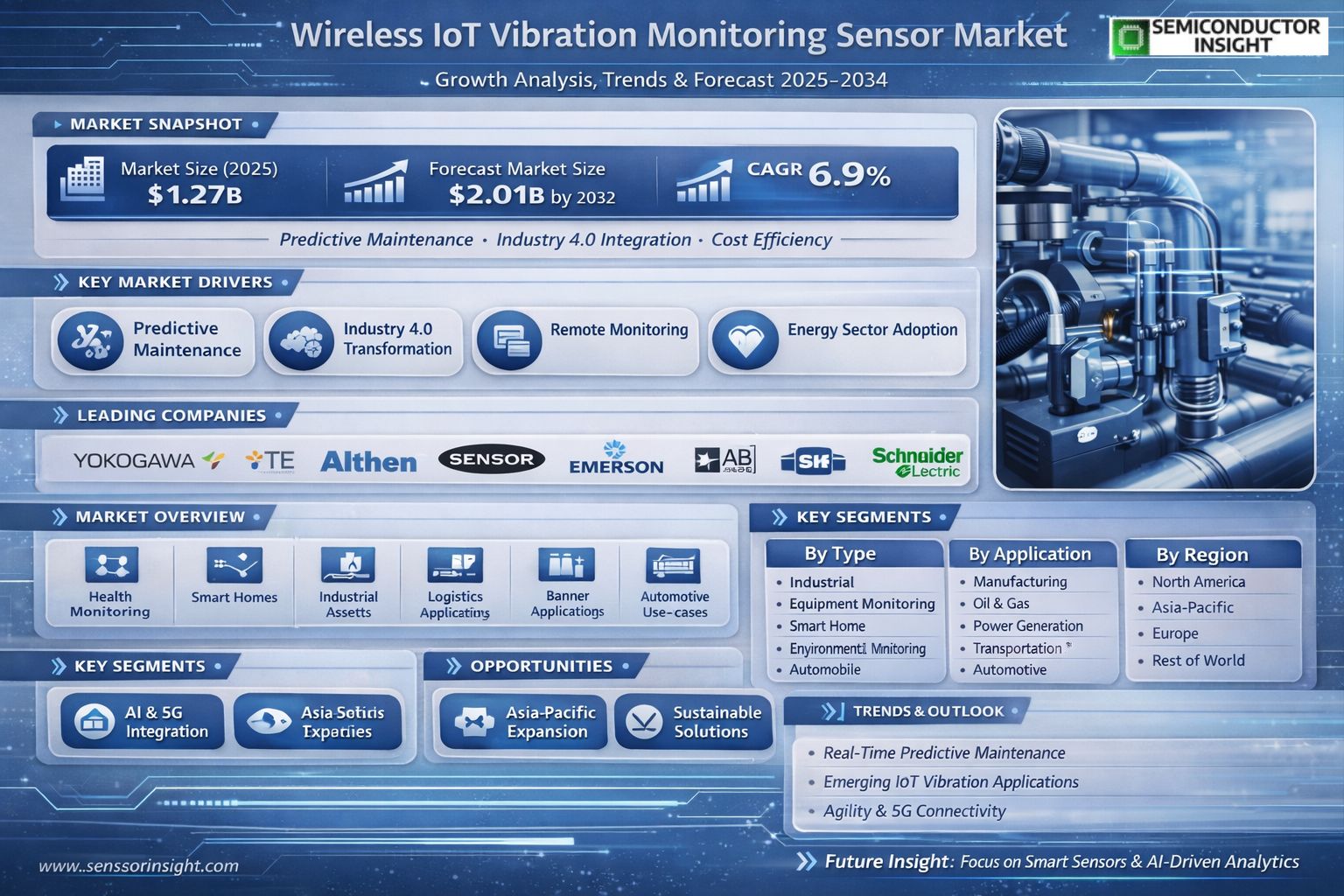
Global Wireless IoT Vibration Monitoring Sensor market size was valued at USD 1.27 billion in 2025. The market is projected to reach USD 2.01 billion by 2032, exhibiting a CAGR of 6.9% during the forecast period.
Wireless IoT vibration monitoring sensors utilize wireless communication technology specifically designed to monitor the vibration status of equipment or machines. They transmit data to the cloud or local systems in real time through IoT technology, detecting vibration amplitude, frequency, and other key information. This enables remote monitoring, fault warnings, and maintenance optimization, finding wide application in health monitoring, preventive maintenance, and intelligent management of industrial equipment. Thanks to their wireless design, they require no wiring for installation and suit complex environments or areas difficult to access for power.
The market sees strong growth fueled by surging demand for predictive maintenance, IoT integration in Industry 4.0, and cost efficiencies from wireless solutions. Advancements in sensor accuracy and battery life further boost adoption across manufacturing and energy sectors. Key manufacturers like Yokogawa Electric, Emerson, ABB, SKF, and Banner Engineering lead with robust portfolios, while ongoing innovations in edge computing and AI analytics propel expansion. For example, the focus on real-time data processing helps industries minimize downtime effectively.
MARKET DRIVERS
Adoption of Predictive Maintenance
Wireless IoT Vibration Monitoring Sensor Market is propelled by the growing emphasis on predictive maintenance across industries like manufacturing and oil & gas. These sensors enable real-time detection of equipment vibrations, preventing costly failures and reducing downtime by up to 50%. With IoT integration, data analytics provide actionable insights, driving operational efficiency.
Industry 4.0 Transformation
Industry 4.0 initiatives are accelerating demand for wireless IoT solutions in vibration monitoring. Factories are increasingly deploying these sensors for smart machinery health assessment, supporting a market projected to expand at a CAGR of over 12% through 2030. This shift from reactive to proactive strategies enhances productivity.
➤ Key sectors like automotive and energy are leading with wireless IoT vibration sensors for remote asset management, cutting maintenance costs significantly.
Additionally, advancements in edge computing and low-power wireless protocols further boost market drivers by ensuring seamless data transmission in harsh environments.
MARKET CHALLENGES
Integration Complexities
One major hurdle in Wireless IoT Vibration Monitoring Sensor Market is the complexity of integrating sensors with existing legacy systems. Many industrial sites rely on outdated infrastructure, leading to compatibility issues and extended deployment times that can delay ROI realization.
Other Challenges
Data Security and Reliability
Cybersecurity threats pose significant risks, as interconnected IoT devices are vulnerable to breaches. Moreover, inconsistent connectivity in remote locations affects data reliability, challenging the scalability of wireless vibration monitoring deployments. Battery life limitations also require frequent replacements, increasing operational costs.
Addressing these requires robust protocols and hybrid solutions, yet progress remains gradual amid evolving standards.
MARKET RESTRAINTS
High Initial Investment
Market restraints for Wireless IoT Vibration Monitoring Sensor Market stem primarily from high upfront costs associated with sensor networks and supporting infrastructure. Small and medium enterprises often hesitate due to budgets constrained by these investments, limiting widespread adoption.
Regulatory compliance in sectors like energy adds further barriers, with stringent safety standards demanding certified devices that inflate prices. Supply chain vulnerabilities, exacerbated by global chip shortages, have restrained production scalability.
Competition from wired alternatives also persists where reliability trumps wireless flexibility, slowing market penetration in conservative industries.
MARKET OPPORTUNITIES
AI and 5G Integration
Wireless IoT Vibration Monitoring Sensor Market presents opportunities through AI-driven analytics and 5G connectivity, enabling ultra-low latency monitoring for critical assets. This convergence could unlock advanced anomaly detection, boosting accuracy by 30-40% in predictive applications.
Emerging markets in Asia-Pacific offer expansion potential, with rapid industrialization driving demand for cost-effective wireless solutions in manufacturing hubs.
Sustainability trends further favor these sensors by optimizing energy use and extending equipment life, aligning with global ESG goals and fostering new partnerships.
Wireless IoT Vibration Monitoring Sensor Market Trends
Shift Towards Real-Time Predictive Maintenance
In Wireless IoT Vibration Monitoring Sensor Market, a dominant trend is the accelerated adoption of real-time predictive maintenance solutions. These sensors utilize wireless communication to capture vibration amplitude, frequency, and related data from equipment, transmitting it instantly to cloud or local IoT systems. This enables remote monitoring, early fault warnings, and proactive maintenance optimization, significantly minimizing unplanned downtimes for industrial machinery. The inherent wireless architecture eliminates wiring complexities, making deployment feasible in inaccessible or harsh environments where traditional sensors falter, thus enhancing overall operational efficiency and equipment longevity.
Other Trends
Diversification into Emerging Applications
Another notable trend involves the expansion of Wireless IoT Vibration Monitoring Sensor applications beyond core industrial equipment monitoring. Sectors such as smart homes, environmental monitoring, logistics and transportation, and automobiles are increasingly incorporating these sensors for vibration-based health assessments and performance tracking. This broadening adoption leverages the sensors’ compact, battery-powered designs for seamless integration into diverse systems, supporting intelligent management and anomaly detection across varied use cases.
Intensified Innovation and Competitive Dynamics
Competition within Wireless IoT Vibration Monitoring Sensor Market is intensifying among leading manufacturers including Yokogawa Electric, TE, Banner Engineering, Emerson, ABB, SKF, and Schneider. These key players are focusing on advancements in product types like split and integrated variants, improving IoT connectivity, data accuracy, and durability. Recent developments, informed by industry surveys on demand drivers and challenges, include enhanced sensor sensitivity and integration with broader industrial IoT ecosystems. This competitive landscape fosters continuous improvements in reliability and cost-effectiveness, propelling market evolution through strategic collaborations and technological refinements tailored to regional needs in North America, Europe, and Asia.
COMPETITIVE LANDSCAPE
Key Industry Players
Leading Manufacturers and Market Share Leaders in Wireless IoT Vibration Monitoring Sensor
Wireless IoT Vibration Monitoring Sensor Market is characterized by a moderately concentrated structure, with the global top five players collectively holding a significant revenue share in 2025. Emerson emerges as a leading force, leveraging its extensive automation expertise and integrated IoT platforms to dominate predictive maintenance solutions for industrial equipment. Companies like Yokogawa Electric and ABB follow closely, benefiting from their robust sensor portfolios and strong presence in process industries. This oligopolistic landscape drives innovation in wireless connectivity and real-time data analytics, enabling remote fault detection and maintenance optimization amid rising demand for Industry 4.0 applications.
Beyond the frontrunners, a diverse array of niche players contributes to market dynamism, particularly in specialized segments like split-type and integrated sensors for smart homes, logistics, and environmental monitoring. Firms such as SKF and Banner Engineering excel in high-precision vibration analysis for automotive and transportation uses, while emerging innovators like Petasense and Broadsens focus on cost-effective, scalable IoT deployments. Regional contenders including Beijing Bohua Xinzhi Technology and SumYoung Tech bolster growth in Asia, emphasizing affordable solutions for complex environments. Intense competition fosters advancements in battery life, data security, and AI-driven diagnostics, challenging incumbents to expand globally.
List of Key Wireless IoT Vibration Monitoring Sensor Companies Profiled
- Yokogawa Electric
- TE Connectivity
- Althen Sensor & Control
- Banner Engineering
- Emerson
- Srlinfo
- Analog Devices (ADI)
- ABB
- SKF
- Schneider Electric
- GE Digital
- Siemens
- Fluke
- Broadsens
- Petasense
- ZifiSense
Segment Analysis:
| Segment Category | Sub-Segments | Key Insights |
| By Type |
|
Split Type leads due to its modular design enabling flexible deployment in diverse industrial settings.
|
| By Application |
|
Industrial Equipment Monitoring dominates as the core application driving adoption for predictive maintenance.
|
| By End User |
|
Manufacturing emerges as the primary end user owing to intensive reliance on machinery reliability.
|
| By Connectivity |
|
LoRaWAN leads in connectivity preferences for its suitability in expansive industrial IoT deployments.
|
| By Power Source |
|
Battery-Powered prevails for its simplicity and reliability in wireless IoT vibration sensing.
|
Regional Analysis: Wireless IoT Vibration Monitoring Sensor Market
North America
In North America, manufacturing stands out with widespread Wireless IoT Vibration Monitoring Sensor integration on production lines. These sensors provide continuous vibration data, allowing factories to predict equipment wear and schedule maintenance efficiently. The shift toward smart manufacturing enhances throughput and reduces unplanned downtimes, bolstering competitiveness in global supply chains.
The energy sector in North America leverages Wireless IoT Vibration Monitoring Sensors for offshore rigs and pipelines. Real-time vibration insights help mitigate risks in remote operations, ensuring safety and longevity of critical infrastructure. This application supports the region’s energy independence goals through reliable asset monitoring.
Technological prowess defines North America’s Wireless IoT Vibration Monitoring Sensor Market, with advancements in AI-driven analytics and low-power wide-area networks. Sensor fusion with machine learning delivers precise fault detection, empowering industries to transition toward autonomous operations seamlessly.
Favorable regulations in North America encourage Wireless IoT Vibration Monitoring Sensor adoption by mandating safety standards in heavy industries. Incentives for IoT infrastructure investments create a conducive environment, accelerating market penetration and innovation in vibration-based predictive strategies.
Europe
Europe exhibits strong growth in Wireless IoT Vibration Monitoring Sensor Market, fueled by its emphasis on Industry 4.0 and sustainable manufacturing practices. Countries with robust automotive and renewable energy sectors deploy these sensors extensively for wind turbines and assembly lines, capturing vibration patterns to extend equipment life. EU directives on digitalization promote wireless IoT integration, enhancing cross-border data sharing for optimized maintenance. The region’s focus on circular economy principles aligns with sensor-enabled resource efficiency, reducing waste in heavy machinery operations. Collaborative R&D initiatives between manufacturers and tech providers drive customized solutions for diverse industrial vibrations.
Asia-Pacific
Asia-Pacific emerges as a dynamic hub in Wireless IoT Vibration Monitoring Sensor Market, propelled by rapid industrialization and expanding manufacturing bases. High-volume production in electronics and heavy machinery benefits from cost-effective sensor deployments, monitoring vibrations to sustain output amid intense competition. Government-backed smart city projects integrate these technologies into infrastructure, supporting predictive maintenance in transportation and power grids. The blend of local innovation and international partnerships accelerates adoption, tailoring solutions to regional seismic and operational challenges effectively.
South America
South America’s Wireless IoT Vibration Monitoring Sensor Market gains traction through its resource-rich mining and agriculture sectors. Sensors monitor vibrations in heavy earth-moving equipment and processing plants, minimizing disruptions in remote operations. Growing investments in digital infrastructure bridge connectivity gaps, enabling cloud-based analytics for better asset utilization. Regional focus on operational resilience amid volatile commodity prices underscores the value of proactive vibration detection for sustained productivity.
Middle East & Africa
In the Middle East & Africa, Wireless IoT Vibration Monitoring Sensor Market thrives on oil and gas dominance alongside emerging infrastructure projects. Harsh desert environments demand rugged sensors for pipeline and refinery monitoring, providing vital vibration data for integrity management. Diversification efforts into manufacturing and renewables further expand applications, with wireless IoT facilitating scalable solutions across vast territories. Strategic alliances enhance technology transfer, positioning the region for advanced predictive capabilities.
Report Scope
This market research report provides a comprehensive analysis of Wireless IoT Vibration Monitoring Sensor Market, covering the forecast period 2025–2032. It offers detailed insights into market dynamics, technological advancements, competitive landscape, and key trends shaping the industry.
Key focus areas of the report include:
- Market Overview: The report begins with an overview outlining its current market scenario, key growth indicators, and industry transformation drivers. It discusses macroeconomic factors, demand–supply balance, regulatory landscape, and the strategic role of wireless IoT sensors in powering advancements across industries such as industrial equipment monitoring, automotive, logistics and transportation, environmental monitoring, and preventive maintenance.
- Market Size & Forecast: Historical data and future projections for revenue, unit shipments, and market value across major regions and segments.
- Segmentation Analysis: Detailed breakdown by product type, technology, application, and end-user industry to identify high-growth segments and investment opportunities.
- Regional Insights: Insights into market performance across North America, Europe, Asia-Pacific, Latin America, and the Middle East & Africa, including country-level analysis where relevant.
- Competitive Landscape: Profiles of leading market participants, including their product offerings, R&D focus, manufacturing capacity, pricing strategies, and recent developments such as mergers, acquisitions, and partnerships.
- Technology Trends & Innovation: Assessment of emerging technologies, integration of AI/IoT, semiconductor design trends, fabrication techniques, and evolving industry standards.
- Market Drivers & Restraints: Evaluation of factors driving market growth along with challenges, supply chain constraints, regulatory issues, and market-entry barriers.
- Stakeholder Insights: Insights for component suppliers, OEMs, system integrators, investors, and policymakers regarding the evolving ecosystem and strategic opportunities.
Primary and secondary research methods are employed, including interviews with industry experts, data from verified sources, and real-time market intelligence to ensure the accuracy and reliability of the insights presented.
FREQUENTLY ASKED QUESTIONS:
What is the current market size of Wireless IoT Vibration Monitoring Sensor Market?
-> Wireless IoT Vibration Monitoring Sensor Market was valued at USD 1274 million in 2025 and is expected to reach USD 2013 million by 2032, at a CAGR of 6.9% during the forecast period.
Which key companies operate in Wireless IoT Vibration Monitoring Sensor Market?
-> Key players include Yokogawa Electric, TE, Althen Sensor & Control, Banner Engineering, Emerson, Srlinfo, ADI, ABB, SKF, Schneider, among others.
What are the key growth drivers?
-> Key growth drivers include demand for predictive maintenance, remote monitoring of industrial equipment, IoT adoption, and wireless installation in complex environments.
Which region dominates the market?
-> North America dominates the market, while Asia is the fastest-growing region.
What are the emerging trends?
-> Emerging trends include real-time data transmission to cloud systems, fault warning optimization, and expansion in applications like smart homes and logistics.

Get Sample Report PDF for Exclusive Insights
Report Sample Includes
- Table of Contents
- List of Tables & Figures
- Charts, Research Methodology, and more...
 Download Sample Report PDF


