Wired Headphones Market Insights
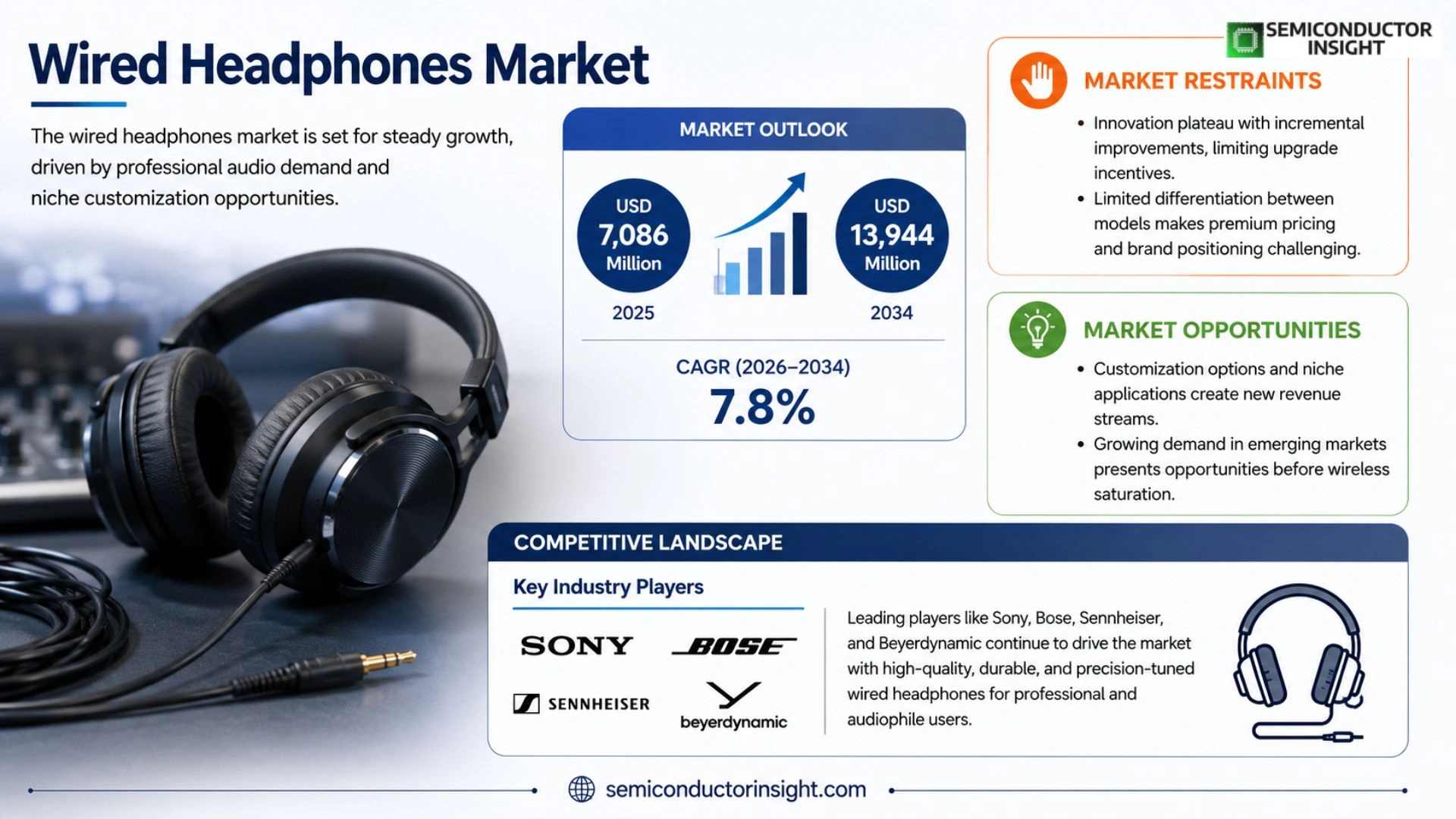
Global Wired Headphones market size was valued at USD 7,086 million in 2025 and climbs to roughly USD 13,944 million by 2034, reflecting an estimated CAGR of about 7.8% over the period.
Wired Headphones are personal audio terminals that directly connect to source devices via physical cables, converting electrical signals into sound through built‑in drivers. Unlike Bluetooth‑based products, they transmit continuous analog current through copper conductors, delivering zero latency and lossless playback. The typical architecture comprises a plug (commonly 3.5 mm or USB‑C), cable, optional splitter, and earcup housing.
Battery‑life anxiety surrounding wireless alternatives and the demand for absolute synchronization in professional recording, esports gaming, and high‑fidelity listening encourage a steady return to wired designs.
MARKET DRIVERS
Premium Audio Demand
Wired Headphones Market benefits from a growing cohort of audiophiles who prioritize signal purity over convenience. Studio engineers and critical listeners cite the absence of compression artifacts as a decisive factor, prompting manufacturers to launch models with high‑resolution drivers and low‑impedance cables. This preference sustains a price premium that offsets the declining cost of wireless modules.
Professional & Gaming Segments
In professional recording settings and competitive gaming, latency remains a non‑negotiable metric. Wired connections guarantee sub‑millisecond transmission, a characteristic that streaming‑oriented Bluetooth cannot match. Companies that integrate detachable, high‑strength cables have captured notable share among esports teams that demand consistent performance.
➤ “For critical listening, the latency advantage of wired headsets is a decisive buying criterion, especially where frame‑accurate audio is mandatory.”
Supply‑chain adjustments after recent component shortages have lowered production lead times for cable assemblies. Manufacturers that diversified their sourcing of copper and shielding materials can meet quarterly demand spikes, reinforcing the market’s resilience amid broader semiconductor volatility.
MARKET CHALLENGES
Consumer Preference Shift
Retail surveys indicate that a sizable portion of new headphone buyers now favor Bluetooth solutions for their mobility. Younger demographics associate wireless freedom with lifestyle branding, diverting discretionary spend away from tethered options. This cultural shift erodes the traditional retail shelf space allocated to wired models.
Other Challenges
Pricing Pressure
Entry‑level wired headphones are increasingly priced close to mid‑range wireless units, squeezing profit margins for manufacturers that rely on volume sales. Cost‑conscious brands must either innovate with premium materials or accept tighter spreads.
Environmental regulations in Europe and North America are tightening requirements for plastic usage in cable jackets. Companies that fail to adopt recyclable or bio‑based polymers may face higher compliance costs, potentially limiting market entry for smaller players.
MARKET RESTRAINTS
Innovation Plateau
Technical breakthroughs in wired technology have largely centered on incremental improvements,such as enhanced shielding or ergonomic ear cups,rather than disruptive leaps. This plateau reduces the incentive for early adopters to upgrade, especially when wireless alternatives showcase active noise cancellation and spatial audio features.
The limited differentiation between flagship and mid‑tier wired models constrains brand storytelling. Without clear feature hierarchies, marketers struggle to justify premium pricing, which can suppress overall market velocity.
MARKET OPPORTUNITIES
Customization & Niche Applications
Tailored cable lengths, detachable connectors, and proprietary sound signatures present untapped revenue streams. Small‑batch production leveraging 3D‑printed housings enables brands to cater to boutique musicians and esports teams seeking a distinct auditory identity.
Emerging markets in Southeast Asia exhibit rising disposable income paired with strong demand for high‑fidelity audio. Companies that localize product lines,offering region‑specific aesthetics and language‑specific user manuals,can capture market share before wireless saturation occurs.
Wired Headphones Market Trends
Enduring Preference for Zero‑Latency Audio
Wired Headphones Market continues to thrive in environments where timing precision matters more than convenience. Professionals in recording studios, live‑stage monitoring and competitive esports rely on the uninterrupted electrical pathway that eliminates any perceptible lag. This technical advantage translates into a competitive edge for producers who cannot tolerate even a few milliseconds of delay, and for gamers whose reaction time is measured in frames. Manufacturers have responded by integrating high‑resolution codecs and modular cable systems that preserve signal integrity while addressing user‑experience complaints such as tangling. Because the audio chain remains wholly analog, the perceived fidelity often surpasses that of compressed Bluetooth streams, reinforcing the product’s reputation among audiophiles who value uncolored sound reproduction.
Other Trends
Consumer Re‑engagement Triggered by Battery‑Life Anxiety
While wireless solutions dominate mainstream media narratives, a notable segment of consumers is reverting to wired options due to concerns over battery depletion during long listening sessions. Business travelers and remote workers cite the assurance of continuous playback without the need to recharge as a decisive factor when choosing between a Bluetooth earset and a traditional wired pair. This sentiment has prompted brands to release limited‑edition retro designs that double as fashion statements, leveraging social‑media influence to create an emotional hook. The convergence of practical utility and aesthetic appeal has opened a niche revenue stream that offsets pressure from declining smartphone jack availability, especially in markets where adapters remain costly or inconvenient.
Regional Production Strength and Supply‑Chain Resilience
Asia Pacific retains its status as the manufacturing hub for Wired Headphones Market, benefitting from vertically integrated supply chains that streamline copper‑cable procurement and high‑precision driver assembly. Companies operating in China and Japan capitalize on lower material costs while maintaining strict quality controls, enabling them to serve both premium audiophile segments and mass‑market entry‑level buyers. In North America, higher disposable income fuels demand for studio‑grade monitoring units, prompting distributors to stock a broader range of high‑impedance models. European purchasers, influenced by sustainability regulations, increasingly favor modular designs that allow component replacement, thereby extending product lifecycles and reducing waste. These regional dynamics collectively shape pricing strategies and profit margins across the global value chain.
COMPETITIVE LANDSCAPE
Key Industry Players
Wired Headphones Market: Competitive Dynamics and Leading Brands
The wired segment remains anchored by a handful of multinational manufacturers whose product portfolios span entry‑level to audiophile‑grade offerings. Sony and Bose dominate the premium‑performance niche, leveraging extensive R&D pipelines to embed high‑resolution codecs and active‑noise‑cancelling architectures while preserving the zero‑latency advantage that professional studios and esports arenas demand. Sennheiser and Beyerdynamic retain deep roots in broadcasting and live‑sound monitoring, where durability and precise acoustic imaging translate into recurring institutional contracts. JBL, backed by the Estee Lauder conglomerate, capitalizes on a strong consumer‑entertainment presence, bundling robust build quality with aggressive pricing that sustains volume sales across North America and Europe. Collectively, these firms command a sizable share of global revenue, dictating pricing benchmarks and setting the technical bar for impedance, driver technology, and modular cable systems.
Beyond the headline names, the market features a vibrant ecosystem of specialized and emerging competitors that address distinct use‑cases. Shure and AKG continue to focus on studio‑grade monitoring, offering interchangeable cable solutions that appeal to mixing engineers seeking component upgrades. Plantronics and Jabra, traditionally known for office headsets, have repurposed their ergonomic expertise toward hybrid wired‑wireless hybrids for corporate environments. Boutique manufacturers such as Grado Labs, HiFiMAN, and Audeze differentiate themselves through hand‑crafted driver designs and premium materials, catering to audiophiles willing to pay a premium for sonic character. Asian innovators including 1MORE, FiiO, Moondrop, and QCY employ streamlined supply chains to deliver competitive specifications at lower price points, fueling growth in emerging markets where cost sensitivity is paramount. This layered competitive fabric creates a landscape where strategic partnerships, component sourcing efficiencies, and focused brand narratives are essential levers for market share expansion.
List of Key Wired Headphones Companies Profiled
- Sony
- Bose
- Sennheiser
- JBL
- Beyerdynamic
- Shure
- AKG
- Plantronics
- Grado Labs
- HiFiMAN
- 1MORE
- FiiO
- Moondrop
- QCY
- Shanling
Segment Analysis:
| Segment Category | Sub-Segments | Key Insights |
| By Type |
|
High‑Fidelity Audiophiles
|
| By Application |
|
Professional Audio Producers
|
| By End User |
|
Competitive Gamers
|
| By Acoustic Principle |
|
Dynamic Driver Enthusiasts
|
| By Cable Arrangement |
|
Detachable‑Cable Advocates
|
Regional Analysis: Wired Headphones Market
North America
Audiophiles in the United States and Canada increasingly bench‑test wired models against high‑resolution streaming services, seeking tangible soundstage separation. This trend fuels niche demand for detachable cables and modular driver swaps, prompting brands to expand customization options that preserve the tactile assurance of a physical connection.
Brick‑and‑mortar outlets have shifted from pure volume sales to experiential showcases, allowing shoppers to audition headphones in acoustic‑treated booths. Online platforms complement this model by offering detailed sound‑signature videos, bridging the gap between tactile trials and digital convenience.
Manufacturers embed smart features such as inline DACs and active noise‑cancellation modules that draw power from the source device, delivering hybrid performance without sacrificing the reliability of a wired link. This convergence appeals to professionals who demand low latency and high dynamic range.
Ongoing scrutiny of electronic waste policies encourages producers to design headphones with recyclable components and detachable cords, aligning product stewardship with corporate sustainability goals while preserving market eligibility across state‑level regulations.
Europe
European consumers exhibit a balanced appetite for wired and wireless solutions, yet cultural attachment to high‑fidelity equipment sustains a resilient Wired Headphones Market segment. In Germany and the United Kingdom, audio‑centric education programs have cultivated a generation of engineers and musicians who advocate for uncompromised signal paths. Retail franchises prioritize boutique collaborations, offering limited‑edition models that emphasize craftsmanship. Meanwhile, sustainability regulations in the EU stimulate a shift toward modular designs, prompting manufacturers to adopt recyclable materials and offer extended warranties to meet consumer expectations for longevity.
Asia‑Pacific
The Asia‑Pacific landscape combines rapid urbanization with a deep‑rooted appreciation for sound quality, especially in South Korea, Japan, and India. While younger demographics gravitate toward seamless wireless experiences, a substantial cohort of content creators and gaming enthusiasts favor wired headphones for their deterministic latency and precise monitoring capabilities. Local manufacturers leverage cost‑effective supply chains to produce competitively priced wired products, ensuring market penetration across price‑sensitive segments. Concurrently, rising disposable incomes in emerging economies accelerate demand for premium wired options that deliver studio‑grade performance without the battery‑related trade‑offs of wireless alternatives.
South America
In South America, economic variability shapes purchasing behavior, yet Wired Headphones Market retains relevance among educators and live‑performance venues where reliability outweighs novelty. Brazil and Argentina host a vibrant music‑production community that values the durability of robust cable constructions, especially in touring contexts where battery depletion poses operational risk. Retailers respond by stocking a mix of internationally recognized brands and regional producers who emphasize rugged designs. Growing awareness of electronic waste disposal drives interest in headphones with replaceable cords, aligning commercial offerings with emerging environmental standards.
Middle East & Africa
The Middle East & Africa region reflects a nuanced interplay between luxury branding and pragmatic adoption. In the United Arab Emirates and South Africa, affluent consumers seek high‑end wired headphones as status symbols that also guarantee uncompromised audio reproduction for luxury vehicles and private studios. Conversely, in markets with limited broadband infrastructure, wired solutions remain the most dependable means of accessing high‑resolution audio content. Distributors focus on curating assortments that blend iconic heritage models with emerging African designers, fostering a nascent ecosystem that prioritizes durability, repairability, and culturally resonant aesthetics.
Report Scope
This market research report provides a comprehensive analysis of the Wired Headphones Market , covering the forecast period 2026–2034. It offers detailed insights into market dynamics, technological advancements, competitive landscape, and key trends shaping the industry.
Key focus areas of the report include:
- Market Overview: The report begins with an overview outlining its current market scenario, key growth indicators, and industry transformation drivers. It discusses macroeconomic factors, demand–supply balance, regulatory landscape, and the strategic role of semiconductors in powering advancements across industries such as automotive, telecommunications, consumer electronics, and industrial automation.
- Market Size & Forecast: Historical data and future projections for revenue, unit shipments, and market value across major regions and segments.
- Segmentation Analysis: Detailed breakdown by product type, technology, application, and end-user industry to identify high-growth segments and investment opportunities.
- Regional Insights: Insights into market performance across North America, Europe, Asia-Pacific, Latin America, and the Middle East & Africa, including country-level analysis where relevant.
- Competitive Landscape: Profiles of leading market participants, including their product offerings, R&D focus, manufacturing capacity, pricing strategies, and recent developments such as mergers, acquisitions, and partnerships.
- Technology Trends & Innovation: Assessment of emerging technologies, integration of AI/IoT, semiconductor design trends, fabrication techniques, and evolving industry standards.
- Market Drivers & Restraints: Evaluation of factors driving market growth along with challenges, supply chain constraints, regulatory issues, and market-entry barriers.
- Stakeholder Insights: Insights for component suppliers, OEMs, system integrators, investors, and policymakers regarding the evolving ecosystem and strategic opportunities.
Primary and secondary research methods are employed, including interviews with industry experts, data from verified sources, and real-time market intelligence to ensure the accuracy and reliability of the insights presented.
FREQUENTLY ASKED QUESTIONS:
What is the current market size of Wired Headphones Market?
-> Wired Headphones Market was valued at USD 7,086 million in 2025 and is expected to reach USD 11,892 million by 2032, growing at a CAGR of 7.8% during the forecast period.
Which key companies operate in Wired Headphones Market?
-> Key players include Sony, Bose, Sennheiser, JBL, Beyerdynamic, Shure, Denon, Koss, Ultrasone, Jabra, BANG & OLUFSEN, PLANTRONICS, AKG, Grado Labs, Westone, Audeze, JVC, Roland, Etymotic Research, Neumann, Custom Art, Edifier, TANCHJIM, NiceHCK, QCY, Shanling, 1MORE, HiFiMAN, FiiO, Moondrop, among others.
What are the key growth drivers?
-> Key growth drivers include battery‑life anxiety and connection‑stability concerns with wireless headphones, the demand for zero‑latency and lossless sound quality in professional audio, esports gaming and music monitoring, integration of high‑resolution audio standards and active noise‑cancellation, and the retro fashion trend driven by celebrities and social media.
Which region dominates the market?
-> Asia‑Pacific dominates Wired Headphones Market, supported by extensive manufacturing supply chains, large domestic consumer bases in China and Japan, and growing adoption in emerging Southeast Asian markets.
What are the emerging trends?
-> Emerging trends include high‑resolution audio support, active‑noise‑cancellation features in wired designs, retro‑styled fashion accessories, and the incorporation of modular, repairable designs driven by environmental regulations.
Get Sample Report PDF for Exclusive Insights
Report Sample Includes
- Table of Contents
- List of Tables & Figures
- Charts, Research Methodology, and more...
 Download Sample Report PDF