MARKET INSIGHTS
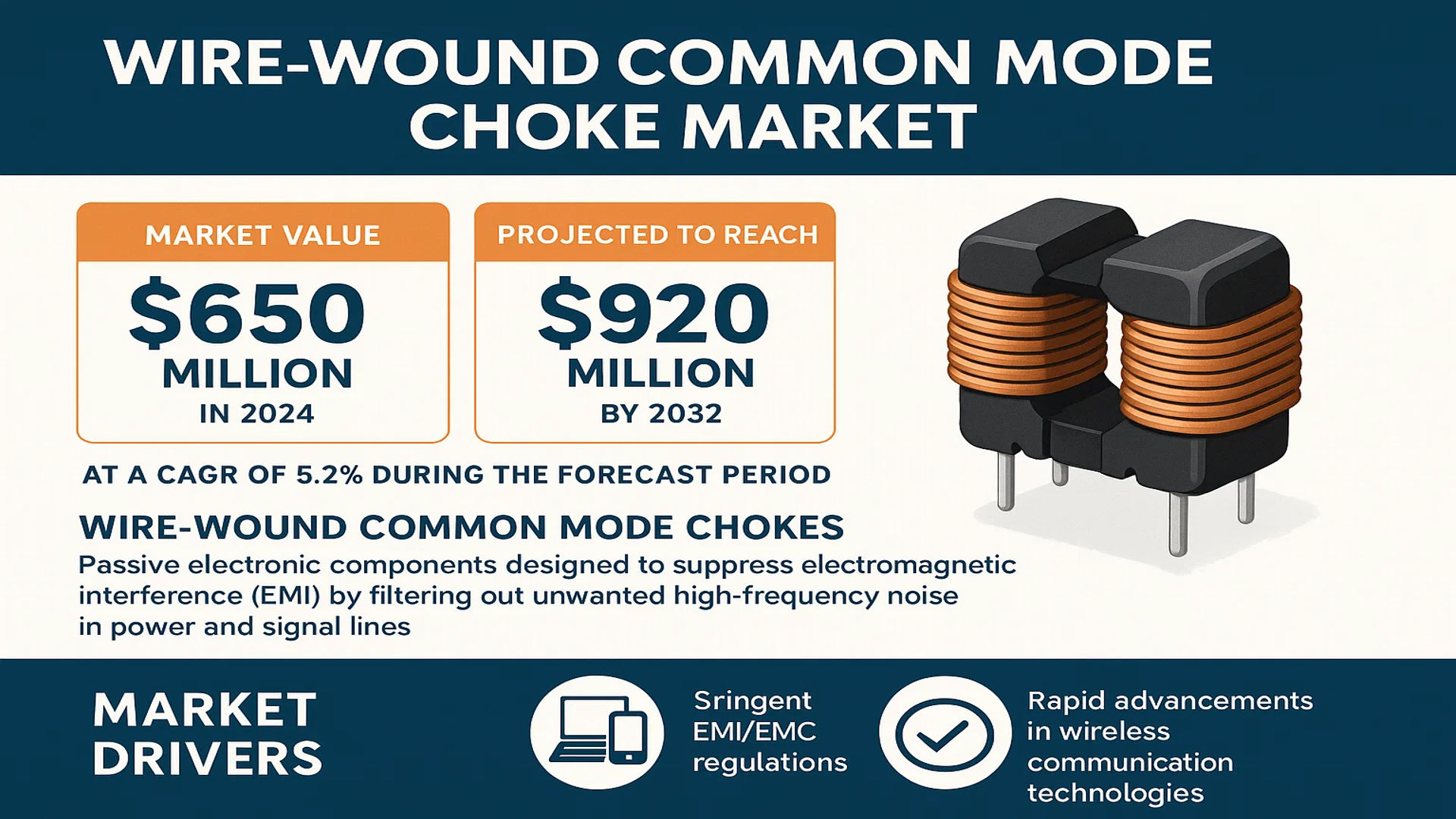
The global Wire-Wound Common Mode Choke Market was valued at 650 million in 2024 and is projected to reach US$ 920 million by 2032, at a CAGR of 5.2% during the forecast period.
Wire-wound common mode chokes are passive electronic components designed to suppress electromagnetic interference (EMI) by filtering out unwanted high-frequency noise in power and signal lines. These devices consist of two or more coils wound on a magnetic core, which attenuate common-mode currents while allowing differential signals to pass through. They are widely used in applications such as power supplies, data communication systems, and automotive electronics to ensure signal integrity and compliance with EMI regulations.
The market is driven by increasing demand for electronic devices, stringent EMI/EMC regulations, and rapid advancements in wireless communication technologies. Asia Pacific dominates the market with a 57% share, followed by North America (15%) and Europe (11%). Key players such as Murata, TDK, and Chilisin collectively hold 41% of the market, leveraging their technological expertise and extensive product portfolios to maintain competitive advantage.
MARKET DYNAMICS
MARKET DRIVERS
Rising Demand for EMI/RFI Suppression in Electronics to Accelerate Market Growth
The proliferation of electronic devices across industries is significantly driving demand for wire-wound common mode chokes, as these components play a critical role in suppressing electromagnetic interference (EMI) and radio frequency interference (RFI). With the global electronics market expanding rapidly—projected to exceed $3 trillion by 2030—the need for effective noise suppression solutions has never been greater. These chokes are particularly vital in high-frequency applications where signal integrity is paramount, such as 5G infrastructure and advanced automotive electronics. The increasing complexity of circuits and higher operating frequencies in modern devices make EMI suppression components indispensable for maintaining performance reliability.
Automotive Electrification Trend to Fuel Adoption
The accelerating shift toward electric vehicles (EVs) represents a major growth driver for wire-wound common mode chokes. Electric powertrains generate significant electromagnetic noise that requires mitigation, with current projections indicating that EV sales will account for over 30% of global vehicle sales by 2030. These components are essential for power line communications and battery management systems in EVs, where they prevent interference with critical control signals. The automotive industry’s stringent EMC (electromagnetic compatibility) standards are further compelling manufacturers to incorporate high-performance common mode chokes in their designs.
Additionally, increasing investments in renewable energy systems and smart grid technologies are expanding application opportunities. Solar inverters and wind turbine generators require robust EMI filtering solutions to ensure stable power conversion and transmission.
MARKET RESTRAINTS
Material Cost Volatility to Pressure Profit Margins
The wire-wound common mode choke market faces significant challenges from fluctuating raw material costs, particularly for copper and ferrite cores which account for approximately 60-70% of component costs. Copper prices have shown historical volatility, with recent market conditions causing price swings exceeding 25% year-over-year. This unpredictability creates margin pressure for manufacturers who face difficulty passing cost increases to customers in competitive markets. The specialized nature of high-permeability materials required for optimal performance further compounds cost challenges, as limited suppliers create potential supply chain bottlenecks.
Other Constraints
Design Complexity Challenges
Miniaturization trends in electronics are pushing common mode chokes to their physical limits, requiring increasingly sophisticated winding techniques and materials. The balance between size reduction and maintaining required inductance values presents significant engineering hurdles that slow development cycles.
Competitive Pricing Pressure
The presence of numerous regional manufacturers offering lower-cost alternatives creates pricing pressure on established suppliers. This is particularly evident in consumer electronics applications where cost sensitivity is extreme.
MARKET CHALLENGES
Technical Limitations in High-Frequency Applications
While wire-wound common mode chokes excel in low to medium frequency ranges, their performance degrades significantly at higher frequencies—typically above 1GHz. This creates compatibility challenges with emerging 5G and millimeter-wave applications where operating frequencies continue to climb. Parasitic capacitances inherent in traditional winding techniques limit effectiveness, requiring expensive alternative solutions or compromising system performance. These limitations are becoming increasingly problematic as communication protocols push toward higher bandwidths and faster data rates.
Additionally, thermal management presents growing challenges as power densities increase. The need for smaller components with higher current handling capabilities creates heat dissipation issues that can affect reliability and lifespan.
MARKET OPPORTUNITIES
Emerging AI and IoT Applications to Open New Growth Avenues
The rapid expansion of artificial intelligence (AI) systems and Internet of Things (IoT) devices represents a significant growth opportunity for wire-wound common mode choke manufacturers. With over 75 billion IoT devices projected to be in use by 2025, the need for reliable EMI filtering in distributed sensor networks and edge computing devices will grow substantially. AI server farms and data centers are increasingly demanding high-performance noise suppression components to maintain signal integrity in densely packed racks. This emerging application area requires chokes capable of handling complex noise spectra associated with high-speed computing environments.
Advanced Material Innovations to Enable Market Expansion
Breakthroughs in nanocrystalline and amorphous magnetic materials are creating opportunities for next-generation common mode chokes with superior performance characteristics. These advanced materials offer higher permeability and saturation flux density compared to traditional ferrites, enabling smaller form factors with improved efficiency. Manufacturers investing in material science research can potentially capture premium market segments requiring enhanced performance. The medical electronics sector, where both miniaturization and reliability are critical, presents particularly promising opportunities for advanced choke solutions.
WIRE-WOUND COMMON MODE CHOKE MARKET TRENDS
Rising Demand for EMI Suppression in Electronics Drives Market Growth
The global wire-wound common mode choke market is experiencing steady growth, with projections estimating expansion from $650 million in 2024 to $920 million by 2032, at a CAGR of 5.2%. This upward trajectory is primarily fueled by increasing demand for electromagnetic interference (EMI) suppression in electronic devices. As modern electronics become more compact and power-dense, the need for effective noise filtering solutions has intensified. These chokes play a crucial role in suppressing common mode noise in power supply lines, making them indispensable in applications ranging from consumer electronics to automotive systems. With the proliferation of IoT devices and 5G infrastructure, component manufacturers are seeing heightened demand for these specialized filtering components.
Other Key Trends
Automotive Electrification and ADAS Systems
The rapid electrification of vehicles and growing adoption of Advanced Driver Assistance Systems (ADAS) are significantly driving demand for high-performance common mode chokes. Modern electric vehicles contain numerous sensitive electronic systems that require robust EMI protection, particularly in battery management systems and motor drives. Statistical projections suggest that the automotive segment accounts for approximately 18-22% of overall wire-wound common mode choke demand as of 2024. With autonomous vehicle technologies advancing, manufacturers are developing specialized chokes capable of withstanding harsh automotive environments while maintaining superior noise suppression characteristics.
Miniaturization Trend and High-Frequency Applications
The ongoing miniaturization of electronic components is pushing manufacturers to develop smaller yet more efficient wire-wound chokes capable of operating at higher frequencies. Surface-mount device (SMD) variants now account for nearly 65% of total market share due to their compatibility with automated PCB assembly processes. Meanwhile, the shift toward high-frequency power electronics in applications like server power supplies and telecom infrastructure is driving innovation in materials and winding techniques. Manufacturers are increasingly utilizing advanced ferrite cores and optimized winding patterns to achieve better performance within smaller form factors while maintaining thermal stability.
While the market shows strong growth potential, manufacturers face challenges related to raw material costs and supply chain complexities. The reliance on specialty ferrite materials and precision copper wire creates potential bottlenecks during periods of commodity price volatility. However, strategic partnerships between component suppliers and material science companies are helping stabilize supply chains while driving continuous product improvements through advanced materials research.
COMPETITIVE LANDSCAPE
Key Industry Players
Technological Innovation and Strategic Expansion Drive Market Competition
The global wire-wound common mode choke market is characterized by a mix of established electronics component manufacturers and specialized electromagnetic interference (EMI) solution providers. Murata Manufacturing Co., Ltd. and TDK Corporation dominate the industry, collectively holding approximately 28% market share as of 2024. Their leadership stems from decades of experience in passive components and continuous investments in miniaturization technologies for modern electronics applications.
While the Asia-Pacific region accounts for 57% of global demand, Japanese firms Taiyo Yuden and Chilisin Electronics have been aggressively expanding their production capacities to meet growing requirements from consumer electronics and automotive sectors. Recent facility expansions in Southeast Asia have positioned these companies to better serve regional OEMs while maintaining competitive pricing.
The market has seen increased consolidation, with YAGEO Corporation acquiring several smaller choke manufacturers since 2021 to strengthen its product portfolio. Similarly, Vishay Intertechnology has focused on developing high-temperature resistant chokes for automotive applications, capitalizing on the electric vehicle boom.
Emerging players like Sunlord Electronics are challenging incumbents through cost-competitive offerings, particularly in the mid-range SMD choke segment. However, established brands maintain their edge through patented core materials and winding technologies that deliver superior noise suppression performance.
List of Key Wire-Wound Common Mode Choke Manufacturers
- Murata Manufacturing Co., Ltd. (Japan)
- TDK Corporation (Japan)
- Chilisin Electronics Corp. (Taiwan)
- Taiyo Yuden Co., Ltd. (Japan)
- Cyntec Co., Ltd. (Taiwan)
- Sunlord Electronics (China)
- Vishay Intertechnology, Inc. (U.S.)
- TAI-TECH Advanced Electronic Co., Ltd. (Taiwan)
- Sumida Corporation (Japan)
- YAGEO Corporation (Taiwan)
- Eaton Corporation (Ireland)
- Schaffner Holding AG (Switzerland)
- Laird Performance Materials (U.K.)
- TAMURA CORPORATION (Japan)
- Coilcraft, Inc. (U.S.)
Segment Analysis:
By Type
SMD Common Mode Choke Segment Leads the Market Due to High Integration in Compact Electronic Devices
The market is segmented based on type into:
- SMD Common Mode Choke
- Subtypes: High-frequency, Low-profile, and others
- Through Hole Common Mode Choke
- Subtypes: Radial, Axial, and others
By Application
Automotive Segment Exhibits Strong Growth Due to Increasing EMC Requirements in Electric Vehicles
The market is segmented based on application into:
- Communication
- Industrial
- Automotive
- Consumer Electronics
- Others
By Material
Ferrite Core Dominates Due to Excellent Noise Suppression Properties
The market is segmented based on material into:
- Ferrite Core
- Subtypes: Manganese-zinc, Nickel-zinc, and others
- Powdered Iron Core
- Amorphous Core
By Power Rating
Low Power Segment Holds Significant Share Owing to Widespread Use in Consumer Electronics
The market is segmented based on power rating into:
- Low Power (Below 1A)
- Medium Power (1A-5A)
- High Power (Above 5A)
Regional Analysis: Wire-Wound Common Mode Choke Market
Asia-Pacific
As the dominant region holding 57% of global market share, Asia-Pacific drives wire-wound common mode choke demand through rapid industrialization, expanding telecom infrastructure, and increasing automotive electronics production. China remains the epicenter, with domestic players like Taiyo Yuden and Sunlord Electronics capturing significant shares. Japan’s precision manufacturing prowess supports high-end choke production, particularly for automotive applications where reliability is critical. The proliferation of 5G networks and renewable energy systems across India and Southeast Asia further accelerates adoption. However, price sensitivity in developing markets has led to a mix of premium and budget solutions coexisting in the region.
North America
Accounting for 15% of global sales, North America’s market thrives on stringent electromagnetic compatibility (EMC) regulations and robust R&D investments. The U.S. Department of Defense’s MIL-STD-461 standards govern many applications, pushing manufacturers toward high-performance chokes. Companies like Coilcraft and Bourns lead innovation in miniaturized SMD components for aerospace and medical devices. Electric vehicle adoption and clean energy initiatives present new opportunities, though reliance on Asian suppliers for cost-effective solutions persists. Recent reshoring efforts in semiconductor manufacturing could strengthen domestic choke production capabilities by 2026-2028.
Europe
With an 11% market share, Europe emphasizes energy-efficient choke designs compliant with the Ecodesign Directive and RoHS standards. German automotive Tier 1 suppliers increasingly incorporate advanced chokes in electric drivetrains, collaborating with partners like TDK and Schaffner. The region’s industrial automation sector prioritizes ruggedized through-hole chokes for harsh environments. While innovation remains strong, market growth faces headwinds from prolonged economic uncertainty and competition from Asian manufacturers offering comparable specifications at lower prices. Sustainability-focused redesigns using recyclable materials present a potential growth avenue.
South America
This emerging market shows gradual growth, primarily driven by Brazil’s industrial equipment sector and Argentina’s renewable energy projects. Infrastructure limitations and import dependence constrain market expansion, though local assembly of consumer electronics has spurred demand for mid-range chokes. Currency fluctuations make long-term procurement planning challenging for manufacturers, leading to conservative inventory strategies. The lack of regional component standards results in heterogeneous product requirements across countries, complicating market entry for international suppliers.
Middle East & Africa
Telecom infrastructure upgrades and smart city initiatives in Gulf Cooperation Council (GCC) countries underpin regional demand, albeit from a small base. South Africa serves as a manufacturing hub for automotive electronics, utilizing imported choke components. Political instability and fragmented regulations across African nations inhibit consistent market development, though Chinese investments in local production facilities may alter the landscape post-2025. The absence of regional testing standards leads to reliance on international certifications like IEC and UL for component approvals.
Report Scope
This market research report provides a comprehensive analysis of the global Wire-Wound Common Mode Choke market, covering the forecast period 2025–2032. It offers detailed insights into market dynamics, technological advancements, competitive landscape, and key trends shaping the industry.
Key focus areas of the report include:
- Market Size & Forecast: Historical data and future projections for revenue, unit shipments, and market value across major regions and segments. The global Wire-Wound Common Mode Choke market was valued at USD 650 million in 2024 and is projected to reach USD 920 million by 2032, growing at a CAGR of 5.2%.
- Segmentation Analysis: Detailed breakdown by product type (SMD Common Mode Choke, Through Hole Common Mode Choke), application (Communication, Industrial, Automotive, Consumer Electronics, Others), and end-user industry to identify high-growth segments.
- Regional Outlook: Insights into market performance across North America, Europe, Asia-Pacific, Latin America, and Middle East & Africa. Asia-Pacific dominates with 57% market share, followed by North America (15%) and Europe (11%).
- Competitive Landscape: Profiles of leading market participants including Murata, TDK, Chilisin, Taiyo Yuden, and others, covering their product portfolios, market share (top 3 players hold 41% share), and strategic developments.
- Technology Trends & Innovation: Assessment of emerging EMI suppression technologies, miniaturization trends, and material advancements in choke design.
- Market Drivers & Restraints: Evaluation of factors such as growing demand for electronic components, EMI regulations, and supply chain challenges.
- Stakeholder Analysis: Strategic insights for component manufacturers, OEMs, and investors in the electronics supply chain.
The report employs primary and secondary research methodologies, including analysis of industry databases, company financials, and interviews with key stakeholders to ensure data accuracy.
FREQUENTLY ASKED QUESTIONS:
What is the current market size of Global Wire-Wound Common Mode Choke Market?
-> Wire-Wound Common Mode Choke Market was valued at 650 million in 2024 and is projected to reach US$ 920 million by 2032, at a CAGR of 5.2% during the forecast period.
Which key companies operate in Global Wire-Wound Common Mode Choke Market?
-> Key players include Murata, TDK, Chilisin, Taiyo Yuden, Vishay, and YAGEO Corporation, with the top 3 companies holding 41% market share.
What are the key growth drivers?
-> Key growth drivers include increasing electronic component demand, stricter EMI regulations, and growth in automotive/consumer electronics sectors.
Which region dominates the market?
-> Asia-Pacific leads with 57% market share, driven by electronics manufacturing in China, Japan, and South Korea.
What are the emerging trends?
-> Emerging trends include miniaturization of components, advanced ferrite materials, and integration with power electronics.

Get Sample Report PDF for Exclusive Insights
Report Sample Includes
- Table of Contents
- List of Tables & Figures
- Charts, Research Methodology, and more...
 Download Sample Report PDF