Market Insights
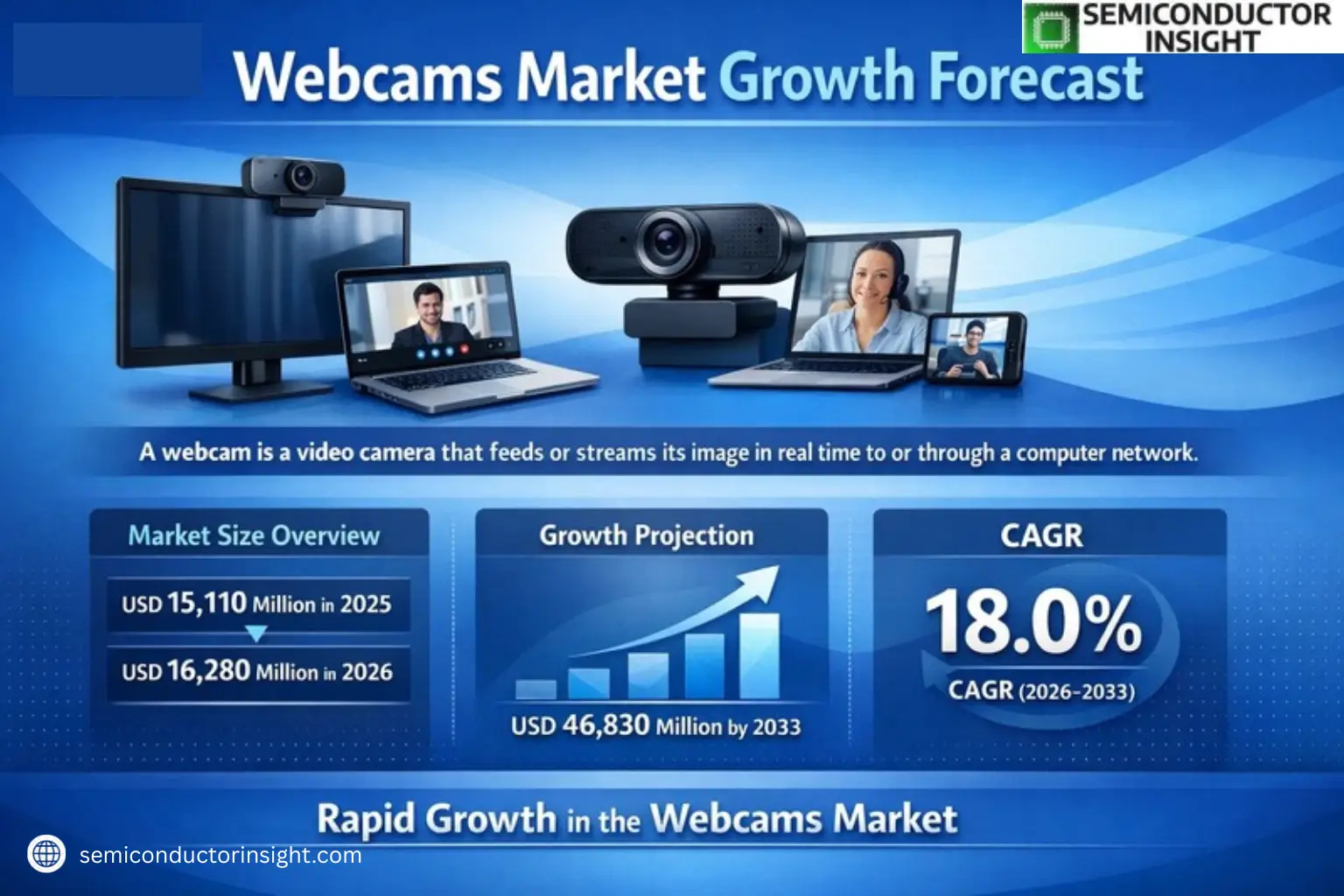
Global Webcams Market size was valued at USD 15,110 million in 2025. The market is projected to grow from USD 16,280 million in 2026 to USD 46,830 million by 2033, exhibiting a CAGR of 18.0% during the forecast period.
A webcam is a video camera that feeds or streams its image in real time to or through a computer network. These devices capture video streams that can be saved, viewed, or transmitted over the internet via email or other platforms. Unlike IP cameras, which connect via Ethernet or Wi-Fi, webcams typically use USB cables or are integrated into hardware like laptops.
The market growth is driven by increasing demand for remote communication tools, accelerated by hybrid work models and virtual collaboration trends. While USB port-based webcams dominate with a 70% market share, wireless variants are gaining traction due to convenience. China leads regional adoption with a 45% market share, followed by Japan and Europe at approximately 15% each. Key players like Logitech and Microsoft continue innovating with HD resolution and AI-enhanced features to meet evolving user needs across applications ranging from video conferencing to telehealth.
MARKET DRIVERS
Rising Demand for Remote Communication
Webcams Market is experiencing significant growth due to the increasing reliance on remote work and virtual collaboration. With over 65% of businesses adopting hybrid work models, high-quality webcams have become essential for professional communication. Consumer preference for 1080p and 4K resolution cameras is driving manufacturers to enhance product offerings.
E-Learning Expansion
Educational institutions worldwide are incorporating digital learning platforms, creating sustained demand for webcams. Global e-learning market growth of approximately 15% annually directly benefits the webcam sector, with schools and universities investing in better video hardware
The gaming and content creation sectors also contribute to market growth, with streamers and professionals seeking advanced features like auto-focus and low-light correction.
MARKET CHALLENGES
Supply Chain Disruptions
Webcams Market faces component shortages, particularly for high-end image sensors. Semiconductor supply issues have led to production delays across major manufacturers, impacting inventory levels globally.
Other Challenges
Laptop Integration Threat
Built-in laptop cameras are improving in quality, reducing demand for external webcams among casual users. Over 70% of premium laptops now feature HD or better integrated cameras.
Price Sensitivity
While professionals invest in premium webcams, the consumer segment remains highly price-conscious, limiting ASP growth in the overall Webcams Market.
MARKET RESTRAINTS
Market Saturation in Developed Regions
North America and Europe show slowing growth rates as webcam penetration reaches near 80% among remote workers. Replacement cycles are extending beyond three years, with many users satisfied with existing equipment quality.
Regulatory Compliance
Stricter data privacy regulations are increasing production costs, as manufacturers must implement hardware-based privacy shutters and enhanced encryption in webcam firmware.
MARKET OPPORTUNITIES
AI-Enhanced Webcams
The integration of AI features like automatic framing, background noise cancellation, and gesture control represents a USD 1.2 billion opportunity in the Webcams Market. These premium features command higher margins and drive replacement purchases.
Emerging Markets Expansion
Developing nations in Asia Pacific and Latin America show strong growth potential, with webcam adoption rates increasing by 25% annually as internet infrastructure improves and remote work policies gain traction.
Webcams Market Trends
Robust Market Growth Projected Through 2033
Global Webcams Market is experiencing significant expansion, with valuations reaching USD 15,110 million in 2025. Industry projections indicate a compound annual growth rate (CAGR) of 18.0%, potentially elevating the market size to USD 46,830 million by 2033. This surge is driven by increasing demand for remote communication solutions across multiple sectors including corporate, education, and healthcare.
Other Trends
Dominance of USB-Powered Devices
USB-connected webcams maintain market leadership, representing approximately 70% of total shipments. Their plug-and-play functionality and cost-effectiveness make them the preferred choice for individual consumers and small businesses. Wireless alternatives are gaining traction in enterprise environments but face battery life and connectivity challenges.
Regional Market Distribution
China commands the largest market share at 45%, supported by local manufacturing ecosystems and high technology adoption rates. Japan and Europe collectively account for 15% each, with North America showing accelerated growth due to hybrid work policies. Emerging markets in Southeast Asia demonstrate the highest growth potential at 22% CAGR.
Application-Specific Demand Patterns
Common network chatting applications lead webcam usage (38%), followed by video conferencing at 32%. The remote medical sector shows the fastest adoption growth at 25% annually, fueled by telehealth expansion. Automotive applications are emerging for in-vehicle communication systems, though currently representing less than 5% of total demand.
Manufacturer Landscape
The top five manufacturers control approximately 10% of global market share, with Logitech, Microsoft, and HP leading the segment. Chinese manufacturers like KYE Systems (Genius) are gaining competitive advantage through cost-effective production. Recent industry developments include AI-powered auto-framing technology and 4K resolution adoption moving from premium to mid-range products.
COMPETITIVE LANDSCAPE
Key Industry Players
Logitech Dominates Webcams Market with 35% Revenue Share in 2025
Global Webcams Market is moderately consolidated, with the top five manufacturers controlling nearly 10% of total market share. Logitech maintains undisputed leadership with its extensive product portfolio spanning consumer and professional segments. Microsoft and HP leverage their strong PC peripheral ecosystems to secure top positions, while Asian manufacturers like KYE Systems (Genius) and Teng Wei Video Technology capture cost-sensitive markets through competitive pricing.
Niche players are gaining traction through specialized offerings – D-Link focuses on security applications, Philips emphasizes healthcare-grade webcams, and Motorola targets enterprise video conferencing solutions. Emerging brands like Ausdom and TeckNet are disrupting the budget segment with feature-rich models under USD 50, intensifying competition in the APAC region which accounts for 45% of global demand.
List of Key Webcams Companies Profiled
- Logitech
- Microsoft
- HP
- D-Link
- Lenovo
- Philips
- Ausdom
- KYE Systems Corp (Genius)
- Motorola
- NEXIA
- Kinobo
- Teng Wei Video Technology Co.
- A4Tech
- TeckNet
Segment Analysis:
| Segment Category | Sub-Segments | Key Insights |
| By Type |
|
USB Ports
|
| By Application |
|
Common Network Chatting
|
| By End User |
|
Consumer
|
| By Price Range |
|
Budget
|
| By Technology |
|
1080p Full HD
|
Regional Analysis: Global Webcams Market
Corporate sector accounts for nearly half of North America’s webcam demand, with businesses prioritizing HD cameras for virtual meetings. Integration with UC platforms like Zoom and Teams drives replacement cycles.
Content creators and gamers fuel premium webcam sales, with 4K resolution and background blur features gaining popularity. Home users show preference for plug-and-play models with built-in microphones.
Silicon Valley firms pioneer AI-enhanced webcams with facial recognition and automatic lighting adjustment. Major vendors focus on developing privacy-focused models with physical shutters.
Online retailers capture over 60% of sales, while B2B distributors serve corporate clients. Specialty electronics stores maintain relevance for high-end webcam purchases requiring product demonstrations.
Europe
Europe represents the second-largest Webcams Market, characterized by stringent data privacy regulations influencing product design. Germany and UK lead regional adoption, with growing demand in France’s gaming sector. Corporate purchases focus on GDPR-compliant models, while educational institutions upgrade legacy equipment. Northern European countries show preference for eco-friendly webcams with energy-saving modes. The region’s mature retail infrastructure supports both online and offline sales channels.
Asia-Pacific
APAC emerges as the fastest-growing Webcams Market, led by China’s manufacturing capabilities and India’s expanding IT sector. Japan and South Korea demand high-tech cameras with advanced features, while Southeast Asia shows price sensitivity. Education technology investments drive bulk purchases across developing markets. Local brands gain traction with affordable models tailored for emerging market needs like low-bandwidth optimization.
Latin America
Brazil dominates Latin America’s webcam market, followed by Mexico’s growing IT outsourcing industry. Economic constraints limit premium product adoption, favoring mid-range models. Distance learning initiatives post-pandemic continue driving education sector demand. E-commerce platforms facilitate access to international brands while local assemblers compete on price.
Middle East & Africa
The region shows uneven adoption, with UAE and Saudi Arabia leading in premium webcam purchases for corporate use. South Africa remains the most developed market in Sub-Saharan Africa. Government digitization programs spur demand in GCC countries, while infrastructure challenges limit growth in other African markets.
Report Scope
This market research report provides a comprehensive analysis of the Webcams Market , covering the forecast period 2026–2033. It offers detailed insights into market dynamics, technological advancements, competitive landscape, and key trends shaping the industry.
Key focus areas of the report include:
- Market Overview: The report begins with an overview outlining its current market scenario, key growth indicators, and industry transformation drivers. It discusses macroeconomic factors, demand–supply balance, regulatory landscape, and the strategic role of semiconductors in powering advancements across industries such as automotive, telecommunications, consumer electronics, and industrial automation.
- Market Size & Forecast: Historical data and future projections for revenue, unit shipments, and market value across major regions and segments.
- Segmentation Analysis: Detailed breakdown by product type, technology, application, and end-user industry to identify high-growth segments and investment opportunities.
- Regional Insights: Insights into market performance across North America, Europe, Asia-Pacific, Latin America, and the Middle East & Africa, including country-level analysis where relevant.
- Competitive Landscape: Profiles of leading market participants, including their product offerings, R&D focus, manufacturing capacity, pricing strategies, and recent developments such as mergers, acquisitions, and partnerships.
- Technology Trends & Innovation: Assessment of emerging technologies, integration of AI/IoT, semiconductor design trends, fabrication techniques, and evolving industry standards.
- Market Drivers & Restraints: Evaluation of factors driving market growth along with challenges, supply chain constraints, regulatory issues, and market-entry barriers.
- Stakeholder Insights: Insights for component suppliers, OEMs, system integrators, investors, and policymakers regarding the evolving ecosystem and strategic opportunities.
Primary and secondary research methods are employed, including interviews with industry experts, data from verified sources, and real-time market intelligence to ensure the accuracy and reliability of the insights presented.
FREQUENTLY ASKED QUESTIONS:
What is the current market size of Webcams Market?
-> Webcams Market size was valued at USD 15,110 million in 2025. The market is projected to grow from USD 16,280 million in 2026 to USD 46,830 million by 2033, exhibiting a CAGR of 18.0% during the forecast period.
Which key companies operate in Webcams Market?
-> Key players include Logitech, Microsoft, Hp, D-Link, Lenovo, Philips, Ausdom, KYE Systems Corp(Genius), Motorola, NEXIA, among others.
What are the key growth drivers?
-> Key growth drivers include rising demand for video conferencing, remote work trends, and increasing adoption of USB port webcams.
Which region dominates the market?
-> China is the largest market with 45% share, followed by Europe and Japan with about 15% each.
What are the emerging trends?
-> Emerging trends include advancements in wireless webcams, integration with AI features, and increased demand for high-resolution streaming.

Get Sample Report PDF for Exclusive Insights
Report Sample Includes
- Table of Contents
- List of Tables & Figures
- Charts, Research Methodology, and more...
 Download Sample Report PDF