Wearable Sensors Market Insights
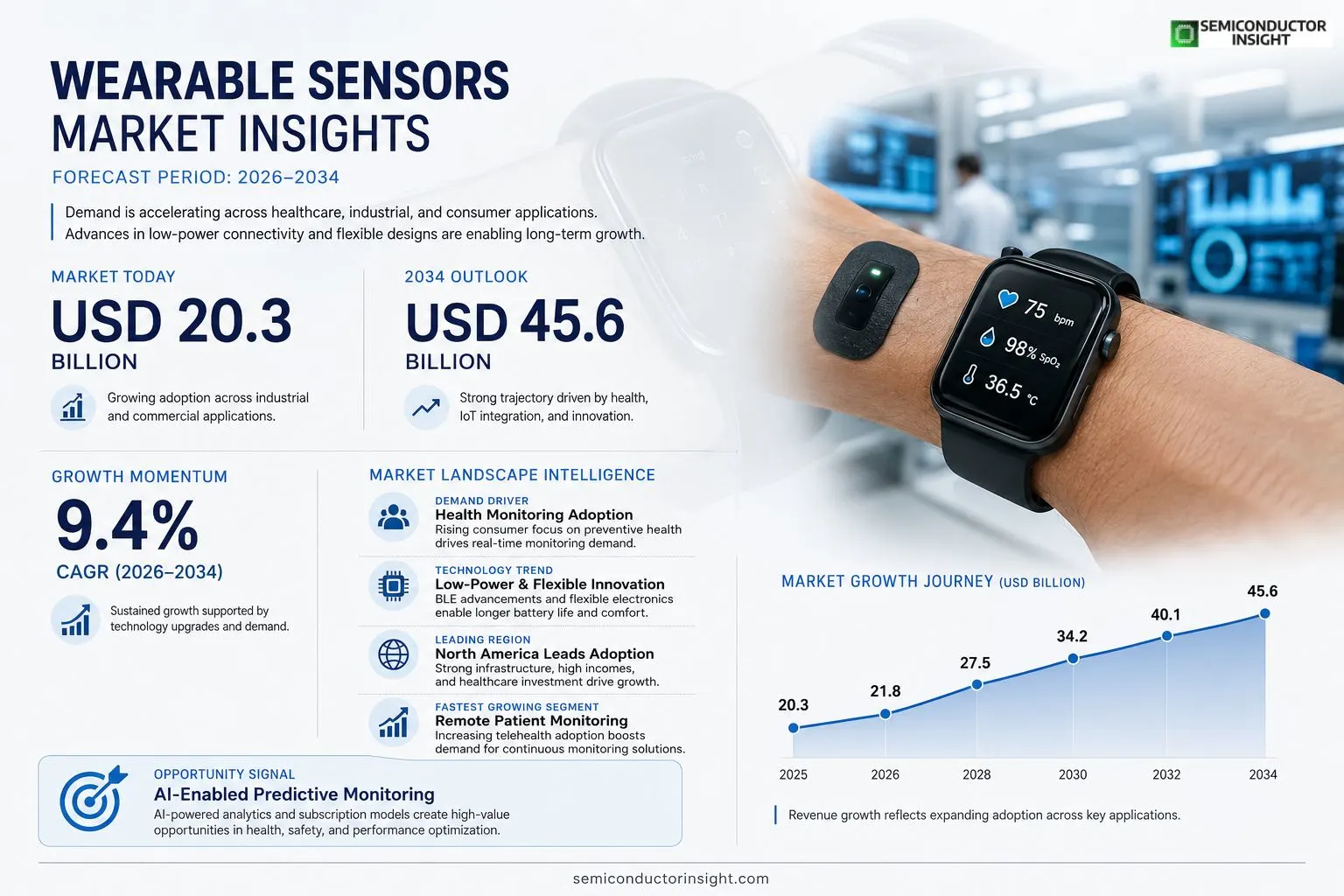
Wearable Sensors Market size was valued at USD 20.3 billion in 2025. The market is projected to grow from USD 21.8 billion in 2026 to USD 45.6 billion by 2034, exhibiting a CAGR of 9.4% during the forecast period.
Wearable sensors are compact electronic devices embedded in garments, accessories or directly on the skin that continuously capture physiological and environmental data such as heart rate, blood oxygen saturation, body temperature, motion dynamics and ambient conditions. These sensors enable real‑time health monitoring, activity tracking and seamless integration with Internet‑of‑Things (IoT) platforms.The market is experiencing rapid expansion because consumer demand for personalized health insights is rising sharply, while healthcare providers increasingly adopt remote patient monitoring solutions to reduce hospital visits. Furthermore, advances in low‑power Bluetooth Low Energy (BLE) modules and flexible printed circuit technologies are driving down costs and improving comfort. Key players,including Apple Inc., Google’s Fitbit division, Garmin Ltd., Philips Healthcare and Samsung Electronics,are accelerating innovation through strategic partnerships and firmware upgrades that enhance sensor accuracy and data analytics capabilities.
MARKET DRIVERS
Health Monitoring Adoption
The increasing focus on preventive health care is accelerating Wearable Sensors Market. Consumers and employers are investing in devices that provide real‑time heart‑rate, blood‑oxygen, and activity data, enabling early detection of chronic conditions. Continuous monitoring drives demand for more accurate and comfortable sensors.
Industrial Automation Integration
Manufacturers are embedding wearable sensors into workforce safety programs and asset tracking systems. The ability to monitor worker fatigue, exposure to hazardous environments, and equipment health reduces downtime and improves compliance, creating a strong B2B pull for Wearable Sensors Market.
➤ Industry forecasts suggest Wearable Sensors Market could surpass $70 billion by 2030, driven by health and industrial applications.
Overall, the convergence of consumer health awareness, regulatory encouragement for workplace safety, and advances in low‑power sensor technology form the core drivers that will shape the market’s trajectory over the next decade.
MARKET CHALLENGES
Data Accuracy and Interoperability
Many devices still struggle to deliver clinically‑grade accuracy across diverse skin tones and motion conditions. Inconsistent data standards hinder integration with electronic health records, limiting the perceived reliability of Wearable Sensors Market among healthcare providers.
Other Challenges
Data Privacy Concerns
Regulatory frameworks such as GDPR and emerging health‑data laws require robust encryption and consent mechanisms. Companies that cannot guarantee privacy risk consumer distrust, which can slow adoption rates.
MARKET RESTRAINTS
Battery Life Limitations
Even though power‑efficient designs have improved, most wearable sensors still rely on rechargeable batteries that require frequent charging, creating user friction. This limitation restrains long‑term engagement and caps the growth potential of Wearable Sensors Market.High component costs for advanced materials such as graphene or stretchable polymers also raise the retail price of premium devices, making them less accessible to price‑sensitive segments.Finally, fragmented distribution channels and the dominance of a few large tech firms can limit market entry for innovative startups, reducing competitive pressure that might otherwise accelerate technology improvements.
MARKET OPPORTUNITIES
Artificial Intelligence Integration
Embedding AI algorithms directly into wearable sensors enables predictive analytics for arrhythmia detection, stress monitoring, and equipment failure prediction. This creates a high‑value service layer that can be monetized through subscription models, opening new revenue streams for Wearable Sensors Market.Emerging applications in sports performance, infant health monitoring, and remote rehabilitation present untapped niches where tailored sensor solutions can command premium pricing and drive market expansion.
Wearable Sensors Market Trends
Integration of Sensors with IoT Platforms
The convergence of wearable sensors with Internet‑of‑Things (IoT) ecosystems is reshaping data collection for health and lifestyle applications. Devices now transmit physiological metrics such as heart rate, blood‑oxygen saturation, and body temperature directly to cloud‑based analytics services, enabling real‑time feedback loops for consumers and clinicians. This seamless data flow reduces latency in alert generation and supports predictive modeling that anticipates health events before they manifest. As broadband connectivity expands and edge‑computing capabilities mature, the value proposition of continuous monitoring strengthens, prompting broader adoption across fitness, chronic‑disease management, and corporate wellness programs.
Other Trends
Advances in Low‑Power Connectivity
Bluetooth Low Energy (BLE) modules have achieved milliwatt‑scale power consumption, extending battery life to several weeks even under constant streaming conditions. Parallel developments in ultra‑low‑power microcontrollers and energy‑harvesting fabrics allow sensors to operate autonomously without frequent charging or replacement. Manufacturers are embedding adaptive duty‑cycle algorithms that scale transmission frequency based on activity intensity, which further conserves energy while preserving data fidelity. The resulting cost reductions make wearable sensors viable for large‑scale deployments in remote patient monitoring and occupational health, where device affordability and reliability are critical success factors.
Rise of Flexible Form Factors
Flexible printed circuit technology and stretchable polymer substrates are driving a new generation of form factors that conform to the human body without compromising comfort. Sensors integrated into textiles, wristbands, or adhesive patches can capture motion dynamics and environmental conditions while remaining virtually invisible to the wearer. These innovations are supported by advances in encapsulation materials that protect delicate electronics from sweat and mechanical stress. As design cycles shorten and manufacturing yields improve, brands are launching collections that blend aesthetic appeal with clinically valid measurements, expanding the market beyond traditional fitness devices into mainstream apparel and medical-grade solutions.
COMPETITIVE LANDSCAPEKey Industry Players
Wearable Sensors Market – Competitive Overview
Wearable Sensors Market, valued at USD 20.3 billion in 2025, is being driven by a small cohort of dominant manufacturers that control the majority of revenue share. Apple Inc. leads the ecosystem with the Apple Watch series, leveraging its large iOS user base and seamless integration with health‑data platforms. Google’s Fitbit division, now part of the Alphabet portfolio, occupies a strong position in the fitness‑focused segment through aggressive pricing and a robust software stack. Garmin Ltd. continues to dominate the outdoor‑activity niche thanks to its rugged hardware and specialized analytics for sports enthusiasts. Samsung Electronics extends the market reach through its Galaxy Watch lineup, embedding advanced BLE modules and flexible printed circuits that lower power consumption. Philips Healthcare, while traditionally a medical‑device supplier, has entered the consumer space with clinically‑validated sensor bands that bridge hospital‑grade monitoring and everyday wearables. Collectively, these leaders set pricing benchmarks, dictate firmware‑update cycles, and shape the strategic direction of the broader wearable sensors landscape.Beyond the primary tier, a diverse set of niche and emerging players contributes depth and innovation to the market. Xiaomi and Huawei exploit scale in the Asian market, offering low‑cost smart bands that capture heart‑rate and SpO₂ data. Zepp Health (formerly Amazfit) differentiates through sport‑specific algorithms and long‑battery designs. Texas Instruments and STMicroelectronics supply critical sensor‑chip architectures that enable OEMs to embed multi‑modal capabilities. Analog Devices focuses on high‑precision biomedical signal processing, serving both consumer and clinical segments. BioTelemetry and Medtronic bring expertise in remote patient monitoring, integrating wearable sensors with tele‑health platforms. ResMed leverages its sleep‑apnea technology to embed respiratory monitoring in wearables, opening new use‑cases in chronic disease management. The confluence of component suppliers, consumer‑focused brands, and medical‑device specialists creates a competitive environment where partnerships, firmware enhancements, and data‑analytics capabilities become key differentiators.
List of Key Wearable Sensors Companies Profiled
- Apple Inc.
- Fitbit (Google)
- Garmin Ltd.
- Samsung Electronics
- Philips Healthcare
- Xiaomi Corporation
- Huawei Technologies Co., Ltd.
- Zepp Health (Amazfit)
- Texas Instruments
- STMicroelectronics
- Analog Devices
- BioTelemetry, Inc.
- Medtronic plc
- ResMed Inc.
Segment Analysis:
| Segment Category | Sub-Segments | Key Insights |
| By Type |
|
Optical Sensors
|
| By Application |
|
Remote Patient Monitoring
|
| By End User |
|
Individual Consumers
|
| By Technology |
|
BLE Enabled Modules
|
| By Functionality |
|
Vital‑Sign Monitoring
|
Regional Analysis: North America
North America
The healthcare sector is a primary consumer of wearable sensors, leveraging them for remote patient monitoring, chronic disease management, and personalized medicine. This translates to increased efficiency and improved patient outcomes. The seamless integration of wearable devices with existing healthcare systems is proving crucial for widespread adoption.
The growing fitness and wellness trend continues to propel the demand for wearable sensors. Consumer-grade devices track activity levels, sleep patterns, and vital signs, empowering individuals to make informed decisions about their health and well-being. The focus on personalized fitness experiences further enhances the appeal of these devices.
Wearable sensors are increasingly utilized in industrial settings for worker safety monitoring, environmental monitoring, and asset tracking. These devices contribute to enhanced safety protocols, improved operational efficiency, and real-time data collection for predictive maintenance.
The application of wearable sensors in smart retail is gaining traction, enabling personalized customer experiences, inventory management, and enhanced security. Data collected from these devices provides valuable insights into consumer behavior and preferences.
Europe
Europe represents a significant and steadily growing market for Wearable Sensors. Driven by robust healthcare systems and increasing consumer awareness of health and fitness, the region is witnessing substantial adoption. Government initiatives supporting technological innovation and a strong emphasis on data privacy are also contributing to market expansion. The integration of wearable sensors within the European Union’s digital health strategy is expected to further accelerate growth in the coming years. Specific national markets, such as Germany and the UK, are demonstrating particularly high levels of demand.
Asia-Pacific
Asia-Pacific is poised for explosive growth in Wearable Sensors Market. The region’s burgeoning middle class, rapid urbanization, and increasing health consciousness are creating a fertile ground for adoption. China, in particular, is emerging as a dominant player, driven by strong domestic manufacturing capabilities and substantial government support for technological advancements. The availability of affordable wearable devices and the expansion of e-commerce platforms are further driving market penetration across various countries in the region.
South America
South America presents a moderate growth opportunity for Wearable Sensors. Rising disposable incomes, particularly in countries like Brazil and Mexico, are fueling consumer demand. The increasing prevalence of chronic diseases and the growing focus on preventative healthcare are also driving adoption in the region. However, challenges related to infrastructure development and affordability may present barriers to wider market penetration.
Middle East & Africa
The Middle East & Africa region offers potential for future growth in Wearable Sensors Market. Increasing investments in healthcare infrastructure and rising awareness of health and wellness are contributing to demand. The region’s young population and growing adoption of mobile technology create opportunities for innovative wearable solutions. Government initiatives promoting digital health and smart cities could further unlock market potential.
Report Scope
This market research report provides a comprehensive analysis of the Wearable Sensors Market , covering the forecast period 2026–2034. It offers detailed insights into market dynamics, technological advancements, competitive landscape, and key trends shaping the industry.
Key focus areas of the report include:
- Market Overview: The report begins with an overview outlining its current market scenario, key growth indicators, and industry transformation drivers. It discusses macroeconomic factors, demand–supply balance, regulatory landscape, and the strategic role of semiconductors in powering advancements across industries such as automotive, telecommunications, consumer electronics, and industrial automation.
- Market Size & Forecast: Historical data and future projections for revenue, unit shipments, and market value across major regions and segments.
- Segmentation Analysis: Detailed breakdown by product type, technology, application, and end-user industry to identify high-growth segments and investment opportunities.
- Regional Insights: Insights into market performance across North America, Europe, Asia-Pacific, Latin America, and the Middle East & Africa, including country-level analysis where relevant.
- Competitive Landscape: Profiles of leading market participants, including their product offerings, R&D focus, manufacturing capacity, pricing strategies, and recent developments such as mergers, acquisitions, and partnerships.
- Technology Trends & Innovation: Assessment of emerging technologies, integration of AI/IoT, semiconductor design trends, fabrication techniques, and evolving industry standards.
- Market Drivers & Restraints: Evaluation of factors driving market growth along with challenges, supply chain constraints, regulatory issues, and market-entry barriers.
- Stakeholder Insights: Insights for component suppliers, OEMs, system integrators, investors, and policymakers regarding the evolving ecosystem and strategic opportunities.
Primary and secondary research methods are employed, including interviews with industry experts, data from verified sources, and real-time market intelligence to ensure the accuracy and reliability of the insights presented.
FREQUENTLY ASKED QUESTIONS:
What is the current market size of Wearable Sensors Market?
-> Wearable Sensors Market was valued at USD 20.3 billion in 2025 and is expected to reach USD 45.6 billion by 2034.
Which key companies operate in Wearable Sensors Market?
-> Key players include Apple Inc., Google’s Fitbit division, Garmin Ltd., Philips Healthcare, and Samsung Electronics.
What are the key growth drivers?
-> Key growth drivers include rising consumer demand for personalized health insights, adoption of remote patient monitoring by healthcare providers, and advances in low‑power Bluetooth Low Energy (BLE) modules and flexible printed circuit technologies.
Which region dominates the market?
-> The reference highlights global expansion but does not specify a single dominant region; market activity is strong across North America, Europe, and Asia‑Pacific.
What are the emerging trends?
-> Emerging trends include integration with Internet‑of‑Things (IoT) platforms, enhanced sensor accuracy through firmware upgrades, and the development of flexible, low‑power wearable form factors.
Get Sample Report PDF for Exclusive Insights
Report Sample Includes
- Table of Contents
- List of Tables & Figures
- Charts, Research Methodology, and more...