MARKET INSIGHTS
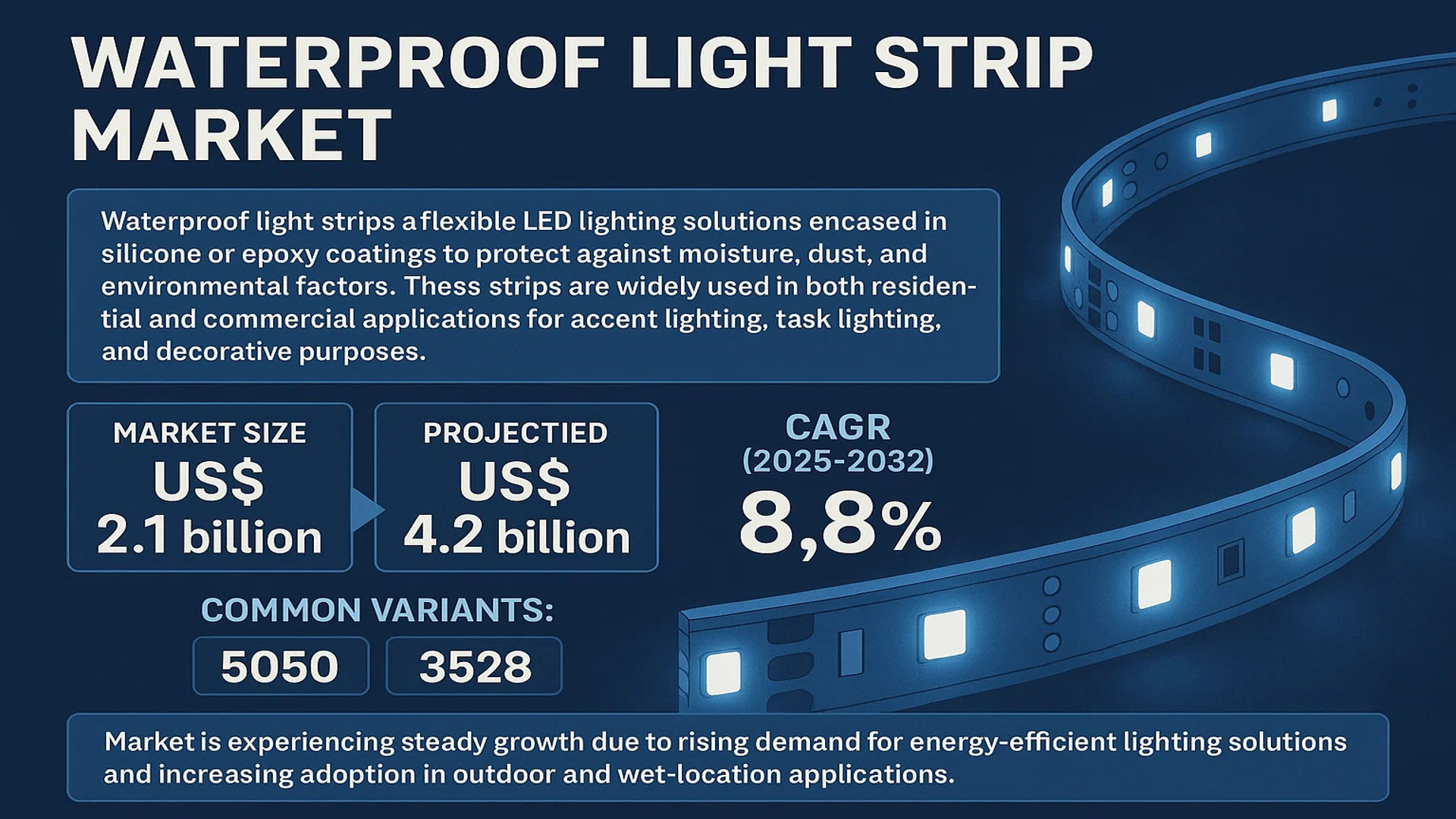
The global Waterproof Light Strip Market size was valued at US$ 2.1 billion in 2024 and is projected to reach US$ 4.2 billion by 2032, at a CAGR of 8.8% during the forecast period 2025-2032.
Waterproof light strips are flexible LED lighting solutions encased in silicone or epoxy coatings to protect against moisture, dust, and environmental factors. These strips are widely used in both residential and commercial applications for accent lighting, task lighting, and decorative purposes. Common variants include 5050 and 3528 LED configurations, offering varying brightness levels and color options.
The market is experiencing steady growth due to rising demand for energy-efficient lighting solutions and increasing adoption in outdoor and wet-location applications. The U.S. market is estimated at USD 820 million in 2024, while China’s market is expected to reach USD 1.1 billion by 2032. The 5050 segment, known for its higher brightness output, is projected to grow at a CAGR of 7.5% through 2030. Key players such as Osram, Philips, and LEDVANCE dominate the market, collectively holding approximately 35% of global revenue share. Recent innovations include smart waterproof strips with Wi-Fi connectivity and improved IP68-rated designs for harsh environments.
MARKET DYNAMICS
MARKET DRIVERS
Rising Smart Home and Architectural Lighting Demand Accelerates Market Growth
The global waterproof light strip market is experiencing robust growth due to increasing adoption of smart home technologies and architectural lighting solutions. With over 300 million smart homes worldwide, the demand for versatile lighting systems compatible with IoT ecosystems has surged significantly. Waterproof LED strips have become integral components in modern interior and exterior designs because they offer flexibility, durability, and seamless integration with voice-controlled assistants and automation systems. Recent advancements in color-tuning technologies and app-controlled functionalities are further expanding their applications in residential and commercial spaces. Leading manufacturers are introducing IP65 and IP67-rated products with enhanced weather resistance, catering to both indoor humid environments and outdoor installations.
Energy Efficiency Regulations Worldwide Fuel Product Innovation
Stringent energy efficiency policies across major economies are compelling businesses and homeowners to transition towards LED-based lighting solutions. Waterproof light strips consume up to 75% less energy compared to traditional lighting while offering superior longevity of 30,000-50,000 operational hours. Regulatory initiatives like the EU’s Ecodesign Directive and Energy Star certification programs in North America are accelerating the phase-out of inefficient lighting technologies. This regulatory push has prompted manufacturers to develop advanced waterproof variants with higher lumen output per watt and reduced heat dissipation. The market is witnessing increased R&D investments to improve thermal management systems and driver efficiency in waterproof LED strips, particularly in the 5050 and 3528 chip segments.
Commercial Sector Adoption Creates New Growth Avenues
Commercial applications now account for nearly 45% of waterproof light strip deployments, driven by their extensive use in retail displays, hospitality venues, and office spaces. These lighting solutions are particularly valued for creating immersive visual experiences through color-changing capabilities and precise brightness control. The restaurant and hotel industry’s post-pandemic revival has spurred investments in ambient lighting systems that enhance customer experience while meeting strict safety standards for moisture-prone areas. Furthermore, growing adoption in automotive showrooms, museum lighting, and healthcare facilities demonstrates the technology’s versatility across diverse commercial environments.
MARKET RESTRAINTS
Supply Chain Disruptions Impact Product Availability and Pricing
The waterproof light strip market continues facing challenges from persistent global supply chain bottlenecks, particularly affecting semiconductor and raw material availability. Fluctuations in rare earth metal prices, especially gallium and indium used in LED chip manufacturing, have led to inconsistent product pricing. Lead times for certain waterproof LED components have extended to 18-24 weeks in some regions, causing project delays for installers and contractors. While manufacturers are implementing inventory management strategies to mitigate these issues, the market remains vulnerable to geopolitical factors and trade policy shifts affecting electronic component supplies.
Technical Limitations in Extreme Environments Constrain Applications
Despite their water-resistant properties, current waterproof light strip technologies face performance limitations in extremely harsh environments. Prolonged exposure to saltwater, intense UV radiation, or temperatures beyond -20°C to 45°C can compromise product lifespan and color consistency. These constraints restrict potential applications in marine, industrial, and certain outdoor settings where more robust (and expensive) lighting solutions are required. Manufacturers are actively working on next-generation encapsulation materials and advanced conformal coating techniques to expand their products’ environmental tolerance thresholds.
Installation Complexity Deters Non-Technical Users
The market growth is partially hindered by the technical expertise required for proper waterproof light strip installation, particularly for large-scale or outdoor projects. Challenges include voltage drop considerations over long runs, waterproof connector reliability, and appropriate power supply sizing. Many residential consumers and small businesses lack the technical knowledge to correctly implement these systems, leading to suboptimal performance or premature failures. While manufacturers are developing plug-and-play solutions with simplified installation processes, the need for professional installers remains a barrier to broader consumer adoption.
MARKET OPPORTUNITIES
Emerging IoT Integration Creates Smart Lighting Ecosystems
The convergence of waterproof light strip technology with advanced IoT platforms presents significant growth opportunities. Next-generation products now incorporate Bluetooth Mesh and Matter protocol compatibility, enabling seamless integration with smart home ecosystems. This technological evolution allows for centralized control of luminaire-level lighting through mobile applications and voice assistants. Industry projections indicate that IoT-enabled waterproof lighting solutions could capture over 35% of the market by 2027, driven by demand for automated lighting scenarios, energy monitoring, and predictive maintenance capabilities in commercial buildings.
Retrofit Solutions for Aging Infrastructure Offer Market Expansion
The global focus on infrastructure modernization is creating substantial opportunities for waterproof light strip applications in renovation projects. Municipalities and property developers are increasingly adopting these solutions for bridge lighting, pathway illumination, and historical building accent lighting due to their flexibility and energy efficiency. Unlike conventional lighting systems requiring extensive structural modifications, waterproof LED strips offer plug-and-play installation with minimal disruption. The retrofit market segment is projected to grow at an accelerated pace as cities worldwide upgrade outdated lighting infrastructure to meet sustainability goals.
Customization and Personalization Trends Drive Product Innovation
Increasing consumer demand for personalized lighting experiences is prompting manufacturers to develop tailored waterproof light strip solutions. Advanced products now offer tunable white temperatures (2700K-6500K), high-CRI options for accurate color rendering, and synchronized multimedia capabilities. The residential sector particularly values these features for mood lighting and wellness applications. Simultaneously, commercial clients are adopting programmable RGBW solutions for dynamic branding and wayfinding applications. This trend towards customization is expected to fuel premium product development and higher-margin market segments in coming years.
MARKET CHALLENGES
Intense Price Competition Squeezes Manufacturer Margins
The waterproof light strip market faces mounting price pressures as low-cost manufacturers flood the market with competitively priced alternatives. While premium brands emphasize quality certifications and longevity guarantees, budget-conscious buyers often prioritize initial cost over lifecycle value. This pricing dynamic has compressed gross margins to 15-25% for many established players, forcing them to optimize production efficiencies and streamline supply chains. The situation is particularly challenging for manufacturers lacking vertical integration, as they face component cost volatility while maintaining competitive end-product pricing.
Counterfeit Products Compromise Market Integrity
The proliferation of counterfeit waterproof light strips has emerged as a significant industry challenge, with estimates suggesting these account for nearly 20% of online sales. These substandard products frequently carry misleading IP ratings and exaggerated performance claims, resulting in premature failures and safety hazards. Beyond damaging brand reputations, counterfeit goods erode consumer confidence in the technology while creating potential liability issues for installers and specifiers. Industry associations are collaborating with regulatory agencies to implement stricter certification processes and supply chain verification protocols to combat this issue.
Technological Obsolescence Requires Continuous R&D Investment
Rapid advancements in LED technology and lighting controls necessitate continuous product innovation, creating financial and operational challenges for market participants. The average product development cycle has shortened to 12-18 months as manufacturers race to integrate the latest chip technologies, control interfaces, and materials science breakthroughs. This acceleration requires substantial R&D expenditures and shorter return-on-investment timelines, putting strain on smaller manufacturers. Companies must carefully balance innovation with backward compatibility to prevent alienating existing customers while attracting new market segments.
WATERPROOF LIGHT STRIP MARKET TRENDS
Rising Demand for Energy-Efficient Lighting Solutions Drives Market Growth
The global waterproof light strip market is experiencing robust growth, fueled by increasing demand for energy-efficient and durable lighting solutions across residential and commercial applications. LED technology, which dominates this market, offers superior energy efficiency with up to 80% lower power consumption compared to traditional lighting solutions, making it a preferred choice for consumers and businesses alike. The rising focus on smart home automation has further accelerated adoption, as waterproof LED strips integrate seamlessly with IoT-enabled lighting systems. In 2024, the market was valued at millions, with projections indicating steady growth through 2032.
Other Trends
Expansion in Outdoor & Architectural Lighting
The waterproof light strip market is witnessing increased application in outdoor and architectural lighting due to its durability and weather-resistant properties. Commercial use in retail outlets, restaurants, and signage has grown by an estimated 15-20% annually, as businesses leverage LED strips to enhance aesthetics and branding. Moreover, urban development programs emphasizing sustainable lighting solutions in infrastructure projects are propelling demand. The ability of waterproof variants to withstand harsh environmental conditions makes them ideal for outdoor installations, from landscape lighting to safety illumination in public spaces.
Innovation in Flexible and Customizable Lighting Solutions
Manufacturers are increasingly focusing on flexible and customizable waterproof light strips to cater to diverse consumer needs. Advancements in RGB and tunable white LED strips allow users to adjust colors and brightness, enhancing their appeal for both decorative and functional uses. The 5050 LED segment, known for its high brightness and versatility, continues to dominate with over 40% market share, while 3528 strips remain popular for energy-sensitive applications. Integration of smart controls, including Bluetooth and Wi-Fi connectivity, is further expanding the market by offering users greater convenience and automation in lighting management.
COMPETITIVE LANDSCAPE
Key Industry Players
Innovation and Geographical Expansion Drive Competition in Waterproof Light Strip Market
The global Waterproof Light Strip market is characterized by a mix of established global brands and emerging players, creating a semi-consolidated competitive environment. Forge Europa and LEDVANCE currently lead the market with their extensive product portfolios, strong R&D capabilities, and dominant distribution networks across North America and Europe. These companies collectively held a significant market share in 2024, driven by their technological advancements in waterproof lighting solutions.
Meanwhile, Osram and Philips have maintained their competitive edge through continuous innovation in energy-efficient and high-durability light strips. Their investments in smart lighting technologies and IoT integration have expanded their presence in both residential and commercial segments. The growth of these companies is reinforced by strategic partnerships with construction firms and smart home solution providers.
Asia-Pacific players like NVC Lighting and Opple are rapidly gaining traction due to cost-efficient manufacturing and localized supply chains. These companies have expanded their footprint in emerging markets by offering competitively priced, high-performance waterproof strips. Their market share is expected to grow further as demand rises in developing economies.
Smaller yet agile players such as OML Technology and Jasco Lighting are strengthening their positions through niche product customization and rapid adoption of new lighting trends. Their focus on UV-resistant and high-lumen waterproof strips has carved out specialized segments, particularly in outdoor and marine applications.
List of Key Waterproof Light Strip Manufacturers
- Forge Europa (UK)
- LEDVANCE (Germany)
- Ledridge Lighting (China)
- Digital Advanced Lighting (U.S.)
- Lighting Ever (China)
- LEDMY (China)
- Osram (Germany)
- Philips (Netherlands)
- Sidon Lighting (China)
- Optek Electronics (U.S.)
- NVC Lighting (China)
- Opple (China)
- Jesco Lighting (U.S.)
- Ledtronics (U.S.)
Segment Analysis:
By Type
5050 Segment Leads the Market Owing to High Brightness and Durability
The market is segmented based on type into:
- 5050
- Subtypes: Standard, RGB, and high-density variants
- 3528
- Subtypes: Single-color and multi-color options
- Others
- Subtypes: Unique form factors and specialized waterproofing technologies
By Application
Commercial Use Segment Dominates Due to Widespread Adoption in Retail and Hospitality
The market is segmented based on application into:
- Commercial Use
- Subtypes: Retail displays, architectural lighting, and outdoor signage
- Home Use
- Subtypes: Residential accent lighting, kitchen under-cabinet lighting, and outdoor patio lighting
By Waterproof Rating
IP67 Standard Maintains Market Leadership for Indoor-Outdoor Applications
The market is segmented based on waterproof rating into:
- IP65
- IP67
- IP68
- Others
By Installation Type
Surface-Mounted Segment Continues to Dominate for Ease of Application
The market is segmented based on installation type into:
- Surface-mounted
- Recessed
- Track-mounted
Regional Analysis: Waterproof Light Strip Market
Asia-Pacific
The Asia-Pacific region dominates the global waterproof light strip market, accounting for the highest revenue share due to rapid urbanization, infrastructure expansion, and growing demand for decorative and functional lighting solutions. China, in particular, is the largest producer and consumer, driven by its booming construction sector and manufacturing capabilities. The region benefits from cost-competitive production, with key players like OML Technology, Jiasheng Lighting, and Opple expanding their market presence. Increasing adoption of smart lighting and energy-efficient solutions, coupled with rising disposable incomes, further propels growth. However, price sensitivity remains a challenge, pushing manufacturers to balance affordability with advanced features.
North America
North America represents a mature yet steadily growing market, fueled by high consumer awareness of smart home technologies and stringent energy efficiency standards. The U.S. leads the region, with residential and commercial sectors increasingly adopting waterproof light strips for architectural lighting, outdoor applications, and entertainment spaces. Brands like Philips, LEDVANCE, and Ledridge Lighting emphasize durability and smart connectivity to cater to tech-savvy customers. Government initiatives promoting sustainable lighting solutions, such as Energy Star certifications, also drive demand. Nevertheless, higher costs compared to Asian alternatives may limit mass-market adoption.
Europe
Europe’s market growth is underpinned by strict environmental regulations and a strong preference for energy-efficient lighting. Germany and the U.K. are key markets, with commercial applications like retail displays and hospitality venues driving demand. Manufacturers such as Osram, Forge Europa, and Ledridge Lighting focus on waterproof strips with low power consumption and long lifespans to comply with EU directives. The residential segment is also expanding due to rising DIY home improvement trends. However, higher import dependence on Asian-made products poses pricing challenges for local suppliers.
South America
South America shows moderate growth potential, with Brazil and Argentina as primary markets. Demand is driven by increasing urbanization and the hospitality sector’s need for aesthetic lighting solutions. However, economic instability and fluctuating raw material costs hinder local manufacturing. Imported products from China dominate, but regional players like Sidon Lighting are gradually gaining traction. The lack of standardized regulations also limits the adoption of premium waterproof lighting solutions.
Middle East & Africa
The MEA market is emerging, with growth centered in GCC countries like the UAE and Saudi Arabia, where luxury real estate and infrastructure projects fuel demand for high-quality waterproof lighting. Turkey and South Africa are also witnessing gradual adoption in commercial spaces. While the region benefits from rising disposable incomes, limited local production and reliance on imports constrain market expansion. Long-term potential lies in smart city initiatives and tourism-driven developments.
Report Scope
This market research report provides a comprehensive analysis of the Global Waterproof Light Strip market, covering the forecast period 2024–2032. It offers detailed insights into market dynamics, technological advancements, competitive landscape, and key trends shaping the industry.
Key focus areas of the report include:
- Market Size & Forecast: Historical data and future projections for revenue, unit shipments, and market value across major regions and segments. The market is projected to grow at a significant CAGR of 8.8% during the forecast period.
- Segmentation Analysis: Detailed breakdown by product type (5050, 3528, Others), application (Home Use, Commercial Use), and end-user industry to identify high-growth segments and investment opportunities.
- Regional Outlook: Insights into market performance across North America, Europe, Asia-Pacific, Latin America, and the Middle East & Africa, including country-level analysis where relevant. The U.S. and China are key growth markets.
- Competitive Landscape: Profiles of leading market participants including Forge Europa, LEDVANCE, Osram, Philips, and others, covering their product offerings, market share, R&D focus, and recent developments.
- Technology Trends & Innovation: Assessment of emerging technologies in waterproof lighting solutions, including energy efficiency improvements and smart lighting integration.
- Market Drivers & Restraints: Evaluation of factors driving market growth such as increasing demand for outdoor lighting solutions, along with challenges like raw material price volatility.
- Stakeholder Analysis: Insights for manufacturers, suppliers, distributors, and investors regarding market opportunities and strategic positioning.
Primary and secondary research methods are employed, including interviews with industry experts and analysis of verified market data to ensure accuracy and reliability.
FREQUENTLY ASKED QUESTIONS:
What is the current market size of Global Waterproof Light Strip Market?
-> Waterproof Light Strip Market size was valued at US$ 2.1 billion in 2024 and is projected to reach US$ 4.2 billion by 2032, at a CAGR of 8.8% during the forecast period 2025-2032.
Which key companies operate in Global Waterproof Light Strip Market?
-> Key players include Forge Europa, LEDVANCE, Osram, Philips, Ledridge Lighting, Digital Advanced Lighting, and NVC Lighting, among others.
What are the key growth drivers?
-> Key growth drivers include increasing demand for outdoor lighting solutions, smart home adoption, and architectural lighting applications.
Which region dominates the market?
-> Asia-Pacific is the fastest-growing region, while North America and Europe maintain significant market shares.
What are the emerging trends?
-> Emerging trends include smart waterproof lighting systems, energy-efficient LED solutions, and increased IP68-rated product offerings.

Get Sample Report PDF for Exclusive Insights
Report Sample Includes
- Table of Contents
- List of Tables & Figures
- Charts, Research Methodology, and more...
 Download Sample Report PDF