MARKET INSIGHTS
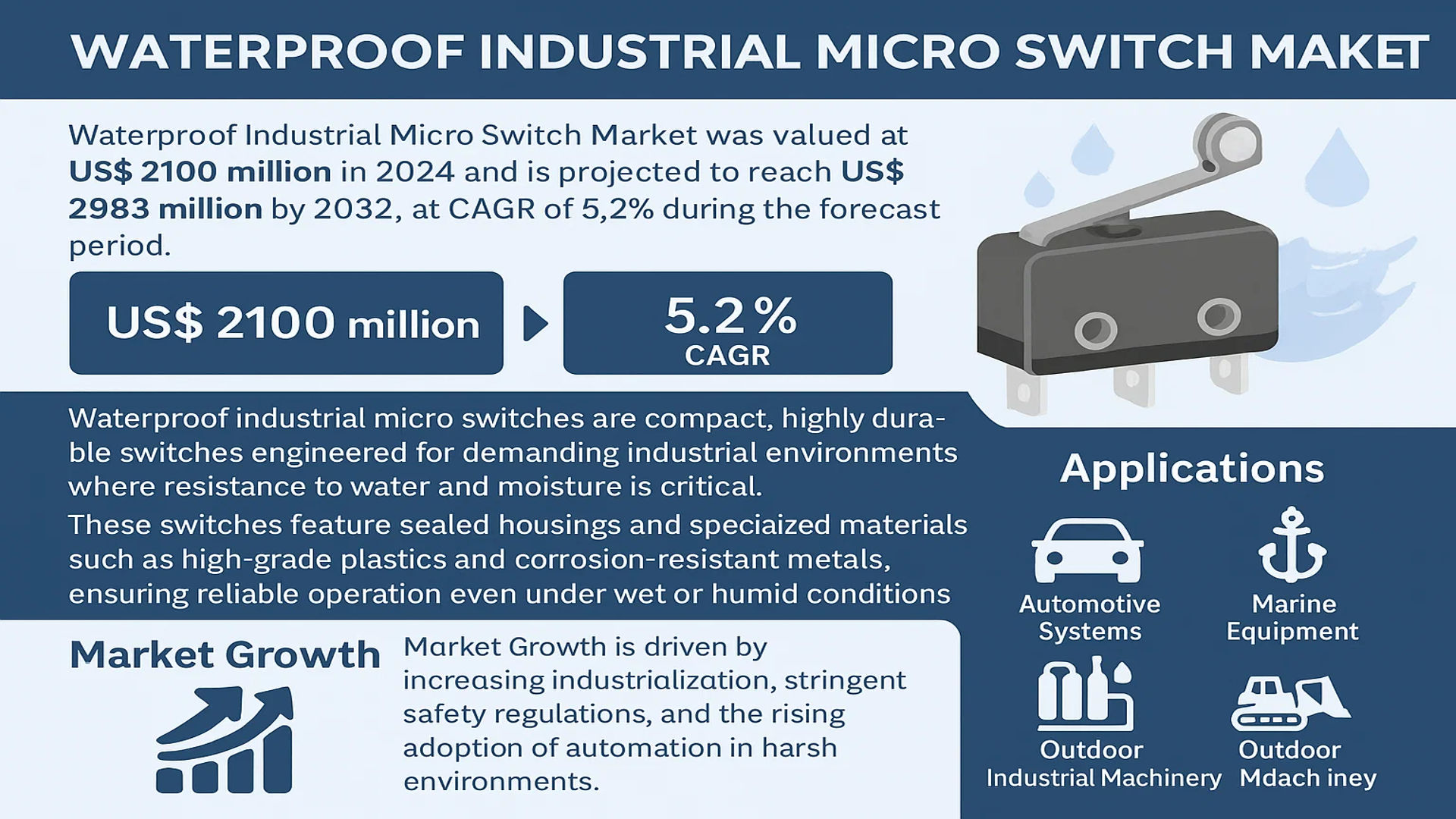
The global Waterproof Industrial Micro Switch Market was valued at 2100 million in 2024 and is projected to reach US$ 2983 million by 2032, at a CAGR of 5.2% during the forecast period.
Waterproof industrial micro switches are compact, highly durable switches engineered for demanding industrial environments where resistance to water and moisture is critical. These switches feature sealed housings and specialized materials such as high-grade plastics and corrosion-resistant metals, ensuring reliable operation even under wet or humid conditions. They are widely utilized in applications like automotive systems, marine equipment, water treatment plants, and outdoor industrial machinery.
The market growth is driven by increasing industrialization, stringent safety regulations, and the rising adoption of automation in harsh environments. Additionally, advancements in material science have enhanced the durability and performance of these switches. Key players like Omron, Honeywell, and Schneider Electric dominate the market, continuously innovating to meet diverse industrial requirements. For instance, in 2023, Omron launched a new IP67-rated micro switch series with enhanced load capacity, catering to heavy-duty applications in the automotive sector.
MARKET DYNAMICS
MARKET DRIVERS
Expansion of Industrial Automation to Fuel Demand for Waterproof Micro Switches
The rapid growth of industrial automation across manufacturing, automotive, and water treatment sectors is significantly driving the waterproof industrial micro switch market. These specialized switches play a critical role in ensuring operational reliability in harsh environments, with the global industrial automation market projected to achieve substantial growth annually. Factories increasingly rely on waterproof micro switches for safety interlocks, position detection, and equipment monitoring in wet conditions. With manufacturing facilities expanding their automation footprint to improve efficiency, the need for durable switching solutions continues to rise.
Stringent Safety Regulations Accelerate Adoption in Marine and Offshore Applications
Maritime safety standards have become increasingly rigorous, particularly concerning electrical components exposed to water and humidity. Waterproof industrial micro switches meet critical IP67 and IP68 ratings required for shipboard equipment, offshore platforms, and port machinery. The marine industry’s focus on preventing electrical failures in wet environments has led to 30% higher adoption rates of waterproof switches compared to standard alternatives in recent years. This trend is further amplified by expanding global trade and shipping activities requiring reliable switching mechanisms.
Furthermore, regulatory bodies continue to enhance electrical safety requirements for industrial equipment operating in wet conditions. Manufacturers must comply with these evolving standards, creating sustained demand for certified waterproof switching solutions.
MARKET RESTRAINTS
High Manufacturing Costs Pose Challenges for Market Expansion
While the waterproof industrial micro switch market shows promising growth, premium material requirements and specialized manufacturing processes create cost barriers. The production of waterproof seals and corrosion-resistant housings adds 25-40% to manufacturing expenses compared to standard micro switches. These elevated costs make adoption challenging for price-sensitive applications and developing markets where budget constraints limit equipment upgrades.
Additional Constraints
Material Scarcity
Certain specialized polymers and alloys required for waterproof sealing face supply chain vulnerabilities. Fluctuations in raw material availability can disrupt production schedules and lead to extended delivery times.
Design Limitations
Waterproofing requirements often reduce switch sensitivity and increase actuation force, limiting their suitability for precision applications. This trade-off between durability and performance remains an ongoing challenge for manufacturers.
MARKET CHALLENGES
Technical Complexity in Extreme Environment Applications
The market faces significant hurdles in developing switches that maintain reliability under extreme conditions. While waterproof ratings address basic moisture protection, industrial applications often involve additional stressors including temperature fluctuations, chemical exposure, and mechanical vibration. Designing switches that withstand these combined challenges requires extensive testing and validation, with failure rates in prototype stages remaining high.
Performance Challenges
Long-Term Seal Degradation
Even high-quality waterproof seals experience gradual wear from repeated actuation cycles and environmental exposure. Predicting and extending product lifespans remains an engineering challenge.
Miniaturization Constraints
As industrial equipment becomes more compact, demand grows for smaller waterproof switches. However, reducing switch size while maintaining waterproof integrity and electrical ratings presents significant design obstacles.
MARKET OPPORTUNITIES
Smart Water Infrastructure Development Creates New Application Potential
Global investments in smart water management systems present substantial growth opportunities for waterproof micro switch manufacturers. Modern water treatment facilities increasingly incorporate automated monitoring and control systems requiring reliable switching components. The integration of IoT capabilities with waterproof switches enables real-time equipment monitoring in wet environments, a feature gaining traction across municipal water systems and industrial processing plants.
Additionally, expanding renewable energy projects involving hydropower and offshore wind installations require robust switching solutions. These emerging applications combined with infrastructure modernization programs worldwide are expected to drive sustained demand for advanced waterproof switching technologies.
WATERPROOF INDUSTRIAL MICRO SWITCH MARKET TRENDS
Increasing Demand for Robust Industrial Automation Solutions to Drive Market Expansion
The global waterproof industrial micro switch market is witnessing significant growth, propelled by the rising adoption of automation in manufacturing and industrial processes. These switches, designed to withstand harsh environments, are increasingly utilized in applications where water exposure is a concern, such as in marine equipment, outdoor machinery, and water treatment plants. The market was valued at approximately $2.1 billion in 2024 and is projected to grow at a CAGR of 5.2%, reaching $2.98 billion by 2032. This growth is driven by the need for reliable, durable switching solutions in industries that require high-performance components capable of functioning in wet or humid conditions.
Other Trends
Growing Adoption in Automotive and Marine Applications
The automotive and marine industries are increasingly incorporating waterproof industrial micro switches due to their ability to function effectively in moisture-prone environments. In automotive applications, these switches are used in electric vehicle (EV) charging systems, automated doors, and safety mechanisms, where resistance to water ingress is critical. Similarly, marine equipment, including navigation systems and vessel control panels, relies on waterproof switches to ensure operational reliability. The demand in these sectors is further amplified by stringent safety regulations that mandate fail-safe solutions for critical systems.
Technological Advancements and Miniaturization
Technological advancements are playing a pivotal role in the waterproof industrial micro switch market. Manufacturers are focusing on miniaturization without compromising durability, enabling these switches to be integrated into compact yet high-performance industrial equipment. Recent innovations include improved sealing techniques using advanced polymers and elastomers, which enhance resistance against water and dust ingress. Furthermore, the integration of smart sensing capabilities, such as IoT-enabled micro switches, is gaining traction, allowing for real-time monitoring and predictive maintenance in industrial settings. The shift toward Industry 4.0 and smart manufacturing is further accelerating the adoption of these advanced switching solutions.
COMPETITIVE LANDSCAPE
Key Industry Players
Market Leaders Invest in Innovation to Capture Greater Share in Waterproof Micro Switch Segment
The global waterproof industrial micro switch market features a mix of established multinational corporations and specialized manufacturers competing on product reliability, durability, and technological advancements. Omron Corporation has emerged as a dominant player, capturing a significant market share through its comprehensive range of IP67 and IP68-rated micro switches designed for harsh industrial environments. The company’s strong distribution network across all major regions and continuous R&D investments in predictive maintenance capabilities give it a competitive edge.
Honeywell and Eaton follow closely, leveraging their industrial automation expertise to develop waterproof switching solutions with enhanced lifecycle performance. These companies benefit from cross-selling opportunities through their broader industrial components portfolios while maintaining focus on specialized solutions for marine and outdoor equipment applications where waterproofing is critical.
Recent market dynamics show increasing competition from Asian manufacturers like Panasonic and Zippy Technology, who offer cost-competitive alternatives without compromising on ingress protection standards. Their growing presence in price-sensitive markets has forced traditional leaders to revisit pricing strategies while maintaining quality benchmarks.
Meanwhile, European firms including Siemens and Schneider Electric focus on smart waterproof switches with IoT connectivity for industrial IoT applications, creating new growth avenues in water treatment and automated outdoor equipment sectors. Their innovations in miniature waterproof switches are opening previously untapped applications in compact industrial devices.
List of Key Waterproof Industrial Micro Switch Manufacturers
- Omron Corporation (Japan)
- Honeywell International Inc. (U.S.)
- Eaton Corporation (Ireland)
- Alps Alpine (Japan)
- Johnson Electric (Hong Kong)
- Siemens AG (Germany)
- Schneider Electric (France)
- ABB Ltd. (Switzerland)
- Panasonic Corporation (Japan)
- TROX GmbH (Germany)
- Zippy Technology (Taiwan)
- Cherry GmbH (Germany)
- SCI (Switzerland)
- Camsco Electric (Taiwan)
- Leuze Electronic (Germany)
The competitive intensity continues to rise as manufacturers differentiate through value-added features like extended operational lifespans, customized sealing solutions for specific industrial environments, and integration with Industry 4.0 platforms. While major players dominate through brand reputation and global distribution, mid-sized specialized manufacturers compete effectively in niche applications requiring customized waterproof switch solutions.
Segment Analysis:
By Type
Single Connection Type Segment Leads Due to High Demand in Compact Industrial Applications
The market is segmented based on type into:
- Single Connection Type
- Subtypes: Standard, Miniature, and others
- Double Connection Type
- Subtypes: SPDT, DPDT, and others
- Multiple Connection Type
- Others
By Application
Outdoor Equipment Segment Dominates Market Share Due to Rising Adoption in Harsh Environments
The market is segmented based on application into:
- Outdoor Equipment
- Subtypes: Construction machinery, Agricultural equipment, and others
- Ship
- Water Treatment Equipment
- Others
By IP Rating
IP67 Rated Switches Hold Major Share Due to Superior Protection Against Dust and Water
The market is segmented based on IP rating into:
- IP55
- IP65
- IP67
- IP68
By End User
Industrial Manufacturing Segment Accelerates Market Growth Through Automation Adoption
The market is segmented based on end user into:
- Industrial Manufacturing
- Marine Industry
- Water & Wastewater Management
- Others
Regional Analysis: Waterproof Industrial Micro Switch Market
Asia-Pacific
Dominating the global market with over 40% revenue share, Asia-Pacific remains the epicenter of waterproof microswitch demand, driven by China’s massive manufacturing sector and Japan’s precision engineering industries. The region benefits from rapid industrialization, particularly in water treatment infrastructure and marine applications. China’s “Made in China 2025” initiative prioritizes advanced manufacturing components, accelerating adoption. However, price sensitivity in emerging markets like India and Southeast Asia creates bifurcation between premium IP68-rated switches and basic waterproof models. Major Japanese and Korean automakers increasingly specify waterproof switches for EV battery systems and charging infrastructure, further stimulating growth.
North America
The U.S. accounts for ~28% of the regional market, with stringent UL and NEMA standards governing waterproof switch specifications. Key growth stems from offshore energy projects in the Gulf of Mexico and expanding wastewater treatment facilities complying with EPA regulations. Recent infrastructure bills have earmarked funds for flood-resistant electrical components in public utilities. While automation adoption in manufacturing sustains demand, some segments face pricing pressure from Asian imports. Canadian markets show particular strength in harsh-environment mining applications, where waterproof microswitches ensure reliability in slurry pumps and processing equipment.
Europe
EU machinery directives EN 60947-5-1 and ATEX requirements for explosive environments drive technical specifications across the region. Germany leads in industrial applications, with waterproof switches widely deployed in food processing and pharmaceutical manufacturing where frequent washdowns occur. The Nordic countries exhibit strong demand for marine-grade switches in offshore wind installations. However, the market faces challenges from prolonged replacement cycles (often 7-10 years) in established industries and increasing preference for solid-state alternatives in some applications. Eastern European growth remains constrained by slower industrial modernization outside major manufacturing hubs.
Middle East & Africa
This emerging region shows promising growth in desalination plants and oilfield applications, particularly in GCC countries where corrosion-resistant components are mandatory. The UAE’s focus on smart infrastructure has increased demand for waterproof switches in outdoor control systems. However, market penetration remains limited by the dominance of basic electrical components in price-sensitive African markets. South Africa represents the most mature market, with mining and water infrastructure driving steady demand. The lack of localized manufacturing means most products are imported, creating longer lead times and higher costs that inhibit broader adoption.
South America
Brazil accounts for over half of regional demand, primarily serving automotive and agritech applications where waterproofing is critical for harvesters and irrigation systems. However, economic instability has slowed capital investments in industrial equipment. Argentina’s limited manufacturing base creates dependency on imports, particularly from China. Long-term potential exists in Chile’s mining sector and Colombia’s growing water infrastructure projects, though adoption rates lag behind global averages due to budget constraints and preference for conventional switching solutions in many industries.
Report Scope
This market research report provides a comprehensive analysis of the global and regional Waterproof Industrial Micro Switch markets, covering the forecast period 2024–2032. It offers detailed insights into market dynamics, technological advancements, competitive landscape, and key trends shaping the industry.
Key focus areas of the report include:
- Market Size & Forecast: Historical data and future projections for revenue, unit shipments, and market value across major regions and segments. The global Waterproof Industrial Micro Switch market was valued at USD 2,100 million in 2024 and is projected to reach USD 2,983 million by 2032, growing at a CAGR of 5.2%.
- Segmentation Analysis: Detailed breakdown by product type (Single Connection, Double Connection, Multiple Connection), application (Outdoor Equipment, Ship, Water Treatment Equipment, Others), and end-user industry to identify high-growth segments.
- Regional Outlook: Insights into market performance across North America, Europe, Asia-Pacific, Latin America, and the Middle East & Africa. Asia-Pacific dominates the market with China as a key growth region.
- Competitive Landscape: Profiles of leading market participants including Omron, Honeywell, Schneider Electric, Siemens, and ABB, covering their product portfolios, market shares, and strategic developments.
- Technology Trends & Innovation: Assessment of emerging waterproofing technologies, material advancements, and integration with industrial automation systems.
- Market Drivers & Restraints: Evaluation of factors including increasing industrial automation, demand for reliable switching in harsh environments, and challenges in material costs.
- Stakeholder Analysis: Strategic insights for component manufacturers, industrial equipment providers, and investors regarding market opportunities.
The report employs primary and secondary research methodologies, including interviews with industry experts and analysis of verified market data to ensure accuracy and reliability.
FREQUENTLY ASKED QUESTIONS:
What is the current market size of Global Waterproof Industrial Micro Switch Market?
-> Waterproof Industrial Micro Switch Market was valued at 2100 million in 2024 and is projected to reach US$ 2983 million by 2032, at a CAGR of 5.2% during the forecast period.
Which key companies operate in Global Waterproof Industrial Micro Switch Market?
-> Key players include Omron, Honeywell, Schneider Electric, Siemens, ABB, Panasonic, and Johnson Electric (Burgess), among others.
What are the key growth drivers?
-> Key growth drivers include increasing industrial automation, demand for reliable components in harsh environments, and expansion of water treatment infrastructure.
Which region dominates the market?
-> Asia-Pacific leads the market share, driven by industrial growth in China and Japan, while North America shows strong adoption in marine applications.
What are the emerging trends?
-> Emerging trends include miniaturization of components, development of IP68-rated switches, and integration with IIoT systems for predictive maintenance.

Get Sample Report PDF for Exclusive Insights
Report Sample Includes
- Table of Contents
- List of Tables & Figures
- Charts, Research Methodology, and more...