MARKET INSIGHTS
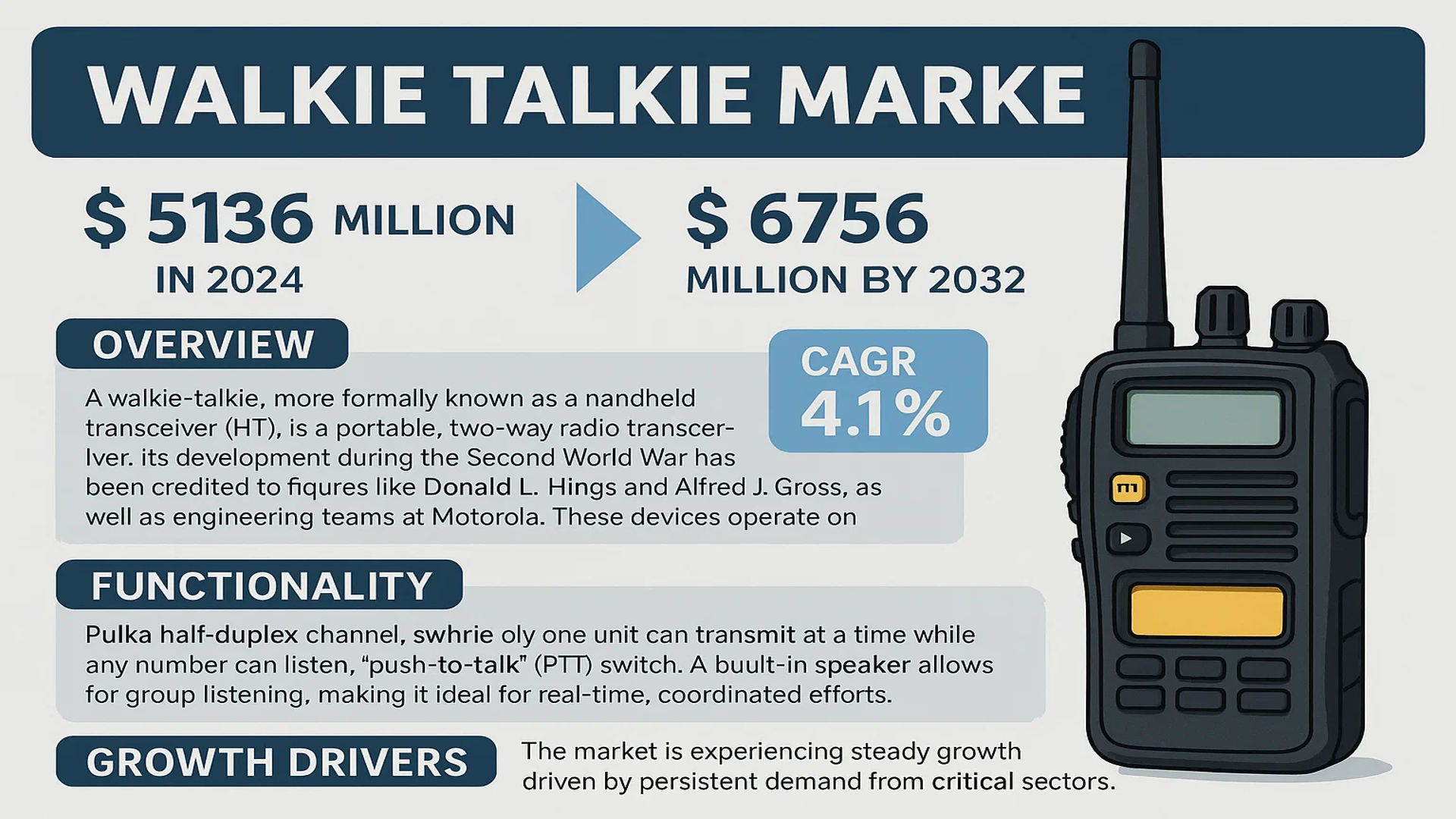
The global Walkie Talkie Market was valued at 5136 million in 2024 and is projected to reach US$ 6756 million by 2032, at a CAGR of 4.1% during the forecast period.
A walkie-talkie, more formally known as a handheld transceiver (HT), is a portable, two-way radio transceiver. Its development during the Second World War has been credited to figures like Donald L. Hings and Alfred J. Gross, as well as engineering teams at Motorola. These devices operate on a half-duplex channel, meaning only one unit can transmit at a time while any number can listen, and feature a “push-to-talk” (PTT) switch to initiate communication. Unlike a telephone handset, a walkie-talkie’s built-in speaker allows for group listening, making it ideal for real-time, coordinated efforts.
The market is experiencing steady growth driven by persistent demand from critical sectors. The government and public safety segment remains the largest downstream application, holding a 40% market share, due to the indispensable need for reliable, instant communication in emergency response and security operations. Furthermore, the ongoing transition from analog to digital technology is a significant trend, with digital walkie talkies now commanding about 73% of the market because of their enhanced audio clarity, improved battery life, and advanced features like GPS and text messaging. This technological evolution, coupled with robust use in utilities, rail transit, and industrial applications, continues to fuel market expansion globally.
MARKET DYNAMICS
MARKET DRIVERS
Rising Demand from Public Safety and Emergency Services to Drive Market Growth
The global walkie-talkie market is experiencing significant growth driven by increasing adoption in public safety and emergency services. Government agencies, law enforcement, fire departments, and emergency medical services rely heavily on reliable communication systems for coordination during critical operations. The transition from analog to digital systems has enhanced communication security, audio quality, and functionality, making walkie-talkies indispensable tools for first responders. With global public safety expenditure exceeding $300 billion annually and growing security concerns worldwide, the demand for robust communication equipment continues to expand. Digital walkie-talkies now represent over 73% of the market share, demonstrating the sector’s preference for advanced technology that offers encryption, GPS tracking, and better spectrum efficiency.
Infrastructure Development and Industrial Expansion to Boost Market Adoption
Major infrastructure projects and industrial expansion across developing economies are creating substantial demand for reliable communication solutions. The construction, manufacturing, and energy sectors require instant communication for operational efficiency, safety coordination, and workforce management. With global infrastructure investment projected to reach $3.2 trillion annually by 2025, the need for durable, weather-resistant communication devices has never been higher. Walkie-talkies provide cost-effective solutions compared to cellular networks, particularly in remote areas or large facilities where cellular coverage may be unreliable. The industrial and commercial segment accounts for approximately 30% of walkie-talkie applications, with growth particularly strong in Asia Pacific where infrastructure development is accelerating at nearly 7% annually.
Furthermore, technological advancements in battery life and rugged design have made modern walkie-talkies more suitable for harsh industrial environments, extending their useful life and reducing total cost of ownership.
➤ For instance, recent product launches feature IP67 waterproof ratings, extended battery life up to 20 hours, and integrated Bluetooth connectivity for hands-free operation.
Additionally, the integration of IoT capabilities and smart features is creating new use cases in warehouse management, logistics, and large-scale event coordination, further driving market expansion.
MARKET CHALLENGES
Increasing Competition from Smartphone-based Communication Solutions to Challenge Market Growth
The walkie-talkie market faces growing competition from smartphone applications and cellular-based push-to-talk services. While traditional walkie-talkies offer advantages in reliability and instant communication, mobile apps provide similar functionality with the added benefit of cellular network coverage. Several major telecommunications companies have launched push-to-talk-over-cellular services that compete directly with traditional two-way radios. These services typically offer nationwide coverage without requiring additional hardware beyond smartphones, presenting a significant challenge particularly in price-sensitive commercial segments. The convenience of using existing devices and infrastructure makes cellular-based solutions attractive to many businesses, potentially limiting walkie-talkie market growth in certain applications.
Other Challenges
Spectrum Allocation and Regulatory Constraints
Stringent regulations governing radio frequency spectrum allocation create operational challenges for market participants. Different countries have varying frequency bands and licensing requirements, complicating product development and international expansion. The transition to digital systems requires significant investment in compatible infrastructure, while older analog systems face potential phase-out in some regions. Regulatory compliance costs and certification processes can add substantial time and expense to product development cycles.
Technological Obsolescence and Upgrade Costs
Rapid technological advancement creates pressure for continuous product innovation while existing installed bases resist frequent upgrades. Many organizations have substantial investments in legacy systems and hesitate to replace functioning equipment, particularly when new digital systems require complete infrastructure overhaul. The average replacement cycle for professional communication equipment ranges from 5-7 years, creating cyclical demand patterns that challenge manufacturers’ production planning and inventory management.
MARKET RESTRAINTS
High Initial Investment and Total Cost of Ownership to Deter Market Growth
The transition to digital walkie-talkie systems requires substantial initial investment in both handsets and supporting infrastructure, creating a significant barrier to adoption particularly for small and medium-sized enterprises. Digital systems typically cost 30-50% more than analog equivalents, while requiring compatible base stations, repeaters, and system management software. For large organizations with hundreds of users, the total cost of ownership including maintenance, licensing, and system upgrades can reach several million dollars. This financial commitment deters price-sensitive customers and extends replacement cycles, particularly in developing markets where budget constraints are more pronounced. The high cost also limits adoption in applications where communication needs are intermittent or where alternative solutions exist.
Additionally, the specialized nature of professional two-way radio systems requires trained personnel for installation, programming, and maintenance, adding to operational expenses. The shortage of qualified radio technicians in many regions further complicates system deployment and increases service costs.
MARKET OPPORTUNITIES
Integration of Advanced Technologies to Create New Growth Opportunities
The integration of advanced technologies such as LTE, 5G, artificial intelligence, and Internet of Things capabilities presents significant growth opportunities for the walkie-talkie market. Modern digital two-way radios are evolving into sophisticated communication devices that combine traditional push-to-talk functionality with data transmission, location services, and multimedia capabilities. The convergence of critical communication and broadband services enables new applications in smart cities, advanced manufacturing, and public transportation systems. The emerging market for broadband push-to-talk solutions is expected to grow at approximately 15% annually, creating new revenue streams for traditional radio manufacturers who adapt to technological convergence.
Furthermore, the development of hybrid devices that can switch between cellular networks and traditional radio frequencies addresses coverage limitations while maintaining reliability for critical communications. These innovations are particularly valuable for public safety applications where communication reliability can be life-critical.
Additionally, the increasing focus on workplace safety regulations and the need for reliable communication in hazardous environments drives demand for intrinsically safe and explosion-proof models, creating specialized market segments with higher margins and reduced price sensitivity.
WALKIE TALKIE MARKET TRENDS
Digital Transformation and Integration of Advanced Technologies
The global walkie talkie market is undergoing a significant transformation driven by the shift from analog to digital technology. Digital walkie talkies now command approximately 73% of the global market share, a figure that underscores the rapid adoption of this superior technology. This transition is fueled by the enhanced features digital systems offer, including superior audio clarity, increased channel capacity, robust encryption for secure communications, and advanced data capabilities such as text messaging and GPS tracking. Furthermore, the integration of Long-Term Evolution (LTE) technology is creating a new category of devices that combine the instant push-to-talk functionality of traditional radios with the wide-area coverage of cellular networks. This convergence is particularly appealing to sectors like logistics and transportation, where reliable, wide-ranging communication is paramount. The market is also witnessing the incorporation of Internet of Things (IoT) sensors, enabling devices to transmit not just voice but also critical environmental and operational data, thereby adding immense value for industrial and commercial users.
Other Trends
Rising Demand from Public Safety and Critical Infrastructure Sectors
The demand for reliable, instant communication in public safety and critical infrastructure remains a primary growth driver for the walkie talkie market. The government and public safety segment alone accounts for about 40% of the global market, highlighting its immense influence. This sustained demand is driven by the need for robust, interoperable communication systems for first responders, law enforcement, and emergency services, especially in scenarios where cellular networks may be congested or compromised. Concurrently, sectors such as utilities, rail transit, and oil & gas are increasingly modernizing their communication infrastructures. These industries require intrinsically safe devices capable of operating in hazardous environments and complex terrains. The deployment of digital mobile radio (DMR) and Project 25 (P25) standards is accelerating in these areas to ensure seamless, secure, and efficient operational coordination, further propelling market expansion.
Market Consolidation and Strategic Regional Expansion
The competitive landscape is characterized by significant consolidation, with the top five manufacturers holding over 70% of the global market share. This high concentration fosters intense competition centered on innovation, product development, and strategic pricing. Leading players are aggressively expanding their presence in high-growth regions, particularly the Asia-Pacific area, which is the largest consumption market with a share exceeding 35%. This expansion is strategically targeted at burgeoning industrial and commercial sectors in countries like China and India. Meanwhile, in developed markets such as North America and Europe, growth is primarily driven by the replacement of aging analog systems with modern digital and LTE-enabled solutions. This regional diversification strategy allows key players to balance growth between replacement cycles in mature markets and new adoption in emerging economies, ensuring sustained global market development.
COMPETITIVE LANDSCAPE
Key Industry Players
Companies Strive to Strengthen their Product Portfolio to Sustain Competition
The competitive landscape of the global walkie talkie market is semi-consolidated, characterized by the presence of several established multinational corporations alongside numerous regional and specialized manufacturers. Motorola Solutions, Inc. stands as the undisputed market leader, commanding a significant revenue share due to its pioneering role in the technology’s development and its dominant position in critical communication sectors, particularly government and public safety. The company’s strength stems from its advanced digital product portfolio, robust R&D capabilities, and a deeply entrenched global distribution network.
JVCKENWOOD Corporation and Hytera Communications Corporation Limited also hold substantial market shares. JVCKENWOOD’s growth is driven by its strong brand reputation for reliability and innovation in professional two-way radios, while Hytera has expanded aggressively outside its native China through strategic acquisitions and a focus on competitive pricing and technological advancement, especially in digital trunking systems.
Furthermore, these leading players are actively pursuing growth through continuous product innovation, such as the development of LTE-capable devices and ruggedized models for harsh environments, alongside strategic geographical expansions into emerging markets. This is expected to further consolidate their positions over the forecast period.
Meanwhile, other key players like Icom Inc. and Tait Communications are strengthening their market presence by focusing on niche applications and vertical-specific solutions. Icom excels in marine and aviation communication equipment, while Tait has a strong foothold in utilities and public transport sectors. Their strategy involves significant investments in R&D for secure and reliable communication protocols and forming strategic partnerships to offer integrated solutions, ensuring their continued relevance in a competitive and evolving marketplace.
List of Key Walkie Talkie Companies Profiled
- Motorola Solutions, Inc. (U.S.)
- JVCKENWOOD Corporation (Japan)
- Hytera Communications Corporation Limited (China)
- Icom Inc. (Japan)
- Tait Communications (New Zealand)
- Yaesu Musen Co., Ltd. (Japan)
- Uniden Holdings Corporation (Japan)
- Entel Group (U.K.)
- Kirisun Communications Co., Ltd. (China)
- Midland Radio Corporation (U.S.)
- Cobra Electronics (U.S.)
- Quansheng Electronics Co., Ltd. (China)
Segment Analysis:
By Type
Digital Walkie Talkie Segment Dominates the Market Due to Superior Audio Clarity and Enhanced Security Features
The market is segmented based on type into:
- Digital Walkie Talkie
- Analog Walkie Talkie
By Application
Government and Public Safety Segment Leads Due to Critical Communication Requirements for Emergency Services
The market is segmented based on application into:
- Government and Public Safety
- Utilities and Rail Transit
- Industrial and Commercial
- Others
By Technology
DMR (Digital Mobile Radio) Technology Gains Traction for its Spectrum Efficiency and Advanced Data Capabilities
The market is segmented based on technology into:
- DMR (Digital Mobile Radio)
- P25 (Project 25)
- TETRA (Terrestrial Trunked Radio)
- Analog Conventional
By Power Output
High-Power Segment is Essential for Long-Range Communications in Large-Scale Industrial and Public Safety Operations
The market is segmented based on power output into:
- Low Power (Up to 1W)
- Medium Power (1W to 5W)
- High Power (Above 5W)
Regional Analysis: Walkie Talkie Market
Asia-Pacific
The Asia-Pacific region is the undisputed leader in the global walkie-talkie market, accounting for over 35% of total consumption. This dominance is fueled by massive infrastructure development, rapid industrialization, and extensive public safety network expansions, particularly in China and India. China, a global manufacturing hub for electronic components, is home to major players like Hytera and Kirisun, which benefit from robust domestic supply chains. The region exhibits a strong preference for cost-effective analog devices but is experiencing a significant and accelerating transition to digital technology. This shift is driven by the need for enhanced security, better audio clarity, and improved spectral efficiency in densely populated urban centers and sprawling industrial complexes.
North America
Characterized by a mature yet steadily growing market, North America is a hub for technological innovation and high-value product demand. The region is a stronghold for industry giants like Motorola Solutions, which commands a significant market share, especially within the critical Government and Public Safety sector. Market growth is propelled by the ongoing transition from legacy analog systems to P25 (Project 25) digital standards, a move mandated by the need for interoperable and secure communications for first responders. Furthermore, substantial investments in modernizing utility grids and transportation infrastructure under initiatives like the Infrastructure Investment and Jobs Act create sustained demand for robust and reliable two-way radio solutions.
Europe
The European market is defined by stringent regulatory standards and a strong focus on advanced, secure communication technologies. Regulations such as the EU’s RED (Radio Equipment Directive) govern equipment approval, pushing manufacturers toward compliance and innovation. There is a pronounced demand for digital technologies, including DMR (Digital Mobile Radio) and TETRA (Terrestrial Trunked Radio), which offer superior encryption and data capabilities crucial for sensitive applications in public safety and transport. While the market is highly competitive and price-sensitive, countries like the UK, Germany, and France continue to invest in upgrading their emergency service communication networks, ensuring a stable demand for high-specification devices.
South America
The South American market presents a landscape of gradual growth and untapped potential. Economic fluctuations and budget constraints often lead to a higher reliance on more affordable analog devices and a slower adoption rate for advanced digital systems. However, key countries like Brazil and Argentina are actively investing in expanding and modernizing their public safety and industrial sectors. The mining, oil & gas, and security industries are primary end-users, driving demand for durable and functional communication tools. While the market is fragmented with the presence of both international brands and local distributors, economic recovery and infrastructure projects are expected to be the main catalysts for future market expansion.
Middle East & Africa
This region represents an emerging market with growth primarily concentrated in the Gulf Cooperation Council (GCC) nations and select African countries with robust extractive industries. The market is bifurcated: oil-rich nations like Saudi Arabia and the UAE invest in top-tier digital systems for large-scale infrastructure, security, and event management projects. In contrast, other parts of the region exhibit demand for basic, rugged analog devices suited for construction, hospitality, and security services. A significant challenge across the region is the prevalence of price sensitivity and the availability of lower-cost alternatives, which can hinder the penetration of advanced digital solutions despite a clear long-term need for reliable communication infrastructure.
Report Scope
This market research report provides a comprehensive analysis of the global Walkie Talkie market, covering the forecast period 2025–2032. It offers detailed insights into market dynamics, technological advancements, competitive landscape, and key trends shaping the industry.
Key focus areas of the report include:
- Market Size & Forecast: Historical data and future projections for revenue, unit shipments, and market value across major regions and segments.
- Segmentation Analysis: Detailed breakdown by product type, technology, application, and end-user industry to identify high-growth segments and investment opportunities.
- Regional Outlook: Insights into market performance across North America, Europe, Asia-Pacific, Latin America, and the Middle East & Africa, including country-level analysis where relevant.
- Competitive Landscape: Profiles of leading market participants, including their product offerings, R&D focus, manufacturing capacity, pricing strategies, and recent developments such as mergers, acquisitions, and partnerships.
- Technology Trends & Innovation: Assessment of emerging technologies, integration of AI/IoT, digital communication protocols, and evolving industry standards.
- Market Drivers & Restraints: Evaluation of factors driving market growth along with challenges, supply chain constraints, regulatory issues, and market-entry barriers.
- Stakeholder Analysis: Insights for component suppliers, OEMs, system integrators, investors, and policymakers regarding the evolving ecosystem and strategic opportunities.
Primary and secondary research methods are employed, including interviews with industry experts, data from verified sources, and real-time market intelligence to ensure the accuracy and reliability of the insights presented.
FREQUENTLY ASKED QUESTIONS:
What is the current market size of Global Walkie Talkie Market?
-> Walkie Talkie Market was valued at 5136 million in 2024 and is projected to reach US$ 6756 million by 2032, at a CAGR of 4.1% during the forecast period.
Which key companies operate in Global Walkie Talkie Market?
-> Key players include Motorola, JVCKENWOOD, Hytera, Icom, Tait, Yaesu, and Uniden Holdings Corporation, among others.
What are the key growth drivers?
-> Key growth drivers include increased demand from public safety sectors, infrastructure development in utilities and rail transit, and adoption in industrial and commercial applications.
Which region dominates the market?
-> Asia-Pacific is the largest consumption market with over 35% share, while North America and Europe remain significant markets.
What are the emerging trends?
-> Emerging trends include digitalization of communication systems, integration of GPS and Bluetooth capabilities, and development of ruggedized devices for harsh environments.

Get Sample Report PDF for Exclusive Insights
Report Sample Includes
- Table of Contents
- List of Tables & Figures
- Charts, Research Methodology, and more...
 Download Sample Report PDF