
VUV Lasers Market Insights
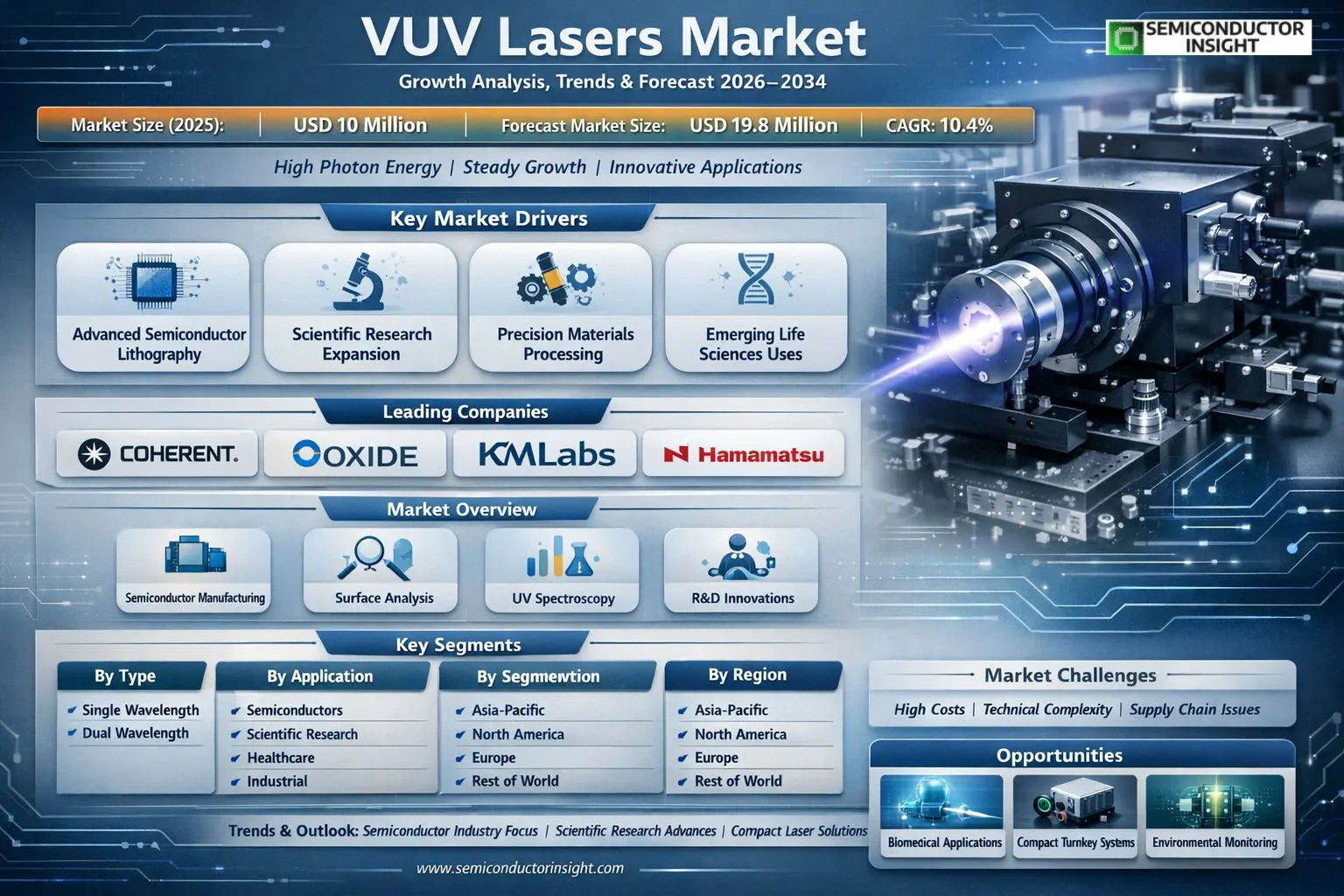
Global VUV lasers market size was valued at USD 10 million in 2025. The market is projected to grow from USD 11.04 million in 2026 to USD 19.8 million by 2034, exhibiting a CAGR of 10.4% during the forecast period.
VUV (Vacuum Ultraviolet) lasers are devices that emit laser light in the vacuum ultraviolet spectral region, typically between 100 and 200 nanometers (nm). This type of laser is an important branch of laser technology, and the light it produces is characterized by high photon energy and extremely short wavelengths, enabling it to play a crucial role in many specialized applications where conventional lasers cannot operate effectively.
The market is experiencing steady growth due to several factors, including increasing demand for advanced lithography in semiconductor manufacturing and rising investments in fundamental scientific research. Additionally, the growing need for high-precision materials processing and surface analysis techniques is contributing to market expansion. Initiatives by key players are also expected to fuel market growth. For instance, companies like Coherent, Inc., OXIDE Corporation, and KMLabs are continuously advancing VUV laser technology for applications in metrology and spectroscopy. These companies are some of the key players that operate in the market with a focused portfolio of advanced photonic solutions.
MARKET DRIVERS
Advancements in Semiconductor Lithography
The relentless push for miniaturization in the semiconductor industry is a primary catalyst for VUV Lasers Market. As chipmakers target nodes below 10nm, traditional deep ultraviolet (DUV) light sources face physical limitations. Vacuum ultraviolet (VUV) lasers, operating at wavelengths below 200nm, enable higher-resolution patterning essential for next-generation integrated circuits. This technological imperative directly propels demand for advanced VUV laser sources and systems. The transition towards extreme ultraviolet (EUV) lithography, which also relies on short-wavelength light generation, further validates and drives foundational R&D in adjacent VUV laser technologies, creating a robust pipeline for market growth. The increasing complexity of memory and logic devices necessitates these precise fabrication tools.
Expanding Applications in Scientific Research
Beyond industrial manufacturing, the unique properties of VUV light are unlocking new frontiers in scientific instrumentation, fueling a steady demand for specialized lasers. These lasers are critical components in high-resolution photoelectron spectroscopy, enabling the study of material surfaces and electronic structures with unprecedented detail. They are also indispensable in advanced spectroscopic techniques for atmospheric science and astrochemistry, where they probe molecular compositions. The growth of synchrotron and free-electron laser facilities, which often incorporate or compete with tabletop VUV laser sources, underscores the expanding need for coherent VUV light across physics, chemistry, and materials science laboratories globally.
➤ The drive for atomic-scale manufacturing and molecular-level diagnostic precision continues to make VUV Lasers Market a cornerstone of high-tech industrial and scientific advancement.
Furthermore, the development of frequency combs in the VUV regime is emerging as a significant driver, promising revolutionary improvements in optical clocks and fundamental constant measurements. This niche but high-impact application area stimulates continuous innovation and specialized market demand. As quantum technologies and advanced material synthesis evolve, the requirement for precise VUV photon sources is expected to become more pronounced, securing long-term growth drivers for VUV Lasers Market.
MARKET CHALLENGES
Technological Complexity and High Cost Barriers
The development and operation of reliable VUV laser systems present formidable technical challenges that directly impact VUV Lasers Market. Generating coherent light at such short wavelengths requires sophisticated optical components, often operating under high-vacuum conditions to prevent atmospheric absorption. Materials for lenses, mirrors, and windows that transmit VUV light are scarce and expensive, typically limited to specialized crystals and coatings. Furthermore, the efficiency of converting pump laser energy into VUV output is generally low, leading to high operational costs, significant thermal management needs, and system complexity that restricts widespread adoption outside well-funded industrial or research settings.
Other Challenges
Limited Commercial Ecosystem and Supply Chain Fragility
VUV Lasers Market is characterized by a small number of specialized manufacturers and a fragmented supply chain for critical components. This concentration creates vulnerabilities, including long lead times for system delivery and maintenance, high dependence on a few technical experts, and limited competitive pressure to reduce costs. For potential end-users, this ecosystem makes procurement a significant investment with concerns about long-term support and upgrade paths.
Operational and Maintenance Hurdles
Maintaining the performance stability of a VUV laser is a persistent challenge. The optics are susceptible to contamination and degradation from the high-energy photons, leading to gradual output power decline and necessitating frequent, expensive realignment or replacement. This results in considerable downtime and requires highly trained personnel for upkeep, adding substantial total cost of ownership that can deter investment from smaller laboratories or manufacturing units.
MARKET RESTRAINTS
Economic Sensitivity of Core End-Use Industries
The growth trajectory of VUV Lasers Market is intrinsically tied to the capital expenditure cycles of its primary consumers, notably the semiconductor and advanced research sectors. These industries are highly sensitive to global macroeconomic conditions. During periods of economic downturn or reduced consumer electronics demand, semiconductor manufacturers often delay or scale back investments in next-generation fabrication tools, which directly impacts orders for high-value VUV laser systems. This cyclicality introduces volatility and can restrain steady market expansion, as the purchase of these lasers represents a major, discretionary capital investment for most end-users.
Competition from Alternative Technologies
While VUV lasers offer unique capabilities, their market penetration is restrained by competition from established and emerging alternative light sources. For certain analytical applications, synchrotron radiation provides higher average brightness over a broad spectrum, albeit at much greater facility cost. In some spectroscopy and metrology roles, advanced tunable lasers in the DUV range or novel high-harmonic generation sources may offer a more cost-effective or simplified solution for specific tasks. This competitive landscape forces VUV laser providers to continuously justify their value proposition based on superior coherence, portability, or specific spectral performance, limiting blanket adoption.
MARKET OPPORTUNITIES
Emerging Applications in Life Sciences and Healthcare
VUV Lasers Market stands to gain significant growth from nascent applications in biomedical research and healthcare diagnostics. The short wavelength of VUV light allows for the detection and analysis of biological molecules, such as proteins and DNA, with high sensitivity through techniques like VUV spectroscopy for macromolecular structure. Research into laser-based surgical techniques at cellular precision and advanced spectroscopic methods for breath analysis for disease biomarkers are emerging fields that could create new, substantial demand streams for compact and user-friendly VUV laser systems designed for clinical or laboratory environments.
Development of Compact and Turnkey Systems
A major opportunity lies in the ongoing R&D to make VUV laser technology more accessible. Efforts to develop robust, sealed, and maintenance-free VUV laser modules that operate at room temperature could dramatically lower the barrier to entry. By transforming VUV lasers from complex experimental apparatus into reliable, turnkey components,similar to the evolution of other laser types,manufacturers can tap into a much broader market. This includes quality control in pharmaceutical manufacturing, environmental monitoring for pollutants, and enhanced security scanning systems at ports and borders, significantly expanding the total addressable market for VUV Lasers Market.
VUV Lasers Market Trends
Dominance of Semiconductor Industry Applications
The primary demand driver for the VUV (Vacuum Ultraviolet) Lasers Market is the semiconductor industry. The high-energy, short-wavelength light (100-200 nm) produced by these lasers is critical for advanced lithography and precision metrology required in next-generation chip manufacturing. As the industry pushes towards smaller nodes, the ability of VUV lasers to enable more accurate patterning and inspection is creating sustained investment and revenue from this sector. This application segment currently constitutes the largest portion of VUV Lasers Market, with manufacturers tailoring products specifically for integration into semiconductor fabrication tools.
Other Trends
Expansion into Advanced Scientific Research
Beyond industrial applications, VUV Lasers Market is witnessing steady growth fueled by fundamental scientific research. These lasers are indispensable tools in fields such as spectroscopy, photochemistry, and materials science, where their unique wavelength range allows researchers to probe atomic and molecular structures with unprecedented detail. The demand from national laboratories, university research groups, and specialized analytical service providers is diversifying the customer base for VUV lasers, supporting development of more versatile and user-friendly systems.
Consolidation and Strategic Competition Among Key Players
The competitive landscape of VUV Lasers Market is defined by a concentrated group of specialized manufacturers, including Coherent, OXIDE Corporation, and KMLabs. These key players drive innovation through significant R&D focused on improving laser output power, stability, and reliability. Competitive strategies often involve technology partnerships with end-use equipment manufacturers in the semiconductor sector. This competitive intensity is leading to continuous product refinement, though the high technical barriers to entry help maintain stable market shares among the established leaders.
COMPETITIVE LANDSCAPE
Key Industry Players
High-Tech Innovation Drives a Concentrated, Growth-Oriented Market
Global VUV Lasers market is characterized by a high level of technical specialization and is moderately concentrated, with Global top five players accounting for a significant share of revenue. Coherent Inc. is a dominant leader, leveraging its broad photonics portfolio and strong R&D capabilities to maintain a leading position in advanced laser systems, including those for the demanding semiconductor lithography and metrology applications. The competitive structure is defined by intense innovation driven by the need for higher precision in semiconductor manufacturing and cutting-edge scientific research. Companies compete on parameters such as wavelength stability, output power, reliability, and the ability to provide tailored solutions for specific applications like wafer inspection and advanced spectroscopy.
Alongside these established leaders, several niche and specialized players hold important positions. Firms like KMLabs and OXIDE Corporation are recognized for their expertise in ultrafast and high-energy VUV laser sources, catering primarily to the academic and government research sectors. Other significant participants are expanding their footprint by focusing on specific wavelengths or integration into larger industrial tools. The market’s growth, projected at a 10.4% CAGR, is attracting attention, potentially leading to strategic mergers and acquisitions as larger photonics firms seek to bolster their capabilities in this high-value segment. The competitive dynamic is further shaped by regional strengths, with North America and Asia-Pacific being key battlegrounds due to their strong semiconductor and research infrastructure.
List of Key VUV Lasers Companies Profiled
- Coherent, Inc.
- OPTO-Sigma (A Division of Sigma Koki)
- KMLabs, Inc.
- OXIDE Corporation
- Newport Corporation (An MKS Instruments Company)
- Hamamatsu Photonics K.K.
- Photonics Industries International, Inc.
- Ekspla UAB
- NKT Photonics A/S
- Lumentum Holdings Inc.
- TOPTICA Photonics AG
- LPKF Laser & Electronics AG
- ASML (Cymer)
- IPG Photonics Corporation
- Amplitude Laser Group
Segment Analysis:
| Segment Category | Sub-Segments | Key Insights |
| By Type |
|
Single Wavelength Laser forms the dominant category due to its widespread commercial adoption and technological maturity. These lasers deliver consistent, high-energy output at a specific vacuum ultraviolet spectral line, making them ideal for established industrial processes.
|
| By Application |
|
Semiconductor Industry is the critical leading application driving advanced VUV laser development and deployment. The sector’s relentless pursuit of miniaturization and performance creates unparalleled demand for the unique capabilities of VUV light.
|
| By End User |
|
Original Equipment Manufacturers (OEMs) represent the most influential end-user segment, as they integrate VUV lasers into complex systems. These companies drive specifications, volume orders, and collaborative development cycles with laser suppliers.
|
| By Technology Readiness |
|
Established Commercial Lasers command the largest share, as they are the workhorse solutions deployed in current industrial and research settings.
|
| By System Integration |
|
Integrated Sub-System Modules are the prevailing trend, reflecting the market shift towards higher-value, application-ready solutions over discrete components.
|
Regional Analysis: Global VUV Lasers Market
North America
The region is a hotbed for pioneering VUV laser research, with national facilities and corporations developing high-power, narrow-linewidth sources for fundamental physics and advanced manufacturing, setting global performance benchmarks.
VUV lasers are critically integrated for remote sensing and chemical agent detection, with defense agencies and prime contractors driving demand for rugged, field-deployable systems that enhance national security capabilities.
The need for next-generation lithography techniques for smaller semiconductor nodes creates a direct and high-value application stream for VUV lasers, supported by established supply chains and fabrication expertise.
Consistent government funding for basic science and applied research, coupled with clear regulatory pathways for industrial laser use, provides a stable and conducive environment for market growth and commercialization.
Europe
Europe represents a formidable and technologically advanced region in VUV Lasers Market, characterized by its collaborative, multinational research infrastructure and stringent focus on high-precision industrial applications. The landscape is shaped by flagship international research organizations and a network of universities excelling in photonics and quantum technology, which drive demand for VUV lasers in attosecond science and environmental monitoring. The region’s strong automotive and optics industries also utilize these lasers for sophisticated surface treatment and high-resolution metrology. Europe’s regulatory emphasis on advanced manufacturing and green technologies encourages the adoption of VUV-based processes for material analysis and pollution control, fostering a specialized, quality-oriented market segment.
Asia-Pacific
The Asia-Pacific region displays the most dynamic growth trajectory for VUV Lasers Market, fueled by massive investments in electronics manufacturing, scientific infrastructure, and national research initiatives. Countries are aggressively building their semiconductor fabrication capabilities, directly increasing the strategic importance of VUV lithography tools. Simultaneously, expanding university research programs in physics and chemistry are creating a burgeoning base for scientific VUV laser systems. This dual demand from both high-volume industrial and burgeoning academic sectors positions Asia-Pacific as a critical growth engine, with local manufacturers increasingly developing competitive VUV laser technologies to reduce import dependency.
South America
VUV Lasers Market in South America is in a developmental phase, with its presence primarily concentrated within major national research institutes and universities focused on atmospheric science and astronomy. Market dynamics are influenced by specific, large-scale scientific projects that require VUV lasers for instrumentation, such as telescope spectrographs and environmental sensing platforms. While industrial adoption remains limited compared to other regions, collaborative international projects and gradual investments in national science programs provide niche opportunities for specialized VUV laser suppliers targeting the research sector.
Middle East & Africa
The market for VUV lasers in the Middle East & Africa is emerging, largely driven by strategic investments in education cities and research hubs, particularly in Gulf nations seeking to build knowledge-based economies. These investments are creating demand for VUV laser systems in new universities and specialized research centers focused on energy, environmental science, and advanced materials. In other parts of the region, the market is minimal and primarily served through international collaborations for specific scientific endeavors. The long-term market potential hinges on the continued expansion and diversification of regional research and industrial capabilities.
Report Scope
This market research report provides a comprehensive analysis of the VUV Lasers Market , covering the forecast period 2026–2034. It offers detailed insights into market dynamics, technological advancements, competitive landscape, and key trends shaping the industry.
Key focus areas of the report include:
- Market Overview: The report begins with an overview outlining its current market scenario, key growth indicators, and industry transformation drivers. It discusses macroeconomic factors, demand–supply balance, regulatory landscape, and the strategic role of semiconductors in powering advancements across industries such as automotive, telecommunications, consumer electronics, and industrial automation.
- Market Size & Forecast: Historical data and future projections for revenue, unit shipments, and market value across major regions and segments.
- Segmentation Analysis: Detailed breakdown by product type, technology, application, and end-user industry to identify high-growth segments and investment opportunities.
- Regional Insights: Insights into market performance across North America, Europe, Asia-Pacific, Latin America, and the Middle East & Africa, including country-level analysis where relevant.
- Competitive Landscape: Profiles of leading market participants, including their product offerings, R&D focus, manufacturing capacity, pricing strategies, and recent developments such as mergers, acquisitions, and partnerships.
- Technology Trends & Innovation: Assessment of emerging technologies, integration of AI/IoT, semiconductor design trends, fabrication techniques, and evolving industry standards.
- Market Drivers & Restraints: Evaluation of factors driving market growth along with challenges, supply chain constraints, regulatory issues, and market-entry barriers.
- Stakeholder Insights: Insights for component suppliers, OEMs, system integrators, investors, and policymakers regarding the evolving ecosystem and strategic opportunities.
Primary and secondary research methods are employed, including interviews with industry experts, data from verified sources, and real-time market intelligence to ensure the accuracy and reliability of the insights presented.
FREQUENTLY ASKED QUESTIONS:
What is the current market size of VUV Lasers Market?
-> Global VUV Lasers market was valued at USD 10 million in 2025 and is projected to reach USD 19.8 million by 2034, growing at a CAGR of 10.4% during the forecast period.
Which key companies operate in VUV Lasers Market?
-> Key players include Coherent, OXIDE Corporation, and KMLabs, among others. Global top five players held a significant revenue share in 2025.
What are the key growth drivers?
-> Key growth drivers include advancements in semiconductor manufacturing, demand for high-precision scientific research tools, and the unique properties of VUV light enabling specialized applications.
Which region dominates the market?
-> North America and Asia are key markets. The U.S. and China are major country-level markets with significant estimated sizes in 2025.
What are the emerging trends?
-> Emerging trends include development of Single Wavelength and Dual Wavelength Lasers, increasing adoption in the semiconductor industry for lithography and inspection, and technological innovations expanding applications in scientific research.

Get Sample Report PDF for Exclusive Insights
Report Sample Includes
- Table of Contents
- List of Tables & Figures
- Charts, Research Methodology, and more...
 Download Sample Report PDF

