
Vibrating Wire Pressure Transmitter Market Insights
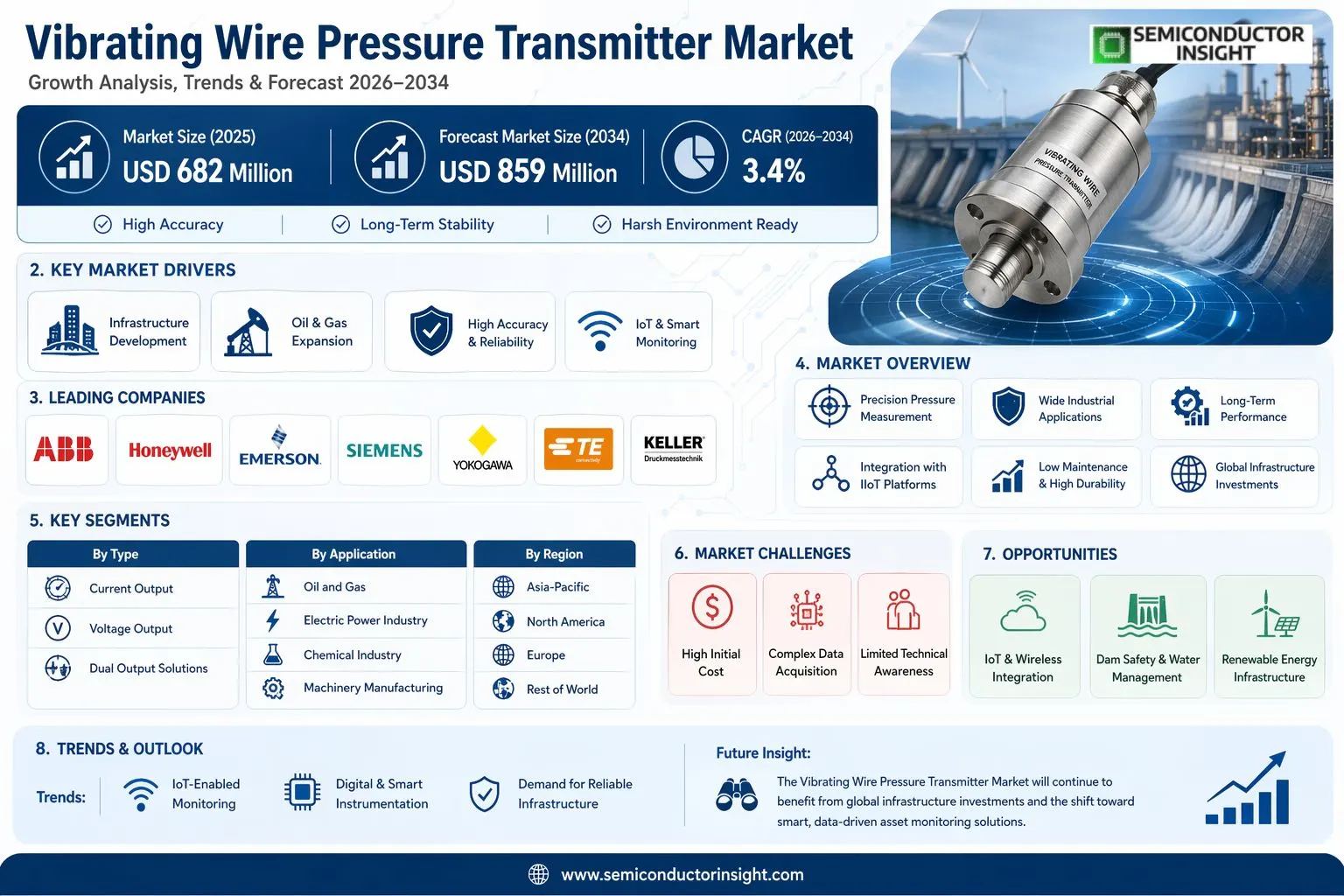
Global Vibrating Wire Pressure Transmitter market size was valued at USD 682 million in 2025. The market is projected to grow from USD 705 million in 2026 to USD 859 million by 2034, exhibiting a CAGR of 3.4% during the forecast period.
Vibrating wire pressure transmitters are precision sensing instruments that operate on the vibrating wire principle, calculating pressure values by measuring changes in the vibration frequency of a tensioned wire under applied pressure. When pressure acts on the sensing element, the resonant frequency of the vibrating wire changes in direct proportion to the applied load. By accurately capturing this shift in resonant frequency, the instrument converts a mechanical pressure input into a corresponding electrical signal, enabling reliable and highly accurate pressure measurement and conversion across a wide range of industrial environments.
The market is experiencing steady growth driven by rising demand for accurate and reliable pressure measurement solutions across industries such as oil and gas, electric power, chemical processing, and machinery manufacturing. The inherent stability, long-term reliability, and resistance to harsh environmental conditions offered by vibrating wire technology continue to make it a preferred choice for critical infrastructure monitoring applications. Key global manufacturers operating in this market include ABB, Honeywell, Emerson, Siemens, Yokogawa, TE Connectivity, and KELLER Druckmesstechnik, among others, collectively accounting for a significant share of global revenue in 2025.
MARKET DRIVERS
Growing Demand from Civil and Geotechnical Engineering Applications
Vibrating Wire Pressure Transmitter Market has been experiencing steady growth, driven largely by the expanding need for precise and reliable pressure monitoring in civil engineering and geotechnical projects. Infrastructure development initiatives across North America, Europe, and Asia-Pacific have accelerated the deployment of vibrating wire pressure transmitters in dam safety monitoring, tunnel construction, retaining wall analysis, and foundation load assessment. These instruments are widely preferred in long-term structural health monitoring due to their inherent stability, resistance to signal degradation over distance, and ability to function in harsh environmental conditions.
Expansion of Oil & Gas and Energy Sector Infrastructure
Rising global investment in oil and gas exploration, pipeline construction, and offshore platform development has emerged as a significant driver for the vibrating wire pressure transmitter industry. These transmitters are extensively used in wellhead monitoring, subsea pressure measurement, and hydraulic fracturing operations where durability and measurement accuracy under extreme pressure and temperature conditions are critical. The ongoing transition toward renewable energy infrastructure, including geothermal energy projects and hydroelectric facilities, further broadens the application scope of vibrating wire pressure transmitters across the energy sector.
➤ Increasing government-backed infrastructure investment programs worldwide are directly stimulating procurement of high-accuracy geotechnical and structural monitoring instruments, including vibrating wire pressure transmitters, particularly in emerging economies across Southeast Asia and Latin America.
Technological advancements in data acquisition systems compatible with vibrating wire sensors have also acted as a key market driver. The integration of wireless data loggers, IoT-enabled readout units, and remote monitoring platforms has significantly enhanced the usability of vibrating wire pressure transmitters in real-time structural monitoring applications. This digital transformation within the instrumentation industry has made vibrating wire technology more accessible and cost-effective for a broader range of end-users, reinforcing market expansion.
MARKET CHALLENGES
Technical Limitations in High-Frequency Dynamic Pressure Measurement
Despite their advantages, vibrating wire pressure transmitters face notable technical challenges that constrain their adoption in certain application segments. One of the primary challenges is their limited suitability for dynamic or rapidly fluctuating pressure measurements, as the vibrating wire technology responds more effectively to quasi-static or slowly varying pressures. This restricts their use in applications demanding high-frequency pressure monitoring, such as certain industrial process control environments, where piezoelectric or strain gauge-based transmitters may be more appropriate alternatives.
Other Challenges
High Initial Cost and Installation Complexity
Vibrating wire pressure transmitters typically carry a higher upfront cost compared to conventional pressure measurement devices. The installation process often requires specialized expertise, particularly in geotechnical embedment applications, which adds to the overall project cost. For cost-sensitive projects in developing regions, this price premium can limit adoption, even when the long-term reliability and low maintenance requirements of vibrating wire instruments are acknowledged by end-users.
Vulnerability to Electromagnetic Interference in Certain Environments
While vibrating wire pressure transmitters are generally resistant to many environmental stressors, they can be susceptible to electromagnetic interference (EMI) in industrial environments with high electrical noise. Cable signal integrity over very long distances may also be affected without proper shielding, requiring additional investment in shielded cabling and signal conditioning equipment, which further increases total system cost and installation complexity for large-scale monitoring networks.
MARKET RESTRAINTS
Competition from Alternative Pressure Sensing Technologies
Vibrating Wire Pressure Transmitter Market faces considerable restraint from competing pressure measurement technologies, including MEMS-based pressure sensors, strain gauge transducers, and capacitive pressure transmitters. These alternatives have benefited from significant miniaturization, cost reduction, and performance improvements in recent years, making them increasingly viable for applications where vibrating wire instruments have traditionally held a competitive edge. The growing availability of low-cost, high-accuracy digital pressure sensors particularly challenges the market positioning of vibrating wire pressure transmitters in price-sensitive project segments.
Supply Chain Constraints and Specialized Component Availability
The production of vibrating wire pressure transmitters relies on precision-engineered components, including specialized wire alloys, hermetic sealing materials, and high-grade stainless steel housings. Global supply chain disruptions, raw material price volatility, and the limited number of specialized component manufacturers have created procurement challenges for market participants. Smaller manufacturers in the vibrating wire pressure transmitter space particularly struggle with consistent component sourcing, which can impact production timelines and overall market supply stability, restraining the ability to scale operations in response to rising demand.
MARKET OPPORTUNITIES
Integration with Smart Monitoring and IoT-Based Infrastructure Platforms
A significant and growing opportunity for Vibrating Wire Pressure Transmitter Market lies in the integration of these instruments with smart infrastructure monitoring platforms and Internet of Things (IoT) ecosystems. As governments and private sector entities invest in smart city initiatives, intelligent transportation systems, and digitally monitored civil infrastructure, the demand for reliable, long-term embedded sensors , including vibrating wire pressure transmitters , is expected to rise substantially. Manufacturers that develop IoT-compatible vibrating wire readout and data transmission systems stand to capture an expanding share of this emerging market segment.
Increasing Adoption in Emerging Economies and Large-Scale Infrastructure Projects
Rapid urbanization, growing infrastructure investment, and the construction of mega-projects in emerging economies across Asia-Pacific, the Middle East, and Africa represent a compelling opportunity for the vibrating wire pressure transmitter industry. Large-scale dam construction, metro rail expansion, deep foundation projects, and flood control infrastructure in these regions require robust and reliable geotechnical monitoring solutions. As awareness of structural health monitoring best practices grows among project developers and government agencies in these markets, vibrating wire pressure transmitters are well-positioned to gain wider adoption as the preferred instrumentation solution for long-term embedded pressure monitoring.
Trends
Rising Demand Across Industrial Applications Driving Vibrating Wire Pressure Transmitter Market
Global Vibrating Wire Pressure Transmitter market is witnessing steady growth, fueled by increasing adoption across critical industrial sectors including oil and gas, electric power, chemical processing, and machinery manufacturing. The core operating principle of vibrating wire pressure transmitters , which measures pressure by detecting changes in the resonant frequency of a vibrating wire element , delivers exceptional accuracy and long-term stability, making these instruments highly preferred for demanding field applications. As industries continue to prioritize precision instrumentation and process reliability, Vibrating Wire Pressure Transmitter Market is positioned for consistent expansion through the forecast period.
Other Trends
Expansion in Oil and Gas Sector
The oil and gas industry remains one of the most prominent end-use segments for vibrating wire pressure transmitters. The need for reliable pressure monitoring in upstream exploration, midstream transportation, and downstream refining operations continues to generate sustained demand. As global energy infrastructure investment recovers and expands, particularly in regions such as the Middle East, North America, and Asia-Pacific, adoption of high-performance pressure sensing devices is expected to accelerate. The inherent durability of vibrating wire technology under harsh environmental conditions makes it particularly suitable for downhole and pipeline monitoring applications.
Integration with Digital and Smart Instrumentation Systems
A notable trend shaping Vibrating Wire Pressure Transmitter Market is the gradual integration of these devices with digital communication protocols and smart monitoring platforms. Industrial operators are increasingly seeking transmitters compatible with HART, FOUNDATION Fieldbus, and IIoT-enabled architectures to enable real-time data acquisition and remote diagnostics. Leading manufacturers such as ABB, Honeywell, Emerson, Siemens, and Yokogawa are investing in product development to align their vibrating wire pressure transmitter portfolios with evolving digital transformation requirements across process industries.
Growing Adoption in Electric Power and Chemical Industries
The electric power generation sector , encompassing both conventional and renewable energy facilities , presents a growing application base for vibrating wire pressure transmitters. Accurate pressure measurement is critical in steam generation, turbine monitoring, and hydraulic systems within power plants. Similarly, the chemical industry demands robust sensing solutions capable of operating in corrosive and high-pressure environments, further broadening the addressable market for vibrating wire technology.
Asia-Pacific Emerging as a Key Growth Region
Asia-Pacific, led by China, Japan, South Korea, and India, is emerging as a significant growth region for Vibrating Wire Pressure Transmitter Market. Rapid industrialization, ongoing infrastructure development, and expanding manufacturing capacity are driving regional demand. Domestic manufacturers such as Xi’an Ounai Sensing Technology and Xi’an Shenghongchuang Instruments are strengthening their presence alongside established global players, intensifying competition and broadening product availability across price segments. This competitive dynamic is expected to support wider market penetration throughout the Asia-Pacific region during the forecast period.
COMPETITIVE LANDSCAPE
Key Industry Players
Vibrating Wire Pressure Transmitter Market – Global Competitive Overview and Leading Manufacturer Profiles
Global Vibrating Wire Pressure Transmitter market, valued at approximately US$ 682 million in 2025 and projected to reach US$ 859 million by 2034 at a CAGR of 3.4%, is characterized by the presence of several well-established multinational corporations alongside a growing number of specialized regional manufacturers. Leading the competitive landscape are industrial instrumentation giants such as ABB, Honeywell, Emerson, Siemens, and Yokogawa, which collectively accounted for a significant share of global revenues in 2025. These companies leverage their extensive R&D capabilities, broad distribution networks, and diversified product portfolios to maintain dominant positions across key end-use segments including oil and gas, electric power, chemical processing, and machinery manufacturing. Their vibrating wire pressure transmitters are recognized for precision measurement, long-term stability, and compatibility with demanding industrial environments, making them preferred choices for large-scale infrastructure and process automation projects worldwide.
Beyond the tier-one players, several niche and regionally significant manufacturers are intensifying competition in the vibrating wire pressure transmitter space. TDK and TE Connectivity bring strong sensing technology expertise and global supply chain advantages, while KELLER Druckmesstechnik has carved out a respected position in high-accuracy, application-specific pressure measurement solutions. Chinese manufacturers such as Xi’an Ounai Sensing Technology, Xi’an Shenghongchuang Instruments, Beijing Jitai Hongsheng Technology, and Shanghai Hangzhen Instruments are increasingly competitive, capitalizing on cost efficiencies and growing domestic demand across Asia. As the market continues to evolve, competitive differentiation is being driven by advances in output signal technology , particularly the shift toward current and voltage output configurations , as well as product miniaturization, improved frequency response accuracy, and integration with digital monitoring platforms.
List of Key Vibrating Wire Pressure Transmitter Companies Profiled
- ABB
- TDK
- Honeywell
- Emerson
- Siemens
- Yokogawa
- TE Connectivity
- KELLER Druckmesstechnik
- Xi’an Ounai Sensing Technology
- Xi’an Shenghongchuang Instruments
- Beijing Jitai Hongsheng Technology
- Shanghai Hangzhen Instruments
- Xi’an Ounai Technology
Segment Analysis:
| Segment Category | Sub-Segments | Key Insights |
| By Type |
|
Current Output transmitters represent the leading segment within Vibrating Wire Pressure Transmitter Market, owing to their superior noise immunity and suitability for long-distance signal transmission in industrial environments.
|
| By Application |
|
Oil and Gas stands as the dominant application segment for vibrating wire pressure transmitters, driven by the industry’s relentless demand for precise, reliable, and durable pressure measurement solutions across upstream, midstream, and downstream operations.
|
| By End User |
|
Energy and Utilities Sector emerges as the leading end user of vibrating wire pressure transmitters, propelled by Global transition toward cleaner energy sources and the consequent need to upgrade measurement and monitoring infrastructure across legacy and new-generation power assets.
|
| By Technology Interface |
|
Digital/Smart Interface transmitters are rapidly becoming the leading technology segment as industrial facilities worldwide accelerate their adoption of Industry 4.0 and Industrial Internet of Things frameworks.
|
| By Installation Environment |
|
Subsurface/Underground Installation represents the leading and most technically demanding environment segment, reflecting the widespread use of vibrating wire pressure transmitters in geotechnical and civil engineering applications such as retaining wall monitoring, foundation pressure assessment, and borehole piezometer measurements.
|
Regional Analysis: Vibrating Wire Pressure Transmitter Market
North America’s extensive pipeline of infrastructure renewal projects , spanning bridge rehabilitation, highway construction, and hydroelectric dam upgrades , generates sustained demand for Vibrating Wire Pressure Transmitter Market. Engineering firms and government agencies increasingly specify these instruments for long-term structural health monitoring programs, where measurement stability and signal integrity over extended durations are non-negotiable requirements.
The North American energy landscape, encompassing both conventional and unconventional hydrocarbon extraction, presents a significant application avenue for Vibrating Wire Pressure Transmitter Market. Monitoring pore water pressure and formation stability during drilling operations has become a standard practice, with transmitters selected for their ruggedness, low power consumption, and ability to operate reliably in harsh subsurface environments across remote field locations.
Stringent safety and environmental compliance standards enforced by regulatory bodies across the United States and Canada compel project owners to deploy certified geotechnical instruments. Vibrating Wire Pressure Transmitter Market benefits directly from requirements around dam safety inspections, mine tailings monitoring, and groundwater management , sectors where mandatory instrumentation programs translate into reliable, recurring procurement activity at both federal and state levels.
North America is home to several leading manufacturers and research institutions advancing the capabilities of vibrating wire sensing technology. Ongoing innovation in wireless data acquisition, remote monitoring integration, and multi-channel readout systems enhances the appeal of these instruments. This culture of continuous product development strengthens the competitive positioning of Vibrating Wire Pressure Transmitter Market across increasingly digitized infrastructure monitoring ecosystems.
Europe
Europe represents a mature yet consistently evolving regional segment within Global vibrating wire pressure transmitter market. Countries including Germany, France, the United Kingdom, and the Nordic nations maintain active geotechnical monitoring programs driven by extensive underground rail networks, alpine tunneling projects, and coastal flood defense infrastructure. The European Union’s commitment to sustainable infrastructure development and environmental stewardship reinforces institutional demand for precision sensing instruments. Vibrating Wire Pressure Transmitter Market in Europe also benefits from a sophisticated base of geotechnical contractors and consultancies that specify high-accuracy instrumentation for both short-term construction monitoring and long-term structural performance assessment. Increasingly, European nations are integrating vibrating wire transmitter data into centralized infrastructure management platforms, reflecting the region’s broader push toward smart, data-driven civil engineering practices throughout the 2026 to 2034 outlook period.
Asia-Pacific
Asia-Pacific represents the fastest-evolving regional market for vibrating wire pressure transmitters, underpinned by an unprecedented scale of infrastructure construction across China, India, Southeast Asia, and Australia. Mega-projects encompassing high-speed rail corridors, large-scale hydroelectric dams, urban metro systems, and deep foundation construction create vast application opportunities for geotechnical monitoring instrumentation. Vibrating Wire Pressure Transmitter Market in Asia-Pacific is further supported by growing awareness of geotechnical risk management among public sector project owners and development banks financing critical infrastructure. India’s accelerating investment in water resource management and dam rehabilitation presents a particularly promising demand corridor. As regional engineering standards evolve and adoption of international best practices in instrumentation deepens, Asia-Pacific is positioned to substantially increase its share of Global vibrating wire pressure transmitter market over the forecast horizon.
South America
South America presents a developing but strategically important regional opportunity within Global vibrating wire pressure transmitter market. Brazil, Chile, Colombia, and Peru are among the key nations where mining operations, hydroelectric power generation, and infrastructure development projects drive demand for reliable geotechnical sensing solutions. The region’s rich mineral resource base sustains continuous investment in mine slope stability monitoring and tailings dam safety assessment , both core application segments for Vibrating Wire Pressure Transmitter Market. Challenges related to procurement infrastructure, import dependency on instrumentation technology, and project financing cycles have historically moderated growth pace. However, expanding multilateral development bank funding for sustainable infrastructure and increasing regulatory scrutiny of tailings dam safety following high-profile incidents are expected to accelerate market maturation across South America through the 2034 forecast period.
Middle East & Africa
The Middle East and Africa region occupies an emerging position in Global vibrating wire pressure transmitter market, with growth trajectories shaped by large-scale construction activity, water resource infrastructure, and expanding extractive industry operations. Gulf Cooperation Council nations are investing heavily in urban development, desalination plant construction, and transportation infrastructure , all sectors requiring dependable geotechnical and structural monitoring instruments. In Sub-Saharan Africa, mining activities and hydroelectric power projects represent the primary demand drivers for Vibrating Wire Pressure Transmitter Market. While market penetration remains relatively limited compared to other regions, growing emphasis on construction quality standards, dam safety legislation, and foreign direct investment in infrastructure development is progressively expanding the addressable opportunity. The Middle East and Africa are expected to register steady, incremental growth within Vibrating Wire Pressure Transmitter Market across the 2026 to 2034 forecast window.
Report Scope
This market research report provides a comprehensive analysis of Vibrating Wire Pressure Transmitter Market, covering the forecast period 2026–2034. It offers detailed insights into market dynamics, technological advancements, competitive landscape, and key trends shaping the industry.
Key focus areas of the report include:
- Market Overview: The report begins with an overview outlining its current market scenario, key growth indicators, and industry transformation drivers. It discusses macroeconomic factors, demand–supply balance, regulatory landscape, and the strategic role of vibrating wire pressure transmitters in powering advancements across industries such as oil and gas, electric power, chemical industry, and machinery manufacturing.
- Market Size & Forecast: Historical data and future projections for revenue, unit shipments, and market value across major regions and segments.
- Segmentation Analysis: Detailed breakdown by product type, technology, application, and end-user industry to identify high-growth segments and investment opportunities.
- Regional Insights: Insights into market performance across North America, Europe, Asia-Pacific, Latin America, and the Middle East & Africa, including country-level analysis where relevant.
- Competitive Landscape: Profiles of leading market participants, including their product offerings, R&D focus, manufacturing capacity, pricing strategies, and recent developments such as mergers, acquisitions, and partnerships.
- Technology Trends & Innovation: Assessment of emerging technologies, integration of AI/IoT, sensor design trends, fabrication techniques, and evolving industry standards.
- Market Drivers & Restraints: Evaluation of factors driving market growth along with challenges, supply chain constraints, regulatory issues, and market-entry barriers.
- Stakeholder Insights: Insights for component suppliers, OEMs, system integrators, investors, and policymakers regarding the evolving ecosystem and strategic opportunities.
Primary and secondary research methods are employed, including interviews with industry experts, data from verified sources, and real-time market intelligence to ensure the accuracy and reliability of the insights presented.
FREQUENTLY ASKED QUESTIONS:
What is the current market size of Vibrating Wire Pressure Transmitter Market?
-> Global Vibrating Wire Pressure Transmitter Market was valued at USD 682 million in 2025 and is expected to reach USD 859 million by 2034, growing at a CAGR of 3.4% during the forecast period.
Which key companies operate in Vibrating Wire Pressure Transmitter Market?
-> Key players include ABB, TDK, Honeywell, Emerson, Siemens, Yokogawa, TE Connectivity, KELLER Druckmesstechnik, Xi’an Ounai Sensing Technology, Xi’an Shenghongchuang Instruments, Beijing Jitai Hongsheng Technology, Shanghai Hangzhen Instruments, and Xi’an Ounai Technology, among others.
What are the key growth drivers?
-> Key growth drivers include rising demand from oil and gas, electric power, and chemical industries, increased adoption of precision pressure measurement technologies, growing industrial automation, and expanding infrastructure investments across emerging economies.
Which region dominates the market?
-> Asia is among the fastest-growing regions driven by rapid industrialization in China, India, and Southeast Asia, while North America and Europe remain significant markets due to established industrial bases and advanced manufacturing sectors.
What are the emerging trends?
-> Emerging trends include integration of IoT-enabled pressure transmitters, advancements in vibrating wire sensing technology, miniaturization of transmitter designs, and growing adoption in machinery manufacturing and infrastructure monitoring applications.

Get Sample Report PDF for Exclusive Insights
Report Sample Includes
- Table of Contents
- List of Tables & Figures
- Charts, Research Methodology, and more...
 Download Sample Report PDF


