Vehicular VLC (visible light communication) traffic light Market Insights
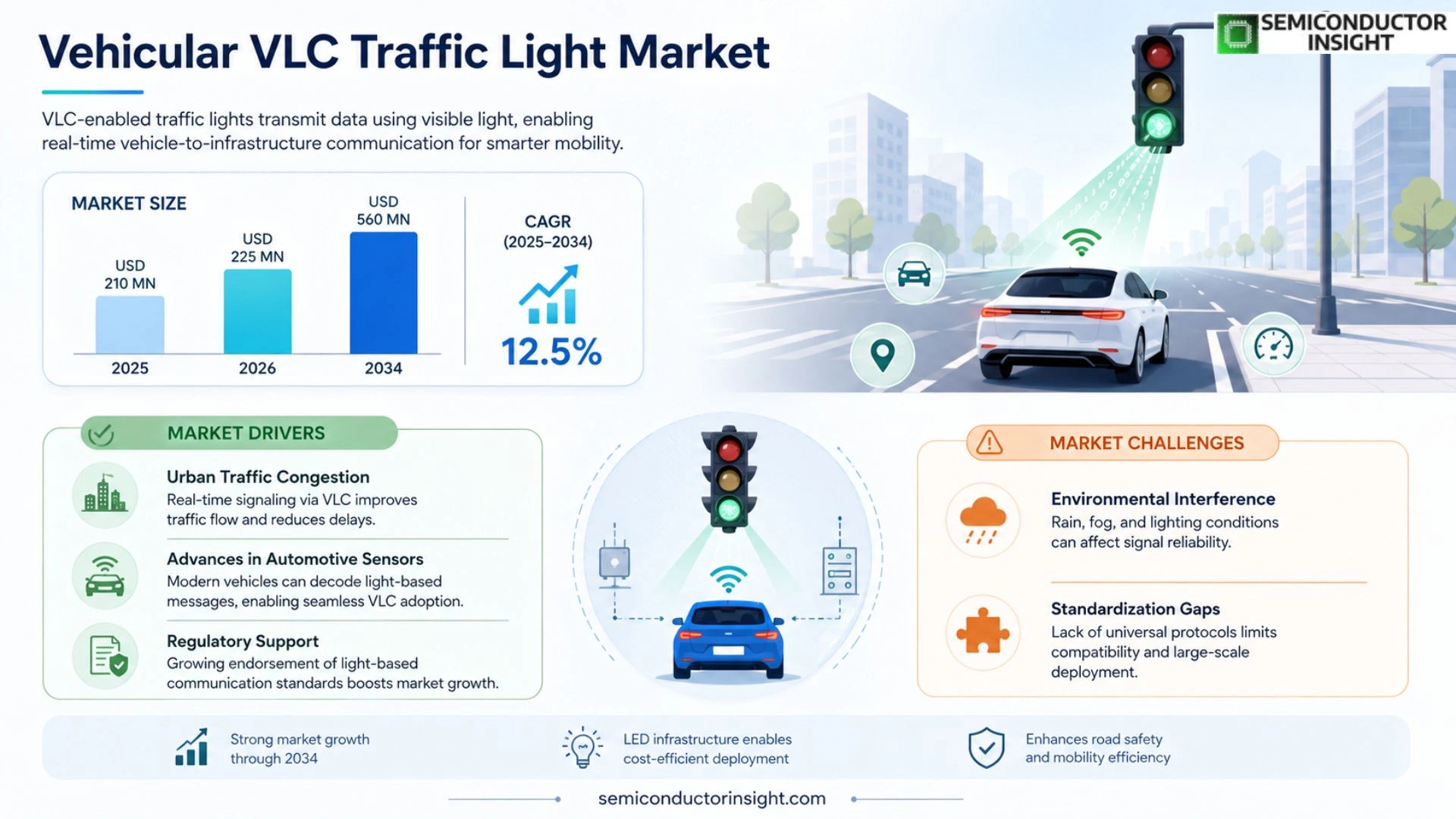
Global Vehicular VLC (visible light communication) traffic light market size was valued at USD 210 million in 2025. The market is projected to grow from USD 225 million in 2026 to USD 560 million by 2034, exhibiting a CAGR of 12.5% during the forecast period.
Vehicular VLC traffic lights are LED‑based signaling devices that embed high‑frequency modulation into standard roadway illumination, enabling vehicles equipped with photodiode receivers to decode data streams such as signal phase, timing information, and hazard alerts. This technology extends traditional visual cues into a bidirectional communication channel for intelligent transportation systems.
The market is experiencing rapid expansion because smart‑city initiatives worldwide are prioritizing low‑latency V2I solutions, while autonomous‑vehicle manufacturers seek reliable line‑of‑sight data links that are immune to radio‑frequency congestion. Furthermore, regulatory support for energy‑efficient lighting and recent collaborations,such as Signify’s partnership with Continental to integrate VLC modules into urban intersections,are accelerating adoption. Key players including Signify (formerly Philips Lighting), OSRAM Licht AG, Bosch Mobility Solutions, and Huawei Technologies are actively developing scalable platforms and securing pilot projects in Europe and Asia.
MARKET DRIVERS
Rising Urban Traffic Congestion
City planners are increasingly looking for real‑time signaling solutions to mitigate gridlock. Vehicular VLC (visible light communication) traffic light Market benefits from these efforts as LED traffic signals can simultaneously transmit data to nearby vehicles, improving flow without additional spectrum.
Advances in Automotive Sensors
Modern vehicles are equipped with photodiodes and camera systems capable of decoding light‑based messages. This technological readiness drives adoption of Vehicular VLC (visible light communication) traffic light technology across new car models.
➤ “Integrating VLC into existing traffic infrastructure reduces deployment costs by leveraging current LED lighting assets.”
Regulatory bodies in several regions have begun endorsing light‑based communication standards, further accelerating market momentum for Vehicular VLC (visible light communication) traffic light Market.
MARKET CHALLENGES
Environmental Interference
Adverse weather conditions such as heavy rain or fog can attenuate visible light signals, posing reliability concerns for Vehicular VLC (visible light communication) traffic light Market. Manufacturers must therefore incorporate robust error‑correction algorithms.
Other Challenges
Standardization Gaps
The lack of universally accepted communication protocols hampers cross‑manufacturer compatibility, limiting large‑scale rollouts of Vehicular VLC (visible light communication) traffic light solutions.
MARKET RESTRAINTS
High Initial Capital Outlay
Upgrading legacy traffic signal infrastructure to VLC‑enabled LEDs requires significant upfront investment, which can deter municipal budgets, especially in emerging economies.
Additionally, the need for retrofitting vehicle optics adds extra cost layers that some automotive OEMs are reluctant to absorb without clear demand signals.
MARKET OPPORTUNITIES
Smart City Initiatives
Governments worldwide are launching Smart City programs that prioritize data‑driven traffic management. Vehicular VLC (visible light communication) traffic light Market stands to capture significant share by offering low‑latency, secure communication channels that complement existing IoT frameworks.Emerging use cases such as pedestrian safety alerts and autonomous vehicle coordination present new revenue streams for VLC solution providers.
Vehicular VLC (visible light communication) traffic light Market Trends
Growing Adoption Driven by Smart‑City Initiatives
Vehicular VLC (visible light communication) traffic light market is gaining momentum as municipalities upgrade legacy signaling to LED‑based units that embed high‑frequency modulation into ordinary roadway illumination. This approach creates a low‑latency, line‑of‑sight data channel that can transmit phase, timing, and hazard information directly to equipped vehicles. Smart‑city programs worldwide prioritize such V2I solutions because they enhance traffic efficiency while reducing energy consumption through adaptive lighting controls. Recent regulatory frameworks that reward energy‑efficient street lighting have further accelerated deployments, especially in dense urban corridors where conventional radio‑frequency bands are congested.
Other Trends
Integration with Autonomous Vehicle Platforms
Autonomous‑vehicle manufacturers are actively seeking reliable complementary communication pathways to augment radar and LiDAR sensing. VLC‑enabled traffic lights provide deterministic, millisecond‑scale updates on signal status, enabling precise maneuver planning at complex intersections. By delivering real‑time phase and countdown data to on‑board photodiode arrays, these systems reduce reliance on cloud‑based V2X services and mitigate latency spikes caused by network congestion. Collaborative efforts such as the Signify‑Continental partnership demonstrate how standardized VLC modules can be retrofitted into existing signal heads, creating a scalable bridge between legacy infrastructure and next‑generation autonomous fleets.
Collaborative Pilot Projects Expand Geographic Reach
Leading technology providers,including OSRAM Licht AG, Bosch Mobility Solutions, and Huawei Technologies,are launching coordinated pilot programs across North America, East Asia, and the Middle East. These initiatives focus on interoperable platform architectures, unified communication protocols, and real‑world performance metrics such as intersection throughput improvement and emission reductions. Early results indicate measurable declines in stop‑and‑go cycles and smoother traffic flow, reinforcing the business case for broader rollout. As standards bodies converge on common VLC specifications, the market is poised for rapid scaling, positioning vehicular VLC traffic lights as a cornerstone of future intelligent transportation ecosystems.
COMPETITIVE LANDSCAPE
Key Industry Players
Competitive Landscape of Vehicular VLC Traffic Light Market
Vehicular VLC (visible light communication) traffic light market is currently led by a coalition of large lighting and automotive technology firms that leverage deep R&D capabilities and global distribution networks. Signify (formerly Philips Lighting) dominates the European segment with its integrated VLC modules that combine high‑efficiency LEDs and secure data encoding, while OSRAM Licht AG provides a complementary portfolio focused on safety‑critical installations in Germany and Scandinavia. Bosch Mobility Solutions and Huawei Technologies bring automotive‑grade reliability and cloud‑connected analytics, positioning them as primary platform providers for smart‑city pilots. These incumbents benefit from strategic partnerships,such as Signify’s collaboration with Continental,to bundle VLC hardware with vehicle‑level sensors, creating scalable ecosystems that accelerate market adoption and attract sizable public‑sector funding.
Beyond the four global leaders, a robust tier of niche innovators is enriching the competitive fabric. Zumtobel Group and Samsung Electronics are expanding VLC functionality into high‑density urban corridors, while LG Innotek supplies specialized photodiode arrays for autonomous‑vehicle manufacturers. General Electric and Texas Instruments contribute advanced driver‑assistance system (ADAS) integration kits, and Molex offers customized connectors for retrofit installations. Notable entrants such as Nokia, Ericsson, and Mitsubishi Electric are applying their telecommunications expertise to enhance low‑latency V2I communication, whereas Valeo and Continental are delivering end‑to‑end solutions that blend lighting, sensor fusion, and vehicle control algorithms. This diversified landscape ensures vigorous innovation and a competitive pricing environment that will shape market growth through 2034.
List of Key Vehicular VLC Traffic Light Companies Profiled
- Signify (formerly Philips Lighting)
- OSRAM Licht AG
- Bosch Mobility Solutions
- Huawei Technologies
- Continental AG
- Zumtobel Group
- Samsung Electronics
- LG Innotek
- General Electric (GE)
- Texas Instruments
- Molex
- Nokia
- Ericsson
- Mitsubishi Electric
- Valeo
Segment Analysis:
| Segment Category | Sub-Segments | Key Insights |
| By Type |
|
LED‑based VLC Traffic Lights
|
| By Application |
|
Intersection Management
|
| By End User |
|
Smart City Authorities
|
| By Technology Integration |
|
Edge Computing Nodes
|
| By Deployment Scenario |
|
Urban Dense Corridors
|
Regional Analysis: North America
Ongoing research and development efforts are focused on improving the range and reliability of Vehicular VLC systems. Advancements in laser diode technology and signal processing are key to enhancing performance and ensuring safe operation in varying environmental conditions.
Government bodies across North America are increasingly recognizing the potential of intelligent transportation systems. Supportive regulations and pilot projects are fostering a conducive environment for the deployment of Vehicular VLC traffic light solutions.
The expansion of smart city infrastructure, including the deployment of sensors and connected devices, is creating a strong ecosystem for the adoption of Vehicular VLC traffic light technology. This includes investment in fiber optic networks and 5G connectivity, which can further enhance the capabilities of VLC systems.
Strong collaboration between automotive manufacturers, technology providers, and transportation authorities is driving innovation and accelerating the market growth of Vehicular VLC traffic light systems in North America.
North America
The market for Vehicular VLC traffic light systems in North America is experiencing steady growth, driven by concerns over traffic congestion and the need for more efficient and safer transportation networks. The region’s advanced technological infrastructure and proactive approach to smart city initiatives are key factors contributing to this expansion. The integration of VLC technology offers a promising path towards optimizing traffic flow and enhancing the overall driving experience.
Europe
Europe represents another significant market for Vehicular VLC traffic light systems. Stringent environmental regulations and a strong focus on sustainable transportation are pushing the adoption of innovative traffic management solutions. The dense urban environments in many European countries create a compelling need for technologies that can improve traffic flow and reduce congestion.
Asia-Pacific
The Asia-Pacific region is expected to witness the fastest growth in the Vehicular VLC traffic light market. Rapid urbanization, increasing vehicle ownership, and substantial investments in smart city projects are driving demand for advanced traffic management systems. The region’s burgeoning automotive industry and supportive government policies are further fueling market expansion.
South America
While still in its early stages of development, the Vehicular VLC traffic light market in South America holds considerable potential. Growing urban populations and increasing traffic congestion are creating a need for more efficient traffic solutions. Government initiatives promoting smart city development and investments in transportation infrastructure are expected to drive future market growth.
Middle East & Africa
The Middle East & Africa region presents a promising, albeit emerging, market for Vehicular VLC traffic light systems. Rapid urbanization and significant infrastructure development projects are creating opportunities for the adoption of innovative traffic management solutions. The region’s focus on smart city initiatives and investments in transportation technology are expected to drive market growth.
Report Scope
This market research report provides a comprehensive analysis of the Vehicular VLC (visible light communication) traffic light Market , covering the forecast period 2026–2034. It offers detailed insights into market dynamics, technological advancements, competitive landscape, and key trends shaping the industry.
Key focus areas of the report include:
- Market Overview: The report begins with an overview outlining its current market scenario, key growth indicators, and industry transformation drivers. It discusses macroeconomic factors, demand–supply balance, regulatory landscape, and the strategic role of semiconductors in powering advancements across industries such as automotive, telecommunications, consumer electronics, and industrial automation.
- Market Size & Forecast: Historical data and future projections for revenue, unit shipments, and market value across major regions and segments.
- Segmentation Analysis: Detailed breakdown by product type, technology, application, and end-user industry to identify high-growth segments and investment opportunities.
- Regional Insights: Insights into market performance across North America, Europe, Asia-Pacific, Latin America, and the Middle East & Africa, including country-level analysis where relevant.
- Competitive Landscape: Profiles of leading market participants, including their product offerings, R&D focus, manufacturing capacity, pricing strategies, and recent developments such as mergers, acquisitions, and partnerships.
- Technology Trends & Innovation: Assessment of emerging technologies, integration of AI/IoT, semiconductor design trends, fabrication techniques, and evolving industry standards.
- Market Drivers & Restraints: Evaluation of factors driving market growth along with challenges, supply chain constraints, regulatory issues, and market-entry barriers.
- Stakeholder Insights: Insights for component suppliers, OEMs, system integrators, investors, and policymakers regarding the evolving ecosystem and strategic opportunities.
Primary and secondary research methods are employed, including interviews with industry experts, data from verified sources, and real-time market intelligence to ensure the accuracy and reliability of the insights presented.
FREQUENTLY ASKED QUESTIONS:
What is the current market size of Vehicular VLC (visible light communication) traffic light Market?
-> Vehicular VLC (visible light communication) traffic light market size is projected to grow from USD 225 million in 2026 to USD 560 million by 2034, exhibiting a CAGR of 12.5%.
Which key companies operate in Vehicular VLC (visible light communication) traffic light Market?
-> Key players include Signify (formerly Philips Lighting), OSRAM Licht AG, Bosch Mobility Solutions, and Huawei Technologies, among others.
What are the key growth drivers?
-> Key growth drivers include smart‑city initiatives, low‑latency V2I solutions, demand from autonomous‑vehicle manufacturers, regulatory support for energy‑efficient lighting, and strategic collaborations such as Signify’s partnership with Continental.
Which region dominates the market?
-> Europe remains a dominant market, while Asia‑Pacific is the fastest‑growing region.
What are the emerging trends?
-> Emerging trends include integration of VLC modules into urban intersections, LED‑based bidirectional communication platforms, AI/IoT‑enabled traffic management, and ongoing standardization efforts for V2I communication.
Get Sample Report PDF for Exclusive Insights
Report Sample Includes
- Table of Contents
- List of Tables & Figures
- Charts, Research Methodology, and more...
 Download Sample Report PDF