VC Heat Sinks Market Insights
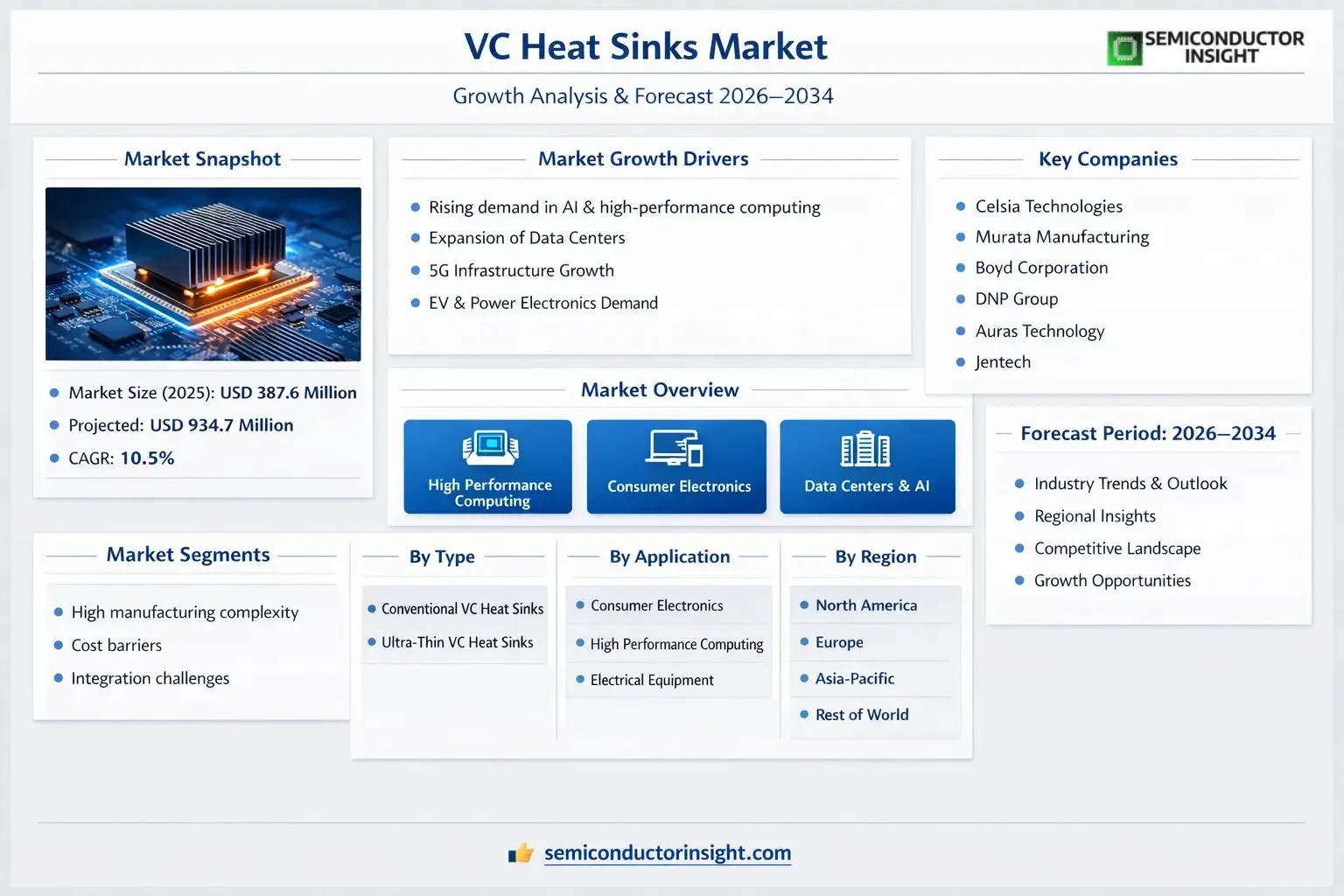
Global VC Heat Sinks market size was valued at USD 387.6 million in 2025. The market is projected to grow from USD 420.3 million in 2026 to USD 934.7 million by 2034, exhibiting a CAGR of 10.5% during the forecast period.
VC heat sinks refer to advanced thermal management components that leverage vapor chamber (VC) technology to achieve highly efficient heat dissipation across a two-dimensional plane. These components utilize the phase-change principle , where a working fluid evaporates upon absorbing heat and condenses after releasing it , enabling fast heat spreading and exceptionally high heat transfer power. As the core raw material of VC vapor chambers, VC heat sinks are specifically engineered to handle high heat flux densities and large-area heat dissipation scenarios, making them distinctly superior to conventional copper or aluminum heat spreaders in thermally demanding applications.
The market is experiencing robust growth driven by escalating thermal management requirements across consumer electronics, high-performance computing, and electrical equipment segments. The proliferation of ultra-thin smartphones, AI-accelerated processors, and 5G infrastructure hardware continues to push thermal loads beyond the capacity of traditional solutions, making VC heat sinks an increasingly critical component. Furthermore, the growing adoption of advanced packaging technologies in semiconductors and the rapid expansion of data center infrastructure globally are reinforcing demand. Key manufacturers actively shaping the competitive landscape include Celsia Technologies, Auras, Jentech, Murata Manufacturing, DNP Group, Radian Thermal Products, Boyd, and Changzhou Zhongying, among others, all of whom continue to invest in product innovation and capacity expansion to address the evolving needs of downstream industries.
MARKET DRIVERS
Rising Thermal Management Demands in High-Performance Electronics
VC heat sinks market is experiencing robust growth driven by escalating thermal management requirements across high-performance computing, telecommunications, and consumer electronics sectors. Vapor chamber (VC) heat sinks, which leverage two-phase heat transfer mechanisms, offer significantly superior thermal conductivity compared to conventional copper or aluminum heat sinks. As processors and GPUs continue to operate at higher power densities, the demand for advanced cooling solutions such as VC heat sinks has become increasingly critical to maintaining device reliability and performance. The transition toward compact, high-wattage electronic designs has positioned VC heat sinks as a preferred thermal management technology among leading hardware developers and OEMs globally.
Rapid Expansion of Data Centers and AI Infrastructure
The accelerated deployment of artificial intelligence workloads and hyperscale data centers represents one of the most significant drivers for VC heat sinks market. Modern AI accelerators and high-density server configurations generate unprecedented levels of heat, rendering traditional air-cooling solutions increasingly inadequate. Vapor chamber heat sinks enable efficient heat spreading across large surface areas, making them indispensable in rack-level and chip-level cooling architectures. As data center operators pursue higher computational density while adhering to strict power usage effectiveness (PUE) targets, investment in advanced thermal solutions including VC heat sinks continues to grow at a consistent pace across North America, Asia-Pacific, and Europe.
➤ The proliferation of 5G base stations, edge computing nodes, and next-generation gaming hardware has further broadened the addressable market for VC heat sinks, with thermal performance increasingly recognized as a key competitive differentiator among electronics manufacturers.
Additionally, the growing adoption of electric vehicles (EVs) and advanced driver-assistance systems (ADAS) has introduced a new frontier for VC heat sink applications. Power electronics modules within EV powertrains and battery management systems require precise thermal regulation, and vapor chamber technology is increasingly being evaluated and integrated into automotive-grade thermal management solutions. This diversification of end-use industries is expected to sustain momentum in VC heat sinks market through the coming years.
MARKET CHALLENGES
High Manufacturing Complexity and Cost Barriers Limiting Widespread Adoption
Despite the clear performance advantages of vapor chamber technology, VC heat sinks market faces significant challenges related to manufacturing complexity and elevated production costs. The fabrication of vapor chambers involves precision sintering, micro-wick structure formation, and hermetic sealing processes that demand specialized equipment and highly controlled environments. These requirements elevate per-unit costs substantially compared to conventional heat sink alternatives. For cost-sensitive applications such as mid-range consumer electronics and industrial equipment, the premium pricing of VC heat sinks can be a deterrent, particularly when simpler heat pipe or extruded aluminum solutions are deemed sufficient. Manufacturers are actively investing in process automation and material optimization to reduce costs, but achieving price parity with conventional solutions remains a medium-term challenge.
Other Challenges
Supply Chain Vulnerabilities for Specialty Materials
The production of high-quality VC heat sinks relies on specialty materials including high-purity copper foils, sintered powder wicks, and controlled-atmosphere working fluids such as deionized water. Disruptions in the supply of these materials , whether due to geopolitical tensions, logistics constraints, or fluctuating commodity prices , can impact production timelines and margins for manufacturers operating in VC heat sinks market. Securing diversified and resilient supply chains has become a strategic priority for leading players.
Technical Integration Challenges in Miniaturized Designs
As electronic devices continue to shrink in form factor, integrating VC heat sinks within constrained physical spaces presents notable engineering challenges. Ultra-thin vapor chambers for smartphones and wearables require advanced micro-fabrication techniques, and maintaining consistent thermal performance at sub-millimeter thicknesses demands continuous innovation. Balancing mechanical robustness with thermal efficiency in miniaturized configurations remains a persistent technical challenge for R&D teams across VC heat sinks market.
MARKET RESTRAINTS
Competition from Alternative Advanced Cooling Technologies
One of the primary restraints on VC heat sinks market is the growing competitive pressure from alternative thermal management technologies, including liquid cooling loops, thermoelectric coolers, and immersion cooling systems. In hyperscale data center environments, direct liquid cooling (DLC) and single-phase immersion cooling are gaining significant traction due to their ability to manage extremely high heat loads at scale. While VC heat sinks offer distinct advantages in space efficiency and reliability for chip-level applications, they face displacement risks in scenarios where full-system liquid cooling is implemented. The availability of diverse cooling solutions at varying price and performance points introduces substitution risks that could moderate growth within specific segments of VC heat sinks market.
Standardization Gaps and Lack of Universal Testing Protocols
The absence of universally accepted industry standards and testing methodologies for vapor chamber heat sinks presents a restraint on broader market adoption, particularly among risk-averse enterprise and industrial buyers. Without consistent benchmarking frameworks, procurement teams face difficulties in objectively comparing the thermal performance, reliability, and longevity of VC heat sinks from different suppliers. This standardization gap can prolong evaluation and qualification cycles, slowing adoption rates in regulated industries such as aerospace, defense, and medical electronics. Industry consortia and standards bodies are beginning to address this gap, but comprehensive protocols are not yet widely established across VC heat sinks market.
MARKET OPPORTUNITIES
Emergence of Next-Generation Consumer Electronics and Foldable Device Segments
The rapid evolution of premium consumer electronics, including foldable smartphones, gaming handhelds, and AR/VR headsets, presents a compelling opportunity for VC heat sinks market. These devices require high-efficiency, ultra-thin thermal solutions capable of managing concentrated heat loads within unconventional form factors. Vapor chamber heat sinks are well-positioned to address these requirements, and leading consumer electronics brands are actively collaborating with thermal solution providers to integrate advanced VC technologies into next-generation product platforms. As the global installed base of premium mobile and wearable devices expands, demand for thin-form-factor VC heat sinks is expected to grow proportionally.
Strategic Expansion into Automotive and Industrial Power Electronics
The electrification of transportation and the modernization of industrial power systems represent high-growth opportunity areas for VC heat sinks market. Power inverters, onboard chargers, and traction control modules in electric and hybrid vehicles operate under demanding thermal conditions that align well with the performance envelope of vapor chamber technology. Similarly, industrial motor drives, renewable energy inverters, and high-frequency switching power supplies in smart grid infrastructure present addressable markets for VC heat sinks. As automotive and industrial OEMs increasingly prioritize thermal reliability as a core design criterion, suppliers capable of delivering application-specific vapor chamber heat sink solutions with automotive-grade qualification stand to capture significant new revenue streams in these emerging verticals.
VC Heat Sinks Market Trends
Rising Demand from High-Performance Computing and Consumer Electronics Drives VC Heat Sinks Market Growth
VC heat sinks market is witnessing significant momentum as industries increasingly prioritize efficient thermal management solutions. Vapor chamber heat sinks, known for their ability to dissipate heat across a two-dimensional plane with high speed and elevated heat transfer power, are becoming indispensable in applications that generate substantial heat flux. The rapid proliferation of high-performance processors, graphics units, and compact consumer devices has pushed the need for advanced cooling technologies to the forefront of product development strategies across multiple sectors.
Consumer electronics and high-performance computing segments are leading demand, as device manufacturers seek to address the thermal challenges posed by increasingly powerful yet miniaturized hardware. The shift toward ultra-thin form factors in laptops, tablets, and smartphones has particularly amplified interest in ultra-thin VC heat sink variants, which offer superior heat spreading capabilities without adding significant bulk to device designs. Major manufacturers such as Celsia Technologies, Murata Manufacturing, Boyd, and Jentech are actively investing in research and development to deliver next-generation vapor chamber solutions that align with evolving industry requirements.
Other Trends
Expansion in Electrical Equipment and Industrial Applications
Beyond consumer electronics, VC heat sinks market is experiencing growing traction in electrical equipment and industrial sectors. Power electronics, EV charging infrastructure, and telecommunications hardware increasingly require robust thermal management to ensure operational reliability and longevity. This diversification of end-use applications is broadening the addressable market for VC heat sink manufacturers, encouraging product innovation tailored to high heat-flux density environments.
Asia-Pacific Emerges as a Key Manufacturing and Consumption Hub
Asia-Pacific, led by China, Japan, and South Korea, continues to dominate both production and consumption of VC heat sinks. The region’s well-established electronics manufacturing ecosystem, combined with the presence of key players such as DNP Group, Auras, and Changzhou Zhongying, positions it as the central hub for market activity. Growing investments in domestic semiconductor fabrication and the rapid expansion of data center infrastructure across Southeast Asia further reinforce this regional dominance.
Competitive Landscape and Technological Innovation Shaping Market Direction
The competitive landscape of VC heat sinks market is marked by continuous technological advancements, with manufacturers focusing on improving thermal conductivity, reducing weight, and enhancing structural durability. Strategic collaborations, capacity expansions, and product portfolio diversification are prominent strategies among leading players. The conventional VC heat sink segment retains a significant market share, while the ultra-thin segment is gaining ground rapidly, reflecting broader trends toward device miniaturization and higher power density management across the global electronics industry.
COMPETITIVE LANDSCAPE
Key Industry Players
VC Heat Sinks Market Competitive Dynamics, Strategic Positioning, and Leading Manufacturer Profiles
VC Heat Sinks market is characterized by a moderately consolidated competitive landscape, with a handful of technologically advanced manufacturers commanding a significant share of global revenues. Celsia Technologies stands out as a prominent leader in vapor chamber-based thermal solutions, leveraging proprietary sintered powder wick structures and advanced two-phase heat transfer technologies to serve high-heat-flux applications across consumer electronics and high-performance computing segments. Murata Manufacturing, a diversified Japanese electronics giant, has made considerable inroads into the VC heat sink domain by integrating its precision manufacturing capabilities with miniaturized vapor chamber designs tailored for next-generation mobile and wearable devices. Boyd Corporation, with its broad thermal management portfolio, continues to expand its VC heat sink offerings through strategic acquisitions and R&D investments, reinforcing its position across North American and European markets. DNP Group (Dai Nippon Printing) applies its advanced etching and lamination expertise to produce ultra-thin VC heat sinks, catering to the rapidly growing segment of slim consumer electronics. In 2025, the global top five players collectively accounted for a substantial share of total market revenue, underscoring the importance of scale, innovation, and supply chain integration in maintaining competitive advantage.
Beyond the dominant players, several niche and regionally significant manufacturers contribute meaningfully to the global VC Heat Sinks ecosystem. Auras Technology, a Taiwan-based thermal solutions specialist, has built a strong reputation for customized VC heat sinks serving notebook computers and gaming hardware. Jentech, another key Taiwanese player, focuses on high-density thermal modules and has steadily expanded its global client base through OEM partnerships with major electronics brands. Radian Thermal Products offers differentiated solutions for industrial and electrical equipment applications, targeting segments that require robust, long-lifecycle thermal management components. Changzhou Zhongying, a rising Chinese manufacturer, has gained market traction by offering cost-competitive VC heat sinks optimized for the domestic consumer electronics supply chain, benefiting from China’s strong position as both a production hub and one of the world’s largest end-markets for thermal management components. The competitive intensity across the market is expected to escalate as demand from AI servers, 5G infrastructure, and advanced semiconductor packaging continues to drive innovation in vapor chamber heat sink design and materials engineering.
List of Key VC Heat Sinks Companies Profiled
- Celsia Technologies
- Auras Technology
- Jentech
- Murata Manufacturing
- DNP Group (Dai Nippon Printing)
- Radian Thermal Products
- Boyd Corporation
- Changzhou Zhongying
- Furukawa Electric
- Delta Electronics
- Cooler Master
- Asia Vital Components (AVC)
- Fujikura Ltd.
- Nidec Corporation
- Sunonwealth Electric Machine Industry (Sunon)
Segment Analysis:
| Segment Category | Sub-Segments | Key Insights |
| By Type |
|
Conventional VC Heat Sinks currently hold the leading position in this segment, driven by their well-established manufacturing processes and broad compatibility with a wide range of thermal management applications.
|
| By Application |
|
Consumer Electronics represents the dominant application segment for VC heat sinks, underpinned by the explosive proliferation of smartphones, tablets, laptops, and wearable devices that demand efficient and compact thermal management solutions.
|
| By End User |
|
Original Equipment Manufacturers (OEMs) constitute the leading end-user segment, as they integrate VC heat sinks directly into finished products at scale, covering consumer electronics, computing hardware, and telecom equipment manufacturing.
|
| By Material |
|
Copper-Based VC Heat Sinks lead this segment owing to copper’s superior thermal conductivity and well-understood material behavior within vapor chamber architectures, making it the material of choice for high-performance and mission-critical thermal applications.
|
| By Sales Channel |
|
Direct Sales dominate VC heat sinks market as large-scale OEMs and enterprise clients prefer to engage directly with manufacturers such as Celsia Technologies, Boyd, and Murata Manufacturing to ensure product customization, quality assurance, and supply chain reliability.
|
Regional Analysis: VC Heat Sinks Market
Asia-Pacific
Asia-Pacific hosts a deeply integrated supply chain for VC heat sinks, with raw material sourcing, component fabrication, and final assembly concentrated within the region. This proximity of suppliers reduces lead times and production costs, enabling manufacturers to respond swiftly to evolving thermal management requirements across consumer electronics, telecommunications, and automotive electronics segments.
The surge in hyperscale data center construction and aggressive 5G infrastructure deployment across China, Japan, and South Korea is creating sustained demand for advanced vapor chamber cooling solutions. These applications require heat sinks capable of handling elevated thermal loads with precision and reliability, pushing regional suppliers to continuously elevate product performance standards.
Asia-Pacific’s position as the world’s largest electric vehicle market directly amplifies demand for VC heat sinks in battery management systems and power electronics modules. Automakers and tier-one suppliers in the region are actively integrating vapor chamber technology to address the stringent thermal control requirements of next-generation EV powertrains and onboard charging systems.
Leading technology conglomerates and specialized thermal management firms across Asia-Pacific are channeling substantial resources into vapor chamber research, focusing on ultra-thin designs, novel working fluids, and sintered wick structures. This innovation-driven approach is enabling the region to set global benchmarks in VC heat sink performance, further reinforcing its competitive advantage in the market.
North America
North America represents a highly significant market for VC heat sinks, underpinned by the presence of world-leading semiconductor companies, hyperscale cloud infrastructure operators, and a robust defense and aerospace sector. The United States, in particular, drives demand through its concentration of major data center campuses operated by technology giants, where efficient thermal management is a critical operational imperative. The region’s strong focus on artificial intelligence hardware, high-performance computing, and advanced server architectures is accelerating the adoption of vapor chamber cooling solutions. Additionally, stringent energy efficiency regulations and sustainability commitments by large enterprises are encouraging the replacement of legacy cooling systems with more effective VC heat sink technologies. North America also benefits from a well-established network of specialized thermal management companies and material science research institutions that continuously advance vapor chamber design capabilities, positioning the region as a key innovation hub in VC Heat Sinks market.
Europe
Europe’s VC heat sinks market is shaped by the region’s commitment to energy efficiency, green technology adoption, and high-performance industrial applications. Germany, France, and the United Kingdom are among the primary contributors, with demand emanating from automotive electronics, industrial automation, renewable energy systems, and telecommunications infrastructure. European automakers, particularly those accelerating their electric vehicle transitions, are increasingly specifying vapor chamber heat sinks for power electronics and battery thermal management applications. The region’s regulatory environment, which places strong emphasis on reducing energy consumption and carbon emissions, serves as a structural driver for the adoption of advanced cooling technologies. Moreover, European research institutions and universities actively collaborate with industry stakeholders to develop next-generation thermal management solutions, fostering an innovation culture that supports long-term market growth in the VC heat sinks segment.
South America
South America represents an emerging opportunity in VC Heat Sinks market, with Brazil leading regional demand on the back of a growing electronics manufacturing sector and expanding telecommunications infrastructure. While the market remains in a relatively nascent stage compared to Asia-Pacific or North America, the gradual modernization of data center facilities and increasing penetration of consumer electronics are creating a foundation for future growth. Local manufacturers are beginning to explore vapor chamber technology as awareness of its thermal performance advantages spreads across the industrial and commercial electronics sectors. Challenges such as economic volatility, limited access to advanced manufacturing capabilities, and reliance on imports of high-performance thermal components continue to moderate growth in the near term, though long-term prospects for VC heat sinks market in South America remain positive as digital infrastructure investments increase.
Middle East & Africa
The Middle East and Africa region occupies a developing position in VC heat sinks market, with demand primarily driven by large-scale data center investments, smart city initiatives, and expanding telecommunications networks in Gulf Cooperation Council countries. Nations such as the United Arab Emirates and Saudi Arabia are actively building digital infrastructure to support economic diversification goals, generating demand for reliable and high-efficiency thermal management solutions. The extreme ambient temperatures prevalent across much of the region further underscore the importance of robust cooling technologies like vapor chamber heat sinks in ensuring the operational reliability of electronic systems. Africa’s market remains at an early stage of development, with growth constrained by infrastructure limitations and economic barriers, though increasing foreign investment in technology infrastructure is expected to gradually stimulate demand for advanced cooling solutions in VC heat sinks market over the coming years.
Report Scope
This market research report provides a comprehensive analysis of VC heat sinks market, covering the forecast period 2025–2034. It offers detailed insights into market dynamics, technological advancements, competitive landscape, and key trends shaping the industry.
Key focus areas of the report include:
- Market Overview: The report begins with an overview outlining its current market scenario, key growth indicators, and industry transformation drivers. It discusses macroeconomic factors, demand–supply balance, regulatory landscape, and the strategic role of semiconductors in powering advancements across industries such as automotive, telecommunications, consumer electronics, and industrial automation.
- Market Size & Forecast: Historical data and future projections for revenue, unit shipments, and market value across major regions and segments.
- Segmentation Analysis: Detailed breakdown by product type, technology, application, and end-user industry to identify high-growth segments and investment opportunities.
- Regional Insights: Insights into market performance across North America, Europe, Asia-Pacific, Latin America, and the Middle East & Africa, including country-level analysis where relevant.
- Competitive Landscape: Profiles of leading market participants, including their product offerings, R&D focus, manufacturing capacity, pricing strategies, and recent developments such as mergers, acquisitions, and partnerships.
- Technology Trends & Innovation: Assessment of emerging technologies, integration of AI/IoT, semiconductor design trends, fabrication techniques, and evolving industry standards.
- Market Drivers & Restraints: Evaluation of factors driving market growth along with challenges, supply chain constraints, regulatory issues, and market-entry barriers.
- Stakeholder Insights: Insights for component suppliers, OEMs, system integrators, investors, and policymakers regarding the evolving ecosystem and strategic opportunities.
Primary and secondary research methods are employed, including interviews with industry experts, data from verified sources, and real-time market intelligence to ensure the accuracy and reliability of the insights presented.
FREQUENTLY ASKED QUESTIONS:
What is the current market size of VC Heat Sinks Market?
-> Global VC Heat Sinks Market was valued at USD 387.6 million in 2025 and is projected to reach USD 934.7 million by 2034.
Which key companies operate in VC Heat Sinks Market?
-> Key players include Celsia Technologies, Auras, Jentech, Murata Manufacturing, DNP Group, Radian Thermal Products, Boyd, Changzhou Zhongying, among others. The global top five players held approximately % market share in 2025.
What are the key growth drivers?
-> Key growth drivers include demand for efficient heat dissipation solutions in high heat flow density applications, adoption in consumer electronics and high-performance computing, and technological advancements in thermal management.
Which region dominates the market?
-> Asia is a key region with China projected to reach USD million by 2034, while the U.S. market was estimated at USD million in 2025.
What are the emerging trends?
-> Emerging trends include development of ultra-thin VC heat sinks, integration in advanced electronics, and expansion into new application areas such as electrical equipment.

Get Sample Report PDF for Exclusive Insights
Report Sample Includes
- Table of Contents
- List of Tables & Figures
- Charts, Research Methodology, and more...
 Download Sample Report PDF