V30 SD Card Market Insights
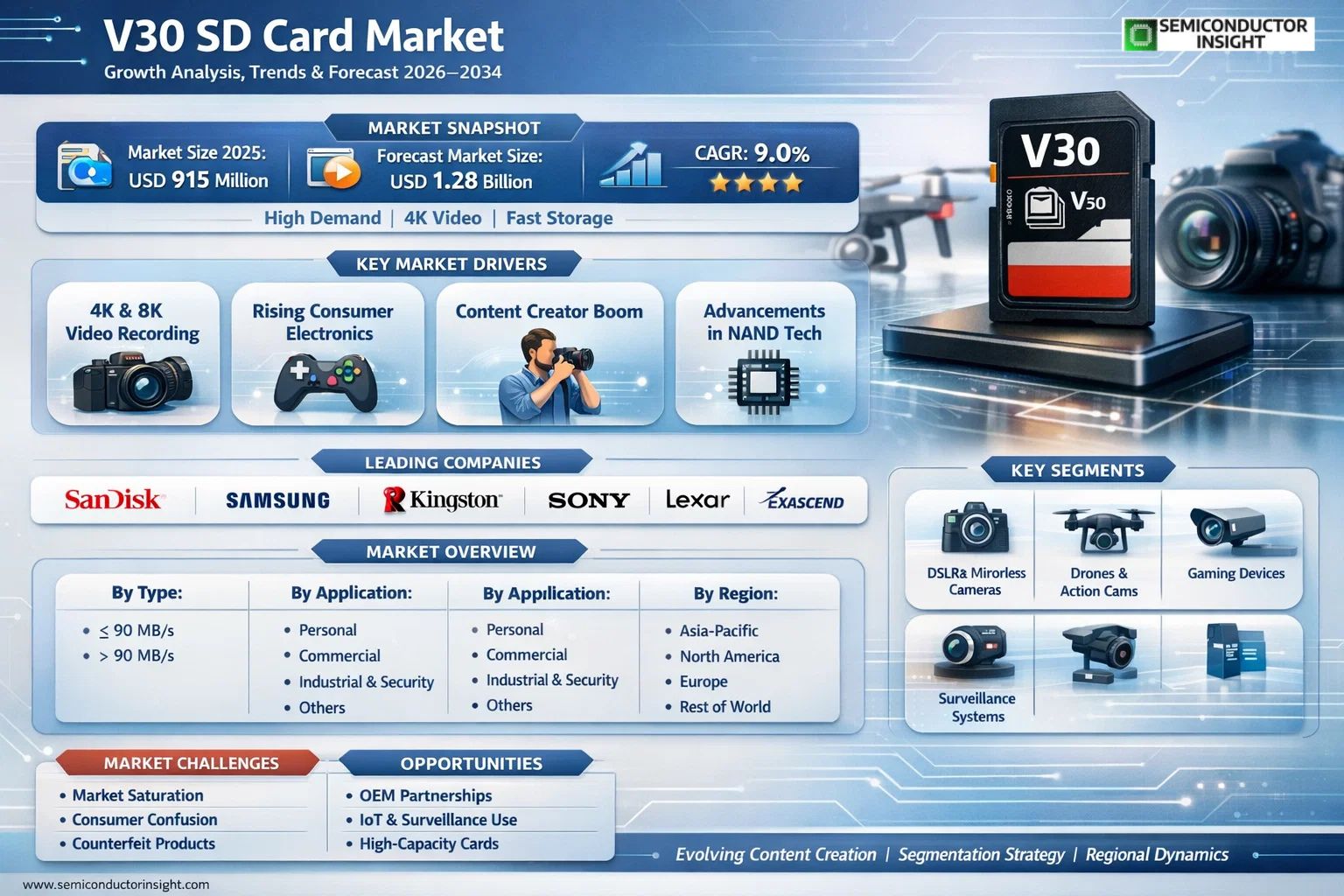
Global V30 SD Card market size was valued at USD 915 million in 2025. The market is projected to grow from USD 1.28 billion in 2026 to USD 1.90 billion by 2034, exhibiting a CAGR of 9.0% during the forecast period.
A V30 SD card is a Secure Digital memory card that meets the Video Speed Class (VSC) V30 standard, as defined by the SD Association. This classification guarantees a minimum sustained write speed of 30 megabytes per second (MB/s), which is critical for recording high-bitrate video formats without dropped frames or interruptions. These cards are essential for demanding applications such as 4K and Full HD video capture, high-speed continuous burst photography in DSLR and mirrorless cameras, and data logging in drones and action cameras.
The market’s robust growth is primarily driven by the proliferation of high-resolution imaging devices and the expanding creator economy. The rising adoption of 4K/60fps and emerging 8K video recording in consumer electronics creates a continuous demand for higher-performance storage. Furthermore, the professionalization of content creation on digital platforms necessitates reliable, fast media. While the market is competitive with established players like SanDisk (Western Digital), Samsung, and Sony holding significant shares, recent developments focus on increasing capacities and integrating advanced features like rugged designs and integrated recovery software to cater to professional users.
MARKET DRIVERS
Growth of High-Resolution Content Creation
The proliferation of high-resolution photography and 4K/6K video recording is a primary force propelling the V30 SD card market. Modern cameras, drones, and smartphones demand storage that can sustain high write speeds to record data-heavy formats without frame drops. The Video Speed Class 30 (V30) certification guarantees a minimum sustained write speed of 30MB/s, which is essential for smooth recording. Therefore, the rise of enthusiast creators and content professionals directly fuels demand for reliable V30 SD cards.
Expansion of the Consumer Electronics Ecosystem
Beyond professional cameras, a wider consumer electronics ecosystem supports this market segment. Devices like the Nintendo Switch, action cameras, advanced dashcams, and high-end tablets require fast storage for optimal performance in gaming, playback, and app operation. The V30 SD card serves as a cost-effective upgrade path for users needing better performance than basic Class 10 cards but not the peak speeds of higher-tier V60 or V90 cards, creating a strong mid-market position.
➤ Market analysis shows that the sustained performance of V30 SD cards reduces buffer times during burst-mode photography by over 70% compared to non-V-rated cards, enhancing user workflow efficiency.
Continuous evolution in NAND flash memory technology allows manufacturers to offer higher capacities and improved durability at stable price points, making V30 performance more accessible. This technological democratization encourages broader market adoption from both OEMs and end-users, integrating these cards into a wider variety of data-intensive applications.
MARKET CHALLENGES
Market Saturation and Consumer Confusion
A significant challenge in the V30 SD card market is product differentiation and education. The marketplace is crowded with numerous speed classes (V30, U3, A2), leading to confusion among less technical consumers about what specification is truly needed for their device. This can result in either overspending or purchasing underperforming cards, which hampers market growth. Furthermore, widespread counterfeit products erode trust and can damage device compatibility.
Other Challenges
Increasing Competition from Embedded Solutions
The trend toward device simplification, with smartphones and ultraportable laptops moving to non-expandable storage, reduces the total addressable market for removable cards like the V30 SD card.
Performance Inconsistency and Endurance Issues
Not all cards marketed as V30 SD cards maintain consistent write speeds under sustained load or across different host devices, a factor critical for professional use. Variations in NAND quality and controller firmware can lead to reliability concerns and negative brand perception.
MARKET RESTRAINTS
Price Sensitivity in Core Markets
Despite technological advances, V30 SD card sales in price-driven markets remain highly restrained. In these regions, the cost-to-performance ratio is heavily scrutinized, and consumers often opt for lower-specification cards despite potential performance drawbacks. This limits market penetration and prioritizes volume sales of basic storage over performance-tier products. Global economic volatility and fluctuating NAND flash memory prices can also create pricing instability, making consistent market growth challenging.
Shift Towards Higher Performance Tiers
The steady advancement of content creation technology itself acts as a long-term restraint. As 8K video and high-frame-rate recording become more mainstream, the V30 SD card market faces pressure from the V60 and V90 segments targeted at professionals. This progression risks positioning the V30 specification as an entry-level, rather than mainstream, performance standard over time, potentially capping its premium valuation.
MARKET OPPORTUNITIES
Partnerships with Device Manufacturers
A key market opportunity lies in forging certified partnerships with leading camera, drone, and gaming console manufacturers. Creating co-branded, device-optimized V30 SD cards can ensure perfect compatibility and drive sales through official retail channels. These partnerships can include bundling cards with new devices, capturing the upgrade market directly and establishing a trusted benchmark for performance.
Growth in Surveillance and IoT Applications
The expansion of high-definition security systems, body cameras, and IoT devices presents a robust growth avenue. These applications require durable, high-endurance storage capable of continuous writing in varied environmental conditions. Specialized V30 SD cards engineered for 24/7 operation, extreme temperatures, and data integrity can open significant B2B and industrial market segments, diversifying revenue beyond consumer electronics.
Advancements offering higher capacities like 1TB within the V30 SD card class create new use cases. This enables users to store extensive 4K video libraries or large game collections on a single card, effectively competing with portable SSDs for certain use cases. Marketing this expanded utility can attract prosumers and tech enthusiasts looking for a versatile, high-capacity storage solution.
V30 SD Card Market Trends
Demand Growth Driven by Evolving Content Creation Tools
The adoption of V30 SD cards is being propelled by the widespread use of 4K-capable smartphones, drones, and entry-level mirrorless cameras. The standard’s guarantee of a minimum sustained write speed of 30 MB/s has become essential for users recording high-bitrate content, ensuring stability during extended shoots. Manufacturers are responding to this consumer trend by integrating UHS-I U3 and V30 specifications into a wider range of mid-tier memory products. This evolution caters to a growing demographic of prosumers and professionals who require reliable performance without the premium cost of V60 or V90 cards for their primary workflows.
Other Trends
Segmentation and Price Positioning
Within the market, a clear segmentation trend is observed based on maximum write speeds. Products with sub-90 MB/s maximum writes are often positioned as budget-conscious options, frequently targeting personal users for everyday device expansion and casual photography. Conversely, models with over 90 MB/s maximum write speeds are designed for more demanding commercial and professional applications like advanced photography, multi-camera setups, and certain surveillance systems. This segmentation strategy allows leading manufacturers to address diverse customer needs while maximizing portfolio coverage.
Regional Market Dynamics
The V30 SD Card market demonstrates distinct regional dynamics driven by technological adoption and manufacturing presence. North America and Asia are key drivers, with Asia, particularly China and Japan, serving as both a major manufacturing hub and a leading consumer market. This is fueled by a high concentration of electronics manufacturers and a massive base of tech-savvy consumers engaged in content creation. The European market follows closely, with demand sustained by a strong photography culture and widespread use of action cameras.
Consolidation and Brand Competition
The competitive landscape remains concentrated, with a few global brands holding significant share. Established players like SanDisk, Samsung, and Kingston leverage broad brand recognition and distribution networks. Innovation in this space focuses on improved durability (waterproof, temperature-resistant, shockproof), enhanced capacity per dollar, and bundled software offerings. The presence of dedicated industrial card manufacturers like Exascend indicates a parallel trend where reliability and specialized endurance for commercial uses are becoming increasingly important alongside consumer-focused performance metrics.
COMPETITIVE LANDSCAPE
Key Industry Players
A Structured Market Led by Storage and Electronics Giants
Global V30 SD card market exhibits a concentrated competitive structure, dominated by leading multinational corporations with strong brand equity and extensive R&D capabilities in flash memory technology. In 2025, Global top five players collectively held a significant share of market revenue, underscoring the high barriers to entry associated with advanced NAND flash manufacturing and controller design. SanDisk, a Western Digital brand, is widely recognized as the market leader, leveraging its pioneering role in flash storage to offer a comprehensive portfolio of high-performance V30 cards. Samsung follows closely, utilizing its vertically integrated semiconductor manufacturing to produce reliable and high-speed memory cards. Kingston Technology, with its strong focus on the consumer and professional photography segments, holds a formidable position, particularly for cards exceeding 90 MB/s maximum write speeds, which is a key growth segment. These leaders compete primarily on performance metrics, reliability, storage capacity, and brand reputation, catering to demanding applications in 4K video recording, drone photography, and high-speed continuous shooting.
Beyond the top-tier players, the market features several significant niche and regional competitors that contribute to its dynamism. Companies like Sony and Lexar (owned by Longsys) target professional content creators and enthusiasts with premium, high-endurance V30 SD cards. Exascend specializes in industrial-grade and ruggedized memory solutions, carving out a niche in commercial and embedded applications. Players such as Integral Memory, Transcend, ADATA, and PNY Technologies offer competitively priced alternatives, capturing value-conscious segments of the personal and commercial markets. The competitive landscape is further populated by specialized brands like Delkin Devices, known for its professional photographic gear, and Phison, a major controller supplier that also markets its own card solutions. This diverse ecosystem ensures a wide range of price-performance options, driving innovation and accessibility across the expanding V30 SD card market.
List of Key V30 SD Card Companies Profiled
- SanDisk (Western Digital)
- Samsung Electronics
- Kingston Technology
- Sony Corporation
- Lexar (Longsys)
- Exascend
- Integral Memory
- Transcend Information
- ADATA Technology
- PNY Technologies
- Delkin Devices
- Toshiba Memory (Kioxia)
- Team Group
- Silicon Power
- Phison Electronics
Segment Analysis:
| Segment Category | Sub-Segments | Key Insights |
| By Type |
|
>90 MB/s Maximum Write represents the technologically advanced and performance-oriented segment. This category is driven by professional content creators and power users who demand superior write speeds to handle data-intensive workflows. The dominance is linked to the growing requirement for high-bitrate 4K video recording and rapid burst-mode photography, where sustained write performance is critical to avoid buffer delays and ensure operational reliability in demanding environments. |
| By Application |
|
Commercial applications are a primary growth driver for the V30 segment. This encompasses professional photography, videography services, and media production houses where robust performance is non-negotiable. The guaranteed minimum write speed ensures smooth, uninterrupted recording for live events, filmmaking, and broadcast applications, making it a preferred choice over lower-grade cards. Furthermore, adoption by drone operators and sports/action videographers fuels demand, as these use cases are highly sensitive to write-speed consistency and card reliability. |
| By End User |
|
Professional Content Creators constitute the core end-user segment, dictating product development and feature prioritization. Their reliance on V30 cards stems from the critical need for data integrity and speed consistency during high-stakes projects. The evolution of camera technology towards higher resolutions and faster burst rates creates a continuous pull for this performance tier. Brand loyalty and trust in established manufacturers like SanDisk and Sony are significant, as professionals seek proven reliability and robust warranty support to safeguard their valuable data and projects. |
| By Capacity Range |
|
High-Capacity (512GB – 1TB) range is witnessing accelerated adoption as the leading value segment. The shift is driven by the exponential growth in file sizes from modern video codecs and high-resolution photography, making lower capacities impractical for extended shoots. Users increasingly prefer fewer, higher-capacity cards to streamline workflow, reduce physical swapping, and minimize the risk of data loss. This trend is particularly pronounced in commercial videography and documentary filmmaking, where shooting durations are long and on-site data offloading opportunities may be limited. |
| By Distribution Channel |
|
Online Retail/E-commerce is the dominant and fastest-evolving channel, fundamentally reshaping market accessibility. This channel offers consumers extensive product comparisons, detailed user reviews, and competitive pricing, which are crucial for a considered purchase like a performance memory card. The convenience of home delivery and the availability of a wide inventory, including the latest high-performance models from all major brands, make it the preferred choice for both new buyers and professionals seeking specific SKUs. Furthermore, targeted online marketing and tech-influencer endorsements effectively drive demand within this segment. |
Regional Analysis: Global V30 SD Card Market
Asia-Pacific Region
The region’s dominance is underpinned by a concentration of semiconductor fabrication and flash memory assembly plants. This proximity from wafer to final card reduces lead times and enhances responsiveness to V30 SD Card Market demand fluctuations, creating a significant competitive advantage for regional players in both pricing and product availability.
Unparalleled adoption rates of devices that mandate V30 speeds, such as advanced action cameras and mid-to-high-tier smartphones, create a built-in, high-volume customer base. Local manufacturers tailor V30 SD Card specifications and bundles to align with popular regional device launches, deeply embedding these storage solutions in the consumer electronics ecosystem.
Regional R&D centers are heavily focused on improving endurance, heat dissipation, and controller firmware tailored for high-ambient-temperature usage common in the region. This focus on environmental durability and performance stability is a key driver for the V30 SD Card Market’s evolution beyond basic minimum speed guarantees.
Advanced digital marketplaces and robust logistics networks enable widespread accessibility of V30 SD Cards, even in tier-2 and tier-3 cities. Aggressive online retail strategies, including bundle deals with compatible devices, significantly lower the barrier to entry and educate new users on the benefits of V30-class performance.
North America
North America represents a high-value, specification-driven segment of the V30 SD Card Market, characterized by robust demand from professional and prosumer user bases. The region’s emphasis on content creation,including professional videography, photography, and livestreaming,creates sustained demand for cards that reliably exceed the V30 minimum to handle high-bitrate codecs. This mature market demands strong brand reputation, extensive warranties, and verified compatibility with professional gear from leading camera manufacturers. The V30 SD Card Market here is also influenced by trends in outdoor recreation technology, such as drones and dash cams, where durability and consistent write speeds are non-negotiable. Enterprise and SMB adoption for surveillance and data logging applications further contributes to a stable, quality-oriented demand.
Europe
The European V30 SD Card Market is defined by stringent consumer protection standards, environmental regulations, and a diverse, multi-language retail landscape. Demand is bifurcated between enthusiast photographers and videographers who prioritize performance and reliability, and general consumers seeking trustworthy storage for smartphones and tablets. Market dynamics are influenced by strong OEM partnerships, where V30 SD Cards are often sold as certified accessories for specific camera or automotive brands. Sustainability considerations, such as recyclable packaging and reduced hazardous materials, are becoming increasingly important purchasing factors, influencing product design and marketing strategies within the regional V30 SD Card Market. Cross-border e-commerce within the EU also facilitates price competition and broader product availability.
South America
The V30 SD Card Market in South America is an emerging growth frontier, primarily driven by the expanding middle class and increasing smartphone penetration with enhanced video recording capabilities. Market growth is tempered by economic volatility, which makes consumers highly price-sensitive and often extends product lifecycles. However, the growth of social media content creation and mobile gaming is creating a discernible shift towards faster, more reliable storage. Distribution channels are crucial, with a mix of formal retail and a significant informal market. The regional V30 SD Card Market exhibits potential for volume growth, with demand centered on affordable, dependable brands that offer a clear performance benefit over slower Class 10 cards for everyday 4K video use.
Middle East & Africa
This region presents a developing and heterogeneous landscape for the V30 SD Card Market. In more affluent Gulf nations, demand mirrors high-value markets, driven by tourism-related content creation, premium automotive dash cam adoption, and a tech-savvy consumer base. In contrast, broader African markets are in early adoption phases, where price is the paramount concern. Growth potential is linked to mobile device proliferation and the nascent creator economy. The V30 SD Card Market here faces unique challenges, including varied import regulations, climate considerations requiring robust thermal performance, and the need for products that balance essential speed guarantees with cost-effectiveness to gain a foothold against slower, cheaper alternatives.
Report Scope
This market research report provides a comprehensive analysis of the V30 SD Card Market, covering the forecast period 2026–2034. It offers detailed insights into market dynamics, technological advancements, competitive landscape, and key trends shaping the industry.
Key focus areas of the report include:
- Market Overview: The report begins with an overview outlining its current market scenario, key growth indicators, and industry transformation drivers. It discusses macroeconomic factors, demand–supply balance, regulatory landscape, and the strategic role of high-speed memory storage in powering advancements across industries such as consumer electronics, professional photography, videography, drones, and automotive systems.
- Market Size & Forecast: Historical data and future projections for revenue, unit shipments, and market value across major regions and segments.
- Segmentation Analysis: Detailed breakdown by product type (e.g., maximum write speed), application, and end-user (Personal, Commercial) to identify high-growth segments and investment opportunities.
- Regional Insights: Insights into market performance across North America, Europe, Asia-Pacific, Latin America, and the Middle East & Africa, including country-level analysis where relevant.
- Competitive Landscape: Profiles of leading market participants, including their product offerings, R&D focus, manufacturing capacity, pricing strategies, and recent developments such as mergers, acquisitions, and partnerships.
- Technology Trends & Innovation: Assessment of emerging standards, integration with advanced devices, semiconductor memory trends, and evolving performance requirements.
- Market Drivers & Restraints: Evaluation of factors driving market growth along with challenges, supply chain constraints, regulatory issues, and market-entry barriers.
- Stakeholder Insights: Insights for component suppliers, OEMs, system integrators, retailers, investors, and policymakers regarding the evolving ecosystem and strategic opportunities.
Primary and secondary research methods are employed, including interviews with industry experts, data from verified sources, and real-time market intelligence to ensure the accuracy and reliability of the insights presented.
FREQUENTLY ASKED QUESTIONS:
What is the current market size of V30 SD Card Market?
-> Global V30 SD Card Market was valued at USD 915 million in 2025 and is projected to reach USD 1899 million by 2034, growing at a CAGR of 9.0% during the forecast period.
Which key companies operate in V30 SD Card Market?
-> Key players include Sandisk, Samsung, Kingston, Exascend, Sony, Lexar, and Integral, among others.
What are the key growth drivers?
-> Key growth drivers include rising demand for high-definition video recording, continuous shooting in photography, adoption in drone photography, and increasing data storage needs in consumer and commercial electronics.
Which region dominates the market?
-> The market features significant activity across key regions. The U.S. and China are major country-level markets. Detailed regional analysis covers North America, Europe, Asia, South America, and Middle East & Africa.
What are the emerging trends?
-> Emerging trends include development of higher speed grade cards, growing segmentation by maximum write speed (e.g., ?90 MB/s), and expansion of application scenarios requiring sustained high data transfer rates.

Get Sample Report PDF for Exclusive Insights
Report Sample Includes
- Table of Contents
- List of Tables & Figures
- Charts, Research Methodology, and more...
 Download Sample Report PDF