
UV LED Spot Curing System Market Insights
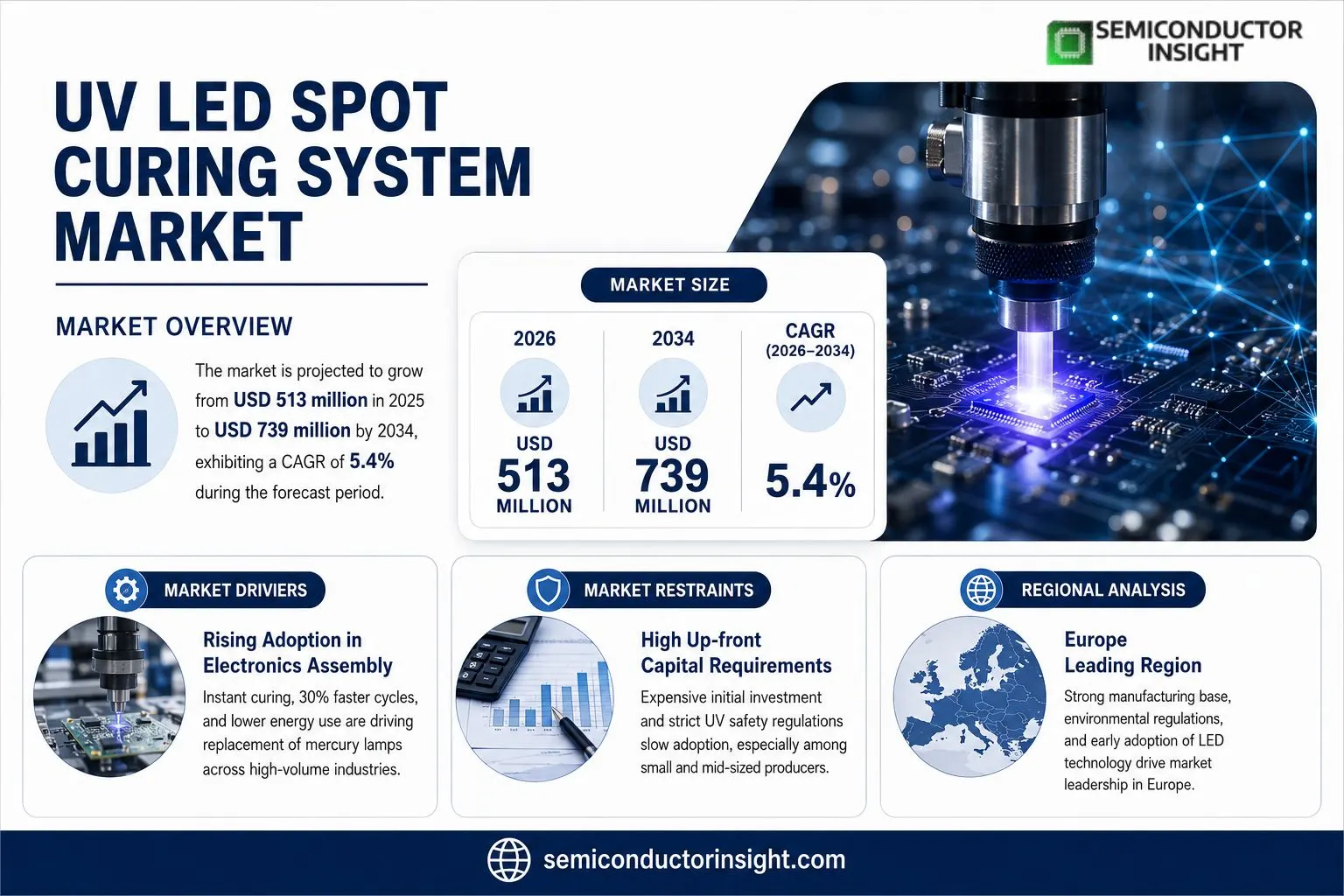
UV LED Spot Curing System market was valued at USD 513 million in 2025 and is expected to reach USD 739 million by 2034, reflecting a CAGR of 5.4% over the forecast period.
UV LED Spot Curing System is an ultraviolet light‑emitting diode technology that delivers high‑purity monochromatic UV light through a point‑like high‑precision spot. It is primarily employed for rapid curing of UV‑sensitive adhesives, inks and other photosensitive materials.The market expands because traditional mercury lamps are being replaced under environmental regulations, while applications in consumer electronics, medical disinfection and printed circuit board manufacturing deepen. Advances such as AI‑controlled intensity uniformity and wavelength‑tunable designs are enhancing system versatility, and increasing localization of upstream chip production is lowering costs.
MARKET DRIVERS
Rising Adoption in Electronics Assembly
UV LED Spot Curing System Market is gaining traction among manufacturers of printed circuit boards because the technology delivers instant polymerization without thermal load. This capability shortens line cycles by up to 30 % and reduces re‑work, prompting midsize and tier‑1 assemblers to replace conventional mercury lamps.
Energy‑efficiency Demands
Industrial plants are under pressure to cut electricity bills, and the LED‑based spot curing units consume roughly 40 % less power than older systems. Operators cite lower utility costs as a decisive factor when budgeting for new equipment, especially in high‑volume sectors such as automotive lighting.
➤ Customers report a payback period of 18‑24 months for the first‑generation LED spot cure installations, driven by reduced consumables and maintenance.
Beyond cost savings, the compact form factor of modern spot curing heads enables tighter integration into automated lines, opening possibilities for inline inspection and real‑time quality control. Companies that embed these systems can differentiate themselves with faster time‑to‑market.
MARKET CHALLENGES
High Up‑front Capital Requirements
Despite observable operating savings, the initial outlay for high‑power UV LED arrays remains steep, often exceeding $150,000 for fully automated stations. Small‑volume producers struggle to justify the expense, leading to a slower diffusion rate in niche markets.
Other Challenges
Material Compatibility
A subset of thermoset adhesives and inks still exhibit limited cure depth under spot illumination. Suppliers must reformulate formulations, which adds R&D cost and extends time‑to‑launch for end‑users.
MARKET RESTRAINTS
Regulatory Hurdles in Certain Regions
Stringent safety certifications for UV radiation exposure delay product approvals in Europe and parts of Asia. Manufacturers often need to redesign enclosure optics or add interlocks, inflating engineering effort and postponing market entry.
MARKET OPPORTUNITIES
Expansion into Medical Device Assembly
The shift toward minimally invasive implants has created a demand for precise, localized curing of biocompatible polymers. UV LED spot curing systems, with their pinpoint accuracy and low thermal impact, are uniquely positioned to serve this high‑margin segment, promising revenue uplift for early entrants.
UV LED Spot Curing System Market Trends
Replacement of Mercury Lamps Accelerates Adoption
The regulatory push for lower hazardous emissions has forced many manufacturers to retire traditional mercury‑based curing equipment. LED spot units, offering monochromatic output and longer service lives, meet compliance requirements while cutting operating expenses. Buyers are also attracted by the ability to fine‑tune spot size between 3 mm and 12 mm, which supports precision‑driven processes such as micro‑electronics assembly and medical device fabrication. Because the average unit price hovers around US$200, the total spend on the roughly 2.8 million units produced in 2025 remains manageable for midsized producers, further encouraging substitution.
Other Trends
AI‑Enabled Uniformity Controls
Recent releases embed machine‑learning models that continuously monitor photometric data and adjust drive currents to keep light intensity within ±3 % across the spot field. This level of consistency reduces rework rates in high‑value ink‑cure applications and shortens cycle times on printed‑circuit‑board lines. Enterprises that have adopted such intelligent modules report a measurable uplift in throughput, prompting equipment suppliers to prioritize firmware upgrades in upcoming product cycles.
Localized Semiconductor Sources Reduce Cost Pressure
Historically, the core UV LED chips were imported, inflating bill‑of‑materials for end users. Over the past two years, Chinese and Korean fabs have scaled production of high‑power UV diodes, cutting lead times and shaving 10‑15 % off component cost. The ripple effect is evident in pricing negotiations: system integrators can now bundle water‑cooled platforms with multi‑lamp intelligence at margins that were previously unattainable. This cost headroom encourages OEMs in consumer electronics and emerging battery‑pack sectors to experiment with wavelength‑tunable solutions, expanding the addressable portfolio of UV LED Spot Curing System Market.
COMPETITIVE LANDSCAPEKey Industry Players
Competitive Landscape of UV LED Spot Curing Systems
The market is dominated by a handful of multinational OEMs that have leveraged deep optical‑design expertise and sophisticated thermal‑management capabilities to secure premium pricing. OCIR TECH INC, headquartered in the United States, commands the highest revenue share by offering fully integrated water‑cooled platforms with AI‑driven intensity control, a feature that differentiates its product line in high‑volume industrial curing lines. Close behind, Phoseon Technology (USA) and Excelitas Technologies (USA) exploit strategic patents on lens‑condensing optics, enabling adjustable spot sizes from 3 mm to 12 mm while maintaining ±3 % uniformity. Their distribution networks in Europe, North America and Japan create a barrier to entry for new entrants, reinforcing a market structure that is heavily top‑heavy yet still open to niche specialization.Beyond the tier‑one giants, a vibrant cohort of regional firms injects competitive pressure through cost‑effective designs and rapid localisation of UV‑LED chip sourcing. Shenzhen Heitande and Shanghai Futanxi, both based in China, focus on compact, air‑cooled units tailored for PCB assembly and consumer‑electronics repair shops, thereby capturing price‑sensitive segments. European specialists such as POMEAS (Germany) and IST METZ (France) concentrate on ultra‑stable wavelength‑tunable systems for medical‑disinfection and Mini‑LED packaging applications. Japanese leader Hamamatsu leverages its semiconductor heritage to supply high‑power chips that underpin many OEM assemblies. This eclectic mix of manufacturers ensures that while the upper echelon controls large‑scale contracts, smaller players sustain innovation in niche verticals.
List of Key UV LED Spot Curing System Companies Profiled
- OCIR TECH INC
- Phoseon Technology
- Excelitas Technologies
- POMEAS
- Hamamatsu Photonics
- Kyocera Corporation
- OSTEC (Opsytec)
- IST METZ
- Dymax Corp.
- Ushio Inc.
- Shenzhen Heitande
- Shanghai Futanxi
- Shenzhen UVSENG
- Agiltron, Inc.
- American Ultraviolet
Segment Analysis:
| Segment Category | Sub-Segments | Key Insights |
| By Type |
|
Single‑Spot Units dominate early‑stage adoption because they deliver precise, high‑intensity curing for niche components.
|
| By Application |
|
Industrial Curing is the leading application segment, driven by the need for rapid, high‑precision bonding in complex assemblies.
|
| By End User |
|
OEMs in Electronics drive the most sophisticated demand due to tight tolerances on component miniaturization.
|
| By Cooling Technology |
|
Water‑Cooled Systems have become the benchmark for high‑power spot curing because they sustain output while protecting device longevity.
|
| By Wavelength |
|
UVA Point Source is the preferred wavelength for most adhesive and ink formulations, offering a balance of curing speed and material compatibility.
|
Regional Analysis: UV LED Spot Curing System Market
Europe
The EU’s REACH amendments tighten limits on solvent‑based curing agents, compelling manufacturers to evaluate UV LED spot systems as compliant alternatives. Certification bodies now require demonstrable energy‑efficiency metrics, accelerating the adoption curve among regulated sectors such as medical device assembly.
Recent semiconductor shortages have spotlighted the advantage of LED modules that rely on mature gallium nitride fabs in the region. Local sourcing reduces lead times, allowing European integrators to keep line‑downtime to a minimum during peak demand periods.
OEMs cite faster cure cycles and lower heat‑stress on substrates as decisive factors. In high‑precision optics production, the ability to cure within milliseconds without warping glass components drives repeat purchases of spot curing platforms.
European vendors differentiate through integrated digital twins that simulate cure profiles, offering a consultative sales approach that competes effectively against Asian price‑focused challengers.
North America
In the United States, UV LED Spot Curing System Market is shaped by a strong incentive structure for energy‑saving technologies, particularly within aerospace and defense supply chains. Federal procurement guidelines reward manufacturers that demonstrate lower carbon footprints, prompting large‑scale OEMs to replace legacy mercury lamps with LED spot units. Canadian adopters, meanwhile, are leveraging provincial grants that subsidize capital expenditures for advanced manufacturing equipment, creating a modest but steady flow of retrofit projects. The prevailing trend is a shift toward modular equipment that can be slotted into existing conveyor lines, allowing firms to scale capacity without extensive plant re‑engineering. This approach reduces disruption risk and aligns with the lean‑manufacturing philosophies prevalent in the region.
Asia‑Pacific
Asia‑Pacific’s attractiveness stems from its blend of high‑volume production and burgeoning innovation hubs in South Korea and Japan. While cost considerations remain paramount, manufacturers are increasingly recognizing the long‑term savings derived from reduced consumable waste and lower maintenance cycles associated with LED spot curing. The region’s rapid rollout of smart factory initiatives embeds IoT sensors within curing stations, delivering real‑time performance analytics that support predictive maintenance. This data‑driven emphasis is nudging midsize factories toward higher‑specification equipment, even as they balance price pressures from low‑cost producers in emerging economies.
South America
In Brazil and Argentina, UV LED Spot Curing System Market is still in an exploratory phase, with pilot installations concentrated in the automotive paint and consumer electronics sectors. Local manufacturers grapple with financing constraints, yet regional development banks have introduced low‑interest loan programs aimed at modernizing production lines. Companies that adopt LED spot curing report notable improvements in surface quality and a decline in hazardous waste disposal costs, arguments that are gradually resonating with senior management seeking compliance with evolving environmental regulations.
Middle East & Africa
The Middle East’s oil‑service and aerospace maintenance firms view UV LED spot curing as a pathway to reduce volatile organic compound emissions in high‑temperature environments. In the United Arab Emirates, government‑driven sustainability targets have spurred early‑stage collaborations between equipment integrators and local downstream processors. African markets, still nascent, are observing the technology through joint‑venture demonstrations in South Africa’s precision engineering sector, where the promise of faster cure times aligns with the continent’s ambition to move up the value chain.
Report Scope
This market research report provides a comprehensive analysis of the UV LED Spot Curing System Market , covering the forecast period 2026–2034. It offers detailed insights into market dynamics, technological advancements, competitive landscape, and key trends shaping the industry.
Key focus areas of the report include:
- Market Overview: The report begins with an overview outlining its current market scenario, key growth indicators, and industry transformation drivers. It discusses macroeconomic factors, demand–supply balance, regulatory landscape, and the strategic role of semiconductors in powering advancements across industries such as automotive, telecommunications, consumer electronics, and industrial automation.
- Market Size & Forecast: Historical data and future projections for revenue, unit shipments, and market value across major regions and segments.
- Segmentation Analysis: Detailed breakdown by product type, technology, application, and end-user industry to identify high-growth segments and investment opportunities.
- Regional Insights: Insights into market performance across North America, Europe, Asia-Pacific, Latin America, and the Middle East & Africa, including country-level analysis where relevant.
- Competitive Landscape: Profiles of leading market participants, including their product offerings, R&D focus, manufacturing capacity, pricing strategies, and recent developments such as mergers, acquisitions, and partnerships.
- Technology Trends & Innovation: Assessment of emerging technologies, integration of AI/IoT, semiconductor design trends, fabrication techniques, and evolving industry standards.
- Market Drivers & Restraints: Evaluation of factors driving market growth along with challenges, supply chain constraints, regulatory issues, and market-entry barriers.
- Stakeholder Insights: Insights for component suppliers, OEMs, system integrators, investors, and policymakers regarding the evolving ecosystem and strategic opportunities.
Primary and secondary research methods are employed, including interviews with industry experts, data from verified sources, and real-time market intelligence to ensure the accuracy and reliability of the insights presented.
FREQUENTLY ASKED QUESTIONS:
What is the current market size of UV LED Spot Curing System Market?
-> UV LED Spot Curing System Market was valued at USD 513 million in 2025 and is expected to reach USD 739 million by 2034, at a CAGR of 5.4% during the forecast period.
Which key companies operate in UV LED Spot Curing System Market?
-> Key players include OCIR TECH INC, Phoseon Technology, Shenzhen Heitande, and Shanghai Futanxi, among others.
What are the key growth drivers?
-> Key growth drivers include the replacement of traditional mercury lamps driven by environmental protection policies, expanding applications in consumer electronics, medical disinfection, PCB manufacturing, and the dominant industrial curing segment.
Which region dominates the market?
-> Europe and North America hold the largest market share, reflecting the high concentration of manufacturers and early adoption of UV LED spot curing technology in these developed regions.
What are the emerging trends?
-> Emerging trends feature integration of AI algorithms to achieve light intensity uniformity of ±3%, development of wavelength‑tunable systems for Mini LED packages and new‑energy batteries, and accelerated localization of upstream chip production to lower costs and boost competitiveness.
What is the production volume and average price in 2025?
-> In 2025, production reached approximately 2,810 K units with an average price of USD 200 per unit.
Get Sample Report PDF for Exclusive Insights
Report Sample Includes
- Table of Contents
- List of Tables & Figures
- Charts, Research Methodology, and more...
 Download Sample Report PDF