Ultrafine Nano Copper Powder Market Insights
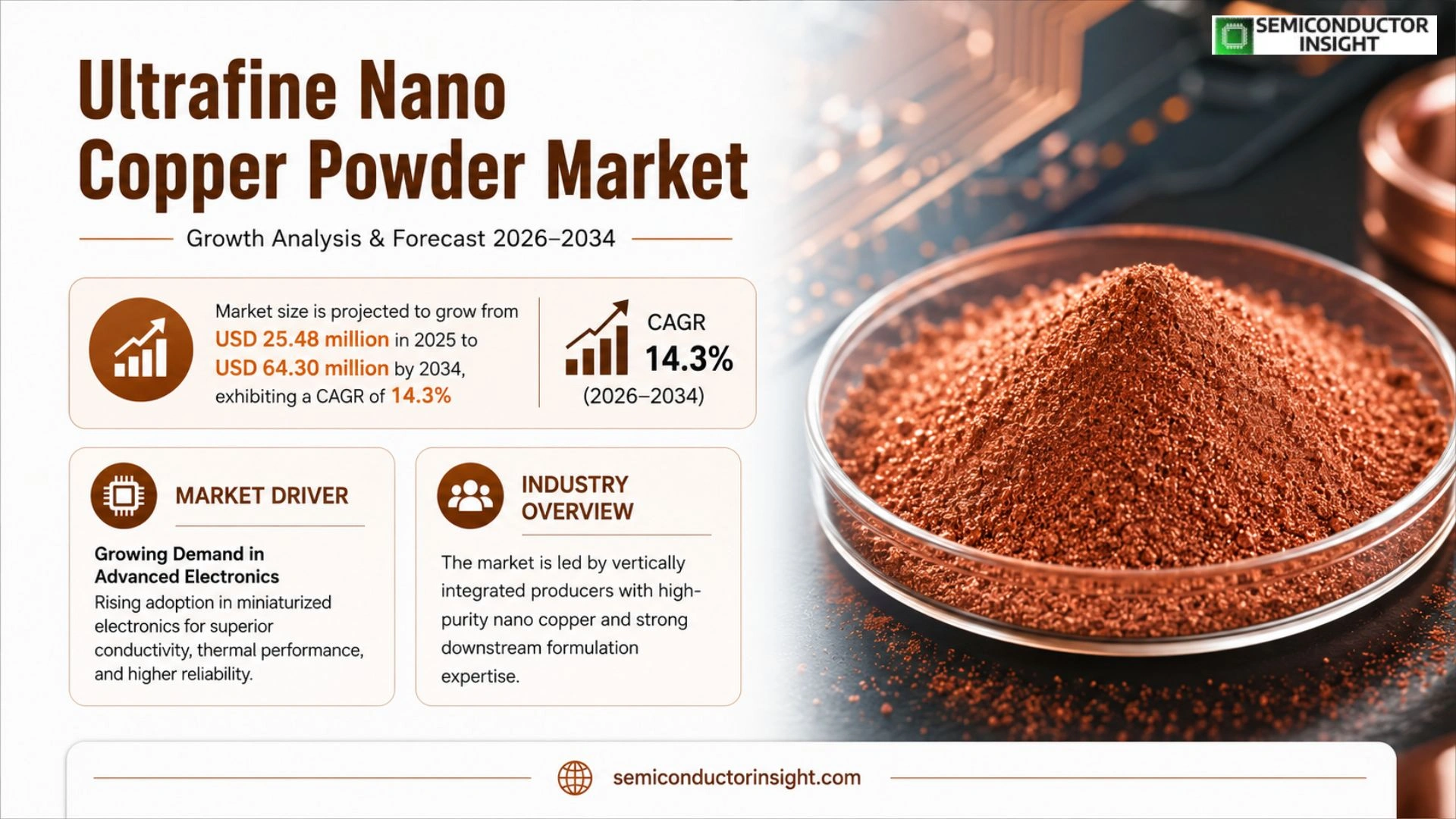
Ultrafine Nano Copper Powder market size was valued at USD 25.48 million in 2025 and is projected to reach USD 64.30 million by 2034, exhibiting a CAGR of 14.3% during the forecast period.
Ultrafine nano‑copper powder refers to copper particles sized between 1 nm and 100 nm; it appears as a purplish‑brown or black powder and provides a large specific surface area, strong adsorption capacity and high surface activity, which together deliver superior catalytic efficiency and electrical conductivity.
The market is gaining momentum because electronics miniaturization requires low‑temperature sintering and high conductivity, while advanced power‑electronics packaging seeks materials that lower resistive loss; simultaneously, producers must control oxidation and maintain tight particle‑size distribution to satisfy demanding performance specifications.
MARKET DRIVERS
Growing Demand in Advanced Electronics
Ultrafine Nano Copper Powder Market is buoyed by a surge in miniaturized circuitry, where copper’s superior conductivity and thermal properties are essential. Manufacturers of smartphones, wearables, and IoT devices are substituting traditional alloys with nano‑copper to achieve tighter tolerances, which translates into higher yields and lower failure rates.
Shift Toward Sustainable Conductive Materials
Environmental regulations are prompting a transition away from lead‑based solders. Ultrafine nano copper offers a recyclable alternative that meets stringent RoHS standards while providing comparable performance. This regulatory pressure is compelling suppliers to expand capacity and invest in greener production lines.
➤ Industry surveys show that over 60% of electronics assemblers plan to increase nano copper usage within the next 12 months.
In addition, the automotive sector’s electrification initiatives are creating a niche for nano copper in high‑efficiency power modules. The material’s ability to dissipate heat in compact formats makes it attractive for electric‑vehicle powertrain components, reinforcing the market’s upward trajectory.
MARKET CHALLENGES
High Production Costs
Despite its technical merits, Ultrafine Nano Copper Powder Market grapples with elevated manufacturing expenses. The precise control required for particle size distribution demands sophisticated equipment, which translates into higher unit costs that can deter price‑sensitive OEMs.
Other Challenges
Supply Chain Volatility
Fluctuations in copper ore availability and geopolitical tensions can disrupt feedstock supply, leading to unpredictable lead times that complicate inventory planning for downstream users.
Technical Integration Barriers
Adapting existing fabrication lines to accommodate nano‑scale powders often requires redesign of handling protocols, raising the barrier to entry for smaller manufacturers.
MARKET RESTRAINTS
Stringent Quality Certification
Regulatory frameworks governing aerospace and medical devices impose rigorous material certification processes. Achieving the necessary purity and consistency levels for ultra‑fine copper particles adds another layer of compliance cost, which can restrain market expansion in these high‑value segments.
Limited Awareness Among End‑Users
Many potential buyers remain unaware of the performance advantages offered by nano copper, leading to slower adoption rates. Educational gaps persist, especially in legacy industries where conventional copper alloys have long been the norm.
MARKET OPPORTUNITIES
Expansion into Additive Manufacturing
Emerging 3‑D printing technologies are beginning to integrate conductive powders for printed electronics. Ultrafine Nano Copper Powder Market can capitalize on this trend by developing formulations optimized for laser sintering and binder jetting, opening a fresh revenue stream.
Partnerships with Renewable Energy Firms
Solar inverter manufacturers and wind‑turbine developers are exploring nano copper for lightweight, high‑efficiency conductors. Strategic alliances with these players could accelerate product rollout and embed the material in next‑generation renewable energy infrastructure.
Ultrafine Nano Copper Powder Market Trends
Electronics Miniaturization Drives Ultrafine Nano Copper Powder Adoption
The 2025 valuation of Ultrafine Nano Copper Powder Market stood at roughly $25.5 million, while worldwide output reached about 44 tonnes with an average price near $624 per kilogram. A decisive factor behind this valuation is the relentless push toward smaller, more densely packed electronic components. When device geometries shrink, manufacturers need conductive inks and pastes that can sinter at temperatures compatible with polymeric substrates. Nano‑scale copper particles furnish a large specific surface area and high surface activity, enabling low‑temperature densification and conductivity that rival silver‑based formulations, yet at a fraction of the material cost. Consequently, printed‑electronics vendors, RFID developers, and flexible‑circuit designers are allocating a growing share of their material budgets to ultrafine copper powders, a shift that analysts forecast will lift market revenue to roughly $64 million by 2032.
Other Trends
Advanced Power Electronics and EV Infrastructure
Rapid adoption of electric vehicles, fast‑charging stations, and high‑efficiency data‑center converters is reshaping the demand profile for conductive fillers. Power modules and inverters require joints that combine low electrical resistance with superior thermal pathways. Nano copper, when incorporated into sinter‑bonded attach materials, delivers a dense metallic network that minimizes resistive losses while supporting heat removal. End‑users in the EV supply chain now specify tight particle‑size distribution and surface‑passivation to guarantee predictable viscosity during dispensing and consistent pack density after sintering. The premium margin achieved by suppliers that can guarantee these specifications,often between 30 % and 40 %,encourages further investment in production capabilities tailored to power‑electronics applications.
Functional Coatings and Antimicrobial Applications
Beyond electronics, ultrafine copper powders are penetrating the functional‑coating arena. Their propensity to form percolation networks at low loading levels makes them attractive for EMI‑shielding paints, conductive adhesives, and lightweight polymer composites. By replacing more massive metal fillers, manufacturers can retain mechanical robustness while shedding weight,an advantage prized in aerospace and automotive sectors. A niche but growing segment involves embedding nano copper into textiles and filtration media for antimicrobial effect; however, regulatory scrutiny and durability testing temper the pace of adoption. Producers that offer surface‑treated grades capable of sustained antimicrobial performance without compromising dispersibility are positioned to capture premium pricing, reinforcing the market’s overall profitability.
COMPETITIVE LANDSCAPE
Key Industry Players
Ultrafine Nano Copper Powder – Competitive Overview
The market is anchored by a handful of vertically integrated producers who command both the high‑purity nanoparticle streams and the downstream formulation capabilities essential for printed‑electronics and advanced packaging. Shoei Chemical, with its long‑standing expertise in copper nanomaterials, supplies a dominant share of sub‑50 nm grades to semiconductor ink manufacturers, leveraging tight particle‑size distribution (PSD) control and proprietary surface‑passivation chemistries. Umcor and Sumitomo Metal Mining follow closely, differentiating through large‑scale physical vapor deposition (PVD) routes that lower unit costs while preserving the reactivity required for low‑temperature sintering. Their combined sales represent roughly a third of global volume, establishing a semi‑oligopolistic structure that pressures smaller entrants to specialize in niche applications such as antimicrobial coatings or catalyst supports.
Beyond the top tier, a diverse cohort of niche players enriches the competitive set by targeting specific end‑uses or regional demand spikes. Companies such as Fulangshi and Hongwu Material focus on wet‑chemical synthesis routes that produce highly dispersible powders for conductive adhesives, whereas QuantumSphere and SkySpring Nanomaterials have built reputations in ultra‑fine (< 30 nm) catalysts for chemical processing. American Elements and Nanoshel bring a broad catalog of nano‑copper variants to the North American market, often coupling product sales with technical consulting. Regional specialists like Jiaozuo Banlv, Kinna Tech, and Suzhou Canfuo Nanotechnology serve the fast‑growing Chinese electronics sector, where localized supply chains and customs‑free imports are decisive factors.
List of Key Ultrafine Nano Copper Powder Companies Profiled
- Shoei Chemical
- Umcor
- Fulangshi
- Sumitomo Metal Mining
- Hongwu Material
- Jiaozuo Banlv
- QuantumSphere
- American Elements
- Nanoshel
- Strem Chemicals
- SkySpring Nanomaterials
- Kinna Tech
- Suzhou Canfuo Nanotechnology
- Nanjing Emperor Nano Material
Segment Analysis:
| Segment Category | Sub-Segments | Key Insights |
| By Type |
|
Below 50nm
|
| By Application |
|
Microelectronic Devices
|
| By End User |
|
Electronics Manufacturers
|
| By Feature |
|
Wet Chemical Method
|
| By Channel |
|
Distribution
|
Regional Analysis: Ultrafine Nano Copper Powder Market
OEMs in the region are re‑engineering high‑frequency devices to exploit the low‑resistance pathways offered by nano‑copper. This shift is reshaping component architecture, prompting designers to replace traditional bulk copper traces with ultra‑thin conductive inks, thereby reducing board thickness and improving signal integrity.
The surge in electric‑vehicle platforms across China and South Korea has heightened interest in lightweight thermal‑interface materials. Ultrafine copper particles enable compact heat‑spreaders that meet stringent weight targets while sustaining high power densities in battery management systems.
Wind‑turbine generators and solar‑inverter modules increasingly incorporate nano‑copper alloys to improve conductivity without enlarging conduit footprints. This trend aligns with regional renewable‑energy mandates that call for higher efficiency in power conversion.
Venture capital funds and state‑backed research grants are flowing into start‑ups that specialize in plasma‑spray and chemical‑reduction methods for copper nanopowders, delivering more consistent particle size distributions that meet the exacting tolerances of modern circuitry.
North America
The United States and Canada view Ultrafine Nano Copper Powder Market through the lens of high‑value aerospace and defense contracts, where reliability and performance cannot be compromised. Defense contractors are piloting nano‑copper‑based conductive pathways in radar and communications hardware, driven by the need for lower insertion loss at microwave frequencies. Simultaneously, research institutions in the Pacific Northwest and the Midwest are advancing additive‑manufacturing techniques that embed ultra‑fine copper within 3‑D‑printed metal matrices, a capability that could transform aerospace structural components. Market entrants find the regulatory environment supportive, though supply chain constraints demand careful sourcing strategies to maintain consistent feedstock quality.
Europe
European manufacturers prioritize sustainability, which influences how they approach Ultrafine Nano Copper Powder Market. The emphasis on circular‑economy principles encourages the reuse of copper‑rich waste streams from automotive recycling operations, feeding them into nanomaterial production lines. In Germany and the Nordics, precision‑engineering firms are integrating nano‑copper inks into sensor arrays for industrial Internet‑of‑Things applications, seeking to boost signal fidelity while adhering to strict environmental standards. Policy incentives for low‑carbon technologies further motivate investment in powder‑based conductive coatings, positioning Europe as a hub for eco‑focused innovation in the sector.
South America
Brazil and Argentina are emerging as niche contributors to Ultrafine Nano Copper Powder Market, largely through mining operations that have begun to experiment with downstream refining to produce high‑purity copper powders. Local electronics assemblers are exploring nano‑copper as a way to differentiate consumer‑grade devices in a price‑sensitive market, focusing on cost‑effective thermal‑management solutions for affordable smartphones. While infrastructure limitations persist, regional trade agreements are opening pathways for technology transfer, allowing South American firms to adopt production practices pioneered in Asia‑Pacific.
Middle East & Africa
The Middle East and Africa exhibit a fragmented yet opportunistic landscape for ultra‑fine copper powders. In the Gulf Cooperation Council, petrochemical complexes are testing nano‑copper additives to improve the conductivity of electrode materials used in advanced fuel‑cell prototypes. South Africa’s developing automotive sector is assessing lightweight conductive polymers that incorporate copper nanoparticles for next‑generation electric‑drive trains. Although the market is still nascent, government‑led diversification programs that fund high‑tech material research are laying the groundwork for broader adoption in the coming years.
Report Scope
This market research report provides a comprehensive analysis of the Ultrafine Nano Copper Powder Market , covering the forecast period 2026–2034. It offers detailed insights into market dynamics, technological advancements, competitive landscape, and key trends shaping the industry.
Key focus areas of the report include:
- Market Overview: The report begins with an overview outlining its current market scenario, key growth indicators, and industry transformation drivers. It discusses macroeconomic factors, demand–supply balance, regulatory landscape, and the strategic role of semiconductors in powering advancements across industries such as automotive, telecommunications, consumer electronics, and industrial automation.
- Market Size & Forecast: Historical data and future projections for revenue, unit shipments, and market value across major regions and segments.
- Segmentation Analysis: Detailed breakdown by product type, technology, application, and end-user industry to identify high-growth segments and investment opportunities.
- Regional Insights: Insights into market performance across North America, Europe, Asia-Pacific, Latin America, and the Middle East & Africa, including country-level analysis where relevant.
- Competitive Landscape: Profiles of leading market participants, including their product offerings, R&D focus, manufacturing capacity, pricing strategies, and recent developments such as mergers, acquisitions, and partnerships.
- Technology Trends & Innovation: Assessment of emerging technologies, integration of AI/IoT, semiconductor design trends, fabrication techniques, and evolving industry standards.
- Market Drivers & Restraints: Evaluation of factors driving market growth along with challenges, supply chain constraints, regulatory issues, and market-entry barriers.
- Stakeholder Insights: Insights for component suppliers, OEMs, system integrators, investors, and policymakers regarding the evolving ecosystem and strategic opportunities.
Primary and secondary research methods are employed, including interviews with industry experts, data from verified sources, and real-time market intelligence to ensure the accuracy and reliability of the insights presented.
FREQUENTLY ASKED QUESTIONS:
What is the current market size of Ultrafine Nano Copper Powder Market?
-> Ultrafine Nano Copper Powder market is projected to reach USD 64.30 million by 2034, exhibiting a CAGR of 14.3% during the forecast period.
Which key companies operate in Ultrafine Nano Copper Powder Market?
-> Key players include Shoei Chemical, Umcor, Fulangshi, Mitsui Kinzoku, Sumitomo Metal Mining, Hongwu Material, Jiaozuo Banlv, QuantumSphere, American Elements, Nanoshel, Strem Chemicals, SkySpring Nanomaterials, Kinna Tech, Suzhou Canfuo Nanotechnology, and Nanjing Emperor Nano Material.
What are the key growth drivers?
-> Key growth drivers include electronics miniaturization and advanced interconnects, advanced packaging and power electronics, and materials engineering & functional coatings such as EMI‑shielding and conductive adhesives.
Which region dominates the market?
-> Asia dominates the market, with China leading production and consumption due to strong demand from printed electronics, automotive electronics, and power‑electronics applications.
What are the emerging trends?
-> Emerging trends include development of low‑temperature sintering inks for printed electronics, integration of nano‑copper in EMI‑shielding coatings, and exploration of antimicrobial and catalytic applications in textiles and filtration media.

Get Sample Report PDF for Exclusive Insights
Report Sample Includes
- Table of Contents
- List of Tables & Figures
- Charts, Research Methodology, and more...
 Download Sample Report PDF