MARKET INSIGHTS
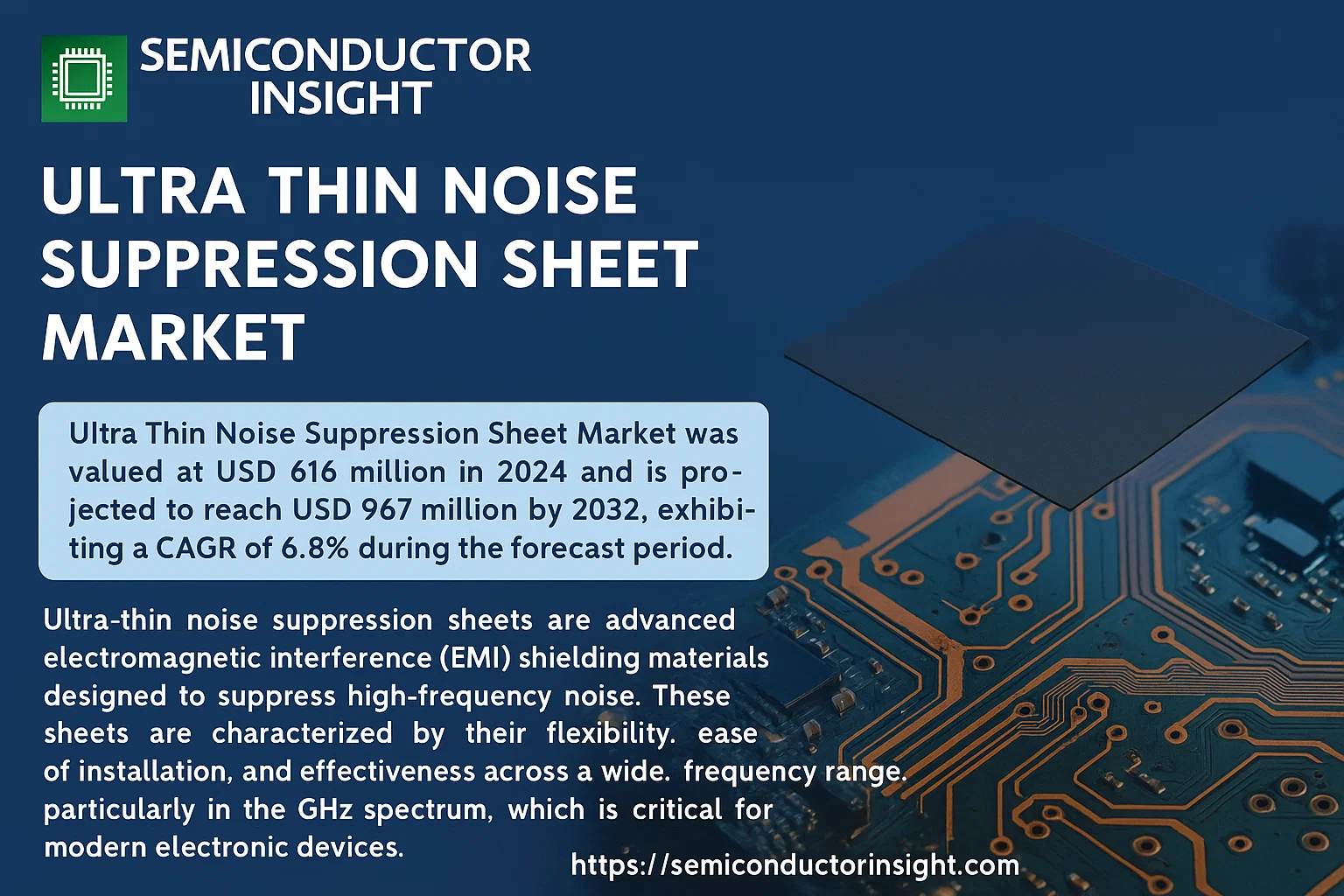
Global Ultra Thin Noise Suppression Sheet Market was valued at USD 616 million in 2024 and is projected to reach USD 967 million by 2032, exhibiting a CAGR of 6.8% during the forecast period.
Ultra-thin noise suppression sheets are advanced electromagnetic interference (EMI) shielding materials designed to suppress high-frequency noise. These sheets are characterized by their flexibility, ease of installation, and effectiveness across a wide frequency range, particularly in the GHz spectrum, which is critical for modern electronic devices. Key applications include mobile phones, consumer electronics, automotive electronics, and communication equipment, where they help improve signal integrity and device performance.
The market growth is primarily driven by the rapid expansion of the electronics industry, the increasing complexity of electronic circuits, and the rising demand for high-speed data transmission. The proliferation of 5G technology and the Internet of Things (IoT) is also creating significant demand for effective EMI shielding solutions. Furthermore, stringent electromagnetic compatibility (EMC) regulations across various regions are compelling manufacturers to adopt advanced noise suppression materials.
Regionally, Asia-Pacific dominates the market, holding the largest share due to the presence of major electronics manufacturing hubs in countries like China, Japan, and South Korea. North America and Europe are also significant markets, driven by advanced technological adoption and stringent regulatory standards.
Key players in the market include TDK Corporation, Murata Manufacturing Co., Ltd., KEMET Corporation, and Asahi Kasei Corporation, among others. These companies are focusing on product innovation, strategic partnerships, and mergers and acquisitions to strengthen their market position. For instance, recent developments include the introduction of thinner and more efficient sheets and the expansion of production capacities to meet the growing demand.
MARKET DRIVERS
Proliferation of High-Frequency Electronic Devices
The demand for ultra-thin noise suppression sheets is being significantly driven by the explosive growth in high-frequency electronic devices, particularly 5G smartphones, wearable technology, and advanced automotive electronics. As these devices operate at increasingly higher frequencies, electromagnetic interference (EMI) becomes a critical design challenge that must be mitigated to ensure performance and regulatory compliance. The miniaturization trend necessitates materials that are not only effective but also extremely thin to fit within compact form factors.
Advancements in Material Science
Continuous innovation in nanomaterials and composite polymers has enabled the development of ultra-thin sheets with superior noise suppression capabilities. These advanced materials offer high magnetic permeability and excellent absorption characteristics across a wide frequency range, from a few MHz to several GHz. The ability to maintain performance while reducing thickness to below 100 microns is a key factor propelling adoption in space-constrained applications.
➤ The global market for EMI shielding materials is projected to grow at a CAGR of over 6% in the coming years, with thin-film solutions capturing an increasing share.
Furthermore, stringent international electromagnetic compatibility (EMC) regulations mandated by bodies like the FCC and CE are compelling manufacturers to integrate reliable noise suppression solutions. This regulatory push, combined with the critical need to prevent signal degradation in sensitive communication and computing hardware, solidifies the position of ultra-thin noise suppression sheets as an essential component in modern electronics.
MARKET CHALLENGES
High Material and Manufacturing Costs
The production of ultra-thin noise suppression sheets involves sophisticated processes and high-purity, often expensive, raw materials such as specialized ferrite powders and advanced polymers. Achieving consistent thinness and performance uniformity at a mass-production scale presents significant technical hurdles, leading to higher per-unit costs compared to traditional thicker materials. This cost factor can be a barrier to adoption in highly price-sensitive consumer electronics segments.
Other Challenges
Performance Trade-offs at Extreme Thinness
As sheets become thinner, there is an inherent challenge in maintaining high attenuation performance across the entire target frequency spectrum. Engineers often face a trade-off between physical thickness and the effectiveness of suppressing high-frequency noise, requiring complex multi-layer designs that add to development complexity and cost.
Integration and Adhesion Issues
Integrating these delicate, thin films into automated assembly lines without causing wrinkles, tears, or poor adhesion can be difficult. Achieving a strong, reliable bond on various substrate surfaces while surviving thermal cycling and mechanical stress during the product’s lifecycle remains a persistent challenge for manufacturers.
MARKET RESTRAINTS
Competition from Alternative EMI Solutions
The growth of the ultra-thin noise suppression sheet market is restrained by competition from other EMI mitigation technologies. These include conductive coatings, metal shields (cans), and in-circuit solutions like filtering components. In some applications, especially where cost is a primary driver and space is less constrained, these alternatives may be preferred, limiting the addressable market for ultra-thin sheets.
Supply Chain Vulnerabilities for Raw Materials
The market is susceptible to disruptions in the supply of key raw materials, such as specific types of soft magnetic alloys and rare-earth elements. Geopolitical factors, trade policies, and limited sourcing options can lead to price volatility and supply insecurity, posing a significant restraint on stable market growth and pricing for end-users.
MARKET OPPORTUNITIES
Expansion into Electric and Autonomous Vehicles
The automotive industry represents a major growth frontier for ultra-thin noise suppression sheets. The rapid electrification of vehicles and the development of advanced driver-assistance systems (ADAS) involve a dense network of high-frequency sensors, radars, and control units that are highly susceptible to EMI. The need for reliable, lightweight, and thin suppression materials in this safety-critical environment creates substantial market opportunities.
Next-Generation Telecommunications Infrastructure
The ongoing global rollout of 5G and the early development of 6G technology require massive infrastructure upgrades, including small cells, base stations, and network equipment. These systems operate in extremely crowded radio frequency environments and demand high-performance EMI shielding. Ultra-thin sheets are ideal for protecting sensitive components within these compact outdoor and indoor units, opening a significant and sustained demand channel.
Medical Electronics and IoT Proliferation
The proliferation of miniaturized, connected medical devices (e.g., implantable monitors, wearable health sensors) and the expansive growth of the Internet of Things (IoT) ecosystem present vast opportunities. These applications require ultra-compact form factors and high reliability, making ultra-thin noise suppression sheets a critical enabling technology for future product innovations in these high-growth sectors.
Ultra Thin Noise Suppression Sheet Market Trends
Strong Growth Driven by Electronics Miniaturization
The global Ultra Thin Noise Suppression Sheet market is exhibiting robust growth, with a valuation of $616 million in 2024 projected to surge to $967 million by 2032, representing a compound annual growth rate of 6.8%. This sustained expansion is fundamentally driven by the relentless miniaturization of electronic components and the escalating need to mitigate electromagnetic interference (EMI) in the increasingly crowded GHz frequency spectrum. As devices become smaller and more densely packed, the demand for effective, space-saving noise suppression solutions has become paramount for manufacturers across various sectors.
Other Trends
Dominance of the Asia-Pacific Region
The geographical landscape of the market is heavily skewed towards the Asia-Pacific region, with China alone accounting for approximately 40% of the global market share. This dominance is attributed to the region’s massive electronics manufacturing base, particularly for consumer electronics and mobile communications. Europe and North America follow, each holding a significant share of about 25%, driven by advanced automotive electronics and high-end communication equipment production.
Preference for 0.1-0.2 mm Thickness
In terms of product segmentation, sheets with a thickness between 0.1 mm and 0.2 mm are the largest segment, commanding over 40% of the market. This preference underscores the industry’s requirement for ultra-thin solutions that provide effective EMI suppression without adding bulk. These sheets offer an optimal balance between performance and the minimal form factor required by modern, sleek electronic designs. The market also includes segments for 0-0.1 mm, 0.2-0.3 mm, and sheets over 0.3 mm.
Consumer Electronics as the Leading Application
The application of ultra-thin noise suppression sheets is most prominent in the Consumer Electronics sector, which represents the single largest end-use market. This is closely followed by Mobile Phones, Communications Equipment, and Automotive Electronics. The proliferation of smartphones, tablets, wearable devices, and the expansion of 5G infrastructure are key factors fueling demand in these segments. The automotive sector’s growth is particularly linked to the increasing integration of advanced driver-assistance systems (ADAS) and in-vehicle infotainment systems.
Consolidated Market with Dominant Players
The competitive environment is characterized by a high degree of consolidation. The global top five manufacturers, including TDK, KEMET Corporation, Asahi Kasei, Hitachi-Metal, and Murata, collectively hold over 45% of the market share. These key players maintain their positions through continuous investment in research and development to enhance product performance, expand application frequency ranges, and improve the flexibility and adhesion properties of their noise suppression sheets.
COMPETITIVE LANDSCAPE
Key Industry Players
A Market Concentrated with Established Global Electronics Component Leaders
The global Ultra Thin Noise Suppression Sheet market demonstrates a moderately concentrated structure, with the top five manufacturers collectively holding over 45% of the market share. This dominance is rooted in the deep technological expertise, extensive patent portfolios, and global supply chains of leading multinational electronics component giants. TDK Corporation stands as the unequivocal market leader, leveraging its profound experience in electromagnetic compatibility solutions and a broad product portfolio that caters to the demanding requirements of consumer electronics and automotive applications. Close competitors like Murata Manufacturing and KEMET Corporation (a part of Yageo Group) also command significant shares, benefiting from strong relationships with major OEMs and continuous R&D investment aimed at creating thinner, more effective noise suppression materials for next-generation high-frequency applications.
Beyond the dominant global players, the market includes a number of significant niche and regional competitors that contribute to a diverse competitive fabric. Companies such as Asahi Kasei and Hitachi Metals (now part of Proterial, Ltd.) bring specialized materials science expertise to the table. Furthermore, a cohort of regional specialists, particularly in Asia, has emerged as formidable players. Shenzhen FRD Science & Technology Co., Ltd. in China, for instance, has grown substantially by serving the vast domestic electronics manufacturing base. Other notable participants, including Dexerials and NEC TOKIN in Japan, and FDK Corporation, focus on specific material technologies or application segments, such as ultra-thin sheets for mobile device antenna systems, creating a competitive environment characterized by both scale and specialization.
List of Key Ultra Thin Noise Suppression Sheet Companies Profiled
- TDK Corporation
- Murata Manufacturing Co., Ltd.
- KEMET Corporation (Yageo Group)
- Asahi Kasei Corporation
- Proterial, Ltd. (formerly Hitachi Metals)
- NEC TOKIN Corporation
- FDK Corporation
- Shenzhen FRD Science & Technology Co., Ltd.
- Dexerials Corporation
- Microwave Absorbers
- Shenzhen Penghui Functional Materials Co., Ltd.
- Zhejiang Yuanbang Material Technology Co., Ltd.
- KOMATSU MATERE Co., Ltd.
- KITAGAWA INDUSTRIES CO., LTD. (KGS)
- U-TEK EMI CORP.
Segment Analysis:
| Segment Category | Sub-Segments | Key Insights |
| By Type |
|
0.1-0.2 mm sheets represent the leading product category, as this thickness range provides an optimal balance of high-performance electromagnetic noise suppression and the space-saving, ultra-thin profile required by modern compact electronic designs. The versatility of these sheets makes them suitable for a wide array of applications, from smartphones to complex communication infrastructure, where managing GHz-frequency interference is critical without compromising device miniaturization trends. |
| By Application |
|
Consumer Electronics constitutes the dominant application area, driven by the proliferation of smart devices, wearables, and home entertainment systems that require effective electromagnetic compatibility solutions. The continuous innovation and high-volume production in this sector create sustained demand for ultra-thin sheets that can be seamlessly integrated into sleek product designs to ensure reliable performance and compliance with stringent electromagnetic interference regulations across global markets. |
| By End User |
|
Original Equipment Manufacturers (OEMs) are the primary end users, as they directly integrate noise suppression sheets into final products during the design and assembly phases. These manufacturers prioritize supply chain reliability and material performance to maintain product quality and brand reputation. Their stringent sourcing criteria and long-term partnerships with key suppliers underscore the critical role of high-performance components in achieving competitive advantage and market differentiation in electronics manufacturing. |
| By Material Composition |
|
Magnetic Rubber Sheets are the leading material type, prized for their excellent flexibility, durability, and effective absorption of electromagnetic noise across a wide frequency spectrum. Their proven performance in demanding environments and relative ease of manufacturing and application make them the material of choice for a majority of use cases. Ongoing material science advancements are further enhancing their efficiency, ensuring they remain the cornerstone technology for noise suppression in high-frequency electronic applications. |
| By Performance Frequency |
|
High Frequency (1-10 GHz) sheets represent the most critical and demanding performance segment, driven by the needs of 5G infrastructure, advanced mobile communication devices, and high-speed data transmission systems. The ability to effectively suppress noise within this frequency band is paramount for ensuring signal integrity and preventing data corruption, making these sheets indispensable for next-generation technologies. This segment experiences intense R&D focus as performance requirements continue to evolve with advancing wireless standards. |
Regional Analysis: Ultra Thin Noise Suppression Sheet Market
Asia-Pacific
The region’s unparalleled concentration of electronics manufacturers creates a captive, high-volume market. A mature and integrated supply chain ensures the availability of specialty materials and streamlined production processes, making it the most cost-effective region for manufacturing ultra thin noise suppression sheets and responding swiftly to global demand fluctuations.
Driven by consumer demand for sleeker devices, Asia-Pacific OEMs are at the forefront of designing ever-thinner electronics. This forces continuous innovation in noise suppression technology, pushing for sheets with higher performance in minimal form factors, a key driver that keeps regional technological capabilities ahead of other markets.
Major regional players invest heavily in developing next-generation materials like nanocrystalline and amorphous alloys, which offer superior high-frequency noise suppression in ultra thin profiles. This focus on advanced material science ensures a pipeline of innovative products tailored for 5G, IoT, and high-speed computing applications.
Supportive industrial policies and significant national investments in rolling out 5G networks and promoting electric vehicle adoption create massive, sustained demand. These government-led initiatives directly benefit the ultra thin noise suppression sheet market, as they are critical components for ensuring signal integrity and EMC compliance in these advanced systems.
North America
The North American market is characterized by high demand for premium, high-performance electronic components, particularly from the aerospace, defense, and automotive sectors. The presence of major technology companies and a strong focus on innovation drive the adoption of advanced ultra thin noise suppression sheets that meet stringent reliability and performance standards. The region’s early and aggressive deployment of 5G technology and investment in autonomous vehicle development further stimulate market growth. While manufacturing is less concentrated than in Asia-Pacific, North America remains a critical center for design, research, and high-value application development, fostering demand for cutting-edge solutions.
Europe
Europe exhibits steady growth, heavily influenced by its strong automotive industry and strict electromagnetic compatibility (EMC) regulations. The transition to electric and hybrid vehicles is a significant driver, as these vehicles require sophisticated noise suppression for powertrains and advanced driver-assistance systems (ADAS). The region’s focus on quality and compliance with directives like the CE marking ensures a market for reliable, high-performance sheets. Additionally, a well-established industrial automation sector and growing investments in renewable energy infrastructure contribute to the demand for effective EMI shielding solutions in power electronics applications.
South America
The South American market is emerging, with growth primarily driven by the gradual expansion of consumer electronics manufacturing and the increasing adoption of mobile communications and internet services. While the market is smaller and less mature, countries like Brazil and Argentina are seeing rising demand as local production increases. The market is cost-sensitive, often adopting proven technologies. Growth is linked to broader economic stability and industrial development, with potential for acceleration as regional automotive and telecommunications sectors continue to evolve and modernize their technological requirements.
Middle East & Africa
This region represents a developing market with growth potential tied to infrastructure development and economic diversification efforts, particularly in the Gulf Cooperation Council (GCC) countries. Investments in smart city projects, telecommunications infrastructure (including 5G), and a growing consumer electronics market are creating nascent demand. The market is largely import-dependent, with demand driven by multinational corporations setting up regional operations and government-led digital transformation initiatives. Growth is anticipated to be gradual, following regional economic trends and the pace of technological adoption.
Report Scope
This market research report provides a comprehensive analysis of the Ultra Thin Noise Suppression Sheet Market , covering the forecast period 2025–2032. It offers detailed insights into market dynamics, technological advancements, competitive landscape, and key trends shaping the industry.
Key focus areas of the report include:
- Market Overview: The report begins with an overview outlining its current market scenario, key growth indicators, and industry transformation drivers. It discusses macroeconomic factors, demand–supply balance, regulatory landscape, and the strategic role of semiconductors in powering advancements across industries such as automotive, telecommunications, consumer electronics, and industrial automation.
- Market Size & Forecast: Historical data and future projections for revenue, unit shipments, and market value across major regions and segments.
- Segmentation Analysis: Detailed breakdown by product type, technology, application, and end-user industry to identify high-growth segments and investment opportunities.
- Regional Insights: Insights into market performance across North America, Europe, Asia-Pacific, Latin America, and the Middle East & Africa, including country-level analysis where relevant.
- Competitive Landscape: Profiles of leading market participants, including their product offerings, R&D focus, manufacturing capacity, pricing strategies, and recent developments such as mergers, acquisitions, and partnerships.
- Technology Trends & Innovation: Assessment of emerging technologies, integration of AI/IoT, semiconductor design trends, fabrication techniques, and evolving industry standards.
- Market Drivers & Restraints: Evaluation of factors driving market growth along with challenges, supply chain constraints, regulatory issues, and market-entry barriers.
- Stakeholder Insights: Insights for component suppliers, OEMs, system integrators, investors, and policymakers regarding the evolving ecosystem and strategic opportunities.
Primary and secondary research methods are employed, including interviews with industry experts, data from verified sources, and real-time market intelligence to ensure the accuracy and reliability of the insights presented.
FREQUENTLY ASKED QUESTIONS:
What is the current market size of Ultra Thin Noise Suppression Sheet Market?
-> Global Ultra Thin Noise Suppression Sheet Market was valued at USD 616 million in 2024 and is projected to reach USD 967 million by 2032, exhibiting a CAGR of 6.8% during the forecast period.
Which key companies operate in Ultra Thin Noise Suppression Sheet Market?
-> Key players include TDK, KEMET Corporation, Asahi Kasei, Hitachi-Metal, and Murata, among others. Global top five manufacturers hold a share over 45%.
What are the key growth drivers?
-> Key growth drivers include the development of electronic equipment, increasing electromagnetic compatibility problems in the GHz frequency range, and the demand for components with characteristics like flexibility, ultra-thin profiles, and wide application frequency ranges.
Which region dominates the market?
-> China is the largest market, with a share of about 40%, followed by Europe and North America, each holding approximately a 25% share.
What are the emerging trends?
-> Emerging trends include the development of new generation electromagnetic noise suppression products that are easy to mount and shrink, alongside growth in key applications such as Consumer Electronics and Mobile Phones.

Get Sample Report PDF for Exclusive Insights
Report Sample Includes
- Table of Contents
- List of Tables & Figures
- Charts, Research Methodology, and more...
 Download Sample Report PDF