MARKET INSIGHTS
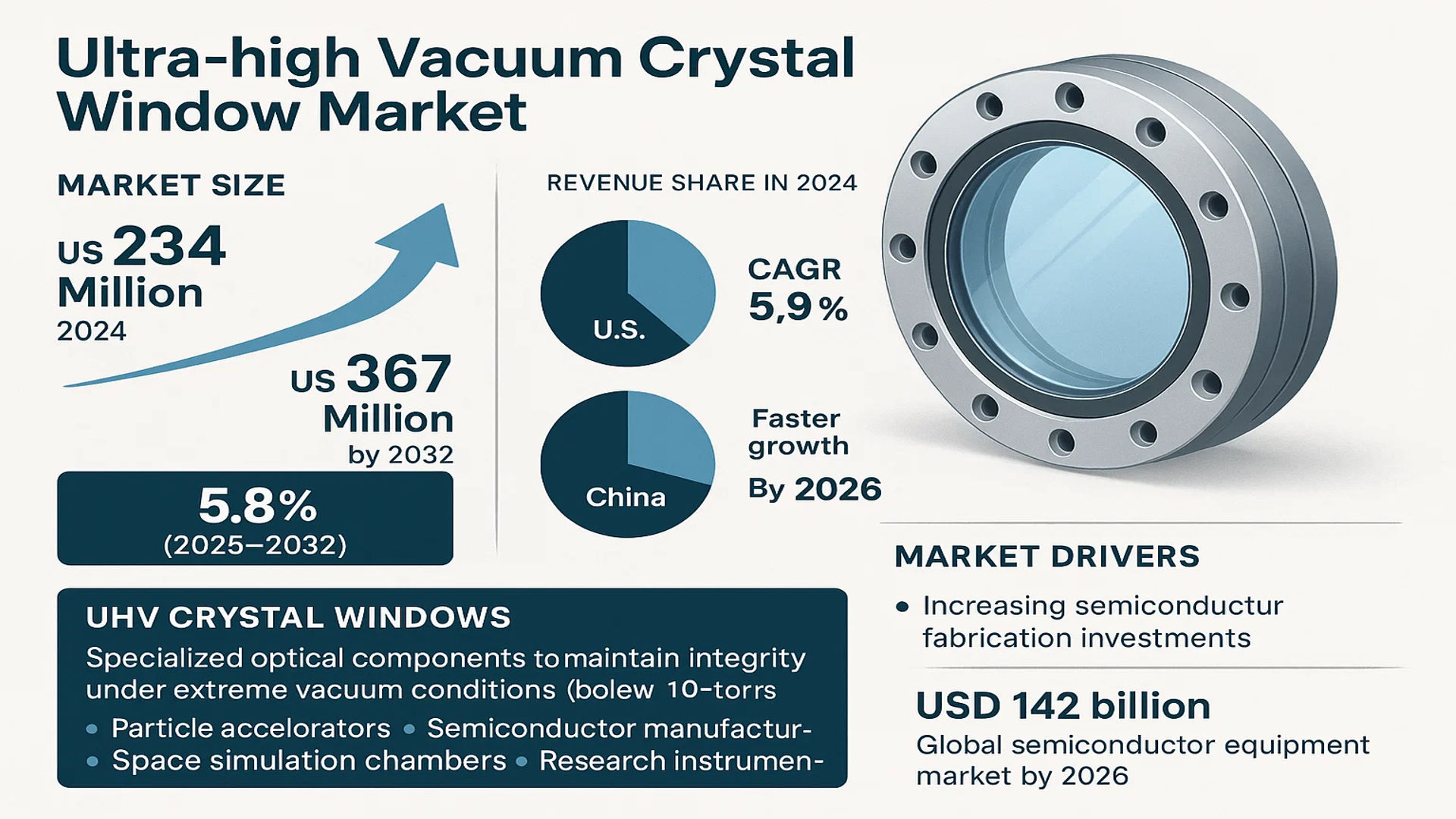
The global Ultra-high Vacuum Crystal Window Market size was valued at US$ 234 million in 2024 and is projected to reach US$ 367 million by 2032, at a CAGR of 5.8% during the forecast period 2025-2032. The U.S. market accounted for 32% of global revenue share in 2024, while China is expected to grow at a faster CAGR of 5.9% through 2032 due to expanding semiconductor and aerospace industries.
Ultra-high vacuum (UHV) crystal windows are specialized optical components designed to maintain structural integrity under extreme vacuum conditions (below 10-9 torr). These precision-engineered windows, typically made from materials like quartz, sapphire, or specialized glasses, enable light transmission while preserving vacuum integrity in critical applications. They serve as viewports in particle accelerators, semiconductor manufacturing equipment, space simulation chambers, and advanced research instrumentation where even minute gas permeation could compromise results.
The market growth is primarily driven by increasing investments in semiconductor fabrication facilities worldwide, with the global semiconductor equipment market projected to reach USD 142 billion by 2026. However, material purity requirements and complex manufacturing processes present significant challenges. Key players like Shibuya Optical and Materion are investing in advanced coating technologies to enhance durability, while emerging applications in quantum computing and fusion research are creating new growth opportunities. The glass segment currently dominates with over 45% market share due to cost-effectiveness, though sapphire windows are gaining traction in high-radiation environments.
MARKET DYNAMICS
MARKET DRIVERS
Rising Demand in Semiconductor Manufacturing to Boost Market Expansion
The ultra-high vacuum crystal window market is experiencing significant growth due to increasing adoption in semiconductor manufacturing processes. These components play a critical role in maintaining vacuum integrity while allowing optical measurements in deposition and etching systems. With semiconductor fabs expanding globally to meet chip demand, particularly for artificial intelligence and 5G applications, the market is projected to grow substantially over the forecast period. Glass-based ultra-high vacuum windows currently dominate the market with an estimated 60% share in 2024, owing to their cost-effectiveness and established manufacturing processes.
Growth in Particle Physics Research Accelerates Demand
High-energy physics research facilities are increasingly adopting ultra-high vacuum crystal windows for particle detection and beam monitoring applications. The need for radiation-resistant materials with minimal outgassing properties in synchrotrons and colliders has driven innovation in sapphire and quartz window technologies. Recent expansions at major research institutes, particularly in Europe and Asia, have contributed to double-digit growth in this segment. For specialized applications requiring extreme conditions, manufacturers have developed windows capable of withstanding pressures below 10-10 torr while maintaining optical clarity.
Advancements in Coating Technologies Enhance Product Performance
Recent breakthroughs in anti-reflective and conductive coatings for ultra-high vacuum windows are creating new market opportunities. Multilayer optical coatings now enable transmission efficiencies exceeding 99% in specific wavelength ranges while maintaining vacuum integrity. These advancements are particularly valuable in analytical instrumentation and space applications where performance specifications are stringent. Leading manufacturers have introduced proprietary coating solutions that extend product lifetimes by reducing contamination buildup under continuous operation.
➤ For instance, a prominent Japanese manufacturer recently developed an ion-beam sputtered coating that maintains vacuum performance even after thousands of thermal cycles between cryogenic and high-temperature conditions.
MARKET RESTRAINTS
High Material and Manufacturing Costs Limit Market Penetration
The production of ultra-high vacuum crystal windows requires specialized materials and controlled manufacturing environments, resulting in substantial costs that hinder broader adoption. Sapphire windows, while offering superior performance in extreme conditions, can cost up to 5-8 times more than standard glass alternatives. The stringent purity requirements for vacuum applications necessitate extensive quality control measures during production, further adding to expenses. For budget-constrained research institutions and smaller manufacturers, these cost barriers remain significant.
Other Restraints
Supply Chain Vulnerabilities
Disruptions in raw material supply, particularly for high-purity quartz and synthetic sapphire, continue to pose challenges for manufacturers. The concentration of specialty material production in limited geographical areas creates potential bottlenecks during periods of high demand.
Technical Limitations at Extreme Conditions
While performance has improved significantly, maintaining optical properties under combined thermal, pressure, and radiation extremes remains technically challenging. This restricts applications in certain cutting-edge research areas pushing physical boundaries.
MARKET CHALLENGES
Stringent Qualification Requirements Extend Product Development Cycles
The ultra-high vacuum crystal window market faces persistent challenges regarding product qualification and certification processes. Each application often requires extensive testing for outgassing rates, leak integrity, and optical performance under specific conditions. These validation procedures can extend for months, delaying time-to-market and increasing development costs. Furthermore, the lack of standardized testing protocols across different industries creates additional complexity for manufacturers serving multiple market segments.
Other Challenges
Limited Innovation in Bonding Technologies
Developing reliable sealing methods that accommodate thermal expansion mismatches between window materials and metal housings remains a technical hurdle. Failures at these interfaces account for a significant portion of field returns and warranty claims.
Niche Application Expertise Requirements
The highly specialized nature of vacuum system design demands deep technical knowledge that is not widely available. This skills gap makes it difficult to scale production while maintaining quality standards.
MARKET OPPORTUNITIES
Emerging Quantum Technology Applications Present New Growth Potential
The rapid development of quantum computing and sensing technologies is creating novel opportunities for ultra-high vacuum window manufacturers. These applications demand windows capable of maintaining extreme vacuum conditions while minimizing photon loss and decoherence effects. The unique requirements of cryogenic quantum systems have prompted manufacturers to develop specialized product lines featuring ultra-low thermal conductivity and vibration damping characteristics.
Expansion in Space Exploration Programs Drives Innovation
Global investments in space exploration are stimulating demand for radiation-hardened vacuum windows suitable for satellite instrumentation and planetary science payloads. The need for lightweight yet durable solutions has accelerated development of advanced composite window designs. Recent contracts awarded to leading manufacturers by space agencies underscore this growing market segment, with projections indicating a compound annual growth rate exceeding 12% through 2030 for space-grade vacuum window products.
Growth in Fusion Energy Research Creates Specialty Demand
The expanding global fusion energy research landscape presents significant opportunities for ultra-high vacuum window suppliers. Diagnostics systems for tokamaks and stellarators require windows capable of withstanding extreme electromagnetic and thermal conditions while maintaining high vacuum integrity. With multiple fusion projects reaching advanced development stages, demand for specialized viewing ports and optical access solutions is expected to increase substantially in coming years.
ULTRA-HIGH VACUUM CRYSTAL WINDOW MARKET TRENDS
Advanced Materials and Coatings Driving Market Expansion
The Ultra-high Vacuum (UHV) Crystal Window market is witnessing rapid advancements in material science, particularly in the development of high-performance optical materials such as sapphire and fused quartz. These materials offer superior thermal stability, minimal outgassing, and exceptional optical clarity, making them ideal for applications in semiconductor manufacturing, space technology, and synchrotron radiation systems. The demand for anti-reflective (AR) and multi-layer coatings has surged, with manufacturers investing in deposition technologies that enhance durability and minimize light scattering under extreme vacuum conditions. Furthermore, the adoption of low-thermal-expansion glass ceramics is gaining traction due to their ability to maintain structural integrity in fluctuating thermal environments, a critical requirement for UHV systems.
Other Trends
Semiconductor Industry Growth
The expansion of the semiconductor industry is a major driver for the UHV Crystal Window market. With semiconductor fabrication processes requiring increasingly stringent vacuum conditions (below 10-9 Torr), crystal windows with high chemical resistance and minimal particle generation are essential. The market is benefiting from the rising demand for EUV lithography systems, which utilize UHV-compatible optical components for next-generation chip production. Countries like China, the U.S., and South Korea are leading investments in semiconductor manufacturing facilities, fueling the need for specialized vacuum windows.
Rising Demand for Space and Scientific Research Applications
Scientific research institutions and space agencies are contributing significantly to market growth. UHV crystal windows are critical components in particle accelerators, space telescopes, and Mars rover instrumentation, where reliability under extreme conditions is non-negotiable. The increasing number of deep-space exploration missions, coupled with government funding for quantum research facilities, is driving demand for radiation-hardened sapphire windows and UV-transmitting fused silica solutions. Collaborative projects between academic institutions and private manufacturers are accelerating innovation in this segment, ensuring the development of windows capable of withstanding prolonged exposure to cosmic radiation and micrometeoroid impacts.
COMPETITIVE LANDSCAPE
Key Industry Players
Innovation and Strategic Expansion Define Market Leadership in Ultra-High Vacuum Crystal Windows
The global ultra-high vacuum (UHV) crystal window market exhibits a dynamic competitive structure, with both established players and niche specialists vying for market share. Shibuya Optical Co., Ltd. has emerged as a frontrunner, leveraging its decades-long expertise in precision optical components manufacturing. Their dominance stems from proprietary sealing technologies that enable exceptional vacuum maintenance below 10-9 Torr – a critical requirement for semiconductor fabrication and particle accelerator applications.
Materion Corporation and VACOM GmbH have carved significant market positions through vertical integration strategies. Materion’s control over beryllium and aluminum oxide raw material supply chains provides distinct cost advantages, while VACOM’s UHV-compatible bonding techniques achieve industry-leading helium leak rates below 10-11 mbar·l/s. The market saw increased consolidation in 2023 when MPF Products was acquired by a private equity consortium, signaling growing investor interest in vacuum component technologies.
Emerging players are disrupting traditional market dynamics through technological breakthroughs. Uni-Nanotech recently introduced graphene-reinforced composite windows with 40% greater fracture toughness than conventional materials, addressing long-standing fragility concerns in synchrotron beamline applications. Meanwhile, Alkor Technologies has gained traction in the Asian market through localized production facilities near major semiconductor fabrication plants in Taiwan and South Korea.
The competitive intensity is further amplified by cross-industry expansion strategies. Major vacuum system manufacturers like Pfeiffer Vacuum have begun backward integrating into window production, while optical component suppliers are developing UHV-specific product lines. This convergence is driving rapid advancements in multi-layer anti-reflection coatings and radiation-hardened materials that maintain performance under extreme conditions.
List of Key Ultra-High Vacuum Crystal Window Manufacturers
- Shibuya Optical Co., Ltd. (Japan)
- Materion Corporation (U.S.)
- VACOM GmbH (Germany)
- Sun Instruments (U.S.)
- Accu-Glass Products, Inc. (U.S.)
- MPF Products, Inc. (U.S.)
- Uni-Nanotech (South Korea)
- Alkor Technologies (Russia)
- Allectra (UK)
- Apex Vacuum (U.S.)
Segment Analysis:
By Material
Glass Segment Dominates the Market Due to High Durability and Cost-Effectiveness
The market is segmented based on material into:
- Glass
- Sapphire
- Subtypes: Single crystal, Polycrystalline
- Quartz
- Subtypes: Fused, Synthetic
- Others
By Application
Ultra High (UHV) Vacuum Application Leads Due to Growing Demand in Semiconductor Manufacturing
The market is segmented based on application into:
- High Vacuum Application
- Ultra High (UHV) Vacuum Application
By End-User Industry
Semiconductor Industry Dominates Owing to Need for Precision in Vacuum Environments
The market is segmented based on end-user industry into:
- Semiconductor
- Aerospace & Defense
- Scientific Research
- Medical
- Others
Regional Analysis: Ultra-high Vacuum Crystal Window Market
Asia-Pacific
The Asia-Pacific region dominates the ultra-high vacuum crystal window market, driven by rapid industrialization and strong investments in semiconductor manufacturing, particularly in China, Japan, and South Korea. China leads the charge with its expanding semiconductor and photonics industries, accounting for over 35% of the regional market share as of 2024. Local manufacturers benefit from government-backed initiatives like “Made in China 2025,” which prioritizes advanced materials and equipment. While quartz remains the preferred material due to its cost-effectiveness, there’s growing adoption of sapphire for specialized UHV applications in aerospace and defense. Japanese firms like Shibuya Optical Co., Ltd. maintain technological leadership, though Chinese competitors are rapidly catching up through R&D partnerships.
North America
The U.S. market, valued at approximately $120 million in 2024, thrives on cutting-edge research facilities and a robust semiconductor ecosystem. Stringent quality standards from organizations like ASTM International compel manufacturers to develop high-performance crystal windows with leak rates below 1×10⁻¹⁰ Torr·L/s. Key clusters in Silicon Valley and Boston leverage these components for quantum computing research and synchrotron radiation facilities. However, the market faces pricing pressures from Asian imports, prompting local players like Materion and Apex Vacuum to focus on customized solutions with advanced coatings and complex geometries. Defense contracts continue to drive premium product development, particularly for infrared-transmissive sapphire windows.
Europe
With Germany and France at the forefront, the European market emphasizes precision engineering and eco-friendly production methods. The region maintains a 22% market share in high-end quartz crystal windows, catering to analytical instrumentation and EUV lithography systems. Strict EU directives on material traceability and hazardous substance control (RoHS/REACH) have accelerated the shift toward lead-free sealing technologies. Collaborative projects like Horizon Europe fund research into novel materials such as diamond-coated windows for extreme environments. While labor costs remain a challenge, manufacturers like VACOM and Allectra compete through patented vacuum sealing techniques that outperform global competitors in long-term stability metrics.
South America
This emerging market shows promising growth in Brazil and Argentina, fueled by expanding petrochemical and materials science research sectors. The regional market remains price-sensitive, with imports constituting nearly 70% of consumption as local production capacity develops. Universities and national labs drive demand for basic UHV windows, though adoption of advanced UHV-grade components lags due to limited infrastructure. Recent trade agreements have improved access to North American and European technologies, while local players focus on servicing mid-range vacuum systems for industrial applications. Political and economic instability continues to pose challenges for long-term investment in manufacturing facilities.
Middle East & Africa
The MEA region presents niche opportunities in oil/gas analysis and emerging semiconductor fabs, particularly in UAE and Saudi Arabia. Market growth hovers around 5-7% annually, constrained by limited local expertise in ultra-high vacuum technology. While international suppliers dominate, regional scientific centers like the SESAME synchrotron in Jordan stimulate specialized demand. Governments’ diversification away from hydrocarbon dependence is gradually increasing investments in research infrastructure, creating avenues for premium products. However, the lack of localized service networks and testing facilities remains a persistent barrier to widespread adoption of high-performance crystal windows.
Report Scope
This market research report provides a comprehensive analysis of the global Ultra-high Vacuum Crystal Window market, covering the forecast period 2024–2032. It offers detailed insights into market dynamics, technological advancements, competitive landscape, and key trends shaping the industry.
Key focus areas of the report include:
- Market Size & Forecast: Historical data and future projections for revenue, unit shipments, and market value across major regions and segments.
- Segmentation Analysis: Detailed breakdown by material type (Glass, Sapphire, Quartz, Others) and application (High Vacuum, Ultra High Vacuum) to identify high-growth segments.
- Regional Outlook: Insights into market performance across North America, Europe, Asia-Pacific, Latin America, and Middle East & Africa, with country-level analysis.
- Competitive Landscape: Profiles of leading manufacturers including Shibuya Optical, Sun Instruments, Accu-Glass Products, and their market strategies.
- Technology Trends: Assessment of emerging materials and manufacturing techniques in vacuum crystal window production.
- Market Drivers & Restraints: Evaluation of factors like semiconductor industry growth versus raw material cost fluctuations.
- Stakeholder Analysis: Strategic insights for manufacturers, suppliers, and end-users in research and industrial applications.
The analysis combines primary interviews with industry experts and validated secondary data from reliable sources to ensure accuracy.
FREQUENTLY ASKED QUESTIONS:
What is the current market size of Global Ultra-high Vacuum Crystal Window Market?
-> Ultra-high Vacuum Crystal Window Market size was valued at US$ 234 million in 2024 and is projected to reach US$ 367 million by 2032, at a CAGR of 5.8% during the forecast period 2025-2032.
Which key companies operate in this market?
-> Major players include Shibuya Optical Co., Ltd., Sun Instruments, Accu-Glass Products, Apex Vacuum, and MPF Products, among others.
What are the key growth drivers?
-> Growth is driven by increasing semiconductor manufacturing, space research activities, and advanced material science applications.
Which material segment dominates the market?
-> Glass currently holds the largest market share, while sapphire is expected to show the highest growth rate.
Which region leads in Ultra-high Vacuum Crystal Window adoption?
-> Asia-Pacific dominates the market, driven by semiconductor manufacturing in countries like China, Japan, and South Korea.
What are the emerging application areas?
-> Emerging applications include quantum computing research, advanced microscopy, and space telescope components.

Get Sample Report PDF for Exclusive Insights
Report Sample Includes
- Table of Contents
- List of Tables & Figures
- Charts, Research Methodology, and more...