Market Insights
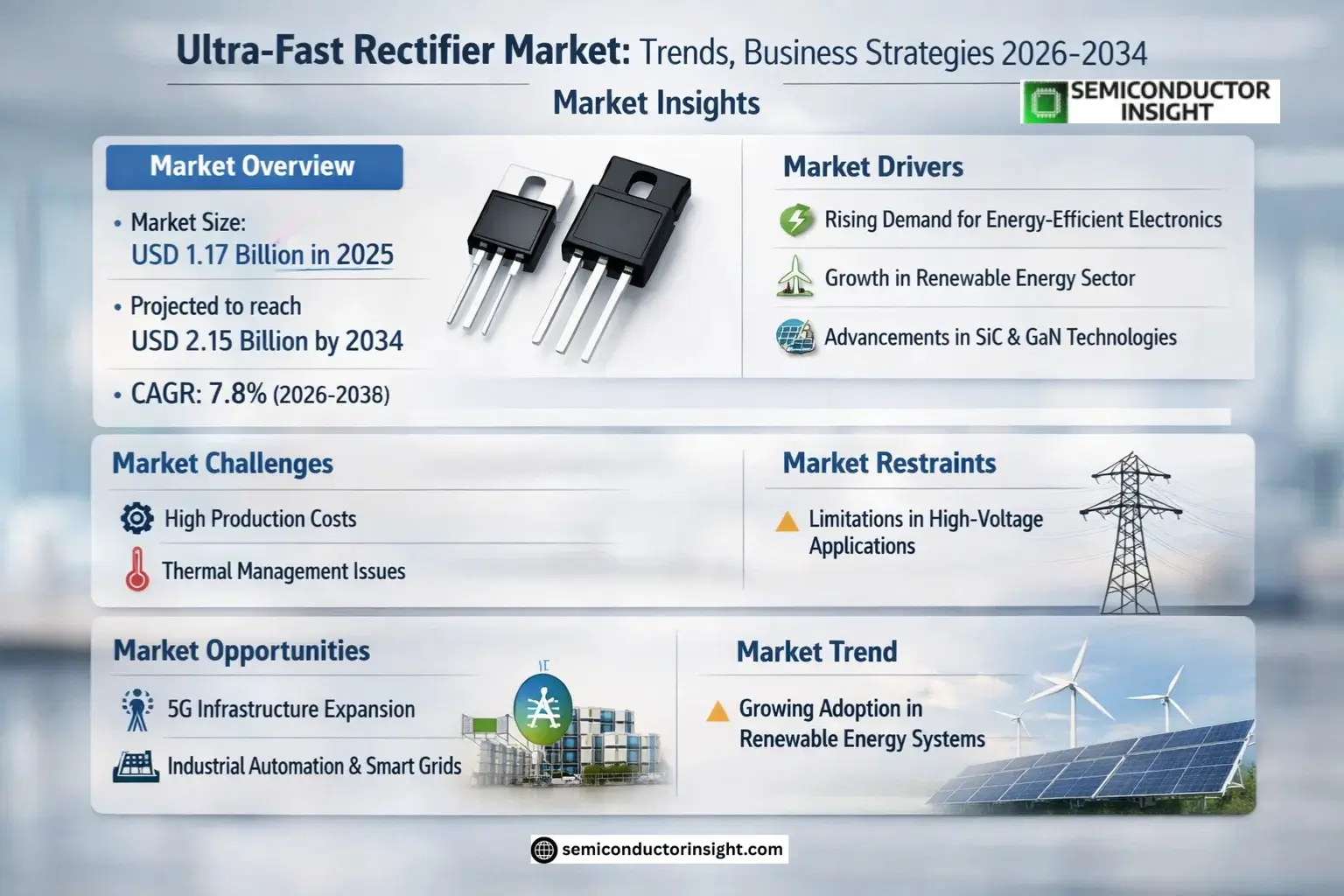
Global Ultra-Fast Rectifier Market size was valued at USD 1.17 billion in 2025. The market is projected to grow from USD 1.25 billion in 2026 to USD 2.15 billion by 2034, exhibiting a CAGR of 7.8% during the forecast period.
Ultra-fast rectifiers are semiconductor devices designed with extremely short reverse recovery times, enabling efficient power conversion in high-frequency applications. These components are critical for minimizing switching losses and improving thermal performance in power electronics systems such as switch-mode power supplies, inverters, motor drives, and renewable energy converters.
The market growth is driven by increasing demand for energy-efficient power solutions across industrial automation, electric vehicles, and telecommunications infrastructure. While silicon carbide (SiC) devices are gaining traction in high-voltage applications, ultra-fast silicon rectifiers maintain dominance in cost-sensitive segments due to their proven reliability and manufacturing maturity.
MARKET DRIVERS
Growing Demand for Energy-Efficient Power Electronics
Ultra-Fast Rectifier Market is experiencing significant growth due to the rising demand for energy-efficient power electronic components. These rectifiers play a crucial role in minimizing switching losses and improving efficiency in high-frequency applications. With increasing focus on sustainable energy solutions, manufacturers are adopting ultra-fast rectifiers to enhance power conversion systems.
Expansion of Renewable Energy Sector
The rapid growth of renewable energy infrastructure, particularly in solar and wind power applications, is driving market demand. Ultra-fast rectifiers are essential components in inverters and converters used in these systems, with the global renewable energy market projected to grow at 8.5% CAGR over the next five years.
Technological advancements in semiconductor materials, including silicon carbide (SiC) and gallium nitride (GaN), are further accelerating market growth through improved performance characteristics.
MARKET CHALLENGES
High Production Costs and Material Constraints
Ultra-Fast Rectifier Market faces challenges related to the high cost of advanced semiconductor materials and complex manufacturing processes. These factors create price pressure in competitive markets and may limit adoption in cost-sensitive applications.
Other Challenges
Thermal Management Requirements
Managing heat dissipation remains a critical challenge as ultra-fast rectifiers operate in high-power, high-frequency environments. This necessitates additional cooling solutions that can increase system complexity and cost.
Supply Chain Vulnerabilities
Geopolitical tensions and semiconductor shortages continue to impact the availability of key components, posing risks to market stability and production timelines.
MARKET RESTRAINTS
Technical Limitations in High-Voltage Applications
While ultra-fast rectifiers excel in medium voltage applications, their performance in ultra-high voltage scenarios remains constrained by material limitations and reliability concerns. This restricts their adoption in certain industrial and power transmission applications where slower, more robust technology remains prevalent.
MARKET OPPORTUNITIES
Emerging 5G Infrastructure Development
Global rollout of 5G networks presents a significant growth opportunity for the Ultra-Fast Rectifier Market. These components are essential in power supply units for 5G base stations, with the telecom infrastructure market expected to require millions of high-performance rectifiers in the coming years.
Industrial Automation and Smart Grid Applications
Increasing adoption of industrial automation and smart grid technologies is creating new demand for ultra-fast rectifiers in power distribution systems, motor drives, and industrial power supplies. The market is projected to benefit from the USD 280 billion global smart grid investment anticipated by 2025.
Ultra-Fast Rectifier Market Trends
Growing Adoption in Renewable Energy Systems
Ultra-Fast Rectifier Market is witnessing increased demand from renewable energy applications, particularly in photovoltaic inverters. These components play a critical role in improving energy conversion efficiency in solar power systems. Manufacturers are optimizing device structures to handle higher voltage classes while maintaining fast switching speeds for grid-tied applications.
Other Trends
Shift Toward Surface-Mount Packaging
Surface-mount technology is gaining prominence in Ultra-Fast Rectifier production, driven by the demand for compact power electronics in consumer devices and telecommunications equipment. This packaging approach offers superior thermal performance and space efficiency compared to traditional through-hole designs.
Advancements in Silicon Technology
While SiC-based devices emerge in high-end applications, silicon Ultra-Fast Rectifiers continue to dominate the market with improved epitaxial designs. Manufacturers are achieving sub-35ns recovery times through advanced doping techniques, catering to industrial motor drives and welding equipment that require precise power control.
Regional Production Capacities
Asia maintains its position as the primary manufacturing hub for Ultra-Fast Rectifiers, with Taiwan and China accounting for over 60% of global production. European and American manufacturers are focusing on high-reliability segments such as aerospace and medical power systems.
Supply Chain Optimization
The industry is witnessing strategic partnerships between material suppliers and rectifier manufacturers to ensure stable wafer and packaging material supplies. This collaboration helps maintain the current 76% capacity utilization rate while preparing for future demand growth in electric vehicle power systems.
COMPETITIVE LANDSCAPE
Key Industry Players
Global Market Dominated by Established Semiconductor Giants
Ultra-Fast Rectifier Market is characterized by strong competition among established semiconductor manufacturers, with Infineon Technologies, ON Semiconductor, and STMicroelectronics collectively holding over 35% global market share. These industry leaders benefit from vertically integrated supply chains, extensive patent portfolios, and established relationships with power electronics OEMs. Competition intensifies in medium-voltage segments (100V-600V) where technological differentiation through epitaxial design and advanced packaging provides marginal gains in recovery time and thermal performance.
Niche players like IXYS and ROHM Semiconductor compete through specialized high-voltage and high-temperature designs, particularly for industrial and renewable energy applications. Emerging Chinese manufacturers such as Inchange Semiconductor and PANJIT are gaining traction in cost-sensitive segments through aggressive pricing and localized supply chain advantages. The market also sees increasing cross-industry competition as silicon carbide device manufacturers gradually expand into traditional ultra-fast rectifier applications.
List of Key Ultra-Fast Rectifier Companies Profiled
- Infineon Technologies
- ON Semiconductor
- STMicroelectronics
- Vishay Intertechnology
- ROHM Semiconductor
- IXYS Corporation
- Diodes Incorporated
- Littelfuse
- Nexperia
- PANJIT Semiconductor
- Zowie Capacitor
- Inchange Semiconductor Company Limited
- Microsemi Corporation
- Renesas Electronics
- Toshiba Electronic Devices & Storage Corporation
Segment Analysis:
| Segment Category | Sub-Segments | Key Insights |
| By Type |
|
Medium-Voltage Segment dominates due to optimal balance between performance and cost efficiency:
|
| By Application |
|
Switching Power Supply Segment shows strongest adoption due to:
|
| By End User |
|
Industrial Equipment Segment leads market adoption because:
|
| By Package Type |
|
Surface-Mount Segment demonstrates strongest growth driven by:
|
| By Technology |
|
Silicon-based Segment maintains dominance due to:
|
Regional Analysis: Ultra-Fast Rectifier Market
Asia-Pacific accounts for over 60% of global electronics production, creating sustained demand for Ultra-Fast Rectifiers. The concentration of smartphone, computer, and home appliance manufacturers ensures steady component consumption with rigorous quality requirements.
Growing solar and wind power installations across the region drive Ultra-Fast Rectifier adoption in power conditioning systems. Government renewable energy targets in China, India, and Australia are accelerating infrastructure development requiring efficient power conversion.
The booming electric vehicle market in Asia-Pacific increases Ultra-Fast Rectifier applications in charging systems and power management. Japanese and Korean automakers lead in developing advanced power electronics solutions for next-generation vehicles.
Strong local semiconductor fabrication capabilities ensure responsive Ultra-Fast Rectifier supply chains. Taiwanese and Chinese foundries increasingly specialize in power device production, reducing dependence on Western suppliers for regional manufacturers.
North America
North America shows robust Ultra-Fast Rectifier demand led by advanced industrial and aerospace applications. The U.S. defense sector requires high-reliability components for radar and communication systems, while Canada’s growing renewable energy sector presents opportunities. Silicon Valley’s tech ecosystem drives innovation in power management ICs incorporating Ultra-Fast Rectifier technology. Stricter energy efficiency regulations are prompting upgrades in power infrastructure and industrial equipment across the region.
Europe
Europe maintains steady Ultra-Fast Rectifier Market growth through automotive and industrial applications. German and Italian industrial automation sectors demand high-performance components for motor drives and power supplies. The EU’s focus on energy-efficient technologies boosts adoption in consumer electronics and smart grid applications. Scandinavian countries lead in implementing Ultra-Fast Rectifiers for offshore wind power conversion systems.
Middle East & Africa
The Middle East shows emerging Ultra-Fast Rectifier demand from oil & gas automation systems and infrastructure projects. UAE and Saudi Arabia invest in smart city technologies requiring advanced power components. Africa’s developing telecom sector creates pockets of demand for power supply applications, though market penetration remains limited compared to other regions.
South America
Brazil and Argentina drive South America’s Ultra-Fast Rectifier Market, primarily serving industrial equipment and renewable energy applications. Growing investments in solar power projects create opportunities, while economic volatility in the region impacts industrial upgrade cycles. Local manufacturing remains limited with most components imported from Asia and North America.
Report Scope
This market research report provides a comprehensive analysis of the Ultra-Fast Rectifier Market , covering the forecast period 2025–2032. It offers detailed insights into market dynamics, technological advancements, competitive landscape, and key trends shaping the industry.
Key focus areas of the report include:
- Market Overview: The report begins with an overview outlining its current market scenario, key growth indicators, and industry transformation drivers. It discusses macroeconomic factors, demand–supply balance, regulatory landscape, and the strategic role of semiconductors in powering advancements across industries such as automotive, telecommunications, consumer electronics, and industrial automation.
- Market Size & Forecast: Historical data and future projections for revenue, unit shipments, and market value across major regions and segments.
- Segmentation Analysis: Detailed breakdown by product type, technology, application, and end-user industry to identify high-growth segments and investment opportunities.
- Regional Insights: Insights into market performance across North America, Europe, Asia-Pacific, Latin America, and the Middle East & Africa, including country-level analysis where relevant.
- Competitive Landscape: Profiles of leading market participants, including their product offerings, R&D focus, manufacturing capacity, pricing strategies, and recent developments such as mergers, acquisitions, and partnerships.
- Technology Trends & Innovation: Assessment of emerging technologies, integration of AI/IoT, semiconductor design trends, fabrication techniques, and evolving industry standards.
- Market Drivers & Restraints: Evaluation of factors driving market growth along with challenges, supply chain constraints, regulatory issues, and market-entry barriers.
- Stakeholder Insights: Insights for component suppliers, OEMs, system integrators, investors, and policymakers regarding the evolving ecosystem and strategic opportunities.
Primary and secondary research methods are employed, including interviews with industry experts, data from verified sources, and real-time market intelligence to ensure the accuracy and reliability of the insights presented.
FREQUENTLY ASKED QUESTIONS:
What is the current market size of Ultra-Fast Rectifier Market?
-> Ultra-Fast Rectifier Market size was valued at USD 1.17 billion in 2025. The market is projected to grow from USD 1.25 billion in 2026 to USD 2.15 billion by 2034, exhibiting a CAGR of 7.8% during the forecast period.
What is the production capacity and utilization rate of ultra-fast rectifiers?
-> Global annual production capacity reached approximately 1.05 billion units in 2025 with actual output of 800 million units, corresponding to a 76% capacity utilization rate.
Which companies are the key players in Ultra-Fast Rectifier Market?
-> Key players include Infineon Technologies, ON Semiconductor, STMicroelectronics, Vishay, ROHM Semiconductor, IXYS, Diodes Incorporated, Littlefuse, Nexperia, PANJIT Semiconductor, among others.
What are the major application areas for ultra-fast rectifiers?
-> Major applications include switch-mode power supplies, inverters, motor drives, welding equipment, industrial power electronics, consumer electronics, renewable energy inverters, automotive electronics, and communication infrastructure.
What are the key growth drivers for this market?
-> Key growth drivers include increasing power density requirements, higher switching frequencies in power conversion equipment, industrial automation, electrification trends, and expansion of global power electronics manufacturing.
Get Sample Report PDF for Exclusive Insights
Report Sample Includes
- Table of Contents
- List of Tables & Figures
- Charts, Research Methodology, and more...
 Download Sample Report PDF