
Market Insights
Global UHD TV Market size was valued at USD 86.41 billion in 2025. The market is projected to grow from USD 94.32 billion in 2026 to USD 303.42 billion by 2034, exhibiting a CAGR of 19.7% during the forecast period.
UHD TV refers to television display systems that conform to the Ultra High Definition (UHD) standard, offering significantly higher resolution than traditional Full HD (1920×1080). The technology includes UHD-1/4K (3840×2160) and UHD-2/8K (7680×4320) resolutions, delivering enhanced picture quality with features like high dynamic range (HDR), wide color gamut, and improved frame rates. These advancements provide an immersive viewing experience for home entertainment, gaming, and commercial applications such as digital signage and broadcasting.
The market growth is driven by increasing consumer demand for premium viewing experiences, declining prices of UHD panels, and rapid adoption of streaming services supporting 4K content. Technological advancements in display technologies like OLED, QLED, and Mini-LED further accelerate adoption. Key players such as Samsung, LG, Sony, and TCL are investing heavily in R&D to enhance product offerings while expanding production capacities to meet rising global demand.
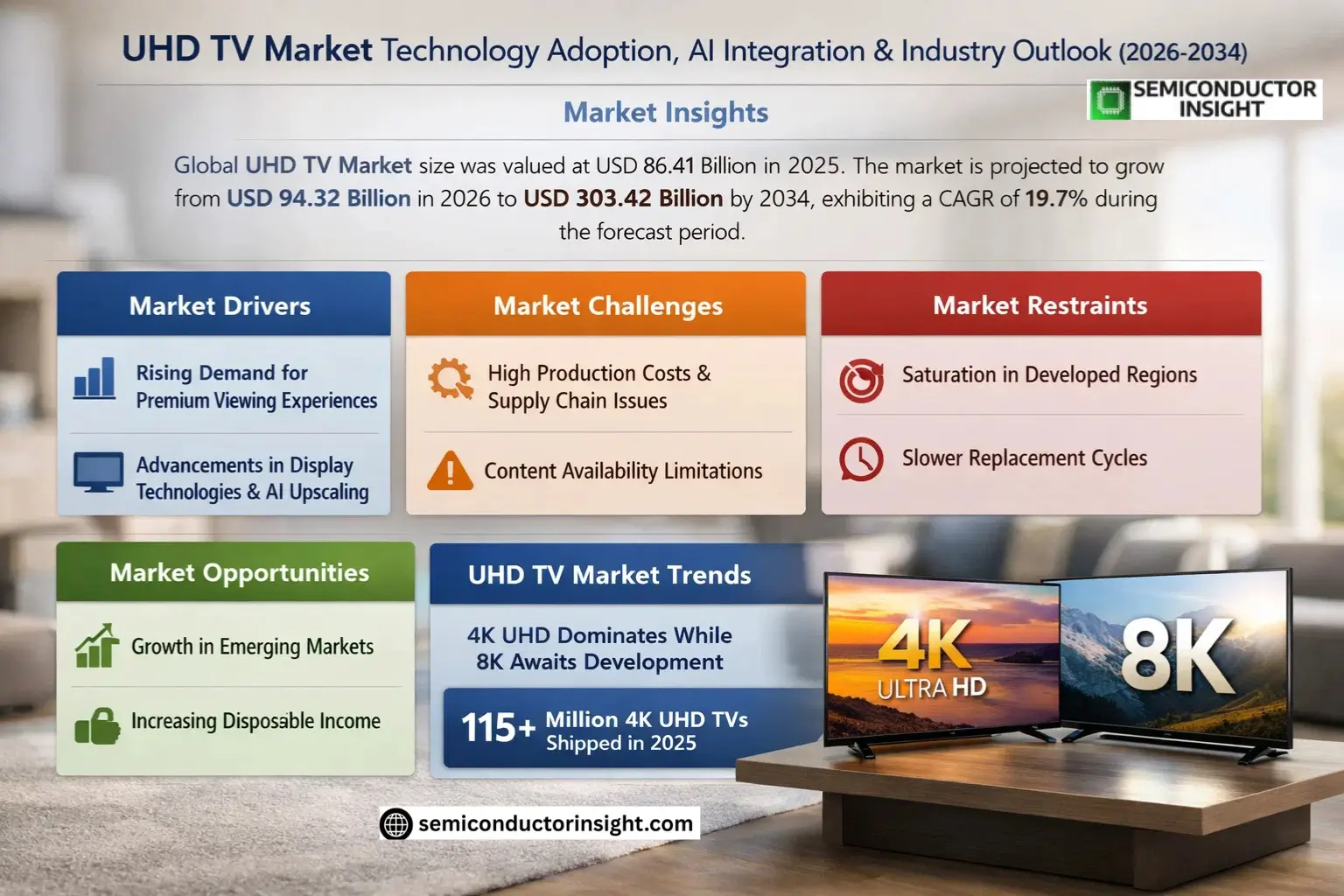
MARKET DRIVERS
Increasing Consumer Demand for Premium Viewing Experiences
UHD TV Market is experiencing significant growth driven by rising consumer expectations for superior visual quality. With resolutions four times higher than Full HD, UHD TVs deliver sharper images and more immersive viewing. The growing popularity of streaming platforms offering 4K content further accelerates adoption, as consumers seek devices that maximize their entertainment experience.
Technological Advancements in Display Panels
Innovations in display technology, such as OLED and QLED panels, have enhanced color accuracy, contrast ratios, and energy efficiency for UHD TVs. Manufacturers are also integrating AI-powered upscaling to optimize lower-resolution content, reducing the gap between legacy and native 4K media.
Additionally, the decreasing cost of production for larger panels has made premium UHD TVs increasingly affordable, broadening their market reach.
MARKET CHALLENGES
High Production Costs and Supply Chain Constraints
Despite growing demand, the UHD TV Market faces challenges in component sourcing, particularly for high-end display panels. Semiconductor shortages and logistical delays have impacted manufacturing timelines, leading to inventory shortages in key markets.
Other Challenges
Content Availability Limitations
While 4K streaming services are expanding, the majority of broadcast content remains in HD or lower resolutions, creating a mismatch between display capabilities and available programming.
MARKET RESTRAINTS
Market Saturation in Developed Regions
In mature markets such as North America and Western Europe, UHD TV penetration exceeds 60%, leading to slower growth rates as replacement cycles lengthen. Consumers are holding onto premium TVs for longer periods before upgrading.
MARKET OPPORTUNITIES
Emerging Markets and Increasing Disposable Income
Developing economies in Asia-Pacific and Latin America present significant growth potential for the UHD TV Market. Rising middle-class populations and improving digital infrastructure are driving demand for higher-end television models, with sales in these regions growing at nearly double the global average.
UHD TV Market Trends
4K UHD Dominates Market Penetration While 8K Awaits Ecosystem Development
UHD TV Market continues to evolve with 4K resolution achieving widespread adoption globally. Over 115 million units were shipped in 2025, driven by falling production costs and increasing consumer demand for premium viewing experiences. Market leaders are focusing on enhancing picture quality through improved HDR technology and wider color gamut capabilities rather than solely competing on resolution metrics.
Other Trends
Display Technology Advancements
Manufacturers are rapidly transitioning from traditional LCD systems to Mini/Micro LED and OLED panels, offering superior contrast ratios and energy efficiency. South Korean brands maintain technological leadership in OLED production, while Chinese manufacturers are gaining ground in Mini LED implementation.
Regional Market Diversification
North America remains the largest market for premium UHD TVs due to high consumer purchasing power. The Asia-Pacific region shows the fastest growth, led by China’s expanding middle class and developed production ecosystem. European markets prioritize energy-efficient models with sophisticated design aesthetics.
Emerging Applications
Commercial Sector Expansion
Beyond residential use, UHD TVs are increasingly deployed in digital signage, corporate environments, and hospitality sectors. The commercial segment is adopting larger screen sizes (65+ inches) with enhanced durability features for continuous operation.
Integration with Smart Ecosystems
Leading manufacturers are embedding advanced AI processors for upscaling legacy content and optimizing streaming performance. The convergence of 5G networks and UHD content delivery platforms is creating new opportunities for interactive applications and cloud gaming services.
COMPETITIVE LANDSCAPE
Key Industry Players
Global UHD TV Market Dominated by Asian Brands with Technological Edge
UHD TV Market is characterized by intense competition among global electronics giants, with Samsung and LG maintaining technological leadership through OLED innovations. The South Korean duopoly controls approximately 40% of the premium segment, leveraging superior display technologies and vertical integration. Chinese manufacturers like TCL and Hisense have gained significant market share (25% combined) through aggressive pricing strategies and rapid adoption of Mini-LED technology, particularly in mid-range 65-inch models.
Japanese brands Sony and Panasonic maintain strong footholds in professional-grade displays and high-end home theater systems, while emerging players like Xiaomi disrupt the market with competitive smart TV ecosystems. European manufacturers Philips and Thomson focus on niche segments through licensing agreements. The industry is witnessing a shift toward integrated solutions combining 8K resolution with AI-powered upscaling and IoT connectivity.
List of Key UHD TV Companies Profiled
- Samsung
- LG Electronics
- Sony
- TCL
- Hisense
- Skyworth
- Panasonic
- Sharp
- Xiaomi
- Philips TV
- Haier
- Konka
- Tsinghua Tongfang
- CHiQ
- Vizio
Segment Analysis:
| Segment Category | Sub-Segments | Key Insights |
| By Type |
|
4K UHD dominates current market adoption with widespread content availability and affordability.
|
| By Application |
|
Residential applications lead market demand across all regions.
|
| By End User |
|
Household Consumers represent the core demographic for UHD TV adoption.
|
| By Screen Size |
|
52-65 Inches segment represents the sweet spot for mainstream adoption.
|
| By Display Technology |
|
LCD System maintains volume leadership with cost-effective solutions.
|
Regional Analysis: Global UHD TV Market
Asia-Pacific
Asia-Pacific hosts the world’s largest UHD TV production facilities, with vertical integration across the supply chain. Regional players optimize costs through scale and proximity to component suppliers, maintaining competitive pricing advantages in global markets.
The region pioneers AI-enhanced UHD TVs with voice control, content recommendations, and smart home connectivity. Asian manufacturers continuously introduce cutting-edge display technologies, including QLED, OLED, and MicroLED variants.
Local streaming services and broadcasters rapidly adopt 4K/8K formats, complementing UHD TV hardware sales. Regional content partnerships and indigenous operating systems enhance the value proposition for consumers.
Brands employ aggressive marketing strategies across both urban and emerging rural markets. Flexible financing options and trade-in programs help overcome price sensitivity barriers in developing Asia-Pacific economies.
North America
The North American UHD TV Market thrives on premium consumer preferences and early technology adoption. High disposable incomes drive demand for large-screen 8K models with advanced HDR capabilities. Streaming platforms lead content delivery with extensive 4K libraries, while cable providers gradually upgrade broadcast infrastructure. The region sees strong integration between UHD TVs and smart home systems, with voice assistants becoming standard features. Retail channels emphasize immersive viewing experiences through in-store demonstrations of cutting-edge display technologies.
Europe
European demand for UHD TVs grows steadily with emphasis on energy efficiency and design aesthetics. Western European markets prefer premium brands with eco-conscious features, while Eastern Europe shows price-sensitive growth. EU regulations promote energy labeling that influences consumer choices. The region shows particular interest in UHD TVs with ambient mode and art display features. Sports broadcasting in 4K/8K drives replacement cycles among enthusiasts, especially during major international tournaments.
Middle East & Africa
The MEA region experiences uneven UHD TV adoption, with Gulf Cooperation Council countries demonstrating mature market characteristics. Luxury real estate developments frequently include high-end UHD TV installations. African urban centers show growing interest, though economic factors limit penetration. Regional players emphasize durability features for harsh climates and multi-language support. Satellite TV providers gradually introduce 4K channels to complement improving broadband infrastructure.
South America
South America’s UHD TV Market expands alongside improving economic conditions and digital broadcasting transitions. Brazil leads in adoption, with manufacturers tailoring products to local content preferences and payment capabilities. Import challenges and currency fluctuations impact pricing strategies throughout the region. Retail partnerships with local football clubs help promote UHD TVs optimized for sports viewing, while streaming platforms gain traction in major urban markets.
Report Scope
This market research report provides a comprehensive analysis of the UHD TV Market, covering the forecast period 2025–2034. It offers detailed insights into market dynamics, technological advancements, competitive landscape, and key trends shaping the industry.
Key focus areas of the report include:
- Market Overview: The report begins with an overview outlining its current market scenario, key growth indicators, and industry transformation drivers. It discusses macroeconomic factors, demand–supply balance, regulatory landscape, and the strategic role of display technologies in powering advancements across industries such as consumer electronics, broadcasting, and commercial displays.
- Market Size & Forecast: Historical data and future projections for revenue, unit shipments, and market value across major regions and segments.
- Segmentation Analysis: Detailed breakdown by product type, technology, application, and end-user industry to identify high-growth segments and investment opportunities.
- Regional Insights: Insights into market performance across North America, Europe, Asia-Pacific, Latin America, and the Middle East & Africa, including country-level analysis where relevant.
- Competitive Landscape: Profiles of leading market participants, including their product offerings, R&D focus, manufacturing capacity, pricing strategies, and recent developments such as mergers, acquisitions, and partnerships.
- Technology Trends & Innovation: Assessment of emerging technologies, integration of AI/IoT, display technology trends, fabrication techniques, and evolving industry standards.
- Market Drivers & Restraints: Evaluation of factors driving market growth along with challenges, supply chain constraints, regulatory issues, and market-entry barriers.
- Stakeholder Insights: Insights for component suppliers, OEMs, system integrators, investors, and policymakers regarding the evolving ecosystem and strategic opportunities.
Primary and secondary research methods are employed, including interviews with industry experts, data from verified sources, and real-time market intelligence to ensure the accuracy and reliability of the insights presented.
FREQUENTLY ASKED QUESTIONS:
What is the current market size of UHD TV Market?
-> UHD TV Market size was valued at USD 86.41 billion in 2025. The market is projected to grow from USD 94.32 billion in 2026 to USD 303.42 billion by 2034, exhibiting a CAGR of 19.7% during the forecast period.
Which key companies operate in UHD TV Market?
-> Key players include Samsung, Hisense, LG, Sony, TCL, Sharp, Panasonic, Xiaomi, Philips, and Haier, among others.
What are the key growth drivers?
-> Key growth drivers include rising demand for high-resolution displays, increasing adoption of smart TV platforms, growth in streaming content, and technological advancements in display technologies.
Which region dominates the market?
-> Asia-Pacific is the largest and fastest-growing market, while North America remains a key market for premium UHD TVs.
What are the emerging trends?
-> Emerging trends include Mini/Micro LED technology integration, AI-powered smart TV features, 8K resolution adoption, and “5G + ultra-high-definition” content delivery.

Get Sample Report PDF for Exclusive Insights
Report Sample Includes
- Table of Contents
- List of Tables & Figures
- Charts, Research Methodology, and more...
 Download Sample Report PDF





