
MARKET INSIGHTS
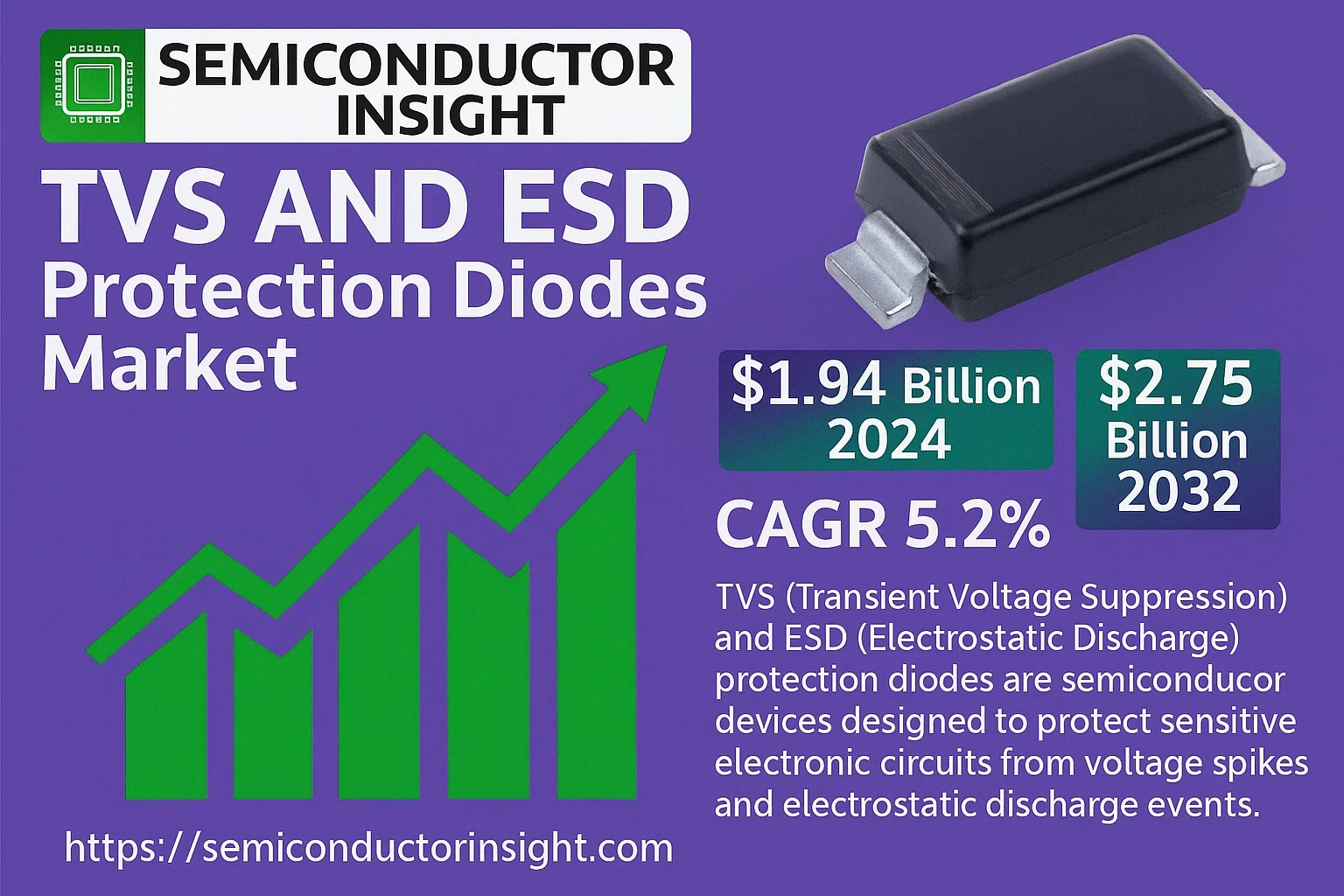
Global TVS and ESD Protection Diodes Market was valued at USD 1.94 billion in 2024 and is projected to reach USD 2.75 billion by 2032, exhibiting a CAGR of 5.2% during the forecast period.
TVS (Transient Voltage Suppression) and ESD (Electrostatic Discharge) protection diodes are semiconductor devices designed to protect sensitive electronic circuits from voltage spikes and electrostatic discharge events. These components are essential for enhancing the reliability and longevity of electronic systems across various industries.
The market is experiencing steady growth due to several factors, including the increasing adoption of electronic devices, the growth of the Internet of Things (IoT), and the rising demand for robust circuit protection in automotive and industrial applications. Furthermore, the ongoing miniaturization of electronic components necessitates more efficient and compact protection solutions, which is driving innovation in this market. Key players like Infineon, Nexperia, and Vishay are focusing on developing advanced products with higher power handling capabilities and lower clamping voltages to meet evolving industry standards.
MARKET DRIVERS
Proliferation of Connected and High-Speed Electronics
The exponential growth in the number of connected devices, from smartphones and wearables to automotive electronics and industrial IoT sensors, is a primary driver. Each new electronic device requires protection against transient voltage spikes and electrostatic discharge (ESD) events to ensure reliability and longevity. The increasing adoption of high-speed interfaces like USB4, Thunderbolt, and 5G infrastructure further necessitates advanced TVS diodes capable of handling fast rise-time transients without signal integrity degradation.
Stringent Electronics Reliability Standards
Global regulatory bodies and industry consortia continue to enforce stricter electromagnetic compatibility (EMC) and ESD immunity standards, such as IEC 61000-4-2. Compliance with these standards is mandatory for product certification and market access, compelling manufacturers across consumer electronics, automotive, and medical sectors to integrate robust protection components like TVS diodes into their designs from the outset.
➤ Miniaturization and Integration Demand: The trend towards smaller, more densely packed PCBs requires protection components that offer high performance in miniature packages, driving innovation in silicon-based TVS arrays and embedded protection solutions.
Furthermore, the rapid electrification of the automotive industry, particularly in electric vehicles (EVs) and advanced driver-assistance systems (ADAS), represents a significant demand driver. These systems operate in harsh electrical environments and rely on sensitive electronics that are highly susceptible to voltage transients from loads like motors and solenoids.
MARKET CHALLENGES
Intense Price Pressure and Commoditization
The market for standard, single-function TVS diodes is highly competitive, leading to significant price erosion. Manufacturers face constant pressure to reduce costs while maintaining performance, especially in high-volume consumer applications. This commoditization challenges profitability and R&D investment for suppliers.
Other Challenges
Protection-Performance Trade-offs
Designing TVS diodes for ultra-high-speed data lines presents a significant engineering challenge. Engineers must balance low capacitance to maintain signal integrity with high surge current handling capability, often requiring complex multi-stage protection schemes that increase design complexity and cost.
Supply Chain and Geopolitical Factors
The semiconductor industry’s vulnerability to supply chain disruptions, as evidenced by recent global chip shortages, also affects the TVS diode market. Geopolitical tensions can impact the availability of raw materials and manufacturing capacity, creating uncertainty for both suppliers and OEMs.
MARKET RESTRAINTS
Technology Maturity in Core Applications
For many established applications, TVS diode technology is mature, offering high performance and reliability at low cost. This maturity can slow the rate of product replacement and limit growth opportunities in saturated market segments, as designers may opt for proven, cost-effective solutions rather than adopting newer, more expensive technologies unless a clear performance benefit is demonstrated.
Design Complexity in Advanced Systems
As electronic systems become more complex, integrating effective circuit protection requires deeper system-level understanding and simulation. This increased design complexity can act as a barrier, particularly for smaller manufacturers who may lack the specialized engineering resources needed to properly specify and implement advanced TVS solutions, potentially leading to underspecification or over-design.
MARKET OPPORTUNITIES
Expansion in Automotive Electronics
The transition to electric and autonomous vehicles creates substantial opportunities. New requirements for protecting high-voltage battery systems, lidar sensors, and sophisticated infotainment systems demand TVS diodes with higher clamping voltages, greater power dissipation, and enhanced ESD robustness, spurring development of specialized automotive-grade products.
Emerging High-Frequency Applications
The deployment of 5G millimeter-wave infrastructure and the ongoing development of 6G technology open new frontiers. These applications require protection solutions that operate effectively at frequencies above 20 GHz with minimal insertion loss, driving innovation in diode design and packaging to meet the stringent performance criteria of next-generation wireless networks.
Integrated and Array-Based Solutions
There is a growing trend towards multi-channel TVS arrays that protect entire interfaces (e.g., multiple data lines and power rails) in a single, small-footprint package. This integration simplifies board design, saves space, and improves reliability, presenting a significant growth avenue for suppliers who can deliver these value-added solutions.
TVS and ESD Protection Diodes Market Trends
Robust Market Growth Fueled by Digitalization
The global market for TVS (Transient Voltage Suppression) and ESD (Electrostatic Discharge) protection diodes is experiencing significant expansion, with a valuation of $1,946 million in 2024. The market is projected to grow at a compound annual growth rate (CAGR) of 5.2%, reaching an estimated $2,752 million by 2032. This sustained growth is primarily driven by the increasing digitalization across industries and the critical need to protect sensitive electronic components from voltage transients and electrostatic discharge events. The proliferation of high-speed data interfaces, the expansion of 5G networks, and the electrification of the automotive sector are key factors contributing to robust demand for these essential protection components.
Other Trends
Product Segments and Technological Evolution
The market is segmented into ESD protection diodes and TVS diodes, with TVS diodes dominating the product landscape, holding approximately 80% of the market share. TVS diodes are favored for their ability to clamp high-voltage transients and handle larger surge currents, making them indispensable in power supply lines and industrial applications. Continuous technological advancements are leading to diodes with lower clamping voltages, faster response times, and smaller form factors, catering to the miniaturization trend in electronics and enabling protection for increasingly dense integrated circuits.
Application-Specific Demand Dynamics
Application analysis reveals that the telecommunications sector is the largest end-user, accounting for over 43% of the market. This is attributable to the massive infrastructure build-out for 5G and the need to protect sensitive base station equipment and consumer devices. The automobile industry represents another major growth area, driven by the increasing electronic content in vehicles, including advanced driver-assistance systems (ADAS) and electric vehicle powertrains, which require robust protection against electrical transients.
Regional Market Concentration and Competitive Landscape
Geographically, North America is the largest market, holding over 30% of the global share, supported by strong presence of leading technology companies and high adoption rates of advanced electronics. The competitive landscape is characterized by the dominance of a few key players, with the top five companies collectively accounting for a significant portion of the market. Infineon, Nexperia, SEMTECH, Vishay, and Littelfuse are among the leading manufacturers, focusing on innovation and strategic partnerships to strengthen their market positions and address the evolving protection requirements across diverse applications.
COMPETITIVE LANDSCAPE
Key Industry Players
A Market Consolidated by Leading Global Semiconductor Giants
The global TVS and ESD Protection Diodes market is characterized by a high degree of consolidation, with the top players commanding a significant share. Infineon Technologies leads the market, renowned for its comprehensive portfolio of robust protection solutions catering to the demanding automotive and industrial sectors. Following closely are Nexperia and Littelfuse, both of which hold substantial market presence through their extensive product lines and strong technological expertise. STMicroelectronics and Vishay are also major forces, leveraging their broad semiconductor portfolios to offer integrated protection solutions. These leading companies collectively account for a dominant portion of the market, driving innovation primarily in Transient Voltage Suppression (TVS) diodes, which constitute the largest product segment.
Beyond the top tier, a range of specialized and niche players contribute to the market’s dynamism. Companies like SEMTECH, ON Semiconductor, and Diodes Inc. are significant competitors, often focusing on specific applications such as high-speed data lines in telecommunications or compact protection for consumer electronics. In the Asia-Pacific region, manufacturers such as BrightKing, Amazing, WAYON, and Prisemi have established strong positions by offering cost-effective solutions, particularly for the high-volume consumer goods and PC markets. Other notable participants, including Bourns, PROTEK, TOSHIBA, and INPAQ, serve specialized segments like military/aerospace and precision power supplies, ensuring a competitive and diverse supplier base for various application needs.
List of Key TVS and ESD Protection Diodes Companies Profiled
- Infineon Technologies AG
- Nexperia
- Littelfuse, Inc.
- STMicroelectronics N.V.
- Vishay Intertechnology, Inc.
- SEMTECH Corporation
- ON Semiconductor
- Diodes Incorporated
- BrightKing
- Amazing Microelectronic Corp.
- WAYON
- Prisemi
- Bourns, Inc.
- TOSHIBA Electronic Devices & Storage Corporation
- PROTEK
Segment Analysis:
| Segment Category | Sub-Segments | Key Insights |
| By Type |
|
TVS Diodes constitutes the dominant product category, primarily due to their superior capability to handle high-power transient voltage surges, which are critical for protecting sensitive electronic circuits in demanding applications. Their robust design and ability to dissipate significant energy make them a preferred choice for a wider range of industrial and telecommunications equipment. ESD Protection Diodes, while essential, cater to more specific, lower-energy electrostatic discharge threats, typically at the component level. The market’s preference for TVS Diodes reflects the broader need for comprehensive circuit protection solutions that can withstand a variety of electrical overstress conditions beyond simple ESD events. |
| By Application |
|
Telecommunications represents the most significant application segment, driven by the critical need to protect expensive network infrastructure and data transmission equipment from voltage transients induced by lightning strikes, power cross, and switching surges. The proliferation of high-speed 5G infrastructure and the constant expansion of global connectivity further solidify this leading position. The Automotive and Industrial segments are also major growth drivers, with increasing electronics content and stringent reliability requirements. In contrast, the Military/Aerospace segment, while not the largest, demands the highest level of reliability and performance under extreme conditions. |
| By End User |
|
Original Equipment Manufacturers (OEMs) represent the primary end-user group, as they integrate TVS and ESD diodes directly into their final products across consumer electronics, automotive systems, and industrial machinery. Their purchasing decisions are heavily influenced by component reliability, technical support, and long-term supply chain stability. Electronic Manufacturing Services (EMS) providers are also significant customers, procuring large volumes of components on behalf of their OEM clients. Component distributors play a crucial role in the supply chain, serving smaller manufacturers and providing inventory flexibility, but their influence on product design and specification is generally secondary to that of direct OEM relationships. |
| By Protection Level |
|
Medium-Voltage Protection solutions are the leading category, offering a versatile balance suitable for the majority of commercial and industrial applications, including data lines, communication ports, and power supply units. These diodes effectively clamp transient overvoltages commonly found in these environments without compromising response time or adding excessive capacitance. High-Voltage Protection diodes are critical for rugged applications like automotive systems and industrial motor drives, where voltage spikes can be severe. Low-Voltage Protection is essential for safeguarding sensitive integrated circuits and interface connections in portable electronics, where even minor ESD events can cause permanent damage. |
| By Product Configuration |
|
Unidirectional Diodes are the most widely adopted configuration, as they are ideal for protecting DC power lines and digital signal lines where the voltage polarity is fixed. Their design provides optimal clamping performance for positive transients relative to ground. Bidirectional Diodes are essential for AC lines and data communication buses like USB or Ethernet, where signals swing both positive and negative, requiring symmetrical protection. Array Diodes are gaining significant traction for protecting multi-channel interfaces, such as those found in smartphones and laptops, as they offer superior board space efficiency and simplified PCB layout compared to using multiple discrete devices, making them a key choice for space-constrained modern electronics. |
Regional Analysis: TVS and ESD Protection Diodes Market
The immense concentration of consumer electronics, telecommunications, and computing device manufacturers in the region creates the world’s largest and most consistent demand base for TVS and ESD diodes, driving both volume and innovation.
A deeply integrated local supply chain, from raw materials to advanced semiconductor fabrication, allows for cost-effective production and rapid response to market demands, giving regional players a significant competitive advantage.
The rapid expansion of the automotive industry, especially electric vehicle production in China, is fueling demand for advanced TVS diodes for battery management, infotainment, and advanced driver-assistance systems.
High investment in R&D and a focus on developing diodes with lower clamping voltages and higher power dissipation capabilities for next-generation 5G and IoT applications keeps the region at the forefront of the market.
North America
North America remains a critical and technologically advanced market for TVS and ESD protection diodes, characterized by its strong demand for high-reliability components. The region’s leadership in the aerospace, defense, and telecommunications infrastructure sectors necessitates components that meet stringent quality and performance standards. The proliferation of data centers, cloud computing, and the ongoing rollout of 5G networks create substantial demand for robust ESD protection in networking equipment. Furthermore, the automotive industry’s shift towards electric and autonomous vehicles is driving the need for sophisticated protection solutions for sensitive electronic control units. While manufacturing volume is lower than in Asia-Pacific, the focus is on high-value, application-specific diodes, supported by significant R&D investments from both established companies and innovative startups.
Europe
The European market for TVS and ESD diodes is distinguished by its strong automotive and industrial sectors. The region is a global leader in automotive manufacturing, with a strong emphasis on premium and luxury vehicles that incorporate extensive electronic systems requiring reliable transient voltage suppression. Strict regulatory standards for electromagnetic compatibility and product safety across the continent drive the adoption of high-quality protection components. The industrial automation sector, particularly in Germany and Italy, is another major consumer, using diodes to safeguard complex machinery and control systems. A growing focus on renewable energy infrastructure also contributes to demand, as protection is critical for inverters and power converters used in solar and wind installations.
South America
The South American market for TVS and ESD protection diodes is emerging, with growth primarily driven by the gradual expansion of its consumer electronics and industrial base. Countries like Brazil and Argentina are seeing increased local assembly of electronic goods, which boosts demand for essential components like protection diodes. The telecommunications sector is a key driver, as investments in network infrastructure modernization create opportunities. However, the market faces challenges including economic volatility and a less developed local semiconductor ecosystem, which can lead to a higher reliance on imported components. The automotive industry also presents a growing, though still nascent, market for diodes as vehicle electrification slowly gains traction.
Middle East & Africa
The Middle East and Africa region represents a market with significant growth potential, though it is currently less developed compared to other regions. Demand is primarily fueled by infrastructure development, particularly in the Gulf Cooperation Council countries, where investments in smart cities, telecommunications, and industrial projects are increasing. The oil and gas industry is a notable consumer, requiring robust protection for electronic equipment in harsh operating environments. In Africa, the market is fragmented, with growth concentrated in a few developing economies where the expansion of mobile telecommunications is a key driver. The region’s overall market dynamics are influenced by economic diversification efforts and a gradual increase in local electronics manufacturing.
Report Scope
This market research report provides a comprehensive analysis of the TVS and ESD Protection Diodes Market, covering the forecast period 2025–2032. It offers detailed insights into market dynamics, technological advancements, competitive landscape, and key trends shaping the industry.
Key focus areas of the report include:
- Market Overview: The report begins with an overview outlining its current market scenario, key growth indicators, and industry transformation drivers. It discusses macroeconomic factors, demand–supply balance, regulatory landscape, and the strategic role of semiconductors in powering advancements across industries such as automotive, telecommunications, consumer electronics, and industrial automation.
- Market Size & Forecast: Historical data and future projections for revenue, unit shipments, and market value across major regions and segments.
- Segmentation Analysis: Detailed breakdown by product type, technology, application, and end-user industry to identify high-growth segments and investment opportunities.
- Regional Insights: Insights into market performance across North America, Europe, Asia-Pacific, Latin America, and the Middle East & Africa, including country-level analysis where relevant.
- Competitive Landscape: Profiles of leading market participants, including their product offerings, R&D focus, manufacturing capacity, pricing strategies, and recent developments such as mergers, acquisitions, and partnerships.
- Technology Trends & Innovation: Assessment of emerging technologies, integration of AI/IoT, semiconductor design trends, fabrication techniques, and evolving industry standards.
- Market Drivers & Restraints: Evaluation of factors driving market growth along with challenges, supply chain constraints, regulatory issues, and market-entry barriers.
- Stakeholder Insights: Insights for component suppliers, OEMs, system integrators, investors, and policymakers regarding the evolving ecosystem and strategic opportunities.
Primary and secondary research methods are employed, including interviews with industry experts, data from verified sources, and real-time market intelligence to ensure the accuracy and reliability of the insights presented.
FREQUENTLY ASKED QUESTIONS:
What is the current market size of TVS and ESD Protection Diodes Market?
-> TVS and ESD Protection Diodes Market was valued at USD 1.94 billion in 2024 and is projected to reach USD 2.75 billion by 2032, exhibiting a CAGR of 5.2% during the forecast period.
Which key companies operate in TVS and ESD Protection Diodes Market?
-> Key players include Infineon, Nexperia, SEMTECH, Vishay, Littelfuse, BrightKing, Amazing, and STMicroelectronics, among others, which collectively account for about 68% of the market.
What are the key growth drivers?
-> Key growth drivers include rising demand from the telecommunications sector, increasing adoption in the automotive industry, and the proliferation of electronic devices requiring robust ESD protection.
Which region dominates the market?
-> North America is the largest market, holding a share of over 30%.
What are the emerging trends?
-> Key trends include the dominant market share of TVS diodes (approx. 80%), the telecommunications sector being the largest application area (over 43% share), and increasing integration in industrial and automotive electronics.

Get Sample Report PDF for Exclusive Insights
Report Sample Includes
- Table of Contents
- List of Tables & Figures
- Charts, Research Methodology, and more...
 Download Sample Report PDF


