MARKET INSIGHTS
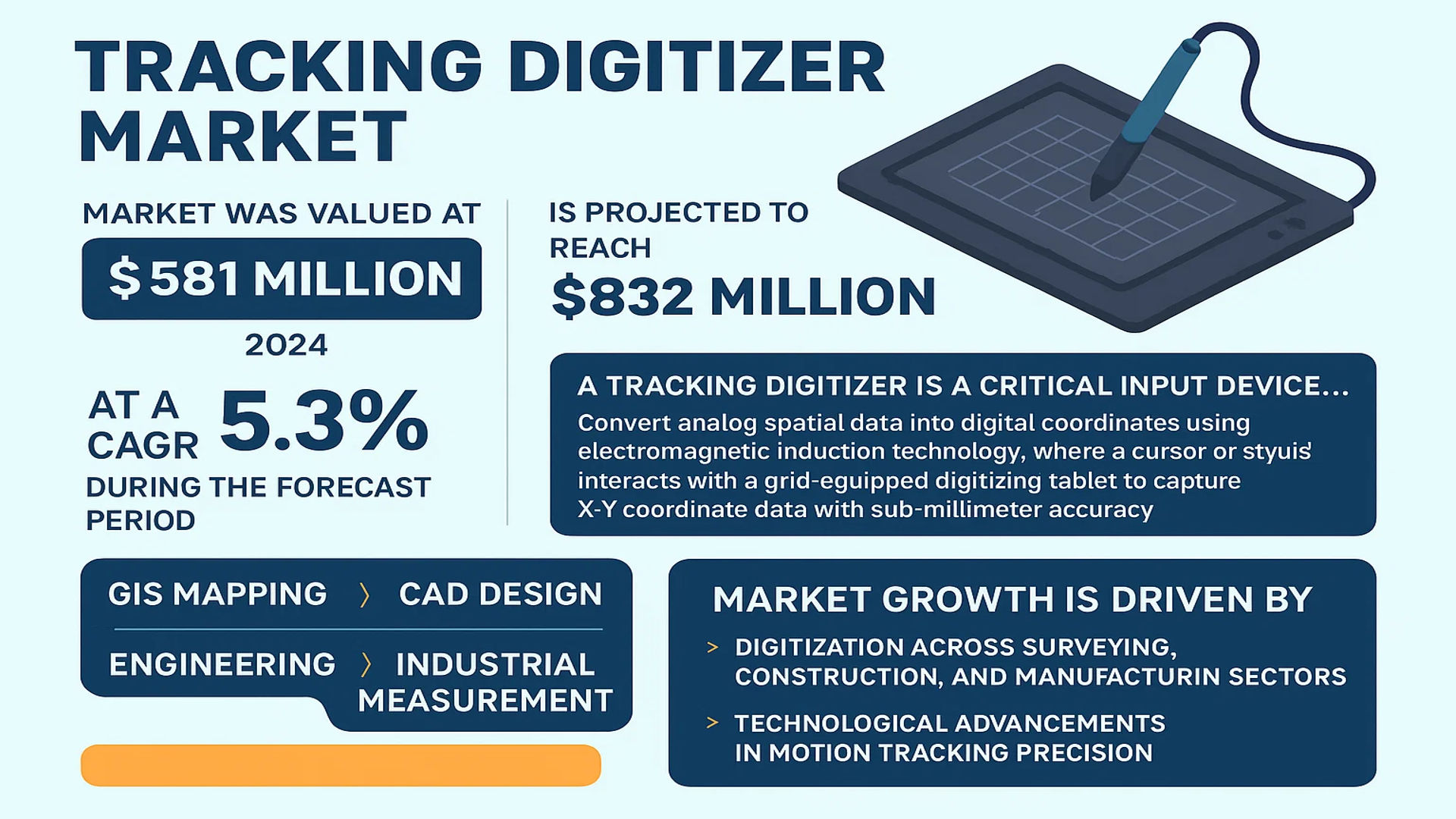
The global Tracking Digitizer Market was valued at 581 million in 2024 and is projected to reach US$ 832 million by 2032, at a CAGR of 5.3% during the forecast period.
A tracking digitizer is a critical input device used to convert analog spatial data from maps, drawings, and graphics into precise digital coordinates. These systems utilize electromagnetic induction technology, where a cursor or stylus interacts with a grid-equipped digitizing tablet to capture X-Y coordinate data with sub-millimeter accuracy. The technology finds extensive application across GIS mapping, CAD design, engineering, and industrial measurement workflows.
Market growth is driven by increasing digitization across surveying, construction, and manufacturing sectors, alongside technological advancements in motion tracking precision. While hand-held tracking devices currently dominate, the automatic tracking segment is gaining traction due to efficiency gains in industrial applications. Key players including Northern Digital, FARO Technologies, and Vicon are investing in enhanced 3D spatial capture capabilities to meet evolving industry demands for high-precision digitization solutions.
MARKET DYNAMICS
MARKET DRIVERS
Expanding GIS and CAD Applications Fuel Market Demand
The tracking digitizer market is experiencing robust growth driven by the expanding applications in geographic information systems (GIS) and computer-aided design (CAD). With the global GIS market projected to maintain a strong growth trajectory, demand for precise data capture tools like tracking digitizers has surged. These devices are critical for converting analog maps and drawings into digital formats, enabling advanced spatial analysis and 3D modeling. The engineering sector alone accounts for over 35% of tracking digitizer usage, as these tools significantly reduce manual errors in technical drawings while improving workflow efficiency.
Rise in Infrastructure Development Projects Accelerates Adoption
Global infrastructure investment exceeding $9 trillion annually is creating substantial demand for surveying and mapping solutions where tracking digitizers play a vital role. The mechanical industry’s shift toward digital twin technologies has further amplified this demand, with tracking digitizers enabling precise equipment modeling and simulation. In developing economies, large-scale urban planning initiatives are driving 20% year-over-year growth in surveying applications, where these devices are essential for creating accurate base maps and cadastral surveys.
➤ The public sector accounts for nearly 60% of tracking digitizer procurement, predominantly for land administration and civil engineering projects.
Technological Advancements Enhance Product Capabilities
The integration of artificial intelligence with tracking digitizers has significantly improved their functionality. Modern systems now feature automated line tracing and object recognition, reducing manual workload by up to 70% compared to traditional digitizing methods. Wireless connectivity options and improved electromagnetic induction technologies have expanded their use in field applications, while higher resolution sensors (now reaching 0.005-inch accuracy) meet the precision requirements of advanced engineering projects.
MARKET RESTRAINTS
High Equipment Costs Limit Market Penetration
While tracking digitizers offer significant workflow advantages, their premium pricing creates barriers for small and medium enterprises. Professional-grade systems can cost between $5,000-$20,000, putting them out of reach for many potential users. Maintenance and calibration expenses add approximately 15-20% to the total cost of ownership annually, particularly for electromagnetic models requiring specialized technical support. This cost structure has constrained adoption in price-sensitive markets and educational institutions despite the clear productivity benefits.
Competition from Alternative Technologies Impacts Growth
The market faces growing competition from 3D laser scanning and photogrammetry solutions that offer faster data acquisition for certain applications. While tracking digitizers maintain advantages in precision and vector data creation, the emergence of AI-powered image recognition software has reduced the need for manual digitizing in some workflows. Additionally, the rise of mobile mapping systems using LiDAR technology has captured market share in large-scale surveying applications, particularly where real-time georeferencing is required.
Operational Complexity Requires Specialized Training
The effective use of tracking digitizers demands specific technical skills that many organizations lack. Proper calibration, error correction, and data processing techniques require specialized training that can take 40-60 hours for proficiency. This learning curve, combined with the industry-wide shortage of qualified GIS technicians, has slowed adoption rates. Many firms report that nearly 30% of the device’s potential productivity gains are lost during the initial implementation phase due to inadequate staff training.
MARKET OPPORTUNITIES
Emerging Markets Present Significant Growth Potential
Developing nations undergoing rapid urbanization offer substantial growth opportunities for tracking digitizer manufacturers. Government initiatives like India’s Digital India Land Records Modernization Programme and Brazil’s National Cartographic System modernization are creating targeted demand for digitizing solutions. These markets are projected to account for nearly 45% of global market growth over the next five years, driven by increasing infrastructure investments and the digitization of legacy paper records.
Integration with BIM Workflows Opens New Applications
The construction industry’s shift toward building information modeling (BIM) creates new use cases for tracking digitizers in as-built documentation and renovation projects. These devices enable precise capture of existing conditions, bridging the gap between physical structures and digital models. As BIM mandates expand globally (with over 40 countries now having national BIM initiatives), tracking digitizers are finding applications in facility management and historic preservation projects where millimeter-level accuracy is required.
➤ The architecture, engineering and construction sector’s BIM adoption rate has surpassed 60% in North America and Europe, creating sustained demand for high-precision digitizing tools.
Advancements in Haptics Technology Enhance User Experience
New developments in haptic feedback technology are transforming tracking digitizers into more intuitive design tools. Systems incorporating force feedback and tactile response mechanisms are gaining traction in industrial design applications, allowing users to ‘feel’ digital surfaces during the design process. This innovation is particularly valuable in automotive and product design workflows, where the combination of precise input and tactile feedback can reduce prototyping cycles by up to 25%.
MARKET CHALLENGES
Data Accuracy Requirements Intensify Quality Demands
As applications become more sophisticated, end-users demand higher levels of data accuracy from tracking digitizers. Many industries now require sub-millimeter precision with error margins below 0.1%, pushing manufacturers to develop more advanced calibration systems. Meeting these standards while maintaining reasonable production costs presents technical challenges, particularly for models designed for field use where environmental factors can impact performance. Regular recalibration (typically every 6-12 months) adds to the total cost of ownership and operational complexity.
Supply Chain Disruptions Affect Production Timelines
The global semiconductor shortage has significantly impacted tracking digitizer manufacturing, with lead times for certain electronic components extending to 52 weeks in some cases. This has created production bottlenecks, particularly for models using specialized sensors and processors. Manufacturers report that component availability issues increased production costs by 12-15% in the past two years, forcing some firms to redesign products around available components rather than optimal technical specifications.
Technology Obsolescence Risks Drive R&D Investment
The rapid pace of technological advancement creates constant pressure to update product lines. Tracking digitizer manufacturers must balance the development of next-generation systems while supporting legacy products, as many enterprise customers have workflows deeply integrated with specific hardware versions. Research and development expenditures now consume 18-22% of revenue for leading manufacturers as they work to incorporate features like cloud connectivity and augmented reality interfaces while maintaining backward compatibility with existing systems.
TRACKING DIGITIZER MARKET TRENDS
Integration of Advanced Motion Capture to Drive Market Expansion
The global tracking digitizer market, valued at $581 million in 2024, is witnessing significant growth driven by advancements in motion capture and spatial tracking technologies. These devices, used for converting physical coordinates into digital data, are increasingly adopted in industries like GIS, CAD, and virtual reality. Notably, the integration of AI-powered tracking systems has enhanced precision, reducing error margins to as low as 0.1mm in high-end models, which is critical for applications in robotics and autonomous navigation. Furthermore, the rise of Industry 4.0 has amplified demand for automated digitizers in smart manufacturing, where real-time data conversion is essential for precision engineering.
Other Trends
Growth in Augmented and Virtual Reality (AR/VR)
The surge in AR/VR applications across gaming, healthcare, and military training has propelled the need for high-accuracy tracking digitizers. Devices with sub-millimeter accuracy are now standard in motion-capture studios, enabling seamless interaction between physical and digital environments. The market for AR/VR in training simulations alone is expected to grow at a CAGR of 18.2% between 2024 and 2032, directly correlating with increased digitizer adoption. Additionally, the automotive sector is leveraging these tools for virtual prototyping, reducing R&D costs by up to 30% compared to traditional methods.
Expansion in Geospatial and Surveying Applications
Geospatial technology adoption is another key driver, with tracking digitizers playing a pivotal role in cadastral mapping and urban planning. Governments worldwide are investing in modernizing surveying infrastructure, particularly in Asia-Pacific, where initiatives like India’s Digital Earth program prioritize high-precision geospatial data. The surveying segment is projected to account for 22% of total digitizer sales by 2027, fueled by advancements in LiDAR-integrated digitizers that enhance 3D terrain modeling. Challenges such as high equipment costs persist, but competitive pricing from manufacturers in China and South Korea is gradually improving accessibility.
COMPETITIVE LANDSCAPE
Key Industry Players
Market Leaders Leverage Innovation and Geographic Expansion to Drive Growth
The global tracking digitizer market features a mix of established electronics manufacturers and specialized motion tracking companies competing for market share. Northern Digital Inc. and Polhemus emerge as dominant players, capturing significant revenue share through their advanced electromagnetic tracking solutions used across medical, aerospace, and industrial applications.
While both companies maintain strong positions in North America, their growth trajectories differ. Northern Digital has aggressively expanded its OEM partnerships, whereas Polhemus continues to focus on high-precision military and VR applications. This strategic divergence highlights how companies are carving distinct niches within the broader market.
The competitive intensity increased in 2023-2024 as Vicon and OptiTrack introduced next-generation optical tracking systems with sub-millimeter accuracy. These launches prompted pricing adjustments across the industry, particularly in the automatic tracking segment where performance thresholds keep rising.
Emerging Chinese manufacturers like Beijing 6dof Technologies are gaining traction in Asia-Pacific markets by offering cost-effective alternatives. However, their market share remains limited in regulated industries requiring stringent certifications. Meanwhile, established players are countering this threat through localized production and enhanced service networks.
Recent corporate movements include FARO Technologies’ acquisition of 3D scanning capabilities and Qualisys’ partnership with Siemens Healthineers, signaling deeper integration of tracking digitizers into smart manufacturing and medical imaging ecosystems. Such strategic alliances are reshaping competitive dynamics as the $832 million market opportunity by 2032 attracts diversified technology providers.
List of Key Tracking Digitizer Companies Profiled
- Northern Digital (Canada)
- Polhemus (U.S.)
- Ascension Technology (U.S.)
- National Instruments (U.S.)
- Vicon (U.K.)
- OptiTrack (U.S.)
- FARO Technologies (U.S.)
- Creaform (Canada)
- Motion Analysis (U.S.)
- Qualisys (Sweden)
- Tektronix (U.S.)
- Beijing 6dof Technologies (China)
- Hangzhou Sikan Technology (China)
Segment Analysis:
By Type
Hand-held Tracking Segment Leads the Market Due to High Precision in Manual Digitization
The Tracking Digitizer market is segmented based on type into:
- Hand-held Tracking
- Automatic Tracking
By Application
Surveying and Mapping Industry Dominates with Essential GIS Applications
The market is segmented based on application into:
- Geological Industry
- Surveying and Mapping Industry
- Engineering Industry
- Mechanical Industry
- Others
By End User
Government and Public Sector Maintains Strong Demand for GIS Applications
The market is segmented based on end user into:
- Government and Public Sector
- Private Enterprises
- Research Institutions
- Educational Institutes
By Technology
Electromagnetic Tracking Maintains Dominance with Established Accuracy Standards
The market is segmented based on technology into:
- Electromagnetic Tracking
- Optical Tracking
- Ultrasonic Tracking
- Hybrid Systems
Regional Analysis: Tracking Digitizer Market
Asia-Pacific
The Asia-Pacific region dominates the global tracking digitizer market, driven by rapid industrialization, urbanization, and technological adoption across key economies like China, Japan, and India. China, in particular, leads in manufacturing and deployment of GIS (Geographic Information Systems) and CAD (Computer-Aided Design) applications. Government initiatives supporting digital infrastructure development—such as China’s “Digital China 2025” strategy—accelerate demand for precision digitizing tools. Additionally, India’s growing engineering and surveying sectors contribute significantly to market expansion. However, price sensitivity in emerging economies remains a challenge, encouraging manufacturers to offer cost-effective solutions without compromising accuracy.
North America
North America holds a significant share of the tracking digitizer market, primarily fueled by advancements in automation, defense applications, and high adoption of GIS in urban planning. The U.S. and Canada are key contributors, with industries such as aerospace, automotive, and healthcare leveraging digitizers for precision data capture. Strong R&D investments by companies like Northern Digital and Polhemus further drive innovation. Regulatory standards emphasizing data accuracy in critical sectors also support market growth. However, the shift toward software-based alternatives for certain applications may temper demand growth in the long term.
Europe
Europe’s tracking digitizer market is characterized by robust demand from the engineering and surveying industries, particularly in Germany, the UK, and France. The region benefits from stringent quality regulations and a well-established industrial base that prioritizes high-accuracy digitizing tools. EU-funded projects in infrastructure mapping and smart city initiatives create steady demand. However, competition from integrated CAD/GIS software solutions poses a challenge. Leading players like Vicon and FARO Technologies are focusing on hybrid solutions that combine hardware precision with software flexibility.
South America
In South America, the tracking digitizer market is expanding at a moderate pace, with Brazil and Argentina as primary markets. Growth stems from mining, agriculture, and infrastructure sectors, where GIS applications are increasingly adopted. However, economic volatility and limited technological adoption in smaller economies restrict faster market penetration. Local players face competition from global manufacturers, but affordability remains a key purchasing criterion. Partnerships with regional distributors are helping international brands gain traction.
Middle East & Africa
The MEA region is an emerging market for tracking digitizers, with growth concentrated in the UAE, Saudi Arabia, and South Africa. Infrastructure megaprojects and smart city initiatives, such as Saudi Arabia’s NEOM, are driving demand for high-precision digitizing tools. However, budget constraints and reliance on imported technology slow market acceleration. Local players are scarce, creating opportunities for global manufacturers to establish a foothold through partnerships or localized offerings.
Report Scope
This market research report provides a comprehensive analysis of the global and regional Tracking Digitizer markets, covering the forecast period 2024–2032. It offers detailed insights into market dynamics, technological advancements, competitive landscape, and key trends shaping the industry.
Key focus areas of the report include:
- Market Size & Forecast: Historical data and future projections for revenue, unit shipments, and market value across major regions and segments. The Global Tracking Digitizer market was valued at USD 581 million in 2024 and is projected to reach USD 832 million by 2032, at a CAGR of 5.3% during the forecast period.
- Segmentation Analysis: Detailed breakdown by product type (Hand-held Tracking, Automatic Tracking), application (Geological Industry, Surveying and Mapping Industry, Engineering Industry, Mechanical Industry, Others), and end-user industry to identify high-growth segments and investment opportunities.
- Regional Outlook: Insights into market performance across North America, Europe, Asia-Pacific, Latin America, and the Middle East & Africa, including country-level analysis where relevant. The U.S. market is estimated at USD million in 2024, while China is projected to reach USD million by 2032.
- Competitive Landscape: Profiles of leading market participants, including their product offerings, R&D focus, manufacturing capacity, pricing strategies, and recent developments such as mergers, acquisitions, and partnerships. Key players include Northern Digital, Polhemus, Ascension Technology, National Instruments, Vicon, OptiTrack, FARO Technologies, Creaform, Motion Analysis, Qualisys, among others.
- Technology Trends & Innovation: Assessment of emerging technologies, integration of AI/IoT, advancements in electromagnetic induction, and evolving industry standards.
- Market Drivers & Restraints: Evaluation of factors driving market growth such as increasing demand for GIS and CAD applications, along with challenges like supply chain constraints and regulatory issues.
- Stakeholder Analysis: Insights for component suppliers, OEMs, system integrators, investors, and policymakers regarding the evolving ecosystem and strategic opportunities.
Primary and secondary research methods are employed, including interviews with industry experts, data from verified sources, and real-time market intelligence to ensure the accuracy and reliability of the insights presented.
FREQUENTLY ASKED QUESTIONS:
What is the current market size of Global Tracking Digitizer Market?
-> Tracking Digitizer Market was valued at 581 million in 2024 and is projected to reach US$ 832 million by 2032, at a CAGR of 5.3% during the forecast period.
Which key companies operate in Global Tracking Digitizer Market?
-> Key players include Northern Digital, Polhemus, Ascension Technology, National Instruments, Vicon, OptiTrack, FARO Technologies, Creaform, Motion Analysis, and Qualisys, among others.
What are the key growth drivers?
-> Key growth drivers include increasing adoption of GIS and CAD applications, technological advancements in electromagnetic induction, and rising demand for precise data input tools.
Which region dominates the market?
-> North America is a dominant market, while Asia-Pacific is expected to witness the fastest growth during the forecast period.
What are the emerging trends?
-> Emerging trends include integration of AI/IoT in tracking digitizers, development of more compact and efficient devices, and increasing use in industrial automation.

Get Sample Report PDF for Exclusive Insights
Report Sample Includes
- Table of Contents
- List of Tables & Figures
- Charts, Research Methodology, and more...
 Download Sample Report PDF