TinyML Chip Market Insights
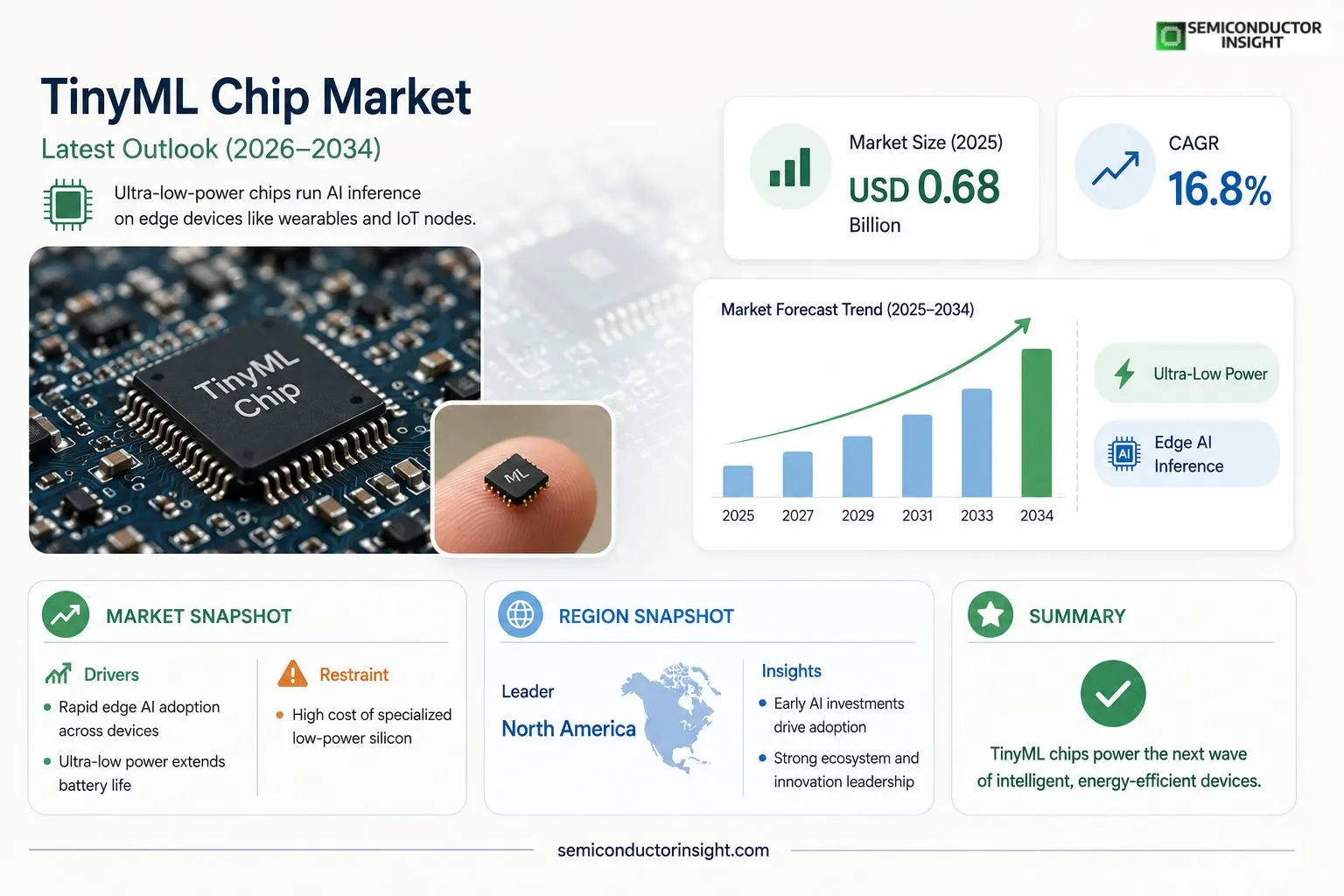
Global TinyML Chip market size was valued at USD 0.68 billion in 2025. The market is projected to grow from USD 0.78 billion in 2026 to USD 3.12 billion by 2034, exhibiting a CAGR of 16.8% during the forecast period.
TinyML chips are ultra‑low‑power microcontrollers designed to run machine‑learning inference directly on edge devices such as wearables, sensors, and IoT nodes. These chips integrate specialized accelerators,often based on ARM Cortex‑M cores or custom ASICs,to execute neural networks with milliwatt‑level energy consumption, enabling real‑time analytics without cloud connectivity.The market is accelerating because enterprises seek energy‑efficient AI solutions for battery‑operated products, while advances in model compression and hardware design reduce silicon cost. However, challenges remain around limited memory footprints and security concerns. Furthermore, strategic partnerships,such as Google’s collaboration with semiconductor firms in early 2024,are expanding ecosystem support, driving broader adoption across automotive, healthcare, and industrial automation sectors.
MARKET DRIVERS
Edge AI Adoption Accelerates
The rapid deployment of edge AI solutions in smart cameras, industrial sensors and autonomous robots creates a strong demand for on‑device inference capabilities. Companies are increasingly seeking TinyML Chip Market offerings that can run neural networks locally, reducing latency and bandwidth costs.
Energy Efficiency Gains
Ultra‑low‑power architectures enable battery‑operated devices to function for months or years without recharging. This energy advantage is a decisive factor for IoT manufacturers, prompting them to prioritize chips optimized for sub‑milliwatt operation.
➤ “The convergence of AI and ultra‑low‑power silicon is reshaping edge computing, turning previously impossible use cases into commercial realities.”
Overall, the combination of pervasive AI workloads and stringent power budgets is propelling the growth of TinyML chip Market, driving investment across semiconductor design houses and end‑user industries.
MARKET CHALLENGES
Integration Complexity
Deploying TinyML solutions often requires co‑design of hardware, firmware and machine‑learning models. Smaller engineering teams may lack the expertise to align these layers efficiently, leading to longer time‑to‑market.
Other Challenges
Limited Toolchain Maturity
Although open‑source frameworks are improving, many developers still encounter gaps in profiling, debugging and deployment tools, which hampers rapid product iteration.
MARKET RESTRAINTS
Manufacturing Cost Constraints
Producing highly specialized low‑power silicon at scale can be cost‑intensive. Foundry capacity for niche process nodes is limited, and higher per‑unit costs may deter price‑sensitive OEMs from adopting advanced TinyML chips.
MARKET OPPORTUNITIES
Emerging Applications in Wearables
Wearable health monitors, smart earbuds and AR glasses increasingly require on‑device AI for real‑time analytics. These segments present a sizable opportunity for chip makers that can deliver sub‑microwatt inference with integrated sensor interfaces, opening new revenue streams for TinyML chip Market.
TinyML Chip Market Trends
Rapid Adoption of Ultra‑Low‑Power AI
The TinyML Chip ecosystem is experiencing a swift shift as manufacturers embed machine‑learning inference directly into ultra‑low‑power microcontrollers. By leveraging specialized accelerators built on ARM Cortex‑M cores or custom ASIC designs, these chips can execute neural‑network workloads at milliwatt‑level energy consumption. This capability enables real‑time analytics on edge devices such as wearables, environmental sensors, and autonomous IoT nodes without reliance on cloud connectivity. Enterprises are prioritizing energy‑efficient AI to extend battery life and reduce data‑transfer costs, driving broader deployment across consumer and industrial segments. The resulting footprint reduction also lowers bill‑of‑materials, making AI‑enabled products financially viable for mass‑market applications within TinyML chip Market. Continued reductions in silicon die cost and expanding software libraries further lower barriers, encouraging startups and large OEMs alike to embed AI directly at the sensor level.
Other Trends
Memory Footprint and Security Considerations
The primary technical constraints for TinyML Chip implementations revolve around limited on‑chip memory and heightened security requirements. Typical devices allocate only a few hundred kilobytes for both model storage and runtime buffers, compelling developers to adopt aggressive model‑compression techniques such as quantization, pruning, and knowledge distillation. At the same time, the growing presence of edge AI in safety‑critical applications raises concerns about data privacy, firmware authenticity, and tamper‑resistance. Vendors therefore integrate lightweight cryptographic modules, secure boot, and over‑the‑air (OTA) update mechanisms that verify code integrity while respecting tight power budgets. These safeguards, however, introduce additional silicon overhead, prompting a continuous trade‑off between security posture and the ultra‑low‑power mandate of TinyML solutions. Emerging non‑volatile memory technologies such as FRAM and MRAM are being explored to augment volatile SRAM, offering higher retention without compromising the strict power envelope.
Ecosystem Partnerships and Market Expansion
Strategic collaborations are accelerating the adoption curve for TinyML Chip solutions across multiple verticals. In early 2024, Google announced joint development programs with several semiconductor manufacturers to provide optimized toolchains, reference designs, and validation suites that streamline model deployment on edge silicon. These alliances extend beyond software, encompassing co‑engineered hardware blocks that embed AI accelerators within automotive control units, medical monitoring implants, and industrial automation controllers. The broadened ecosystem reduces time‑to‑market for OEMs, encourages cross‑industry standardization, and strengthens supply‑chain resilience, positioning TinyML chip Market as a foundational element for next‑generation low‑power intelligent products. As more developers adopt open‑source frameworks tailored for constrained devices, the momentum is expected to sustain, fostering innovative use‑cases in smart agriculture, asset tracking, and augmented‑reality wearables. Regulatory frameworks focusing on data protection and safety certification are also being aligned with TinyML deployments, ensuring that products meet industry‑specific compliance standards.
COMPETITIVE LANDSCAPEKey Industry Players
TinyML Chip Market Competitive Overview
TinyML chip Market is currently dominated by a handful of established semiconductor leaders that leverage deep AI expertise and extensive design‑for‑low‑power IP. Arm Ltd. remains the architectural cornerstone, providing Cortex‑M based microcontroller cores that are licensed by virtually every major player. Google’s Edge TPU, built on a custom ASIC, is the primary reference design for on‑device inference and benefits from Google’s software stack, including TensorFlow Lite for Microcontrollers. NVIDIA, with its Jetson Nano family, supplies higher‑performance edge solutions that complement ultra‑low‑power units, creating a tiered ecosystem. These dominant firms shape market structure through extensive partner programs, reference designs, and ecosystem tools that accelerate time‑to‑market for OEMs across wearables, automotive sensors, and industrial IoT.Beyond the marquee names, a robust cohort of niche innovators drives differentiation in memory‑constrained processing, power gating, and specialized accelerators. Companies such as Syntiant focus on neural‑network‑specific DSPs that achieve sub‑milliwatt operation for voice‑activated devices. Texas Instruments and STMicroelectronics deliver mixed‑signal microcontrollers with integrated TinyML accelerators, while Microchip Technology and NXP Semiconductors emphasize secure IoT nodes with built‑in cryptographic engines. Analog Devices and Silicon Labs provide precision analog front‑ends tightly coupled to TinyML cores, enhancing sensor fidelity. Emerging players like GreenWaves Technologies and Esperanto Technologies contribute open‑source silicon and RISC‑V based designs that broaden the architectural palette, fostering competition and expanding the overall market opportunity.
List of Key TinyML Chip Companies Profiled
- Arm Ltd.
- Syntiant Corp.
- Google (Edge TPU)
- NVIDIA Jetson
- Texas Instruments
- STMicroelectronics
- Microchip Technology
- NXP Semiconductors
- Analog Devices
- Silicon Labs
- GreenWaves Technologies
- Esperanto Technologies
Segment Analysis:
| Segment Category | Sub-Segments | Key Insights |
| By Type |
|
MCU‑based TinyML chips
|
| By Application |
|
Wearables
|
| By End User |
|
Consumer Electronics manufacturers
|
| By Architecture |
|
ARM Cortex‑M based platforms
|
| By Ecosystem Support |
|
Open‑source TinyML frameworks
|
Regional Analysis: North America
United States
The industrial sector is witnessing increasing adoption of TinyML for predictive maintenance, quality control, and process optimization. Edge computing capabilities provide real-time insights for improved efficiency and reduced downtime. Miniaturized chips enable cost-effective deployment in diverse industrial environments.
TinyML chips are revolutionizing healthcare by enabling low-power, on-device analysis of medical data. This facilitates faster and more accurate diagnostics, particularly in remote or resource-constrained settings. Applications include wearable health monitors and portable diagnostic devices.
The retail industry is leveraging TinyML for applications such as inventory management, customer behavior analysis, and personalized marketing. Edge-based processing allows for real-time data analysis at the point of sale and in store.
Integration of TinyML into consumer electronics like smart home devices, wearables, and audio devices is increasing, enabling enhanced functionality and personalized experiences. Voice recognition, gesture control, and activity tracking are key applications.
Europe
Europe represents a significant and growing market for TinyML chips, with a strong emphasis on data privacy and security regulations. The region’s focus on sustainable technologies and the expansion of the Internet of Things (IoT) are driving demand. Key markets include Germany, the UK, and France, each with distinct industry strengths and R&D initiatives supporting TinyML adoption. The European Union’s initiatives encouraging digital transformation and fostering innovation contribute to the market’s expansion.
Asia-Pacific
Asia-Pacific is emerging as a high-growth region for TinyML chip Market, driven by rapid industrialization, increasing disposable incomes, and a large number of IoT deployments. China, Japan, and South Korea are leading markets. The demand for TinyML is particularly strong in manufacturing, automotive, and consumer electronics industries. Government support for smart city initiatives and the development of advanced manufacturing capabilities are propelling market growth.
South America
South America presents a promising, though relatively nascent, market for TinyML chips. Increasing adoption of IoT in agriculture, logistics, and mining sectors is fueling demand. Brazil and Argentina are key markets. Challenges include limited infrastructure and investment, but the potential for growth remains significant as connectivity improves and awareness of TinyML benefits increases.
Middle East & Africa
The Middle East and Africa offer a growing opportunity for TinyML chip Market, driven by increasing investments in smart infrastructure, healthcare, and industrial automation. The region’s focus on digital transformation and the expansion of IoT initiatives are key drivers. Countries like Saudi Arabia, UAE, and South Africa are presenting attractive markets for TinyML solutions.
Report Scope
This market research report provides a comprehensive analysis of the TinyML Chip Market , covering the forecast period 2026–2034. It offers detailed insights into market dynamics, technological advancements, competitive landscape, and key trends shaping the industry.
Key focus areas of the report include:
- Market Overview: The report begins with an overview outlining its current market scenario, key growth indicators, and industry transformation drivers. It discusses macroeconomic factors, demand–supply balance, regulatory landscape, and the strategic role of semiconductors in powering advancements across industries such as automotive, telecommunications, consumer electronics, and industrial automation.
- Market Size & Forecast: Historical data and future projections for revenue, unit shipments, and market value across major regions and segments.
- Segmentation Analysis: Detailed breakdown by product type, technology, application, and end-user industry to identify high-growth segments and investment opportunities.
- Regional Insights: Insights into market performance across North America, Europe, Asia-Pacific, Latin America, and the Middle East & Africa, including country-level analysis where relevant.
- Competitive Landscape: Profiles of leading market participants, including their product offerings, R&D focus, manufacturing capacity, pricing strategies, and recent developments such as mergers, acquisitions, and partnerships.
- Technology Trends & Innovation: Assessment of emerging technologies, integration of AI/IoT, semiconductor design trends, fabrication techniques, and evolving industry standards.
- Market Drivers & Restraints: Evaluation of factors driving market growth along with challenges, supply chain constraints, regulatory issues, and market-entry barriers.
- Stakeholder Insights: Insights for component suppliers, OEMs, system integrators, investors, and policymakers regarding the evolving ecosystem and strategic opportunities.
Primary and secondary research methods are employed, including interviews with industry experts, data from verified sources, and real-time market intelligence to ensure the accuracy and reliability of the insights presented.
FREQUENTLY ASKED QUESTIONS:
What is the current market size of TinyML Chip Market?
-> TinyML chip Market was valued at USD 0.68 billion in 2025 and is expected to reach USD 3.12 billion by 2034, exhibiting a CAGR of 16.8% during the forecast period.
Which key companies operate in TinyML Chip Market?
-> Key players include Google, ARM, Qualcomm, Intel, Texas Instruments, and Apple, among others.
What are the key growth drivers?
-> Key growth drivers include the demand for ultra‑low‑power AI in battery‑operated devices, advances in model compression and hardware design that reduce silicon cost, and increasing adoption of edge analytics across automotive, healthcare, and industrial automation sectors.
Which region dominates the market?
-> North America leads in market adoption due to early AI investments, while Asia‑Pacific is the fastest‑growing region driven by extensive IoT deployments.
What are the emerging trends?
-> Emerging trends include custom ASIC accelerators for TinyML, tighter AI/IoT integration, and expanded ecosystem partnerships such as Google’s collaborations with semiconductor firms.
Get Sample Report PDF for Exclusive Insights
Report Sample Includes
- Table of Contents
- List of Tables & Figures
- Charts, Research Methodology, and more...
 Download Sample Report PDF