Thyristor Type Solid State Relays Market Insights
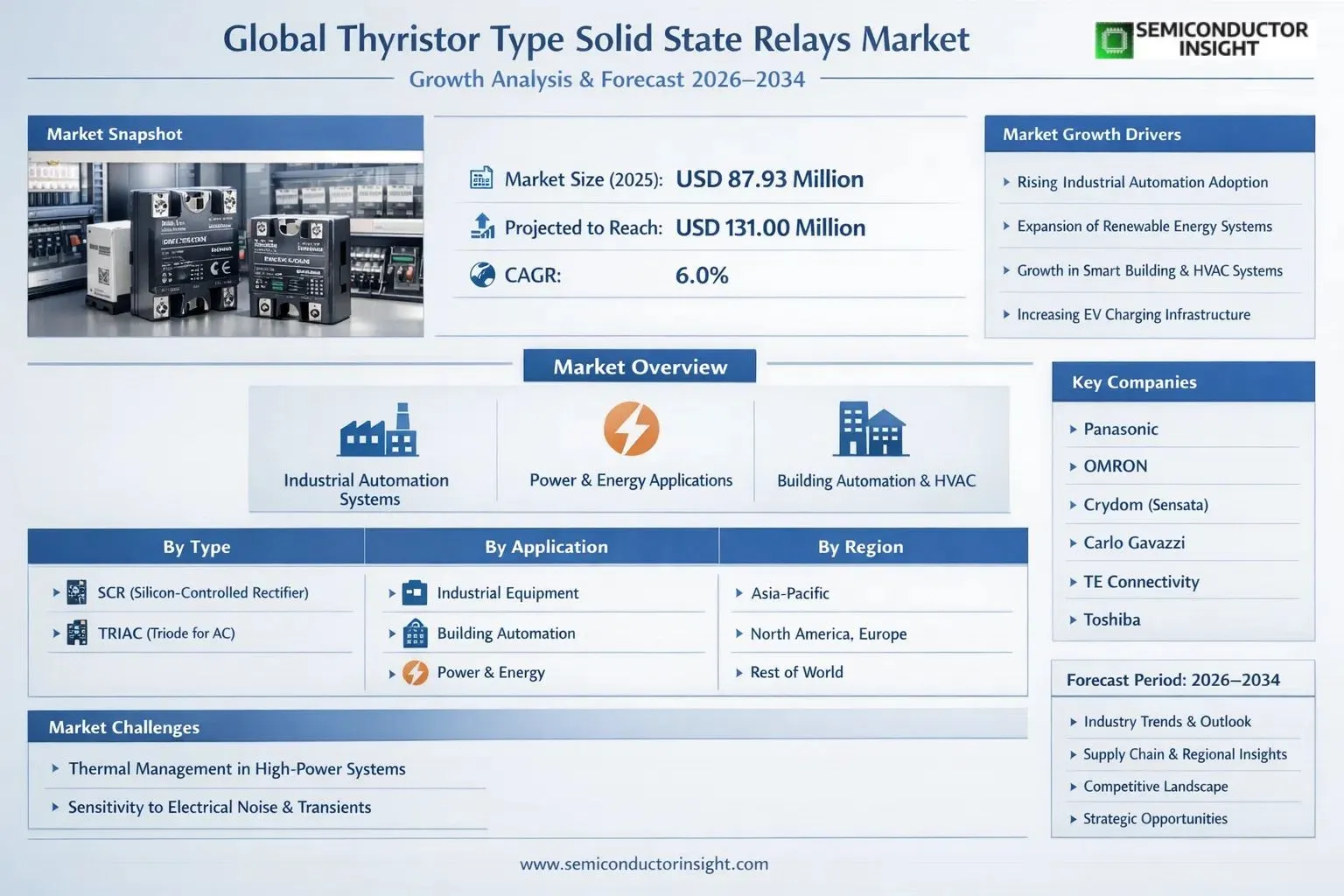
Global Thyristor Type Solid State Relays market size was valued at USD 87.93 million in 2025. The market is projected to grow from USD 93.19 million in 2026 to USD 131.00 million by 2034, exhibiting a CAGR of 6.0% during the forecast period.
A Thyristor-type Solid State Relay (SSR) is a semiconductor-based switching device that utilizes thyristors , specifically SCRs (Silicon-Controlled Rectifiers) and TRIACs (Triode for Alternating Current) , to control the switching of electrical loads without any moving mechanical parts. These relays are particularly well-suited for switching AC (alternating current) loads owing to the inherent characteristics of thyristors, which enable zero-crossing switching, reduced electromagnetic interference, and extended operational lifespan compared to conventional electromechanical relays.
The market is witnessing steady growth driven by expanding industrial automation, rising adoption of energy-efficient switching solutions, and the growing deployment of Thyristor Type SSRs across applications such as industrial equipment, building automation, home appliances, and power & energy sectors. Leading global manufacturers operating in this space include Panasonic, Crydom, OMRON, Carlo Gavazzi, Sharp, TE Connectivity, Groupe Celduc, IXYS, Toshiba, and Fujitsu Limited, among others, collectively holding a significant share of global market revenue.
MARKET DRIVERS
Rising Demand for Industrial Automation and Power Control Systems
Thyristor Type Solid State Relays Market is experiencing significant momentum driven by the accelerating adoption of industrial automation across manufacturing, energy, and process industries. Unlike electromechanical relays, thyristor-based solid state relays offer silent operation, faster switching speeds, and longer operational lifespans, making them increasingly preferred in high-frequency switching and precision power control applications. As industries transition toward smart manufacturing and Industry 4.0 frameworks, the demand for reliable and efficient switching components such as thyristor type SSRs continues to grow steadily.
Expansion of Renewable Energy Infrastructure
Globalpush toward renewable energy generation has emerged as a pivotal driver for Thyristor Type Solid State Relays Market. Solar inverters, wind turbine control systems, and battery energy storage solutions rely heavily on robust and thermally stable switching components. Thyristor-based SSRs, known for their ability to handle high surge currents and deliver consistent performance under variable load conditions, are increasingly integrated into renewable energy control panels and grid-tie systems. This trend is particularly prominent across Asia-Pacific and European markets where renewable capacity additions have been substantial in recent years.
➤ Thyristor Type Solid State Relays are increasingly specified in renewable energy and EV charging infrastructure projects due to their high surge current tolerance and extended mean time between failures (MTBF) compared to mechanical switching alternatives.
Additionally, the proliferation of electric vehicle (EV) charging infrastructure globally is creating fresh demand vectors for thyristor type solid state relays. Charging stations require precise power management and switching solutions that can endure continuous duty cycles, an operational profile where thyristor SSRs demonstrate clear advantages. Combined with growing investments in smart grid modernization, these infrastructure trends collectively reinforce the upward trajectory of Thyristor Type Solid State Relays Market.
MARKET CHALLENGES
Thermal Management Complexities in High-Power Applications
One of the most pressing challenges confronting Thyristor Type Solid State Relays Market is the inherent heat dissipation limitation associated with thyristor-based switching devices. Unlike mechanical relays that generate minimal heat during steady-state conduction, thyristor SSRs exhibit a forward voltage drop that results in continuous power loss proportional to load current. In high-power industrial environments, this necessitates the use of external heat sinks, forced-air cooling systems, or thermal interface materials, which add to system complexity, cost, and overall footprint. Managing these thermal challenges without compromising device reliability remains a critical engineering concern for manufacturers and end-users alike.
Other Challenges
Sensitivity to Voltage Transients and Electrical Noise
Thyristor type solid state relays are inherently susceptible to false triggering caused by voltage transients, electromagnetic interference (EMI), and rapid dV/dt events on AC power lines. In industrial environments with variable frequency drives (VFDs), large motor loads, or switching power supplies operating in proximity, maintaining reliable and noise-immune operation requires additional snubber circuits and EMI filtering components. This sensitivity increases design complexity and can elevate the overall bill of materials for system integrators deploying thyristor SSRs in electrically noisy environments.
Competition from Alternative Solid State Technologies
Thyristor Type Solid State Relays Market faces growing competitive pressure from MOSFET-based and IGBT-based solid state relay alternatives, particularly in low-to-medium power DC switching applications. These alternative technologies offer lower on-state resistance, reduced conduction losses, and enhanced suitability for DC load switching, areas where thyristor SSRs have traditional limitations. As power electronics technology continues to mature, manufacturers of thyristor type SSRs must continuously innovate to defend their application-specific advantages, particularly in AC switching and high-surge-current scenarios.
MARKET RESTRAINTS
Limited Suitability for DC Load Switching Applications
A fundamental technical restraint impacting Thyristor Type Solid State Relays Market is the inherent inability of thyristors to interrupt DC current without specialized commutation circuits. Since thyristors rely on natural zero-crossing of AC waveforms to turn off, their application in direct current switching environments is significantly restricted. As industrial automation increasingly incorporates DC-powered subsystems, including servo drives, DC bus architectures, and battery-backed systems, the structural limitation of thyristor SSRs in these contexts constrains their total addressable market relative to competing relay technologies. This restraint is particularly notable in data center power distribution and telecommunications power systems where DC architectures are standard.
Higher Initial Cost Compared to Electromechanical Relay Alternatives
Despite offering superior reliability and longer service life, thyristor type solid state relays carry a higher upfront procurement cost compared to conventional electromechanical relays of equivalent current ratings. In price-sensitive markets and applications where switching frequency is low and long service life is not a primary requirement, procurement decision-makers often default to lower-cost mechanical alternatives. This cost differential represents a persistent market restraint, particularly in emerging economies and small-to-medium enterprise segments where capital expenditure optimization takes precedence over total cost of ownership considerations. Manufacturers operating in Thyristor Type Solid State Relays Market must articulate lifecycle value propositions more effectively to overcome this procurement barrier.
MARKET OPPORTUNITIES
Integration with Smart Manufacturing and IIoT-Enabled Control Systems
The accelerating convergence of Industrial Internet of Things (IIoT) platforms with factory automation systems presents a substantial growth opportunity for Thyristor Type Solid State Relays Market. As plant operators deploy networked sensor and control architectures, there is increasing demand for intelligent switching components capable of remote monitoring, diagnostics, and predictive maintenance integration. Manufacturers who develop thyristor SSR variants with embedded thermal monitoring, load current sensing, and communication interfaces aligned with industrial protocols such as IO-Link or Modbus are well-positioned to capture value in this evolving segment. Smart solid state relay platforms represent a meaningful product differentiation lever in an otherwise commoditizing market landscape.
Growing Adoption Across HVAC, Medical Equipment, and Food Processing Sectors
Beyond traditional heavy industry, Thyristor Type Solid State Relays Market is finding expanding application opportunities across sectors characterized by stringent hygiene, reliability, and operational continuity requirements. In HVAC systems, thyristor SSRs enable precise heater control and energy-efficient temperature regulation without the contact wear associated with mechanical alternatives. In medical equipment manufacturing and pharmaceutical processing, the zero-noise switching and absence of arcing offered by thyristor SSRs align well with regulatory and operational standards. Similarly, food and beverage processing facilities benefit from the sealed, contaminant-resistant construction available in many thyristor SSR product lines, broadening the addressable market beyond conventional industrial automation end-users and supporting sustained demand growth in Thyristor Type Solid State Relays Market through the forecast period.
Trends
Rising Demand from Industrial Automation Drives Thyristor Type Solid State Relays Market Growth
Thyristor Type Solid State Relays Market is witnessing sustained momentum driven by the accelerating pace of industrial automation across manufacturing sectors worldwide. Thyristor-based SSRs, which utilize Silicon-Controlled Rectifiers (SCRs) and TRIACs to manage AC load switching, are increasingly preferred over electromechanical relays due to their superior switching speed, longer operational lifespan, and reduced electromagnetic interference. As factories modernize their control systems and adopt programmable logic controllers (PLCs) and distributed control systems (DCS), the integration of thyristor-type SSRs into industrial equipment has become a standard engineering practice. This trend is especially prominent in automotive manufacturing, food processing, and chemical production facilities, where precise and reliable load control is operationally critical.
Other Trends
Expanding Role in Building Automation and Power Infrastructure
Building automation represents one of the fastest-evolving application areas for Thyristor Type Solid State Relays Market. Smart buildings increasingly rely on thyristor-based SSRs for HVAC control, lighting management, and energy monitoring systems. The growing global focus on energy efficiency and green building certifications is prompting building managers and contractors to replace conventional switching components with solid state alternatives that offer better thermal performance and lower maintenance requirements. Similarly, in the power and energy sector, thyristor-type SSRs are finding broader adoption in renewable energy installations, including solar inverters and wind turbine control panels, where reliable AC switching under variable load conditions is essential.
Asia-Pacific Emerges as a Dominant Regional Market
The Asia-Pacific region, led by China, Japan, South Korea, and rapidly industrializing Southeast Asian economies, continues to account for a substantial portion of global demand in Thyristor Type Solid State Relays Market. China’s robust electronics manufacturing base and government-backed industrial modernization programs are fueling procurement of thyristor-type SSRs across multiple verticals. India is also registering increased adoption as its manufacturing sector expands under national industrial policy initiatives. Key regional manufacturers and global players such as Panasonic, OMRON, Toshiba, Fujitsu Limited, and Hongfa Technology maintain significant production and distribution footprints across Asia-Pacific, reinforcing supply chain competitiveness in the region.
TRIAC and SCR Segment Dynamics Shape Product Innovation
Within Thyristor Type Solid State Relays Market, the product landscape is defined primarily by two segments , SCR-based and TRIAC-based relays. SCR-type SSRs are widely used in high-power, unidirectional AC applications, while TRIAC-based variants are preferred for bidirectional switching in home appliances and light industrial equipment. Leading manufacturers including Crydom, Carlo Gavazzi, TE Connectivity, IXYS, and Schneider are actively investing in product miniaturization, improved heat dissipation designs, and enhanced surge current tolerance to meet evolving application requirements. The competitive landscape is also seeing contributions from emerging players such as Xiamen Jinxinrong Electronics and Zhejiang Chint Electrics, which are expanding their product portfolios to capture share in both domestic and international markets.
COMPETITIVE LANDSCAPE
Key Industry Players
Thyristor Type Solid State Relays Market – Competitive Dynamics, Strategic Positioning, and Leading Manufacturer Profiles
GlobalThyristor Type Solid State Relays (SSR) market exhibits a moderately consolidated competitive structure, with a handful of established multinational corporations commanding significant revenue shares alongside a growing cohort of regional and specialized manufacturers. Leading the competitive landscape are companies such as Panasonic, OMRON, Crydom (a Sensata Technologies brand), and Schneider Electric, which leverage decades of power electronics expertise, robust distribution networks, and diversified product portfolios spanning both SCR (Silicon-Controlled Rectifier) and TRIAC-based relay configurations. These dominant players continue to invest heavily in research and development to enhance switching precision, thermal management, and integration compatibility for industrial automation, building management systems, and energy infrastructure applications. The market, valued at approximately USD 87.93 million in 2025 and projected to reach USD 131 million by 2034 at a CAGR of 6.0%, reflects intensifying competition driven by rising demand across industrial equipment, power and energy, and home appliance sectors globally.
Beyond the top-tier incumbents, a number of technologically focused and regionally influential players are carving out notable niches within the Thyristor Type SSR market. Companies such as Carlo Gavazzi, TE Connectivity, Groupe Celduc, IXYS (now part of Littelfuse), Toshiba, and Vishay maintain strong footholds through application-specific product innovation and strategic OEM partnerships. Meanwhile, Asia-Pacific manufacturers , including Hongfa Technology, Xiamen Jinxinrong Electronics, JiangSu GlOD Electrical Control Technology, Wuxi Tianhao Electronics, and Zhejiang Chint Electrics , are rapidly expanding their global footprint by offering cost-competitive solutions tailored to high-volume industrial and automation markets. The competitive intensity is further amplified by players such as Rockwell Automation, Siemens, Broadcom, and OPTO22, who integrate thyristor-based SSR technology within broader automation and control ecosystems, thereby reinforcing value-chain stickiness and long-term customer relationships.
List of Key Thyristor Type Solid State Relays Companies Profiled
- Panasonic
- Crydom (Sensata Technologies)
- OMRON
- Carlo Gavazzi
- Sharp
- TE Connectivity
- Groupe Celduc
- IXYS (Littelfuse)
- Toshiba
- Fujitsu Limited
- Schneider Electric
- Siemens
- Hongfa Technology
- Rockwell Automation
- OPTO22
- Vishay
- Broadcom
- Xiamen Jinxinrong Electronics
- JiangSu GlOD Electrical Control Technology
- Zhejiang Chint Electrics
- Wuxi Tianhao Electronics
- Shaanxi Qunli
- Wuxi Solid
- COSMO
- Clion Electric
- Bright Toward
- Suzhou Integrated Technology
Segment Analysis:
| Segment Category | Sub-Segments | Key Insights |
| By Type |
|
SCR (Silicon-Controlled Rectifier) holds a dominant position in the Thyristor Type SSR market and continues to lead due to several compelling technical and commercial advantages:
TRIAC relays, while serving a complementary role, are gaining increasing traction in applications requiring bidirectional AC load switching, particularly in consumer-facing and building automation markets where compact form factors are prioritized. |
| By Application |
|
Industrial Equipment represents the most significant application segment for Thyristor Type Solid State Relays, driven by broad adoption across manufacturing, automation, and process control environments:
Power & Energy is emerging as a high-potential application area, fueled by expanding renewable energy infrastructure and smart grid modernization initiatives globally. Building Automation also demonstrates steady growth, supported by increasing deployment of intelligent HVAC, lighting control, and energy management systems in commercial real estate. |
| By End User |
|
Manufacturing & Process Industries stand out as the leading end-user segment, reflecting the deep integration of Thyristor Type SSRs into the operational fabric of modern industrial facilities:
Utilities & Energy Companies represent a rapidly growing end-user category, particularly as grid operators seek reliable, high-endurance switching components for renewable integration and smart metering infrastructure. |
| By Mounting Type |
|
Panel Mount thyristor SSRs dominate this segmentation owing to their widespread use in control cabinets and electrical enclosures across industrial installations:
DIN Rail Mount variants are gaining increasing adoption in building automation and modular control panel designs, where space optimization and standardized installation practices are critical priorities for system integrators. |
| By Load Voltage Rating |
|
Medium Voltage (241V – 480V AC) thyristor SSRs represent the leading sub-segment by load voltage rating, as this range aligns closely with the operating requirements of the majority of industrial three-phase power systems and commercial building infrastructure:
High Voltage variants are witnessing growing interest in power generation and grid-scale energy applications, where the transition from mechanical switchgear to solid state alternatives is gradually accelerating driven by reliability and lifecycle cost considerations. |
Regional Analysis: Thyristor Type Solid State Relays Market
Asia-Pacific
China’s commanding presence in Thyristor Type Solid State Relays Market stems from its vast network of smart factories and industrial automation initiatives. The “Made in China 2025” policy framework continues to catalyze demand for advanced switching components, positioning Chinese manufacturers and end-users as dominant forces shaping regional market direction and product innovation standards.
Japan and South Korea represent the technological frontier of thyristor relay application within Asia-Pacific. These markets prioritize precision, reliability, and miniaturization, driving demand from semiconductor fabrication, robotics, and advanced electronics sectors. Strong collaboration between relay manufacturers and end-user industries accelerates product refinement and the deployment of next-generation solid state switching solutions.
India’s thyristor type solid state relays market is experiencing a notable upswing, supported by expanding industrial infrastructure, smart city projects, and energy sector modernization. The government’s push toward domestic manufacturing under “Make in India” is stimulating local production of power electronics components, while rising industrial automation adoption among SMEs broadens the addressable market considerably.
Southeast Asian economies including Vietnam, Thailand, and Indonesia are increasingly integrating thyristor type solid state relays into their evolving manufacturing sectors. As multinational corporations relocate production facilities to the region seeking cost advantages, demand for reliable industrial switching components grows steadily, establishing Southeast Asia as an important high-potential submarket within the Asia-Pacific landscape.
North America
North America represents a mature yet consistently evolving market for thyristor type solid state relays, underpinned by a robust industrial automation sector and strong demand from the energy, defense, and process manufacturing industries. The United States leads regional consumption, with thyristor-based relay solutions finding extensive application in power management systems, HVAC controls, and critical infrastructure. The region’s emphasis on energy efficiency and grid modernization has prompted utilities and industrial operators to replace conventional electromechanical relays with solid state alternatives that offer superior switching speed and durability. Canada contributes meaningfully through its mining, oil and gas, and utilities sectors, where reliable power switching is non-negotiable. Technological innovation from North American semiconductor firms continues to enhance thyristor relay performance characteristics, while the reshoring of manufacturing activities post-pandemic is generating additional demand. Regulatory compliance requirements related to energy consumption and operational safety further incentivize investment in advanced thyristor type solid state relay technologies across the forecast period.
Europe
Europe occupies a significant position in Thyristor Type Solid State Relays Market, characterized by stringent industrial safety standards, a mature automation ecosystem, and a strong commitment to energy transition goals. Germany, France, Italy, and the United Kingdom collectively drive the majority of regional demand, particularly from automotive manufacturing, renewable energy installations, and process industries. The European Union’s regulatory landscape, emphasizing reduced energy consumption and improved industrial efficiency, creates a favorable environment for solid state relay adoption over traditional switching technologies. Germany’s renowned engineering and machinery sector consistently integrates thyristor type solid state relays into precision manufacturing equipment, while Scandinavia’s growing renewable energy infrastructure amplifies demand from power conversion and grid control applications. Eastern European nations are increasingly joining the growth narrative as industrial modernization investments accelerate, making Europe a stable and strategically important region within Globalthyristor type solid state relays market through 2034.
South America
South America presents a gradually expanding market opportunity for thyristor type solid state relays, with Brazil and Argentina serving as the primary demand centers. The region’s industrial landscape, encompassing agribusiness processing, mining operations, petrochemicals, and utilities, provides a foundational base for solid state relay adoption where reliable and low-maintenance switching solutions are highly valued. Brazil’s ongoing efforts to modernize its electrical grid and expand industrial automation capabilities are contributing positively to market development. Economic volatility across parts of the region has historically tempered growth rates; however, increasing foreign direct investment in manufacturing and infrastructure sectors is expected to progressively elevate demand for thyristor type solid state relays. As industrial operators recognize the long-term operational cost advantages associated with solid state switching over electromechanical alternatives, adoption rates are anticipated to strengthen throughout the 2026–2034 forecast period.
Middle East & Africa
The Middle East and Africa region represents an emerging frontier for Thyristor Type Solid State Relays Market, with demand primarily concentrated in the Gulf Cooperation Council countries and select African industrializing economies. The Middle East’s ambitious economic diversification programs, exemplified by Saudi Arabia’s Vision 2030 and the UAE’s industrial development agenda, are driving significant investment in manufacturing, utilities, and smart infrastructure , all of which create measurable demand for advanced power switching components. Oil and gas facilities across the region also rely on thyristor type solid state relays for critical process control applications. In Africa, South Africa and Nigeria are leading adoption, supported by mining sector modernization and expanding electricity infrastructure. While the region currently accounts for a modest share of global market volume, its growth trajectory is expected to steepen as industrial maturity deepens and infrastructure investment intensifies across the forecast horizon.
Report Scope
This market research report provides a comprehensive analysis of Thyristor Type Solid State Relays Market, covering the forecast period 2026–2034. It offers detailed insights into market dynamics, technological advancements, competitive landscape, and key trends shaping the industry.
Key focus areas of the report include:
- Market Overview: The report begins with an overview outlining its current market scenario, key growth indicators, and industry transformation drivers. It discusses macroeconomic factors, demand–supply balance, regulatory landscape, and the strategic role of semiconductors in powering advancements across industries such as automotive, telecommunications, consumer electronics, and industrial automation.
- Market Size & Forecast: Historical data and future projections for revenue, unit shipments, and market value across major regions and segments.
- Segmentation Analysis: Detailed breakdown by product type, technology, application, and end-user industry to identify high-growth segments and investment opportunities.
- Regional Insights: Insights into market performance across North America, Europe, Asia-Pacific, Latin America, and the Middle East & Africa, including country-level analysis where relevant.
- Competitive Landscape: Profiles of leading market participants, including their product offerings, R&D focus, manufacturing capacity, pricing strategies, and recent developments such as mergers, acquisitions, and partnerships.
- Technology Trends & Innovation: Assessment of emerging technologies, integration of AI/IoT, semiconductor design trends, fabrication techniques, and evolving industry standards.
- Market Drivers & Restraints: Evaluation of factors driving market growth along with challenges, supply chain constraints, regulatory issues, and market-entry barriers.
- Stakeholder Insights: Insights for component suppliers, OEMs, system integrators, investors, and policymakers regarding the evolving ecosystem and strategic opportunities.
Primary and secondary research methods are employed, including interviews with industry experts, data from verified sources, and real-time market intelligence to ensure the accuracy and reliability of the insights presented.
FREQUENTLY ASKED QUESTIONS:
What is the current market size of Thyristor Type Solid State Relays Market?
-> Thyristor Type Solid State Relays Market was valued at USD 87.93 million in 2025 and is expected to reach USD 131 million by 2034, growing at a CAGR of 6.0% during the forecast period.
Which key companies operate in Thyristor Type Solid State Relays Market?
-> Key players include Panasonic, Crydom, OMRON, Carlo Gavazzi, Sharp, TE Connectivity, Groupe Celduc, IXYS, Toshiba, Fujitsu Limited, Schneider, Siemens, Hongfa Technology, Rockwell Automation, and OPTO22, among others.
What are the key growth drivers?
-> Key growth drivers include rising demand for industrial automation, growth in building automation systems, increasing adoption in power & energy applications, and expanding use in home appliances and industrial equipment. The superior switching characteristics of thyristors such as SCRs and TRIACs for AC load control further accelerate market adoption.
Which region dominates the market?
-> Asia is a significant and fast-growing region in Thyristor Type Solid State Relays Market, with China, Japan, South Korea, and Southeast Asia being key contributors. North America and Europe also hold substantial market shares, supported by strong industrial automation and power & energy infrastructure.
What are the emerging trends?
-> Emerging trends include integration of solid state relay technologies into smart building automation, growth in power & energy management applications, increasing use of TRIAC and SCR-based relays in industrial equipment, and rising adoption of thyristor-based switching solutions in home appliances and green energy systems.

Get Sample Report PDF for Exclusive Insights
Report Sample Includes
- Table of Contents
- List of Tables & Figures
- Charts, Research Methodology, and more...
 Download Sample Report PDF