Key Statistics
Key Takeaways
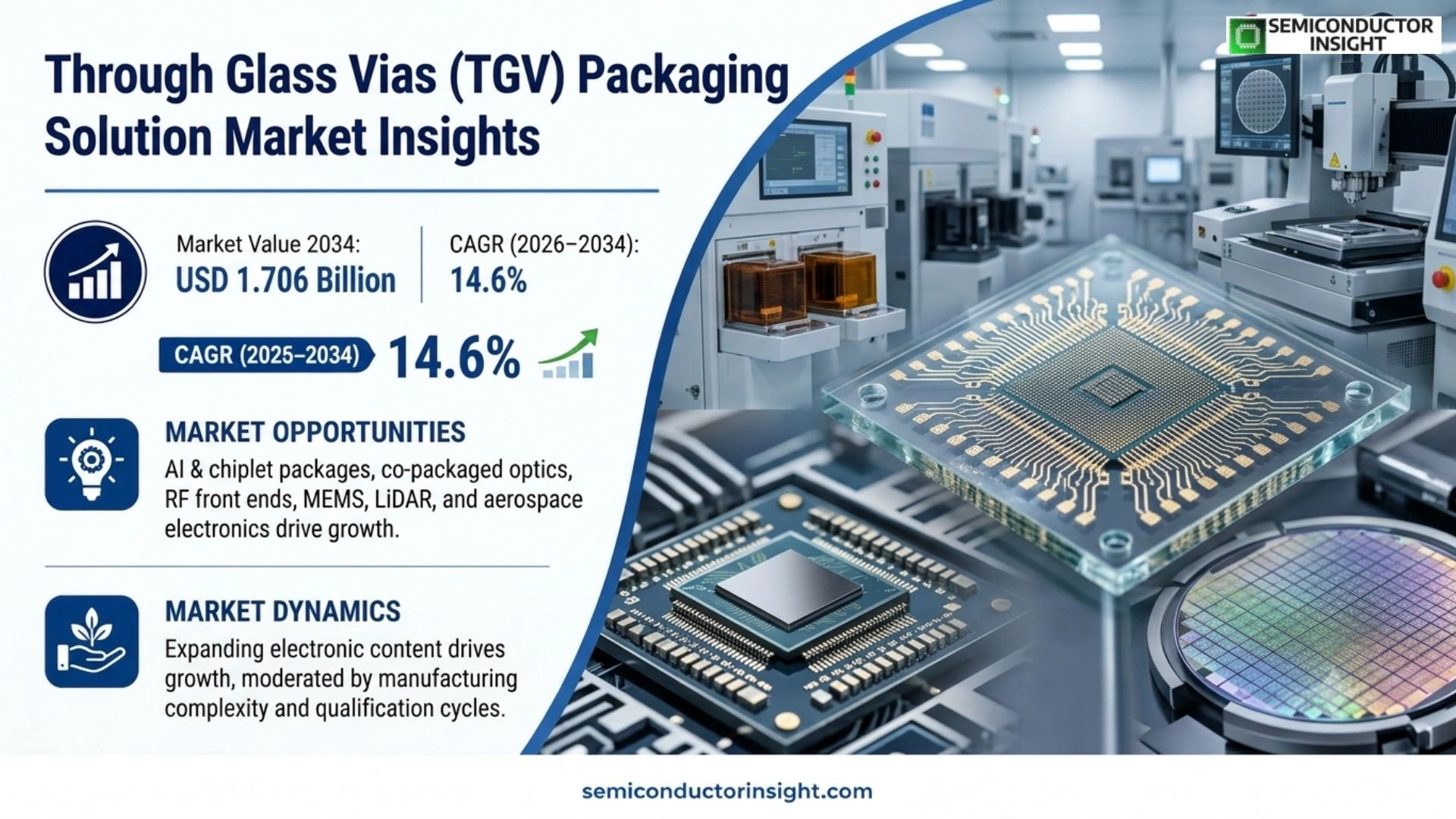
- The Through Glass Vias (TGV) Packaging Solution Market was valued at USD 493.9 million in the 2025 base year and is projected to reach USD 1.706 billion by 2034, expanding at a 14.6% CAGR during 2026–2034.
- 150 mm Wafer is a leading product grouping because customers value qualified performance, integration readiness, and lifecycle support.
- Semiconductor Glass Interposer is a major demand centre, while adjacent uses broaden the addressable opportunity.
- Asia Pacific leads the regional market through concentrated manufacturing, customers, and technology investment.
- Reliability, qualification, process control, and total ownership economics shape competition.
Through Glass Vias (TGV) Packaging Solution Market Overview
Through Glass Vias (TGV) Packaging Solution Market was valued at USD 493.9 million in 2025 and is projected to reach USD 1.706 billion by 2034, growing at a CAGR of 14.6% during 2026–2034. Asia Pacific held the largest regional position in 2025, supported by concentrated manufacturing, downstream electronics production and established component supply networks.
Through-glass vias create vertical electrical paths through glass substrates or interposers. Glass offers electrical insulation, low dielectric loss, high dimensional stability, optical transparency, and hermetic-packaging potential. TGV value depends on via diameter, aspect ratio, drilling method, metallization, wafer size, panel handling, thermal cycling, and compatibility with the downstream package. The analysis also considers qualification requirements, supplier capability, regional purchasing conditions, technology substitution, operating economics, implementation risk, customer procurement cycles, lifecycle support, regulatory context, and evidence required for sustained commercial adoption through the forecast period.
The 2026 estimated year reflects advanced semiconductor packaging, high-speed RF, photonics, MEMS, sensors, and heterogeneous integration. Glass interposers and 3D integrated passive devices are being evaluated where silicon interposers, organic substrates, or wire bonds cannot simultaneously meet density, loss, flatness, and thermal requirements. The analysis also considers qualification requirements, supplier capability, regional purchasing conditions, technology substitution, operating economics, implementation risk, customer procurement cycles, lifecycle support, regulatory context, and evidence required for sustained commercial adoption through the forecast period.
Competition spans glass makers, laser-drilling specialists, packaging companies, and interconnect suppliers. Customers evaluate via yield, metallization reliability, panel or wafer throughput, electrical performance, warpage, cost, and the supplier’s ability to co-develop a qualified package flow. The analysis also considers qualification requirements, supplier capability, regional purchasing conditions, technology substitution, operating economics, implementation risk, customer procurement cycles, lifecycle support, regulatory context, and evidence required for sustained commercial adoption through the forecast period.
Segment Analysis: By Type
By type, the Through Glass Vias (TGV) market is segmented into 150 mm Wafer · 200 mm Wafer · 300 mm Wafer · Other Wafer Formats. Each category represents a different degree of integration, qualification burden and value capture, so suppliers compete through a combination of material performance, design support, manufacturing consistency, package architecture and application-specific testing rather than through unit price alone.
| Type | Market relevance |
|---|---|
| 150 mm Wafer | Supports established MEMS and specialty-package flows with lower entry cost and mature handling infrastructure. |
| 200 mm Wafer | Balances higher throughput with established semiconductor equipment and packaging compatibility. |
| 300 mm Wafer | Targets high-volume advanced packaging where larger substrates can reduce unit cost after yield is qualified. |
| Other Wafer Formats | Serves specialty devices, panels, and customer-specific package geometries requiring tailored process control. |
Segment Analysis: By Application
By application, the market covers Semiconductor Glass Interposer · 3D Glass IPD · MEMS and Sensor Devices · Other Applications. Demand varies by production volume and qualification intensity: consumer programmes reward scale and miniaturisation, while automotive, industrial, aerospace, medical or security designs place greater weight on reliability evidence, long product availability and system-level performance under demanding operating conditions.
| Application | Market relevance |
|---|---|
| Semiconductor Glass Interposer | AI, high-performance computing, RF, and chiplet packages use glass interposers to obtain low dielectric loss, dimensional stability, and dense vertical interconnection. |
| 3D Glass IPD | Integrated passive devices use patterned glass to combine filters, capacitors, inductors, and routing in compact RF and mixed-signal modules. |
| MEMS and Sensor Devices | MEMS, pressure, inertial, biomedical, and optical sensors use TGVs for wafer-level routing, hermetic packaging, optical access, and miniaturization. |
| Other Applications | Photonics, LiDAR, medical implants, aerospace electronics, and specialty RF packages create demand where transparency, chemical stability, sealing, or low loss is valuable. |
Regional Analysis
Asia Pacific is the largest regional market for Through Glass Vias (TGV) products, combining an established component-production ecosystem with major downstream customers. North America and Europe are strategically important for premium, automotive, aerospace, industrial and specialised applications, while South America and Middle East & Africa are primarily import- and project-led markets where distributor reach, local support and supply continuity shape vendor selection.
How does regional demand differ across this market?
For Through Glass Vias (TGV), Asia Pacific holds the largest position, supported by an established customer base, supplier presence, and mature purchasing channels. Europe contributes regulation, industrial demand, and technical expertise, while Asia Pacific combines electronics manufacturing, large device populations, and expanding engineering capability. South America and the Middle East and Africa develop through targeted infrastructure, enterprise, research, consumer, or public-sector programs rather than uniform adoption.
| Region | Position |
|---|---|
| North America | Demand is supported by advanced-packaging R&D, defense electronics, photonics, and government-backed semiconductor capacity. |
| Europe | Automotive, medical, industrial, and photonics programs support specialized TGV adoption and process development. |
| Asia Pacific | Largest and most established demand base |
| South America | Early demand is concentrated in imported specialty packages, research programs, and aerospace or medical electronics. |
| Middle East & Africa | Emerging use is tied to specialized sensing, communications, and imported advanced-electronics programs. |
Key Through Glass Vias (TGV) Manufacturers and Competitive Landscape
The Through Glass Vias (TGV) competitive landscape includes global technology leaders, diversified semiconductor or component groups, RF and imaging specialists, and regional manufacturers. The report profiles every named company across product positioning, manufacturing footprint, application exposure, recent development activity and strategic strengths; the complete coverage list is reproduced below so the intended company universe is explicit.
The competitive landscape covers Corning Incorporated, LPKF Laser & Electronics, Samtec, Kiso Micro, Tecnisco, Microplex, Plan Optik, NSG Group, Allvia, AGC, SCHOTT, and Vitrion. Profiles assess glass materials, via formation, metallization, packaging integration, application exposure, capacity, partnerships, and recent developments. The analysis also considers qualification requirements, supplier capability, regional purchasing conditions, technology substitution, operating economics, implementation risk, customer procurement cycles, lifecycle support, regulatory context, and evidence required for sustained commercial adoption through the forecast period.
Suppliers compete on glass purity, coefficient of thermal expansion, via density, drilling speed, metallization yield, surface finish, wafer or panel size, process integration, reliability data, and cost. Foundries and OSATs value process control and co-design because TGV performance depends on the complete interposer and package stack. The analysis also considers qualification requirements, supplier capability, regional purchasing conditions, technology substitution, operating economics, implementation risk, customer procurement cycles, lifecycle support, regulatory context, and evidence required for sustained commercial adoption through the forecast period.
Key companies profiled
- Corning Incorporated
- LPKF Laser & Electronics
- Samtec
- Kiso Micro
- Tecnisco
- Microplex
- Plan Optik
- NSG Group
- Allvia
- AGC
- SCHOTT
- Vitrion
Through Glass Vias (TGV) Production Capacity Analysis
Production capacity is a material competitive factor in the Through Glass Vias (TGV) market because electrical performance depends on specialised processes, qualified materials, repeatable yields and application-specific test capability. Capacity cannot be assessed only by nominal factory floor area: effective supply is the output that passes dimensional, electrical, reliability and customer qualification requirements at the required product mix.
Capacity depends on specialty glass, wafer or panel cutting, laser or etch tools, via cleaning, seed deposition, copper filling, planarization, bonding, inspection, and reliability test equipment. Effective output is qualified TGV substrate capacity that meets dimensional, electrical, thermal, and package-yield requirements. The analysis also considers qualification requirements, supplier capability, regional purchasing conditions, technology substitution, operating economics, implementation risk, customer procurement cycles, lifecycle support, regulatory context, and evidence required for sustained commercial adoption through the forecast period.
Manufacturing requires control of via taper, cracks, debris, roughness, dielectric integrity, metal adhesion, voiding, and thermal-expansion stress. Standardized wafer formats improve throughput, while custom glass compositions and fine-pitch structures require longer process development and metrology cycles. The analysis also considers qualification requirements, supplier capability, regional purchasing conditions, technology substitution, operating economics, implementation risk, customer procurement cycles, lifecycle support, regulatory context, and evidence required for sustained commercial adoption through the forecast period.
Application engineering includes via layout, material selection, metallization design, thermal-cycle testing, RF characterization, optical alignment, and package assembly. Pilot-line capacity and repeatable process data are essential before high-volume customers commit. The analysis also considers qualification requirements, supplier capability, regional purchasing conditions, technology substitution, operating economics, implementation risk, customer procurement cycles, lifecycle support, regulatory context, and evidence required for sustained commercial adoption through the forecast period.
Through Glass Vias (TGV) Market Dynamics: Drivers, Restraints and Opportunities
Through Glass Vias (TGV) market growth reflects expanding electronic content and higher performance requirements, moderated by manufacturing complexity, long qualification cycles and competing technologies. The impact ranges below are directional analytical estimates rather than additive forecasts; they show the relative pressure each factor can place on the baseline CAGR when other assumptions remain broadly stable.
TGV demand follows chiplet packaging, glass interposers, high-frequency RF, MEMS, sensors, photonics, 5G, AI accelerators, and miniaturized medical or automotive electronics. Glass becomes attractive when electrical isolation, low loss, flatness, transparency, or hermetic sealing outweighs process complexity. The analysis also considers qualification requirements, supplier capability, regional purchasing conditions, technology substitution, operating economics, implementation risk, customer procurement cycles, lifecycle support, regulatory context, and evidence required for sustained commercial adoption through the forecast period.
Via-first, via-middle, via-last, and panel-level routes create different cost and integration tradeoffs. Customers balance via density and performance against drilling throughput, copper filling, yield, warpage, thermal mismatch, and compatibility with existing wafer-level packaging tools. The analysis also considers qualification requirements, supplier capability, regional purchasing conditions, technology substitution, operating economics, implementation risk, customer procurement cycles, lifecycle support, regulatory context, and evidence required for sustained commercial adoption through the forecast period.
MARKET DRIVERS
Drivers Impact Analysis*
| Driver | (~) % impact on CAGR forecast | Geographic relevance | Impact timeline |
|---|---|---|---|
| Advanced packaging and chiplet integration | +3.2% | Asia Pacific, North America, Europe | Long term (≥4 years) |
| High-frequency RF and 5G modules | +2.4% | Asia Pacific, North America | Medium term (2–4 years) |
| MEMS, sensors, and photonic integration | +2.0% | Japan, Europe, North America | Medium term (2–4 years) |
| 300 mm and panel-level scale-up | +1.5% | Taiwan, South Korea, China, United States | Long term (≥4 years) |
| Hermetic and high-reliability packaging | +1.0% | Aerospace, medical, automotive markets | Long term (≥4 years) |
| Government-backed advanced-packaging capacity | +0.8% | United States, Europe, East Asia | Medium term (2–4 years) |
Advanced packaging and chiplet integration is influencing demand, investment and adoption across the Asia Pacific, North America, Europe region over the long term (≥4 years). The analysis also considers qualification requirements, supplier capability, regional purchasing conditions, technology substitution, operating economics, implementation risk, customer procurement cycles, lifecycle support, regulatory context, and evidence required for sustained commercial adoption through the forecast period.
High-frequency RF and 5G modules is influencing demand, investment and adoption across the Asia Pacific, North America region over the medium term (2–4 years). The analysis also considers qualification requirements, supplier capability, regional purchasing conditions, technology substitution, operating economics, implementation risk, customer procurement cycles, lifecycle support, regulatory context, and evidence required for sustained commercial adoption through the forecast period.
MEMS, sensors, and photonic integration is influencing demand, investment and adoption across the Japan, Europe, North America region over the medium term (2–4 years). The analysis also considers qualification requirements, supplier capability, regional purchasing conditions, technology substitution, operating economics, implementation risk, customer procurement cycles, lifecycle support, regulatory context, and evidence required for sustained commercial adoption through the forecast period.
MARKET RESTRAINTS
Restraints Impact Analysis*
| Restraint | (~) % impact on CAGR forecast | Geographic relevance | Impact timeline |
|---|---|---|---|
| High process and equipment cost | −1.8% | Global packaging programs | Persistent |
| Via drilling and metallization yield variability | −1.4% | Pilot and high-density production | Persistent |
| Thermal-expansion and reliability qualification | −1.0% | Automotive, aerospace, medical | Long term (≥4 years) |
| Limited high-volume ecosystem | −0.8% | New TGV adopters | Medium term (2–4 years) |
| Specialty glass and equipment lead times | −0.6% | Cross-border supply chains | Medium term (2–4 years) |
High process and equipment cost can delay purchasing, reduce utilisation, or increase qualification and lifecycle cost for global packaging programs customers over the persistent. The analysis also considers qualification requirements, supplier capability, regional purchasing conditions, technology substitution, operating economics, implementation risk, customer procurement cycles, lifecycle support, regulatory context, and evidence required for sustained commercial adoption through the forecast period.
Via drilling and metallization yield variability can delay purchasing, reduce utilisation, or increase qualification and lifecycle cost for pilot and high-density production customers over the persistent. The analysis also considers qualification requirements, supplier capability, regional purchasing conditions, technology substitution, operating economics, implementation risk, customer procurement cycles, lifecycle support, regulatory context, and evidence required for sustained commercial adoption through the forecast period.
Thermal-expansion and reliability qualification can delay purchasing, reduce utilisation, or increase qualification and lifecycle cost for automotive, aerospace, medical customers over the long term (≥4 years). The analysis also considers qualification requirements, supplier capability, regional purchasing conditions, technology substitution, operating economics, implementation risk, customer procurement cycles, lifecycle support, regulatory context, and evidence required for sustained commercial adoption through the forecast period.
MARKET OPPORTUNITIES
AI and chiplet packages, co-packaged optics, RF front ends, MEMS, LiDAR, biomedical sensors, and high-reliability aerospace electronics create opportunities. Suppliers can combine glass, vias, metallization, redistribution, and package assembly into qualified modules. The analysis also considers qualification requirements, supplier capability, regional purchasing conditions, technology substitution, operating economics, implementation risk, customer procurement cycles, lifecycle support, regulatory context, and evidence required for sustained commercial adoption through the forecast period.
Panel-level TGV, fine-pitch metallization, low-loss RF substrates, and optical alignment can raise value per substrate. Open design rules and process-development kits help designers compare TGV with silicon interposers and organic substrates. The analysis also considers qualification requirements, supplier capability, regional purchasing conditions, technology substitution, operating economics, implementation risk, customer procurement cycles, lifecycle support, regulatory context, and evidence required for sustained commercial adoption through the forecast period.
Regional pilot lines, shared development programs, and partnerships among glass makers, laser-equipment firms, OSATs, foundries, and system companies can reduce adoption risk and accelerate transfer to volume production. The analysis also considers qualification requirements, supplier capability, regional purchasing conditions, technology substitution, operating economics, implementation risk, customer procurement cycles, lifecycle support, regulatory context, and evidence required for sustained commercial adoption through the forecast period.
Through Glass Vias (TGV) Supply Chain Analysis
The Through Glass Vias (TGV) supply chain links specialty materials and wafer or ceramic processing equipment to high-precision manufacturing, packaging, distribution and downstream system integration. Commercial resilience depends on qualified alternate materials, realistic yield assumptions, geographic redundancy and traceable process controls because a nominal second source is not interchangeable until the customer has validated electrical behaviour, reliability and package compatibility.
The supply chain includes specialty glass, carriers, laser and etch tools, cleaning chemicals, dielectric and seed layers, copper plating, bonding materials, inspection systems, and package assembly. TGV manufacturers integrate these inputs before delivery to foundries, OSATs, MEMS makers, RF companies, and photonics developers. The analysis also considers qualification requirements, supplier capability, regional purchasing conditions, technology substitution, operating economics, implementation risk, customer procurement cycles, lifecycle support, regulatory context, and evidence required for sustained commercial adoption through the forecast period.
Resilience depends on qualified glass compositions, drilling and plating capacity, metrology, cleanroom handling, and documented process changes. Altering glass thickness, via geometry, seed chemistry, plating recipe, or bonding can change electrical loss, strength, warpage, and thermal reliability. The analysis also considers qualification requirements, supplier capability, regional purchasing conditions, technology substitution, operating economics, implementation risk, customer procurement cycles, lifecycle support, regulatory context, and evidence required for sustained commercial adoption through the forecast period.
Recent Developments in the Through Glass Vias (TGV) Market
Developments tracked to September 2026 and linked to official company or industry sources.
- October 2025 Published
Onto Innovation published technical guidance on the inspection and process-control requirements created by glass substrates and through-glass vias in advanced packaging. Source - 2025 Published
Corning continued to present glass-substrate and through-glass-via capabilities for RF, interposer, and advanced-packaging applications. Source - 2025 Published
LPKF continued to provide laser micromachining and glass-processing technologies relevant to precision via formation and packaging development. Source - 2024 Published
Plan Optik continued its glass wafer and substrate portfolio for semiconductor, MEMS, and sensor applications requiring controlled flatness and material quality. Source - 2024 Published
AGC continued advanced glass materials and electronics-related technology activities supporting high-performance substrate development. Source
REPORT SCOPE & SEGMENTATION
| Attribute | Details |
|---|---|
| Study Period | 2021–2034 |
| Base Year | 2025 |
| Estimated Year | 2026 |
| Forecast Year | 2034 |
| Historical Period | 2021–2025 |
| Market Size 2025 | USD 493.9 million |
| Market Size 2034 | USD 1.706 billion |
| Growth Rate | CAGR of 14.6% from 2026–2034 |
| Unit | Value in USD billion and shipment or production volume where disclosed |
| Segmentation | By Type, By Application, additional technology axis and By Region |
| By Type | 150 mm Wafer · 200 mm Wafer · 300 mm Wafer · Other Wafer Formats |
| By Application | Semiconductor Glass Interposer · 3D Glass IPD · MEMS and Sensor Devices · Other Applications |
| By Via Architecture | Via-first · Via-middle · Via-last · Panel-level TGV |
| By Region | Each region analysed by type, application and countryNorth AmericaU.S., Canada, MexicoEuropeGermany, France, U.K., Italy, Nordic Countries, BeneluxAsia PacificChina, Japan, South Korea, India, Southeast AsiaSouth AmericaBrazil, Argentina, Rest of South AmericaMiddle East & AfricaTurkey, Israel, Saudi Arabia, UAE, Rest of MEA |
| Key Companies Profiled | Corning Incorporated; LPKF Laser & Electronics; Samtec; Kiso Micro; Tecnisco; Microplex; Plan Optik; NSG Group; Allvia; AGC; SCHOTT; Vitrion |
| Customization Scope | Free report customization equivalent to up to four analyst working days with purchase, including additions or alterations to country, regional and segment coverage. |
Frequently Asked Questions
What is a through-glass via?
The Through Glass Vias (TGV) Packaging Solution Market is valued at USD 493.9 million in the 2025 base year and is projected to reach USD 1.706 billion by 2034, expanding at a CAGR of 14.6% during 2026–2034. Advanced packaging, RF, MEMS, photonics, and chiplet integration support demand.
What is the market outlook through 2034?
Demand should expand through 2034 as chiplet packaging, glass interposers, high-frequency RF, photonics, MEMS, sensors, and hermetic packages move from pilot programs toward qualified production. Via yield, metallization, thermal reliability, panel or wafer throughput, and compatibility with downstream assembly will determine adoption. The analysis also considers qualification requirements, supplier capability, regional purchasing conditions, technology substitution, operating economics, implementation risk, customer procurement cycles, lifecycle support, regulatory context, and evidence required for sustained commercial adoption through the forecast period.
Which wafer format leads?
150 mm wafers are the current volume anchor in the source scope because they fit established MEMS and specialty-packaging flows. 200 mm and 300 mm formats gain importance as customers pursue larger-area throughput, lower unit cost, and integration with mainstream semiconductor manufacturing. The analysis also considers qualification requirements, supplier capability, regional purchasing conditions, technology substitution, operating economics, implementation risk, customer procurement cycles, lifecycle support, regulatory context, and evidence required for sustained commercial adoption through the forecast period.
Which applications create demand?
Semiconductor glass interposers, 3D integrated passive devices, MEMS, sensors, RF modules, photonics, and other advanced packages use TGVs. Selection depends on via density, signal loss, transparency, sealing, thermal cycling, warpage, and downstream assembly compatibility. The analysis also considers qualification requirements, supplier capability, regional purchasing conditions, technology substitution, operating economics, implementation risk, customer procurement cycles, lifecycle support, regulatory context, and evidence required for sustained commercial adoption through the forecast period.
Why does Asia Pacific lead?
Asia Pacific combines semiconductor fabs, OSATs, MEMS production, electronics manufacturing, specialty glass suppliers, and government-backed advanced-packaging programs. Japan, Taiwan, South Korea, and China provide concentrated customers and process expertise, while North America and Europe contribute equipment, glass, research, and high-reliability applications. The analysis also considers qualification requirements, supplier capability, regional purchasing conditions, technology substitution, operating economics, implementation risk, customer procurement cycles, lifecycle support, regulatory context, and evidence required for sustained commercial adoption through the forecast period.
What drives growth?
Chiplets, 3D integration, 5G and RF, photonics, MEMS, sensors, AI packaging, fine-pitch interconnects, and hermetic packages drive growth. TGVs gain value where low loss, electrical isolation, flatness, transparency, or sealing improve system performance. The analysis also considers qualification requirements, supplier capability, regional purchasing conditions, technology substitution, operating economics, implementation risk, customer procurement cycles, lifecycle support, regulatory context, and evidence required for sustained commercial adoption through the forecast period.
What limits adoption?
High equipment cost, drilling and metallization yield, thermal mismatch, limited ecosystem, specialty-material availability, and long qualification cycles limit adoption. Buyers need reliable process data across via formation, filling, assembly, and thermal or mechanical testing. The analysis also considers qualification requirements, supplier capability, regional purchasing conditions, technology substitution, operating economics, implementation risk, customer procurement cycles, lifecycle support, regulatory context, and evidence required for sustained commercial adoption through the forecast period.
How do suppliers compete?
Suppliers compete on glass quality, via precision, density, drilling throughput, metallization yield, surface finish, package integration, reliability evidence, cost, and co-development support. The ability to transfer a pilot process into stable volume production is a decisive advantage. The analysis also considers qualification requirements, supplier capability, regional purchasing conditions, technology substitution, operating economics, implementation risk, customer procurement cycles, lifecycle support, regulatory context, and evidence required for sustained commercial adoption through the forecast period.
Where are the best opportunities?
AI and chiplet packages, co-packaged optics, RF modules, MEMS, LiDAR, biomedical sensors, and aerospace electronics offer opportunities. Panel-level processing, fine-pitch vias, shared pilot lines, and integrated substrate-to-package services can expand adoption. The analysis also considers qualification requirements, supplier capability, regional purchasing conditions, technology substitution, operating economics, implementation risk, customer procurement cycles, lifecycle support, regulatory context, and evidence required for sustained commercial adoption through the forecast period.
Which companies are covered?
The report covers Corning Incorporated, LPKF Laser & Electronics, Samtec, Kiso Micro, Tecnisco, Microplex, Plan Optik, NSG Group, Allvia, AGC, SCHOTT, and Vitrion. Profiles assess materials, process technology, applications, capacity, partnerships, and strategy. The analysis also considers qualification requirements, supplier capability, regional purchasing conditions, technology substitution, operating economics, implementation risk, customer procurement cycles, lifecycle support, regulatory context, and evidence required for sustained commercial adoption through the forecast period.
Get Sample Report PDF for Exclusive Insights
Report Sample Includes
- Table of Contents
- List of Tables & Figures
- Charts, Research Methodology, and more...
 Download Sample Report PDF