Through-beam Photoelectric Sensor Market Insights
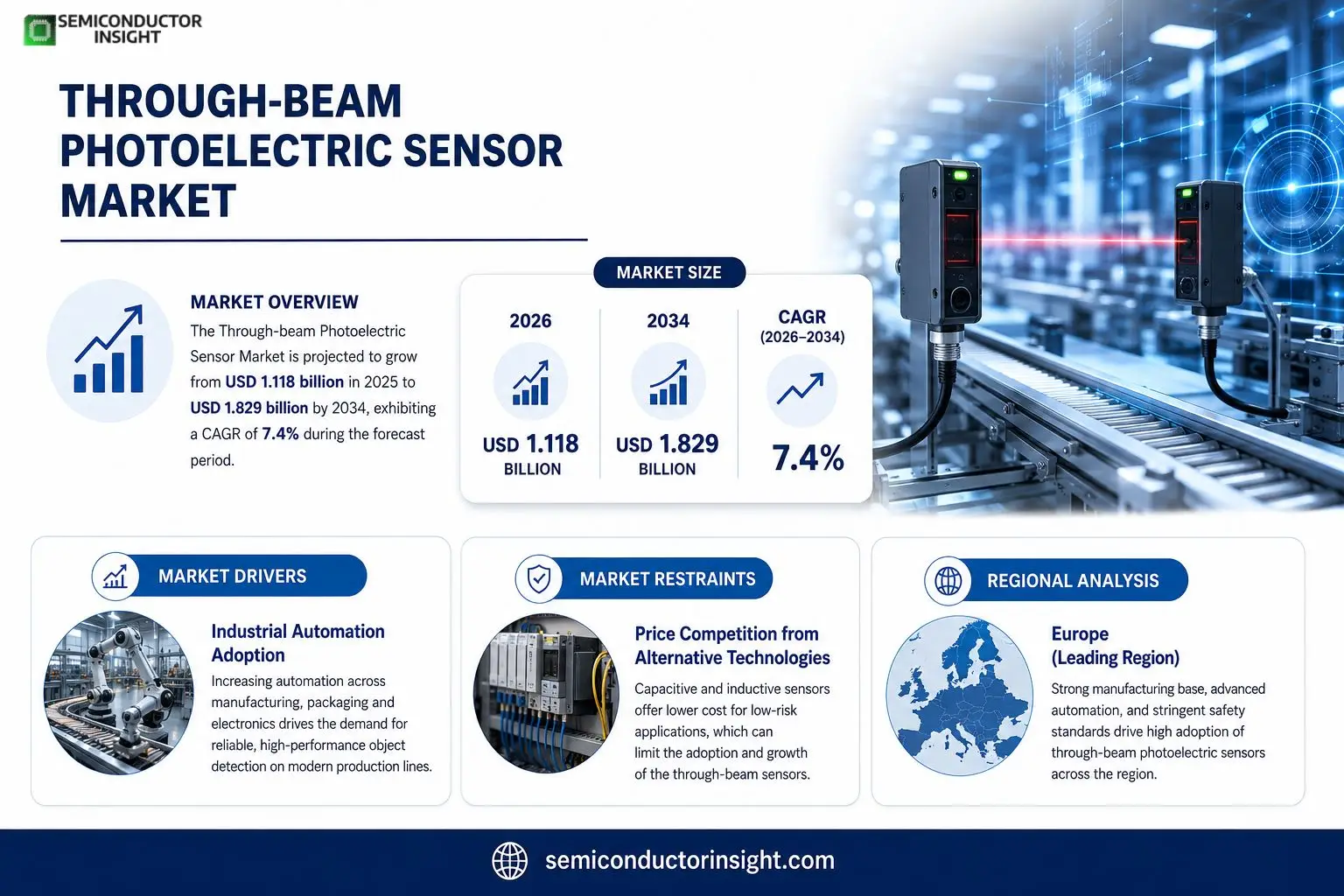
Through-beam Photoelectric Sensor market size was valued at USD 1.118 billion in 2025. The market is projected to reach USD 1.829 billion by 2034, exhibiting a CAGR of 7.4% during the forecast period.
Through‑beam photoelectric sensors are industrial detection devices composed of separate transmitters and receivers that sense an object when it interrupts a light beam. They provide long detection distances, strong anti‑interference capability and rapid response speed, making them suitable for automated production lines, logistics transportation, packaging machinery, elevator safety systems and smart warehousing.The upward trend stems from expanding manufacturing automation and the rapid rollout of intelligent logistics solutions. Compared with diffuse or reflective sensors, through‑beam types deliver superior stability and resistance to harsh environments, which sustains demand across high‑speed lines and safety‑critical applications while opening opportunities for long‑distance detection and higher protection‑level products.
MARKET DRIVERS
Industrial Automation Adoption
Manufacturers across automotive, packaging, and electronics are integrating more sophisticated production lines, and the need for reliable object detection has placed the Through-beam Photoelectric Sensor Market at the core of these upgrades. Higher machine uptime and tighter quality tolerances push firms to select sensors that deliver consistent performance under harsh conditions.
Demand for High‑Speed Detection
Conveyor systems operating at speeds exceeding 200 m/min require sensors with rapid response times. Suppliers that can guarantee nanosecond‑level latency are gaining preference, as any lag directly translates to product defects or line stoppages. This pressure motivates vendors to refine emitter‑receiver alignment and to embed advanced signal‑processing chips.
➤ Customers prioritize sensors that combine durability with ultra‑fast response, accelerating product cycles and reinforcing the strategic importance of the Through-beam Photoelectric Sensor Market.
In parallel, the shift toward Industry 4.0 platforms encourages the deployment of sensors that can seamlessly communicate with PLCs and edge‑computing devices. The ability to publish real‑time status updates reduces maintenance overhead and supports predictive‑analytics initiatives, further cementing demand growth.
MARKET CHALLENGES
Integration Complexity with Legacy Systems
Many plants still rely on aging PLC architectures that lack native support for modern sensor protocols. Retrofitting Through-beam Photoelectric Sensor Market solutions often entails custom wiring, firmware updates, and staff training, inflating project costs and extending deployment timelines.
Other Challenges
Environmental Sensitivity
Sensors exposed to dust, moisture, or extreme temperatures can suffer calibration drift. Manufacturers must invest in robust housing designs, which raises unit prices and may limit adoption in cost‑sensitive segments.
MARKET RESTRAINTS
Price Competition from Alternative Technologies
Capacitive and inductive sensors are often priced lower and offer sufficient performance for low‑risk applications. When budget constraints dominate purchasing decisions, end‑users may favor these alternatives, curbing the expansion trajectory of the Through-beam Photoelectric Sensor Market.
MARKET OPPORTUNITIES
Smart Factory Integration
Emerging standards for industrial IoT enable sensors to deliver diagnostics, energy‑usage metrics, and self‑test results directly to cloud dashboards. Vendors that embed secure communication stacks and analytics capability can capture a premium segment of customers seeking comprehensive digital‑twin solutions within the Through-beam Photoelectric Sensor Market.
Through-beam Photoelectric Sensor Market Trends
Automation and Smart Logistics Driving Demand
The lift in manufacturing automation, combined with the rollout of intelligent logistics platforms, has pushed the Through-beam Photoelectric Sensor Market past the 1.1 billion‑dollar threshold in 2025. With 68 million units sold at an average price of US$18, the sector is delivering a reliable revenue stream that outpaces many niche sensor categories. Long‑range detection and immunity to ambient light make through‑beam designs the preferred choice for high‑speed conveyor belts and automated sorting facilities, where a missed pulse can halt an entire line. As warehouses adopt robotic pickers and autonomous transport carts, the need for sensors that can guarantee beam interruption over several meters grows in direct proportion to the value of the goods handled.
Other Trends
Competitive Landscape and Domestic Substitution
International players retain an edge in ultra‑precise, high‑power laser variants that serve aerospace and semiconductor equipment. Their products, typically priced at a premium, command the high‑end segment where strict reliability standards dominate. Meanwhile, domestic manufacturers are expanding aggressively in the low‑to‑mid tier, leveraging a 41 % industry gross margin and a production capacity of roughly 82 million units to undercut import prices. The result is a measurable shift toward locally sourced sensors in regions that emphasize cost efficiency and rapid delivery. As core components such as infrared emitters and signal‑processing ASICs mature, the performance gap narrows, allowing domestic brands to win contracts that previously required imported technology.
Emerging Applications and Technological Shifts
Beyond traditional automation lines, the market is finding fresh traction in smart warehousing, electric‑vehicle assembly, and safety‑critical elevator systems. These sectors demand miniaturized housings, extended operating lifespans, and built‑in diagnostic feedback—features that manufacturers are beginning to embed at the design stage. The rise of Class 1 protection ratings and IP‑68 sealing further opens opportunities in harsh environments, such as outdoor logistics hubs exposed to dust and moisture. Consequently, suppliers that can combine long‑distance beam stability with rugged packaging are positioned to capture the next wave of growth, especially as equipment upgrade cycles accelerate across emerging economies.
COMPETITIVE LANDSCAPEKey Industry Players
Through-beam Photoelectric Sensor Market: Competitive Overview
Omron, SICK and Keyence dominate the top tier of the market, leveraging advanced optics and highly integrated signal‑processing ASICs to secure contracts with OEMs in high‑speed packaging, automotive assembly and safety‑critical equipment. Their product portfolios span visible‑red, infrared and laser‑based families, each calibrated for long‑range detection under harsh temperature swings. The three firms maintain a tier‑one status not merely through technology leadership but by operating after‑sales networks that guarantee rapid firmware upgrades and field service. This breadth allows them to command premium pricing and lock‑in large‑scale automation projects, where downtime penalties dwarf component cost considerations.Beyond the tier‑one cluster, a diverse set of manufacturers competes on cost efficiency, localized support and niche application expertise. Panasonic and Wenglor have carved out strong positions in electronics‑assembly lines and logistics sorting, respectively, by offering compact designs that integrate seamlessly with PLC ecosystems. Pepperl+Fuchs, Balluff and Leuze focus on ruggedized enclosures suitable for chemical plants and heavy‑duty material handling. Emerging Chinese players such as Shenzhen Winfor Canbo Technology, HECHUAN and DADISICK are gaining market share through aggressive pricing and rapid delivery, while smaller specialists like LEELAVATI AUTOMATION PVT. LTD, OMCH, and Garantta address custom‑engineered solutions for renewable‑energy subsystems and smart‑warehouse retrofits. The overall competitive picture reflects a dual‑track dynamic: premium innovators defend high‑margin segments, while a growing cohort of cost‑conscious producers expand the addressable base in mid‑range and low‑end applications.
List of Key Through-beam Photoelectric Sensor Companies Profiled
- Omron
- Omron
- SICK
- SICK
- Keyence
- Keyence
- Panasonic
- Panasonic
- Wenglor
- Pepperl+Fuchs
- Balluff
- Leuze
- DADISICK
- HECHUAN
- LEELAVATI AUTOMATION PVT. LTD
- OMCH
- Garantta
- Shenzhen Winfor Canbo Technology Co.,Ltd
- Telemecanique Sensors
Segment Analysis:
| Segment Category | Sub-Segments | Key Insights |
| By Type |
|
Infrared and Laser Sensors
|
| By Application |
|
Intelligent Warehousing
|
| By End User |
|
Manufacturing Equipment Makers
|
| By Technology |
|
Miniaturization Trend
|
| By Market Dynamics |
|
Domestic Substitution
|
Regional Analysis: Through-beam Photoelectric Sensor Market
Europe
Germany’s precision‑mechanics clusters host a concentration of sensor integrators, while the Czech Republic offers cost‑effective assembly capacities. This geographic spread enables tier‑1 suppliers to source components close to end‑users, shortening lead times and enhancing service responsiveness.
The Machinery Directive and EU safety directives compel manufacturers to adopt fail‑safe detection mechanisms. Compliance audits increasingly reference through‑beam sensors for their predictable line‑of‑sight characteristics, nudging firms toward standardised specifications.
High‑speed packaging lines and autonomous guided vehicles rely on uninterrupted beam continuity. As these applications scale, the demand for sensors with tighter beam diameters and extended range intensifies, fostering niche product development.
Legacy European players defend market share through long‑term service contracts, while Asian entrants seek footholds by offering stripped‑down modules that meet basic performance thresholds at lower price points.
North America
The United States exhibits a fragmented landscape where a handful of large automation firms dominate automotive assembly, yet a vibrant startup ecosystem fuels sensor innovation for robotics and logistics. Federal incentives for smart factory retrofits have spurred mid‑size manufacturers to replace older optical detectors with more reliable through‑beam solutions. In Canada, the emphasis on mining safety has opened avenues for ruggedized sensors capable of operating in dusty environments, compelling suppliers to adapt housing designs. Overall, market participants must balance the demand for high‑specification products against cost pressures from lean manufacturing initiatives.
Asia‑Pacific
Rapid expansion of electronics manufacturing in China, South Korea, and Taiwan creates a substantial appetite for compact, high‑speed through‑beam sensors. Local OEMs prioritize volume pricing and rapid iteration cycles, encouraging manufacturers to streamline supply chains and localise component sourcing. Meanwhile, Japan’s focus on precision equipment for semiconductor fabs demands sensors with exceptional alignment tolerance, driving a parallel niche market. The divergent needs across the sub‑regions compel vendors to offer both mass‑market and specialist variants.
South America
Brazil’s growing food‑processing sector leverages through‑beam sensors to meet stringent hygiene standards, as the technology offers easy cleaning and minimal contamination risk. In Argentina, automotive parts assemblers are modernising legacy lines, favouring sensors that integrate seamlessly with existing PLC architectures. However, currency volatility and import tariffs pose challenges, prompting distributors to seek locally assembled alternatives or hybrid solutions that blend imported optics with domestic electronics.
Middle East & Africa
The Gulf Cooperation Council invests heavily in petrochemical complexes and water‑treatment facilities, where reliable detection is critical for safety interlocks. Suppliers that can certify sensors against harsh temperature swings and saline corrosion gain a competitive edge. In South Africa, the mining sector’s shift toward autonomous drilling rigs creates a niche for rugged through‑beam sensors with extended range. Market growth is tempered by limited local engineering talent, driving partnerships with European firms for technology transfer.
Report Scope
This market research report provides a comprehensive analysis of the Through-beam Photoelectric Sensor Market , covering the forecast period 2026–2034. It offers detailed insights into market dynamics, technological advancements, competitive landscape, and key trends shaping the industry.
Key focus areas of the report include:
- Market Overview: The report begins with an overview outlining its current market scenario, key growth indicators, and industry transformation drivers. It discusses macroeconomic factors, demand–supply balance, regulatory landscape, and the strategic role of semiconductors in powering advancements across industries such as automotive, telecommunications, consumer electronics, and industrial automation.
- Market Size & Forecast: Historical data and future projections for revenue, unit shipments, and market value across major regions and segments.
- Segmentation Analysis: Detailed breakdown by product type, technology, application, and end-user industry to identify high-growth segments and investment opportunities.
- Regional Insights: Insights into market performance across North America, Europe, Asia-Pacific, Latin America, and the Middle East & Africa, including country-level analysis where relevant.
- Competitive Landscape: Profiles of leading market participants, including their product offerings, R&D focus, manufacturing capacity, pricing strategies, and recent developments such as mergers, acquisitions, and partnerships.
- Technology Trends & Innovation: Assessment of emerging technologies, integration of AI/IoT, semiconductor design trends, fabrication techniques, and evolving industry standards.
- Market Drivers & Restraints: Evaluation of factors driving market growth along with challenges, supply chain constraints, regulatory issues, and market-entry barriers.
- Stakeholder Insights: Insights for component suppliers, OEMs, system integrators, investors, and policymakers regarding the evolving ecosystem and strategic opportunities.
Primary and secondary research methods are employed, including interviews with industry experts, data from verified sources, and real-time market intelligence to ensure the accuracy and reliability of the insights presented.
FREQUENTLY ASKED QUESTIONS:
What is the current market size of Through-beam Photoelectric Sensor Market?
-> Through-beam Photoelectric Sensor Market was valued at USD 1118 million in 2025 and is expected to reach USD 1829 million by 2034 with a CAGR of 7.4%.
Which key companies operate in Through-beam Photoelectric Sensor Market?
-> Key players include Omron, SICK, Panasonic, Wenglor, Keyence, Telemecanique Sensors, Shenzhen Winfor Canbo Technology Co.,Ltd, LEELAVATI AUTOMATION PVT. LTD, DADISICK, Garantta, Pepperl+Fuchs, OMCH, Balluff, HECHUAN, Leuze.
What are the key growth drivers?
-> Key growth drivers include increasing automation in manufacturing, rapid development of intelligent logistics systems, and rising safety inspection standards.
Which region dominates the market?
-> Asia-Pacific is the fastest‑growing region and holds the largest share of demand, while Europe remains a strong, mature market.
What are the emerging trends?
-> Emerging trends include miniaturization of sensors, extended lifespan, higher protection levels (IP ratings), and intelligent diagnostic functions integrated with IoT platforms.
Get Sample Report PDF for Exclusive Insights
Report Sample Includes
- Table of Contents
- List of Tables & Figures
- Charts, Research Methodology, and more...
 Download Sample Report PDF