
MARKET INSIGHTS
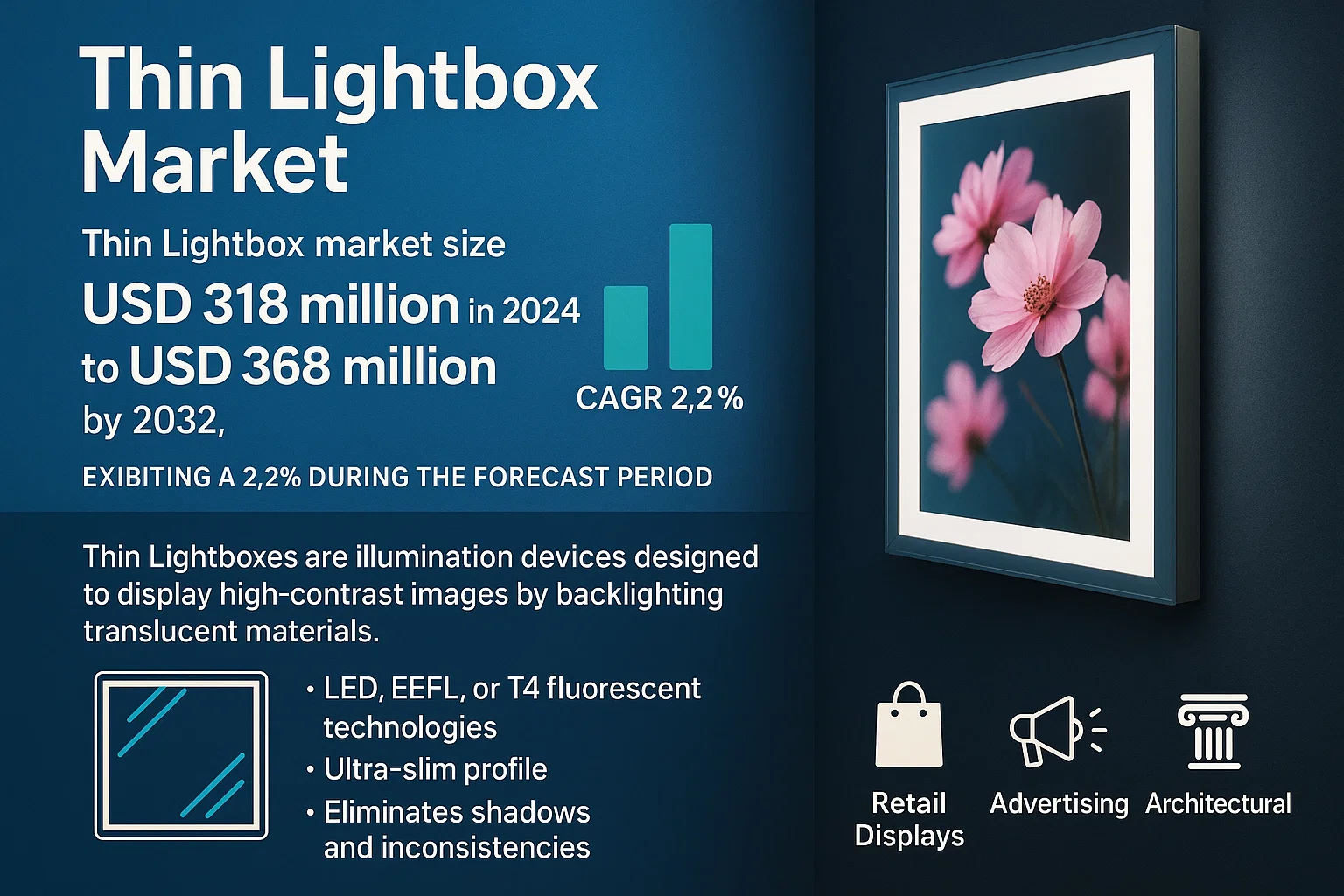
Global Thin Lightbox Market size was valued at USD 318 million in 2024 to USD 368 million by 2032, exhibiting a CAGR of 2.2% during the forecast period.
Thin Lightboxes are illumination devices designed to display high-contrast images by backlighting translucent materials. These units typically incorporate LED, EEFL, or T4 fluorescent bulb technologies to provide uniform light distribution while maintaining an ultra-slim profile. The product eliminates shadows and lighting inconsistencies, making it ideal for retail displays, advertising, and architectural applications where visual clarity is paramount.
The market growth is primarily driven by increasing demand for energy-efficient display solutions across commercial sectors. However, competition from digital signage alternatives presents a challenge. North America currently dominates consumption with 40% market share, followed by Europe at 21%, reflecting strong adoption in retail and corporate environments. Key manufacturers including DSA, Displays4sale, and Uniko collectively hold over 52% market share, leveraging technological advancements in LED efficiency and modular designs.
MARKET DRIVERS
Energy Efficiency and Sustainability Initiatives
Thin lightbox technology offers significant energy savings compared to traditional lighting solutions, with some models consuming up to 70% less electricity. This aligns with global sustainability goals and corporate environmental responsibility initiatives, driving adoption across multiple sectors.
Growth in Digital Signage and Advertising
The rapid expansion of digital advertising in retail environments, transportation hubs, and public spaces has created substantial demand for thin lightbox solutions. Their ability to integrate with digital content management systems while providing uniform illumination makes them ideal for modern advertising applications.
➤ Advanced materials and manufacturing techniques have reduced production costs by approximately 35% over the past three years, while improving light output efficiency by 20-25% in the same period.
Additionally, the integration of smart lighting controls and IoT connectivity in thin lightboxes has created new value propositions for facility managers and advertisers seeking data-driven insights into audience engagement.
MARKET CHALLENGES
Technical Complexity in Integration
While thin lightbox technology offers numerous benefits, the integration with existing building infrastructure and digital systems can present significant challenges. Many older facilities lack the necessary infrastructure to support advanced thin lightbox installations without substantial retrofitting.
Other Challenges
Standardization and Compatibility Issues
The lack of universal standards across different manufacturers can create compatibility issues, particularly when integrating lighting controls, content management systems, and energy management solutions. This can increase total cost of ownership and delay return on investment calculations.
MARKET RESTRAINTS
Economic Volatility and Budget Constraints
Global economic uncertainties and fluctuating raw material prices continue to impact investment decisions across the construction, retail, and hospitality sectors. Many organizations have delayed or scaled back their facility upgrade budgets, particularly for non-essential lighting and display enhancements, which directly impacts the thin lightbox market.
MARKET OPPORTUNITIES
Emerging Smart City Applications
The rapid development of smart city infrastructure worldwide presents significant opportunities for thin lightbox manufacturers. Municipal governments are increasingly investing in intelligent lighting solutions that can serve multiple purposes – from wayfinding and public information to emergency signaling and environmental monitoring. Thin lightbox technology is uniquely positioned to integrate these functions while maintaining aesthetic appeal and energy efficiency.
Thin Lightbox Market Trends
Global Thin Lightbox Market Projected to Reach $368 Million by 2032
The global Thin Lightbox market continues to show steady growth, with projections indicating a rise from $318 million in 2024 to $368 million by 2032, driven by increasing demand in commercial and residential applications. The market is dominated by key players across different regions, with North America holding the largest consumption share at 40%, closely followed by Europe at 21%.
Market Segmentation and Regional Distribution
Market analysis reveals that Thin Lightbox technology is segmented primarily by light source type, with LED technology dominating due to its energy efficiency and longevity. The market sees strong adoption in business environments for advertising and in public spaces for informational displays. Regional analysis indicates North America as the primary market, though Asia-Pacific regions show the fastest growth rate due to increasing infrastructure development.
Other Trends
Technological Advancements and Sustainability
Manufacturers are focusing on developing thinner and more energy-efficient lightboxes, with recent innovations including ultra-thin profiles under 2cm thickness. Sustainability trends are driving adoption of LED technology with 50% less energy consumption compared to traditional lighting. Market leaders are also exploring recyclable materials for lightbox construction, aligning with global environmental regulations.
Market Consolidation and Competitive Landscape
The Thin Lightbox market remains fragmented with the top 10 manufacturers holding approximately 52% market share. Key players are expanding their global presence through strategic partnerships and mergers, particularly in North American and European markets. Recent industry movements include acquisitions of smaller specialized manufacturers by larger lighting conglomerates, strengthening their product portfolios and distribution networks.
Market analysis indicates steady price stabilization despite raw material fluctuations, attributed to improved manufacturing processes and economies of scale. The average price point for standard Thin Lightbox units has decreased by 8% over the past two years while maintaining quality standards, making the technology more accessible to smaller businesses and residential users.
COMPETITIVE LANDSCAPE
Key Industry Players
Global Thin Lightbox Market Leaders
The global thin lightbox market features several established manufacturers specializing in various lighting technologies and display solutions. DSA and Displays4sale lead with comprehensive product portfolios covering LED, EEFL, and fluorescent-based systems, while Uniko and Duggal focus on premium custom solutions for high-end retail and exhibition spaces. 40 Visual and Prime LED compete in the commercial segment with energy-efficient LED panels, while Blue Spark Design Group and Slimbox target niche architectural applications.
Regional specialists including Display Lightbox (Asia-Pacific), Dmuk (Europe), and Artillus (North America) maintain strong local distribution networks. W&Co and Snapper Display have gained market share through e-commerce channels, while Display Lightbox and First African focus on emerging markets. Emerging manufacturers like Guangzhou Brilliant, Jinyb, and Guangdong Rimei are expanding rapidly with competitive pricing and improved product quality.
List of Key Thin Lightbox Companies
- DSA
- Displays4sale
- Uniko
- Duggal
- 40 Visual
- Prime LED
- Blue Spark Design Group
- Slimbox
- Snapper Display
- W&Co
- Display Lightbox
- Dmuk
- Artillus
- First African
- Fabric Lightbox
- EDLITE
- Guangzhou Brilliant
- Jinyb
- Guangdong Rimei
Segment Analysis:
| Segment Category | Sub-Segments | Key Insights |
| By Type |
|
OLED Lightbox segment leads due to superior color accuracy and thinness, making them preferred for high-end retail and art displays where visual quality is paramount. |
| By Application |
|
Retail Signage dominates as thin lightboxes provide ideal illumination for product displays while maintaining sleek aesthetics that complement modern retail environments. |
| By End User |
|
Retail Chains lead adoption as they utilize thin lightboxes for in-store branding, product highlighting, and creating immersive shopping experiences that drive customer engagement. |
| By Installation Type |
|
Wall-mounted installations dominate as they offer space efficiency and seamless integration into retail environments, hospitals, and public spaces while providing even illumination. |
| By Illumination Technology |
|
Edge-Lit technology leads as it enables the thinnest possible profiles while providing uniform light distribution, making it ideal for space-constrained applications where both form factor and performance are critical. |
Regional Analysis: Thin Lightbox Market
North American manufacturers excel at integrating thin lightbox technology with smart home systems and IoT connectivity. This creates seamless user experiences where lighting, entertainment, and information systems work in harmony. The region leads in developing lightboxes that integrate with voice assistants, mobile apps, and home automation platforms, making them more than just lighting solutions but central components of modern smart environments.
North American designers and engineers have pioneered ultra-slim profiles that maintain structural integrity while reducing material usage. This innovation extends beyond the product itself to installation systems that require minimal space and preparation. The region’s focus on minimalist aesthetics has driven development of lightboxes that disappear into walls and ceilings when not in use, creating clean, uncluttered environments.
North American markets prioritize energy efficiency, with thin lightbox technology offering significant advantages over traditional lighting. The region’s focus on green building standards has accelerated adoption in both new construction and retrofitting applications. Manufacturers have developed energy recovery systems, advanced thermal management, and materials that contribute to LEED and other green building certifications, making these products environmentally responsible choices.
The North American market demonstrates sophisticated product segmentation with distinct solutions for residential, commercial, and industrial applications. Distribution channels are well-established with strong relationships between manufacturers, distributors, and installation specialists. The market has moved beyond basic functionality to value-added features like customizable lighting temperatures, adaptive brightness, and integrated media capabilities that respond to market demands.
Europe
European markets demonstrate sophisticated adoption patterns with Northern Europe focusing on energy efficiency and Southern Europe emphasizing design integration. The region benefits from strong regulatory frameworks that mandate energy efficiency in both residential and commercial buildings. European manufacturers excel in creating products that meet diverse architectural needs from historic preservation to ultra-modern designs. The market shows particular strength in commercial applications where thin lightbox technology integrates with smart building systems and energy management solutions.
Asia-Pacific
Asia-Pacific represents the fastest growing market with countries like South Korea and Japan leading in technological innovation while emerging economies focus on cost-effective solutions. The region benefits from massive manufacturing capacity that drives down production costs and enables wider adoption. Cultural preferences for sleek, minimalist design align well with thin lightbox applications. The region shows particular strength in integrating these technologies into consumer electronics and creating new applications beyond traditional lighting.
South America
South American markets show growing interest, particularly in urban centers and new construction projects. The region shows preference for solutions that offer both aesthetic appeal and functional benefits like weather resistance and durability. Market growth is closely tied to construction industry trends and urban development initiatives. Countries with stronger economies show faster adoption while others follow as technology costs decrease and local manufacturing capacity improves.
Middle East & Africa
These regions show selective adoption primarily in high-end commercial and hospitality projects. Luxury hotels, corporate headquarters, and high-end retail represent the strongest markets currently. The focus tends to be on imported premium products rather than local manufacturing. However, growing urban centers and infrastructure development are creating new opportunities. The market shows potential for growth as technology costs decrease and local expertise develops.
Report Scope
This market research report provides a comprehensive analysis of the Thin Lightbox Market, covering the forecast period 2025-2032. It offers detailed insights into market dynamics, technological advancements, competitive landscape, and key trends shaping the industry.
Key focus areas of the report include:
- Market Overview: The report begins with an overview outlining the current market scenario, key growth indicators, and industry transformation drivers. It examines macroeconomic factors, demand-supply balance, regulatory landscape, and the strategic role of advanced materials across industries such as retail, healthcare, and advertising.
- Market Size & Forecast: Historical data and future projections for revenue, unit shipments, and market value across major regions and segments.
- Segmentation Analysis: Detailed breakdown by product type, technology, application, and end-user industry to identify high-growth segments and investment opportunities.
- Regional Insights: Insights into market performance across North America, Europe, Asia-Pacific, Latin America, and the Middle East & Africa, including country-level analysis where relevant.
- Competitive Landscape: Profiles of leading market participants, including their product offerings, R&D focus, manufacturing capacity, pricing strategies, and recent developments such as mergers, acquisitions, and partnerships.
- Technology Trends & Innovation: Assessment of emerging technologies, integration of AI/IoT, material science innovations, fabrication techniques, and evolving industry standards.
- Market Drivers & Restraints: Evaluation of factors driving market growth along with challenges, supply chain constraints, regulatory issues, and market-entry barriers.
- Stakeholder Insights: Insights for component suppliers, OEMs, system integrators, investors, and policymakers regarding the evolving ecosystem and strategic opportunities.
Primary and secondary research methods are employed, including interviews with industry experts, data from verified sources, and real-time market intelligence to ensure the accuracy and reliability of the insights presented.
FREQUENTLY ASKED QUESTIONS:
What is the current market size of Thin Lightbox Market?
-> The Thin Lightbox Market was valued at USD 318 million in 2024 and is projected to reach USD 368 million by 2032.
What is the growth rate of Thin Lightbox Market?
-> The market is expected to grow at a CAGR of 2.2% during the forecast period 2024-2032.
Which key companies operate in Thin Lightbox Market?
-> Key players include DSA, Displays4sale, Uniko, Duggal, 40 Visual, Prime LED, Blue Spark Design Group, Slimbox, Snapper Display, W&Co, Display Lightbox, Dmuk, Artillus, First substitutes, Fabric Lightbox, EDLITE, Guangzhou Brilliant Light Box Manufacture, Jinyb, Guangdong Rimei Optoelectronics Technology, Guangzhou Youguang Optoelectronics Technology, among others.
What is the regional distribution of Thin Lightbox Market?
-> North America is the largest consumption region with approximately 40% market share, followed by Europe with about 21% market share.
What are the major applications of Thin Lightbox?
-> Major applications include business advertising, public spaces, family use, and various activities requiring high-quality illuminated displays.

Get Sample Report PDF for Exclusive Insights
Report Sample Includes
- Table of Contents
- List of Tables & Figures
- Charts, Research Methodology, and more...
 Download Sample Report PDF


