
Thin Film Surface Acoustic Wave Filter (TF-SAW) Market Insights
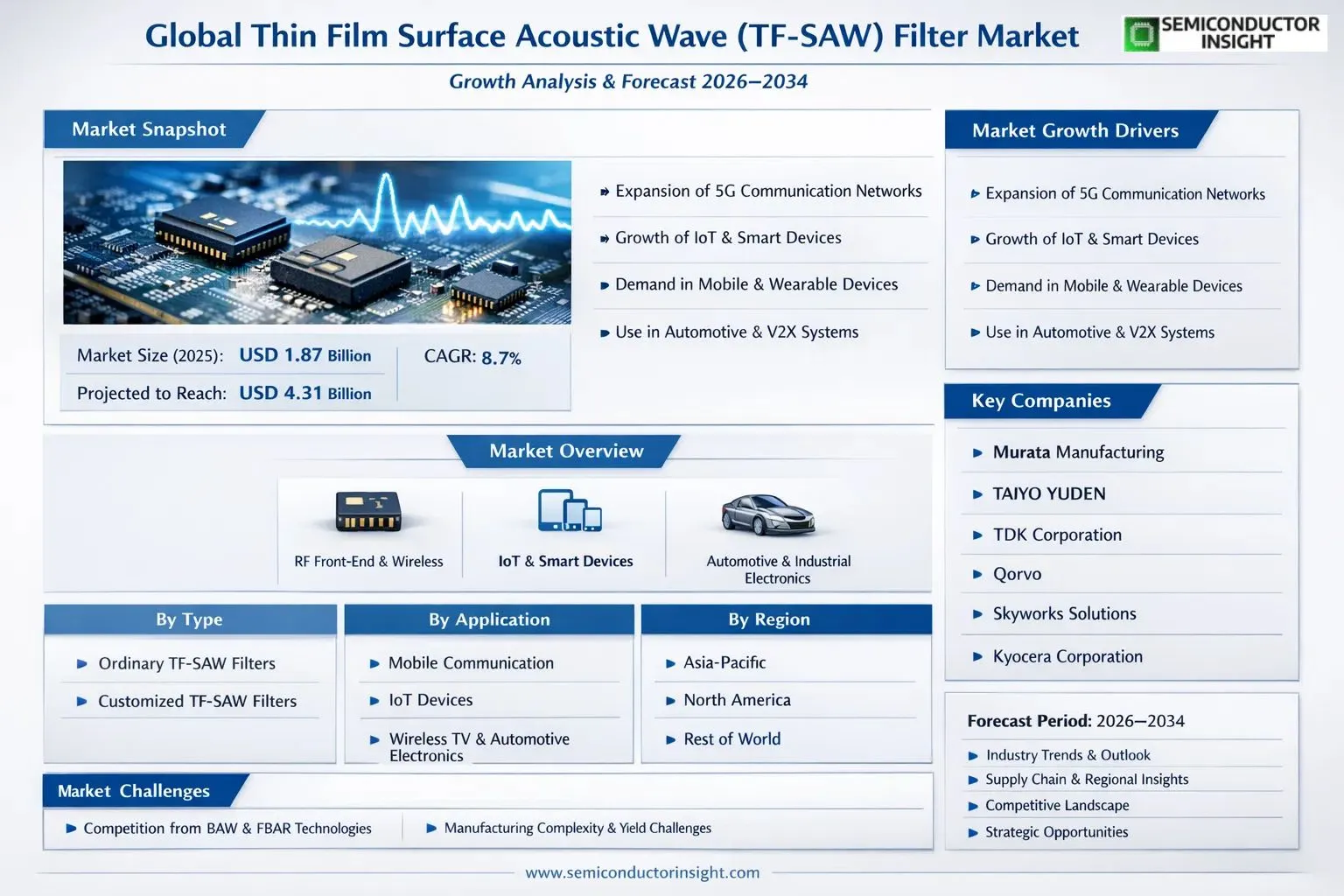
Global Thin Film Surface Acoustic Wave Filter (TF-SAW) market size was valued at USD 1.87 billion in 2025. The market is projected to grow from USD 2.04 billion in 2026 to USD 4.31 billion by 2034, exhibiting a CAGR of 8.7% during the forecast period.
Thin-film surface acoustic wave filters are advanced filtering components that utilize surface acoustic waves propagating along piezoelectric crystal structures. Surface acoustic waves are elastic waves that travel along the surface of an object, generated and sustained on the surface of a piezoelectric substrate material, with amplitude decreasing rapidly as depth into the substrate increases. TF-SAW filters achieve precise filtering and frequency selection of signals at specific frequencies by adjusting the electrode structure on the crystal and controlling the propagation path of the surface acoustic wave. These filters are widely deployed across frequency band selection, frequency conversion, RF front-end, and baseband processing in wireless communication systems, with critical applications spanning mobile phones, satellite communications, wireless television, radar systems, and medical diagnostic equipment.
As an essential component of RF front-end chips, TF-SAW filters leverage the piezoelectric effect and acoustic characteristics to filter radio electromagnetic waves, offering simple and flexible signal processing alongside strong production consistency and repeatability. The market is experiencing robust expansion driven by the rapid proliferation of 5G communications infrastructure, growing adoption in mobile terminal devices including smartphones, tablets, smart home systems, and wearable technology, as well as increasing penetration into navigation systems such as GPS and Beidou, and expanding WIFI applications. Key industry participants shaping the competitive landscape include Murata Manufacturing, TAIYO YUDEN, TDK, Qorvo, and Skyworks Solutions, among others operating with diversified product portfolios across global markets.
MARKET DRIVERS
Surging Demand for Advanced RF Filtering in 5G Networks
The rapid global rollout of 5G infrastructure has emerged as one of the most significant forces shaping Thin Film Surface Acoustic Wave Filter (TF-SAW) Market. As mobile network operators deploy sub-6 GHz and millimeter-wave frequency bands, the need for high-performance RF front-end components has grown substantially. TF-SAW filters are increasingly preferred in 5G-enabled smartphones and base station equipment due to their superior frequency selectivity, compact form factor, and ability to operate effectively across wider bandwidths compared to conventional SAW filters. The proliferation of multi-band, multi-mode devices requiring precise signal isolation has further accelerated adoption across the consumer electronics and telecommunications sectors.
Proliferation of IoT Devices and Smart Consumer Electronics
Beyond 5G handsets, the explosive growth of the Internet of Things (IoT) ecosystem has created substantial new demand vectors for Thin Film Surface Acoustic Wave Filter market. Smart home devices, wearables, industrial sensors, and connected automotive components all require compact, energy-efficient RF filtering solutions capable of managing increasingly congested wireless spectrums. TF-SAW filters are well-suited to these applications owing to their low insertion loss characteristics, miniaturized packaging, and compatibility with high-volume wafer-level manufacturing processes. As global IoT device installations continue to expand, OEMs are increasingly specifying TF-SAW components in next-generation product designs to meet stringent performance and size constraints.
➤ The convergence of 5G connectivity, IoT proliferation, and advanced automotive electronics has positioned Thin Film Surface Acoustic Wave Filter (TF-SAW) Market as a strategically critical segment within the broader RF components industry, with sustained demand anticipated across multiple application verticals through the coming decade.
The automotive sector represents an additional and fast-growing demand driver for the TF-SAW market. Modern vehicles are increasingly equipped with V2X (Vehicle-to-Everything) communication systems, advanced driver-assistance systems (ADAS), and integrated telematics units, all of which depend on reliable RF filtering components. The transition toward electric and connected vehicles has further intensified the incorporation of wireless communication modules, generating consistent demand for high-frequency, thermally stable filtering solutions. Thin Film SAW filter technology, with its enhanced temperature coefficient of frequency (TCF) performance relative to standard SAW devices, is particularly well-positioned to serve the demanding environmental conditions of automotive applications.
MARKET CHALLENGES
Intense Competition from BAW and FBAR Filter Technologies
One of the foremost challenges facing Thin Film Surface Acoustic Wave Filter (TF-SAW) Market is the intensifying competition from Bulk Acoustic Wave (BAW) and Film Bulk Acoustic Resonator (FBAR) filter technologies. At higher frequency bands, particularly those above 2.5 GHz increasingly required in 5G applications, BAW-based filters have demonstrated superior power handling, lower insertion loss, and better out-of-band rejection performance. Leading semiconductor and component manufacturers continue to invest heavily in BAW and FBAR technology development, raising the performance threshold that TF-SAW solutions must meet to remain competitive in premium frequency applications. This technological rivalry creates ongoing pressure on TF-SAW suppliers to innovate continuously and demonstrate clear differentiation in cost-performance trade-offs.
Other Challenges
Complex Manufacturing Processes and Yield Management
The fabrication of Thin Film SAW filters involves precision thin-film deposition, photolithography, and etching processes that demand highly controlled manufacturing environments and advanced process equipment. Achieving consistent performance uniformity across high-volume production runs while maintaining acceptable yield rates presents an ongoing operational challenge for manufacturers. Any variation in piezoelectric thin-film quality, electrode geometry, or substrate characteristics can result in frequency drift or performance degradation, necessitating robust quality control protocols that add to production costs and complexity within the TF-SAW market.
Supply Chain Concentration and Raw Material Dependencies
Thin Film Surface Acoustic Wave Filter market is exposed to supply chain concentration risks, particularly with respect to specialized piezoelectric substrates such as lithium niobate (LiNbO₃) and lithium tantalate (LiTaO₃), the production of which is concentrated among a limited number of global suppliers. Geopolitical tensions and trade policy uncertainties have highlighted the vulnerability of globally distributed semiconductor supply chains, with potential disruptions to raw material availability posing a credible risk to production continuity and cost stability for TF-SAW filter manufacturers operating at scale.
MARKET RESTRAINTS
Performance Limitations at Higher Frequency Bands
A fundamental technical restraint on Thin Film Surface Acoustic Wave Filter (TF-SAW) Market relates to inherent performance limitations as operating frequencies increase. While TF-SAW technology offers meaningful improvements over conventional SAW filters in terms of temperature stability and power handling, its performance characteristics at frequencies exceeding 3 GHz remain constrained relative to competing acoustic filter architectures. As 5G network deployments progressively utilize higher frequency allocations, including mid-band and upper mid-band spectrum, the frequency ceiling of commercially viable TF-SAW devices may limit their addressable application space, potentially confining the technology to specific sub-3 GHz use cases and ceding higher-band opportunities to BAW-based alternatives.
High Capital Investment Requirements for Advanced Fabrication
The capital-intensive nature of semiconductor-grade thin-film manufacturing represents a structural restraint on market entry and capacity expansion within the TF-SAW filter industry. Establishing or upgrading production facilities capable of consistently fabricating high-performance Thin Film SAW components requires substantial investment in specialized deposition equipment, cleanroom infrastructure, and metrology systems. These significant upfront capital requirements create meaningful barriers for smaller or emerging manufacturers seeking to enter the market, thereby concentrating production capacity among a limited number of established players and potentially constraining the overall pace of market capacity growth relative to demand trajectories in the broader RF components sector.
MARKET OPPORTUNITIES
Expanding Application Scope in Next-Generation Wireless Infrastructure
The ongoing global expansion of wireless communication infrastructure presents substantial growth opportunities for Thin Film Surface Acoustic Wave Filter (TF-SAW) Market. Network densification efforts, including the deployment of small cells and distributed antenna systems (DAS) essential for 5G coverage, require large volumes of compact, high-performance RF filtering components. TF-SAW filters, with their favorable combination of compact packaging, low power consumption, and competitive cost profiles, are well-positioned to capture significant share within infrastructure equipment segments that demand high-volume, cost-optimized RF front-end solutions. As global 5G subscriber penetration deepens across both developed and emerging economies, infrastructure buildout requirements are expected to sustain demand for TF-SAW components across extended deployment cycles.
Technological Innovation and Integration with Advanced Packaging Platforms
Ongoing research and development in piezoelectric thin-film materials and advanced packaging architectures presents a meaningful opportunity for the TF-SAW market to extend its competitive relevance. Innovations in temperature-compensated thin-film structures, heterogeneous integration with RF front-end modules (FEMs), and co-packaging with low-noise amplifiers and antenna switches are enabling TF-SAW filter suppliers to deliver higher levels of integration and system-level performance. Additionally, the development of novel piezoelectric materials and improved electromechanical coupling coefficients may progressively extend the usable frequency range of Thin Film SAW devices, potentially reopening competitive opportunities in mid-band 5G applications and positioning TF-SAW technology as a viable, cost-effective alternative to BAW solutions in a broader range of frequency segments.
Growth in Emerging Markets and Localized Supply Chain Development
Emerging economies across Asia-Pacific, Latin America, and the Middle East & Africa represent significant untapped opportunity areas for Thin Film Surface Acoustic Wave Filter market. Accelerating smartphone adoption, expanding 4G and early 5G network deployments, and growing domestic electronics manufacturing industries in countries such as India, Vietnam, and Brazil are generating rising demand for RF filtering components at competitive price points. Furthermore, national policy initiatives aimed at reducing dependency on foreign semiconductor supply chains are incentivizing regional investment in RF component manufacturing capabilities, potentially creating new localized production and partnership opportunities for TF-SAW filter suppliers seeking to diversify their geographic revenue base and strengthen supply chain resilience.
MAIN TITLE HERE () Trends
Rising Demand from 5G Wireless Communication Infrastructure Driving TF-SAW Adoption
Thin Film Surface Acoustic Wave Filter (TF-SAW) Market is experiencing significant momentum, primarily driven by the accelerating global rollout of 5G communication networks. As wireless infrastructure continues to evolve, TF-SAW filters have emerged as critical components within RF front-end modules, enabling precise frequency band selection and signal clarity across increasingly congested spectrum environments. Mobile terminal devices , including smartphones, tablets, and wearable technology , rely heavily on thin film surface acoustic wave filters to manage complex multi-band signal processing requirements. The growing number of frequency bands supported by modern 5G-enabled devices has directly translated into higher filter content per device, reinforcing demand across the supply chain. Manufacturers such as Murata Manufacturing, Qorvo, TDK, and Skyworks Solutions have been scaling production capacities and advancing piezoelectric substrate technologies to meet this rising need. The integration of TF-SAW filters in RF front-end chips continues to be a focal point of product development strategies across leading players in the market.
Other Trends
Expansion into IoT and Smart Connected Devices
Beyond traditional mobile communication applications, Thin Film Surface Acoustic Wave Filter (TF-SAW) Market is witnessing growing penetration into the Internet of Things (IoT) ecosystem. Smart home devices, industrial wireless sensors, and connected wearables increasingly depend on compact, high-performance RF filtering solutions. TF-SAW filters offer distinct advantages in these applications due to their small form factor, low insertion loss, and reliable signal selectivity , characteristics that are particularly valued in power-sensitive IoT designs. Navigation systems incorporating GPS and BeiDou technologies are also contributing to incremental demand, as these platforms require precise frequency filtering to maintain positional accuracy. Companies such as TAI-SAW Technology, CTS Corporation, and emerging Chinese manufacturers including Hangzhou Zuolan Microelectronics Technology and Dolon Technology are actively targeting this diversified application base.
Shift Toward Customized Filter Solutions
A notable structural shift is underway within Thin Film Surface Acoustic Wave Filter (TF-SAW) Market, with customized filter variants gaining traction alongside standard ordinary filters. As device manufacturers face increasingly stringent RF performance specifications , particularly for multi-band and carrier aggregation scenarios , off-the-shelf solutions are proving insufficient. This trend is prompting closer collaboration between filter suppliers and OEM customers at the design stage, enabling application-specific electrode structures and propagation path configurations tailored to unique frequency requirements. The customized segment is expected to maintain above-average growth relative to standard filter categories through the forecast horizon.
Asia-Pacific Manufacturing Consolidation and Competitive Landscape Evolution
The competitive landscape of Thin Film Surface Acoustic Wave Filter (TF-SAW) Market reflects a pronounced concentration of manufacturing expertise in the Asia-Pacific region, particularly across Japan, South Korea, China, and Southeast Asia. Japanese firms such as Murata Manufacturing and TAIYO YUDEN maintain strong technological leadership in piezoelectric substrate engineering, while Chinese domestic players are rapidly closing the capability gap through sustained R&D investment and government-backed semiconductor development initiatives. This regional dynamic is reshaping global supply chains, with procurement diversification becoming a strategic priority for international buyers seeking supply resilience. Meanwhile, wireless television applications continue to represent a stable demand channel, as TF-SAW filters remain essential for noise reduction and signal quality enhancement in broadcast reception equipment.
COMPETITIVE LANDSCAPE
Key Industry Players
Thin Film Surface Acoustic Wave Filter (TF-SAW) Market – Global Competitive Analysis and Key Manufacturer Profiles
Global Thin Film Surface Acoustic Wave Filter (TF-SAW) market is characterized by a moderately consolidated competitive structure, with a handful of technologically advanced multinational corporations commanding significant revenue share. Japanese conglomerate Murata Manufacturing Co., Ltd. stands as the dominant force in the TF-SAW landscape, leveraging decades of piezoelectric materials expertise, vertically integrated manufacturing capabilities, and deep-rooted partnerships with major mobile device OEMs. Murata’s stronghold is reinforced by its continuous investment in next-generation SAW and temperature-compensated SAW (TC-SAW) technologies tailored for 5G RF front-end modules. Alongside Murata, TAIYO YUDEN and TDK Corporation maintain formidable positions, particularly in the Asia-Pacific region, where demand for compact, high-performance RF filters in smartphones, IoT devices, and wearables continues to surge. American players such as Qorvo and Skyworks Solutions further intensify competition by offering highly integrated RF front-end solutions that combine TF-SAW filters with amplifiers and switches, catering to the rapidly evolving 5G and Wi-Fi 6/6E ecosystems.
Beyond the tier-one incumbents, a growing cohort of specialized and regional manufacturers is reshaping the competitive dynamics of the TF-SAW market. TAI-SAW Technology and CTS Corporation serve as notable mid-tier players, addressing niche segments including GPS/GNSS, satellite communications, and industrial wireless applications. Meanwhile, emerging Chinese manufacturers such as Hangzhou Zuolan Microelectronics Technology, Dolon Technology, and Shenzhen Jingkexin Industry are rapidly scaling their production capacities and R&D investments, benefiting from strong domestic demand and government-backed semiconductor initiatives. These players are increasingly competitive on cost and are gaining traction in mobile communication and IoT applications. The market also witnesses participation from optical and precision filter specialists like Alluxa, Chroma Technology, and IDEX, which bring complementary thin-film deposition and precision engineering capabilities to the broader filter technology space. As 5G deployment accelerates globally, competitive differentiation is increasingly driven by frequency band coverage, miniaturization, insertion loss performance, and the ability to deliver customized filter solutions at scale.
List of Key Thin Film Surface Acoustic Wave Filter (TF-SAW) Companies Profiled
- Murata Manufacturing Co., Ltd.
- TAIYO YUDEN Co., Ltd.
- TDK Corporation
- Qorvo, Inc.
- Skyworks Solutions, Inc.
- TAI-SAW Technology Co., Ltd.
- CTS Corporation
- Hangzhou Zuolan Microelectronics Technology Co., Ltd.
- Dolon Technology
- Shenzhen Jingkexin Industry Co., Ltd.
- Alluxa, Inc.
- Chroma Technology Corporation
- IDEX Corporation
Segment Analysis:
| Segment Category | Sub-Segments | Key Insights |
| By Type |
|
Customized TF-SAW Filters represent the fastest-growing sub-segment, driven by the increasing complexity of modern wireless communication architectures and the unique frequency band requirements of next-generation devices.
|
| By Application |
|
Mobile Communication remains the dominant application segment for TF-SAW filters, underpinned by the relentless global proliferation of smartphones, tablets, and wearable devices that demand high-performance RF filtering across an expanding array of frequency bands.
|
| By End User |
|
Consumer Electronics Manufacturers constitute the leading end-user segment for TF-SAW filters, driven by the massive global demand for smartphones, tablets, smart wearables, and connected home appliances that depend critically on precise RF signal filtering for seamless wireless performance.
|
| By Frequency Band |
|
1 GHz – 3 GHz Band filters represent the leading frequency segment in the TF-SAW market, as this range encompasses the most widely deployed commercial wireless communication standards including LTE, Wi-Fi, Bluetooth, and early 5G NR sub-6 GHz bands.
|
| By Substrate Material |
|
Lithium Niobate (LiNbO₃) substrates lead the TF-SAW market by material type, owing to their superior piezoelectric coupling coefficient, which enables efficient acoustic wave generation and propagation essential for achieving high-performance filtering characteristics in modern wireless communication devices.
|
Regional Analysis: Thin Film Surface Acoustic Wave Filter (TF-SAW) Market
Asia-Pacific
Asia-Pacific’s TF-SAW market leadership is fundamentally anchored in its world-class manufacturing ecosystem. Precision fabrication facilities in Japan and Taiwan operate at cutting-edge process nodes, enabling consistent production of high-frequency, low-insertion-loss filters. Vertically integrated supply chains reduce lead times and production costs, giving regional manufacturers a structural competitive advantage that continues to attract global OEM partnerships and long-term procurement agreements.
The accelerated rollout of 5G networks across China, South Korea, and Japan has created substantial and sustained demand for advanced RF filtering solutions. TF-SAW filters, valued for their compact form factor and superior frequency performance, are increasingly designed into 5G-compatible smartphones and base station equipment, positioning Asia-Pacific as the primary consumption market for next-generation thin film acoustic wave technologies throughout the forecast horizon.
Asia-Pacific’s enormous consumer electronics manufacturing base , encompassing smartphones, tablets, smart home devices, and wearables , generates consistent, high-volume demand for miniaturized filtering components. The expanding IoT ecosystem across urban centers in China, India, and Southeast Asia further diversifies application demand. Thin Film Surface Acoustic Wave Filter integration in connected devices is expected to deepen as smart device adoption accelerates across both mature and emerging markets within the region.
Leading Asia-Pacific economies are channeling significant investments into semiconductor R&D, with targeted focus on acoustic wave filter miniaturization, thermal stability improvements, and multi-band frequency support. Collaborative initiatives between academic institutions and industry players in Japan, South Korea, and China are yielding incremental but impactful advances in TF-SAW substrate engineering and piezoelectric material performance, ensuring the region retains its technological edge well into the 2034 forecast period.
North America
North America represents a strategically significant market within Global Thin Film Surface Acoustic Wave Filter (TF-SAW) landscape, characterized by robust demand from the telecommunications, defense, and automotive sectors. The United States leads regional consumption, supported by the widespread commercialization of 5G services and the growing integration of advanced RF components in connected vehicle platforms. Leading American semiconductor design firms play a pivotal role in specifying and procuring TF-SAW filters for high-performance applications, even as physical manufacturing remains concentrated in Asia. Defense and aerospace applications present a particularly compelling growth avenue, as military communication systems require filters capable of operating reliably across demanding frequency ranges and environmental conditions. Ongoing government-backed initiatives aimed at strengthening domestic semiconductor capabilities are gradually influencing regional supply chain strategies, potentially fostering greater North American involvement in advanced filter production over the long-term forecast period.
Europe
Europe’s Thin Film Surface Acoustic Wave Filter (TF-SAW) market is shaped by the region’s strong industrial electronics tradition, automotive technology leadership, and progressive deployment of smart infrastructure. Germany, France, and the Nordic countries stand out as key demand centers, with the automotive sector emerging as a particularly dynamic application segment. As European automakers accelerate electrification and vehicle connectivity programs, the need for reliable, miniaturized RF filtering components integrated into telematics, V2X communication, and advanced driver assistance systems (ADAS) is expanding steadily. European regulatory frameworks promoting spectrum efficiency and electromagnetic compatibility further reinforce the adoption of high-quality thin film acoustic wave solutions. Although Europe does not command a dominant share of TF-SAW manufacturing, its engineering expertise and precision electronics capabilities position the region as an important innovator in application-specific filter design and system integration through the forecast horizon.
South America
South America occupies an emerging position within Global Thin Film Surface Acoustic Wave Filter (TF-SAW) market, with growth primarily driven by expanding telecommunications infrastructure and rising consumer electronics adoption across Brazil, Argentina, and Colombia. The ongoing expansion of mobile broadband networks, including gradual LTE consolidation and early-stage 5G deployment in major urban centers, is generating incremental demand for advanced RF filtering components. While South America currently relies predominantly on imported TF-SAW solutions to meet its market requirements, the region’s growing technology consumer base and improving digital connectivity present meaningful long-term opportunity. Investment in regional telecommunications infrastructure by both domestic operators and multinational vendors is expected to progressively elevate demand for compact, high-performance filtering technologies as network modernization programs advance through the 2026–2034 forecast period.
Middle East & Africa
The Middle East and Africa region represents a nascent but gradually evolving segment within Global Thin Film Surface Acoustic Wave Filter (TF-SAW) market. Growth dynamics in this region are primarily underpinned by telecommunications network expansion, smart city development initiatives, and increasing mobile device penetration across urban and semi-urban populations. Gulf Cooperation Council (GCC) nations, particularly the UAE and Saudi Arabia, are leading regional 5G deployment efforts, creating demand for high-frequency RF components including TF-SAW filters in both consumer and infrastructure applications. Africa’s rapidly growing mobile subscriber base, while currently served by predominantly legacy network technologies, is expected to generate incremental TF-SAW demand as network modernization progresses. The region’s overall market development will remain contingent on sustained infrastructure investment and continued expansion of the broader digital economy throughout the forecast period.
Report Scope
This market research report provides a comprehensive analysis of Thin Film Surface Acoustic Wave Filter (TF-SAW) Market, covering the forecast period 2026–2034. It offers detailed insights into market dynamics, technological advancements, competitive landscape, and key trends shaping the industry.
Key focus areas of the report include:
- Market Overview: The report begins with an overview outlining its current market scenario, key growth indicators, and industry transformation drivers. It discusses macroeconomic factors, demand–supply balance, regulatory landscape, and the strategic role of thin film surface acoustic wave filters in powering advancements across industries such as mobile communications, wireless television, Internet of Things, and RF front-end applications.
- Market Size & Forecast: Historical data and future projections for revenue, unit shipments, and market value across major regions and segments.
- Segmentation Analysis: Detailed breakdown by product type (Ordinary, Customized), application (Mobile Communication, Wireless TV, Internet of Things, Other), and end-user industry to identify high-growth segments and investment opportunities.
- Regional Insights: Insights into market performance across North America, Europe, Asia-Pacific, Latin America, and the Middle East & Africa, including country-level analysis where relevant.
- Competitive Landscape: Profiles of leading market participants, including their product offerings, R&D focus, manufacturing capacity, pricing strategies, and recent developments such as mergers, acquisitions, and partnerships.
- Technology Trends & Innovation: Assessment of emerging technologies, integration of AI/IoT, piezoelectric design trends, fabrication techniques, and evolving industry standards in surface acoustic wave filter technology.
- Market Drivers & Restraints: Evaluation of factors driving market growth along with challenges, supply chain constraints, regulatory issues, and market-entry barriers.
- Stakeholder Insights: Insights for component suppliers, OEMs, system integrators, investors, and policymakers regarding the evolving ecosystem and strategic opportunities.
Primary and secondary research methods are employed, including interviews with industry experts, data from verified sources, and real-time market intelligence to ensure the accuracy and reliability of the insights presented.
FREQUENTLY ASKED QUESTIONS:
What is the current market size of Thin Film Surface Acoustic Wave Filter (TF-SAW) Market?
-> Thin Film Surface Acoustic Wave Filter (TF-SAW) Market was valued at USD million in 2025 and is expected to reach USD million by 2034, growing at a CAGR of % during the forecast period 2026–2034.
Which key companies operate in Thin Film Surface Acoustic Wave Filter (TF-SAW) Market?
-> Key players include Murata Manufacturing, TAIYO YUDEN, TDK, Qorvo, Skyworks Solutions, TAI-SAW Technology, CTS Corporation, Chroma Technology, IDEX, Alluxa, Hangzhou Zuolan Microelectronics Technology, Dolon Technology, and Shenzhen Jingkexin Industry, among others.
What are the key growth drivers?
-> Key growth drivers include rapid development of 5G communications, rising demand for RF front-end components in mobile terminal devices, expansion of IoT applications, growing adoption of smart homes and wearable devices, and increasing penetration into navigation systems (GPS, Beidou) and WIFI technologies.
Which region dominates the market?
-> Asia is a dominant region in Global Thin Film Surface Acoustic Wave Filter (TF-SAW) Market, with key contributors including China, Japan, and South Korea, while North America also holds a significant market share driven by advanced wireless communication infrastructure.
What are the emerging trends?
-> Emerging trends include increasing integration of TF-SAW filters in 5G-enabled devices, growing use in IoT and smart home ecosystems, advancement in piezoelectric substrate materials, expansion into satellite communications and radar applications, and rising demand for customized filter solutions to meet diverse wireless communication requirements.

Get Sample Report PDF for Exclusive Insights
Report Sample Includes
- Table of Contents
- List of Tables & Figures
- Charts, Research Methodology, and more...




