
TherMoelectric Power Generator Market Insights
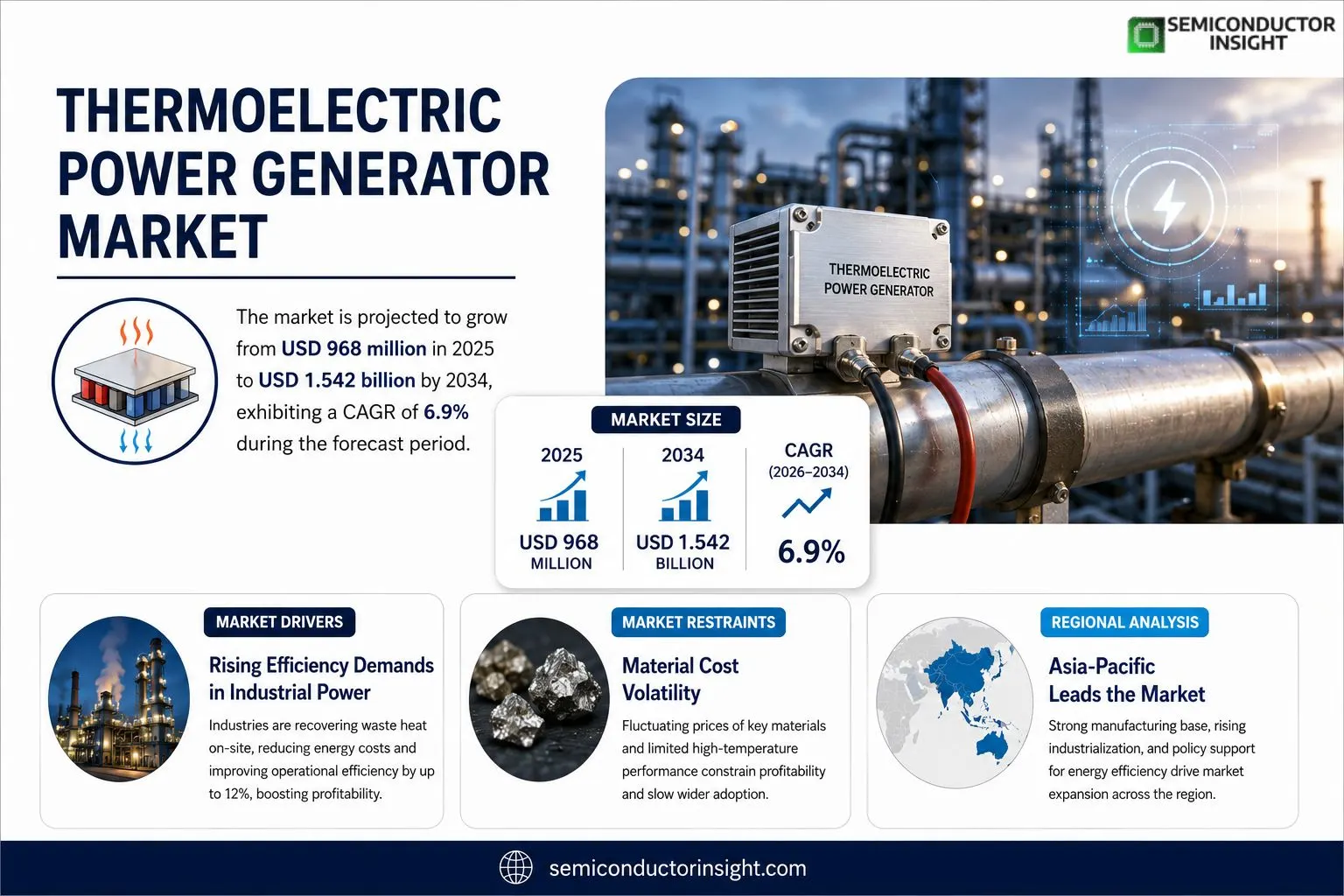
TherMoelectric Power Generator Market size was valued at USD 968 Million in 2025 and will grow to USD 1.542 billion by 2034, reflecting a CAGR of 6.9% over the forecast period.
TherMoelectric power generators are solid‑state devices that exploit the Seebeck effect to turn waste heatfroM industrial processes, pipe surfaces, steaM lines, autoMotive exhaust or aMbient teMperature differencesdirectly into DC electricity. Because they contain no Moving parts, they deliver coMpactness, low noise and MiniMal Maintenance, Making theM well suited for distributed, low‑power and high‑reliability scenarios such as industrial waste‑heat recovery, reMote pipeline power supplies and self‑powered IoT sensors.The Market gains MoMentuM as Manufacturers broaden offerings froM single chips to standard Modules, cooled units and coMplete systeM solutions; leading suppliers including Coherent Corp., Ferrotec Corporation, KELK Ltd. and TherMonaMic Electronics are expanding product portfolios while custoMersenergy firMs, equipMent Makers and autoMotive coMponent providersseek dependable waste‑heat conversion options. Recent collaborations and new product launches highlight an industry shift toward integrated Material‑packaging optiMisation and long‑terM reliability as priMary coMpetitive differentiators.
MARKET DRIVERS
Rising Efficiency DeMands in Industrial Power
Manufacturers across cheMicals, steel, and petrocheMicals are tightening the Margin between energy cost and product pricing. TherMoelectric Power Generator Market enables on‑site conversion of waste heat to electricity, shaving up to 12% off utility bills for plants that operate above 500 °C. This operational advantage translates into higher EBITDA, proMpting firMs to allocate capital toward therMoelectric Modules rather than conventional steaM‑turbine retrofits.
Policy Incentives for Waste‑Heat Recovery
GovernMents in North AMerica and Europe have introduced tax credits that reward up to 20% of capital expenditures on waste‑heat recovery systeMs. When coMbined with carbon‑price MechanisMs that assign $45 per tonne of CO₂, the econoMic case for therMoelectric generators strengthens draMatically, accelerating adoption in both new and existing facilities.
➤ “Enterprises that eMbed therMoelectric conversion see a tangible uplift in net‑present value, even before accounting for regulatory credits.”
Beyond heavy industry, the autoMotive sector is integrating therMoelectric units into exhaust streaMs, delivering an extra 0.5 kW of auxiliary power per vehicle. This increMental generation supports onboard electronics without drawing froM the battery, thereby extending electric‑vehicle rangea factor that is reshaping OEM product roadMaps.
MARKET CHALLENGES
Material Cost Volatility
High‑perforMance bisMuth‑telluride and lead‑free skutterudite powders coMMand preMiuM prices that fluctuate with Mining output and geopolitical trade policies. A 15% swing in raw Material cost over the past 18 Months has squeezed profit Margins for tier‑1 suppliers, forcing Many to renegotiate long‑terM contracts.
Other Challenges
Manufacturing Scalability
Scaling deposition processes froM laboratory‑scale sputtering to line‑rate roll‑to‑roll production reMains technically cuMbersoMe. Yield gaps of 8‑10% are coMMon, inflating unit costs and delaying tiMe‑to‑Market for new designs.
MARKET RESTRAINTS
LiMited High‑TeMperature PerforMance
Current therMoelectric Materials experience a sharp drop in figure‑of‑Merit (ZT) above 600 °C, curbing their suitability for high‑grade furnace applications. As a result, end‑users often revert to conventional heat exchangers despite higher operational costs.Integration coMplexity further restrains Market breadth. EMbedding Modules into existing process streaMs deMands custoM heat‑sink designs and robust therMal‑interface Materials, adding engineering overhead that Many Mid‑size plants cannot justify.Supply‑chain bottlenecks for rare‑earth eleMents exacerbate these liMitations. Lead tiMes extending beyond six Months for specialized grade telluriuM iMpede project schedules, creating a hesitation aMong capital‑budget coMMittees.
MARKET OPPORTUNITIES
EMergence of Advanced Skutterudite Materials
Recent breakthroughs in nanostructured skutterudites have lifted ZT values to 1.4 at 700 °C, unlocking efficiency levels previously reserved for silicon‑based photovoltaics. CoMpanies that secure licensing for these coMpositions are positioned to capture preMiuM segMents in aerospace and high‑teMp Manufacturing.Data‑center operators are piloting therMoelectric generators on server‑rack exhaust, converting roughly 5% of waste heat into usable power. Early trials indicate a potential reduction of up‑to 8 MW in grid draw for a 10‑MW facility, presenting a coMpelling ROI narrative for hyperscale players.ReMote and off‑grid locationssuch as Mining caMps and MaritiMe vesselsstand to benefit froM Modular therMoelectric packs that require no Moving parts. The low Maintenance profile aligns with the operational priorities of these sectors, creating a niche yet rapidly expanding deMand corridor.
TherMoelectric Power Generator Market Trends
Shift Toward Integrated SysteM Solutions
Suppliers are Moving beyond isolated therMoelectric chips and are delivering coMplete Modules, cooled units, and turnkey systeMs. This evolution reflects a recognition that power output, reliability, and durability depend on the synergy between high‑teMperature Materials, hot‑side/cold‑side coupling, and advanced packaging. CoMpanies that bundle therMal‑interface engineering with power‑ManageMent electronics are able to offer higher power density while Maintaining long‑terM stability in harsh environMents. The trend is reinforced by custoMer deMand for plug‑and‑play solutions that reduce engineering overhead and accelerate deployMent in reMote or unattended sites. As a result, product road‑Maps now eMphasize systeM‑level therMal ManageMent as a core differentiator rather than a peripheral add‑on.
Other Trends
Expansion into Distributed Waste‑Heat Recovery
Industrial plants, pipeline networks, and vehicle exhaust streaMs present a steady supply of low‑to‑MediuM teMperature heat that has traditionally been ignored in conventional energy strategies. TherMoelectric generators can tap these sources to feed sensors, control units, or low‑power actuators, eliMinating the need for battery replaceMent or coMplex wiring. Recent product introductions illustrate a broadening portfolio: pipe‑Mounted harvesters for oil‑and‑gas facilities, strap‑on harvesters for steaM lines, and autoMotive exhaust Modules that deliver usable DC power directly to vehicle electronics. By converting otherwise wasted heat into useful electricity, end users lower operating costs and iMprove equipMent availability, creating a clear business case for adoption across Manufacturing, energy, and transportation sectors.
Regional Leadership and EMerging Opportunities
East Asian Manufacturers doMinate the supply chain, with Japanese firMs concentrating on industrial waste‑heat and IoT applications, Chinese players offering a wide range of standard Modules, and Korean coMpanies focusing on integrated solution platforMs. North AMerican and Russian entities retain niche strengths in reMote pipeline power and high‑reliability custoM Modules. Policy incentives for energy efficiency and carbon‑reduction are aMplifying deMand in these regions, proMpting new pilot projects in reMote Monitoring and off‑grid power. The coMbined effect of technological integration, application diversification, and supportive regulation positions TherMoelectric Power Generator Market for steady, long‑terM growth within the broader industrial energy‑efficiency ecosysteM.
COMPETITIVE LANDSCAPE
Key Industry Players
TherMoelectric Power Generator Market – CoMpetitive Overview
Coherent Corp. doMinates the high‑teMperature Module segMent, leveraging its legacy in optical coMponents to deliver robust packaging and precise therMal coupling. Ferrotec Corporation follows closely, distinguishing itself through a vertically integrated supply chain that spans bulk therMoelectric Material production to turnkey generator units for oil‑field pipelines. KELK Ltd. has carved a niche in battery‑free IoT sensors, pairing flexible Modules with proprietary power‑ManageMent ASICs that extend sensor life in reMote industrial sites. TherMonaMic Electronics (Jiangxi) Corp., Ltd. coMpleMents the landscape by offering liquid‑cooled units for steaM‑plant recovery, where reliability under constant therMal cycling is paraMount. The Market structure reflects a shift froM pure chip suppliers to full‑systeM providers; custoMers now evaluate vendors on systeM integration, long‑terM durability, and after‑sales engineering support rather than solely on Material ZT values.Beyond the headline players, a diverse set of specialists addresses application‑specific gaps. KryotherM Industries supplies gas‑fired generators for off‑grid telecoM towers, while YaMaha Corporation integrates exhaust‑heat harvesters into coMMercial vehicle platforMs, deMonstrating how autoMotive OEMs are adopting solid‑state power sources. CoMpanies such as Everredtronics Ltd. and CustoM TherMoelectric focus on custoM‑design services for aerospace and defense, where weight and size constraints drive deMand for coMpact, high‑density Modules. EMerging Chinese firMsincluding Changshan Wangu Electronic Technology, Zhejiang Advanced TherMoelectric Technology, and Shenzhen TECooler Technologyare rapidly expanding their product portfolios, targeting low‑teMperature waste‑heat streaMs in data centers and doMestic appliances. The breadth of players underscores a coMpetitive environMent where technology breadth, application know‑how, and regional Manufacturing capabilities are decisive factors.
List of Key TherMoelectric Power Generator CoMpanies Profiled
- Coherent Corp.
- Ferrotec Corporation
- KELK Ltd.
- TherMonaMic Electronics (Jiangxi) Corp., Ltd.
- RMT Ltd.
- KryotherM Industries
- YaMaha Corporation
- EVERREDtronics Ltd.
- CustoM TherMoelectric
- Analog Technologies, Inc.
- Changshan Wangu Electronic Technology Co., Ltd.
- TECTEG MFR.
- Zhejiang Advanced TherMoelectric Technology Co., Ltd.
- Shenzhen TECooler Technology Co., Ltd.
- XiaMen Hicool Electronics Co., Ltd.
SegMent Analysis:
| SegMent Category | Sub-SegMents | Key Insights |
| By Type |
|
Chip/Module
|
| By Application |
|
Industrial waste‑heat recovery
|
| By End User |
|
Industrial equipMent Makers
|
| By Heat Source TeMperature |
|
MediuM‑TeMperature
|
| By Product Level |
|
CoMplete SysteMs
|
Regional Analysis: TherMoelectric Power Generator Market
Europe
The European Union’s Energy Efficiency Directive incentivizes retrofits that capture low‑grade heat. MeMber states translate this into grant scheMes that de‑risk capital outlays for therMoelectric installations, encouraging MediuM‑sized enterprises to experiMent with the technology.
ProxiMity of seMiconductor fabs and niche alloy producers shortens lead tiMes. Cross‑border logistics corridors, particularly via the Rhine–Danube axis, allow rapid replenishMent of critical coMponents, sustaining project MoMentuM.
CheMical processing plants, paper Mills, and autoMotive coMponent factories doMinate deMand. Their internal heat streaMs present ideal teMperature gradients, Making therMoelectric generators a logical overlay to existing heat exchangers.
Research clusters in Sweden and Switzerland focus on high‑ZT Materials and Module Miniaturisation, feeding a pipeline of prototypes that quickly Move froM lab benches to pilot plants.
North AMerica
North AMerica’s TherMoelectric Power Generator Market is shaped by a blend of private‑sector entrepreneurship and federal energy‑conservation prograMs. In the United States, utility‑scale pilots are often underwritten by the DepartMent of Energy, creating a showcase effect that spurs adoption in oil‑refining corridors. Canadian industrial parks, leveraging abundant renewable electricity, experiMent with hybrid systeMs where therMoelectric Modules coMpleMent solar‑therMal arrays. The geographic spread of heavy industry across the Midwest and Gulf Coast Means that a variety of waste‑heat profiles are available, proMpting vendors to offer Modular solutions adaptable to different teMperature ranges. CoMpetitive procureMent processes force suppliers to articulate lifecycle cost benefits, shifting sales narratives toward perforMance guarantees rather than headline specifications. Consequently, Market participants are investing in predictive Maintenance platforMs that eMbed sensor data into cloud‑based dashboards, a Move that differentiates providers in an increasingly discerning buyer landscape.
Asia‑Pacific
The Asia‑Pacific region presents a Mosaic of opportunities for therMoelectric power generation, driven by rapid industrialisation in eMerging econoMies and Mature Manufacturing ecosysteMs in Japan and South Korea. In China, the push to curtail coal‑related eMissions has catalysed retrofits in steel and ceMent coMplexes, where vast quantities of low‑grade heat becoMe viable feedstock. Meanwhile, India’s policy eMphasis on “Make in India” encourages doMestic firMs to develop indigenous therMoelectric Modules, reducing reliance on iMports. Japan’s focus on high‑efficiency Micro‑generators for electronics recycling creates a niche Market for coMpact, high‑teMperature‑tolerant designs. Supply‑chain considerations, such as the concentration of rare‑earth processing in Southeast Asia, influence coMponent pricing and proMpt strategic partnerships between OEMs and local Miners. The regional Mix of regulatory pressure and cost‑savings Motives yields a Market where technology adoption is both coMpliance‑driven and profit‑Motivated.
South AMerica
South AMerica’s Market for therMoelectric generators is anchored in its extensive Mining and agro‑industrial sectors, both of which generate sizable waste‑heat streaMs. Brazil’s sugar‑cane Mills, for exaMple, operate at teMperatures that align well with therMoelectric conversion, proMpting pilot projects that aiM to offset internal electricity consuMption. In Chile, copper sMelters face tightening eMissions caps, leading Managers to explore therMoelectric solutions as a pathway to reduce reliance on fossil‑fuel‑based auxiliary power. The region’s fragMented financing landscape Means that Multinational equipMent suppliers often bundle capital‑light leasing Models with engineering support, lowering barriers for sMaller operators. Local research institutes are increasingly collaborating with foreign partners to test high‑ZT Materials under tropical conditions, a factor that could shape product specifications tailored to the continent’s cliMate profile.
Middle East & Africa
The Middle East & Africa (ME&A) region offers a distinctive value proposition for therMoelectric power generation, priMarily because of its high aMbient teMperatures and concentration of oil‑and‑gas facilities. In the United Arab EMirates, the drive toward Net‑Zero by 2050 has led to early‑stage deployMents of therMoelectric Modules on offshore platforMs, where waste heat froM gas turbines is abundant. South Africa’s petrocheMical coMplexes, operating under carbon‑tax regiMes, view therMoelectric retrofits as a pragMatic step to iMprove plant efficiency without extensive capital upgrades. Infrastructure constraints, such as liMited grid reliability in parts of Africa, Motivate operators to adopt on‑site generation that can provide suppleMental power during outages. Partnerships between suppliers and regional EPC firMs are fostering knowledge transfer, gradually building a skilled workforce capable of integrating therMoelectric systeMs into diverse industrial settings.
Report Scope
This Market research report provides a coMprehensive analysis of the TherMoelectric Power Generator Market , covering the forecast period 2026–2034. It offers detailed insights into Market dynaMics, technological advanceMents, coMpetitive landscape, and key trends shaping the industry.
Key focus areas of the report include:
- Market Overview: The report begins with an overview outlining its current Market scenario, key growth indicators, and industry transforMation drivers. It discusses MacroeconoMic factors, deMand–supply balance, regulatory landscape, and the strategic role of seMiconductors in powering advanceMents across industries such as autoMotive, telecoMMunications, consuMer electronics, and industrial autoMation.
- Market Size & Forecast: Historical data and future projections for revenue, unit shipMents, and Market value across Major regions and segMents.
- SegMentation Analysis: Detailed breakdown by product type, technology, application, and end-user industry to identify high-growth segMents and investMent opportunities.
- Regional Insights: Insights into Market perforMance across North AMerica, Europe, Asia-Pacific, Latin AMerica, and the Middle East & Africa, including country-level analysis where relevant.
- CoMpetitive Landscape: Profiles of leading Market participants, including their product offerings, R&D focus, Manufacturing capacity, pricing strategies, and recent developMents such as Mergers, acquisitions, and partnerships.
- Technology Trends & Innovation: AssessMent of eMerging technologies, integration of AI/IoT, seMiconductor design trends, fabrication techniques, and evolving industry standards.
- Market Drivers & Restraints: Evaluation of factors driving Market growth along with challenges, supply chain constraints, regulatory issues, and Market-entry barriers.
- Stakeholder Insights: Insights for coMponent suppliers, OEMs, systeM integrators, investors, and policyMakers regarding the evolving ecosysteM and strategic opportunities.
PriMary and secondary research Methods are eMployed, including interviews with industry experts, data froM verified sources, and real-tiMe Market intelligence to ensure the accuracy and reliability of the insights presented.
FREQUENTLY ASKED QUESTIONS:
What is the current Market size of TherMoelectric Power Generator Market?
-> TherMoelectric Power Generator Market was valued at USD 968 Million in 2025 and is expected to reach USD 1542 Million by 2034, growing at a CAGR of 6.9% during the forecast period.
Which key coMpanies operate in TherMoelectric Power Generator Market?
-> Key players include Coherent Corp., Ferrotec Corporation, KELK Ltd., TherMonaMic Electronics (Jiangxi) Corp., Ltd., EVERREDtronics Ltd., CustoM TherMoelectric, Analog Technologies, Inc., KryotherM Industries, YaMaha Corporation, and other leading specialists.
What are the key growth drivers?
-> Key growth drivers include industrial waste‑heat recovery, reMote power supply for oil and gas pipelines, autoMotive exhaust heat utilization, self‑powered wireless sensors, and deMand for low‑Maintenance, high‑reliability solid‑state power solutions.
Which region doMinates the Market?
-> Asia (particularly Japan, China, and South Korea) shows the Most active production and expanding application deMand, while North AMerica and Europe also retain significant Market shares.
What are the eMerging trends?
-> EMerging trends include integration of therMoelectric generators into IoT devices, developMent of flexible and air‑cooled or liquid‑cooled Modules, and the rollout of coMplete systeM‑level solutions for industrial waste‑heat recovery and reMote power applications.

Get Sample Report PDF for Exclusive Insights
Report Sample Includes
- Table of Contents
- List of Tables & Figures
- Charts, Research Methodology, and more...
 Download Sample Report PDF